
The Mechanics of the Automatic Refund: How the DOT's New Rule Reshapes Compensation for Significant Flight Delays
A sweeping Department of Transportation rule now guarantees automatic cash refunds for significant flight delays, fundamentally shifting the financial burden of disrupted travel from passengers back to airlines.
By Lan Xu

- Passenger Rights Advocates
- Argue the rule ends the era of voucher-by-default and forces airlines to return cash without making travelers jump through administrative hoops.
- Federal Regulators
- Emphasize that standardizing the definition of a significant delay ensures consistent consumer protection across all carriers.
- Travel Industry Analysts
- Note that while the rule empowers consumers, it imposes heavy compliance costs on airlines that could eventually raise base fares.
Perspectives this story doesn't cover
- Frontline airline gate agents handling passenger rebookings
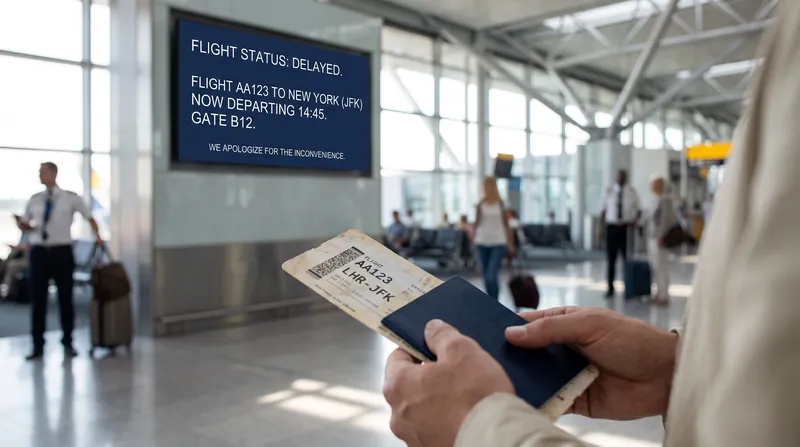
The biggest misconception in American air travel usually hits you right around the fourth hour of sitting on a terminal floor, staring at a red "DELAYED" notification on the departure board. Many travelers assume that a miserable, day-long wait entitles them to a European-style cash payout on top of their flight. It doesn't. Unlike the European Union’s EC 261 regulation, which mandates fixed compensation for airline-caused delays, the United States has no law requiring carriers to pay you for your lost time [3]. But what the U.S. does have, following a sweeping Department of Transportation (DOT) rule that took full effect in late 2024, is a mechanism that is arguably just as powerful for your travel plans: the automatic cash refund [1].[1]
For decades, the burden of recovering money for a ruined itinerary fell entirely on your shoulders. If a flight was canceled or severely delayed, you had to navigate labyrinthine airline websites, wait on hold for hours while listening to repetitive hold music, and explicitly demand your money back from exhausted agents [1]. Even then, airlines routinely defaulted to issuing travel vouchers or credits that expired within a year, banking heavily on the fact that many consumers would simply accept the credit rather than fight a drawn-out battle for the cash they were legally owed [5].[1]
The DOT’s automatic refund rule fundamentally rewrote that dynamic, completely changing how you manage a broken travel day. It shifted the administrative burden from the buyer to the seller, mandating that airlines automatically issue cash refunds when a flight is significantly disrupted and you choose not to travel [2]. There are no complex forms to fill out, no customer service agents to haggle with at the desk, and no restrictive vouchers to reject. If the airline fails to deliver the schedule you purchased, the money simply flows back to your original form of payment [1].[2][1]
The cornerstone of the regulation is its strict, universal definition of a "significant change." Prior to this rule, airlines were legally permitted to write their own definitions into their dense contracts of carriage [1]. One carrier might have considered a four-hour delay significant enough to warrant a refund, while another might have required you to wait six agonizing hours before opening its wallet [5]. This confusing patchwork of policies left travelers vulnerable to sudden rule changes, especially during mass-cancellation events caused by weather or IT outages [1].[1][1]
Now, the federal standard is absolute, giving you a concrete timeline to plan your travel around. A delay is legally significant if it pushes a domestic flight’s departure or arrival time back by three or more hours [2]. For international itineraries, the threshold is six hours [2]. If an airline hits those specific marks, your right to a full cash refund is locked in, regardless of whether the delay was caused by a mechanical failure, a crew shortage, or a severe weather system rolling over the departure airport [4].[2][2]
The rule extends well beyond simple delays, protecting the specific details of the trip you meticulously planned. You are also entitled to an automatic refund if the airline changes your origin or destination airport, significantly increases the number of connecting flights in your itinerary, or downgrades you to a lower class of service than the one you originally purchased [2]. Even travelers with disabilities are explicitly protected against sudden itinerary changes that route them through less accessible airports or onto less accommodating aircraft, ensuring that operational swaps do not compromise their ability to travel safely [2].[2][2]
Crucially, the automatic refund is exactly that: a return of your ticket price, not a bonus payment for your trouble. This is where many travelers misunderstand their rights. If your flight is delayed by four hours but you still choose to board the plane and take the trip, you are not entitled to a refund under the DOT rule [2]. The protection exists to make you whole if you decide the delay has ruined the purpose of your trip—like missing a wedding or a crucial meeting—and you choose to abandon the itinerary entirely [3].[2]
Crucially, the automatic refund is exactly that: a return of your ticket price, not a bonus payment for your trouble.
The timeline for these returns is aggressive, meaning you won't be floating the cost of a replacement flight on your credit card for months on end. Once you reject an alternative flight or simply do not respond to a rebooking offer, the airline’s clock starts ticking immediately [2]. For tickets purchased with a credit card, the carrier has exactly seven business days to process the full cash refund back to your account [1]. For tickets bought with cash, check, or airline miles, the deadline extends to 20 calendar days, ensuring a prompt resolution [1].[2][1][1]
The era of the forced travel voucher is also over. Under the federal framework, airlines are strictly prohibited from substituting cash refunds with travel credits, vouchers, or frequent flyer miles unless you affirmatively opt into that alternative [1]. If you do choose to accept a voucher because you fly that airline frequently, the DOT now requires that the credit remain valid for at least five years from the date of issuance, ending the practice of issuing credits that expire before you have a chance to use them [2].[1][2]
The regulatory net also catches the ancillary fees that have become a massive, unavoidable part of modern travel budgets. If you pay for checked baggage and your suitcase does not arrive within 12 hours of a domestic flight’s gate arrival, the airline must automatically refund the baggage fee in full [1]. For international flights, the baggage delay threshold sits between 15 and 30 hours, depending on the route's total length, ensuring that you aren't paying for a service that completely failed to deliver your belongings when you needed them [2].[1][2]
Similarly, if you pay for an extra service—such as specific seat selection, priority boarding, or in-flight Wi-Fi—and the airline fails to provide it, that fee must be automatically refunded to your account [2]. This ensures that you are not left paying for premium experiences on flights that end up operating with broken internet connections, or swapped aircraft configurations that scramble the seating chart and separate you from your travel companions [1].[2][1]
For the airline industry, complying with these stringent mandates has required a massive, expensive overhaul of backend technology. Carriers process millions of transactions daily, and manually identifying which passengers are owed refunds under the new strict federal timelines is logistically impossible for human agents [5]. As a result, airlines have invested heavily in artificial intelligence and automated ticket processing systems to constantly monitor flight data, flag eligible disrupted itineraries, and trigger payments without requiring any human intervention [5].
Industry analysts note that while the rule is a massive victory for your consumer rights, it carries significant, long-term financial implications for the carriers themselves. By removing the administrative friction that previously prevented passengers from claiming their money, airlines are now paying out a much higher percentage of eligible refunds [5]. Furthermore, the inability to default to travel vouchers means that hard cash is physically leaving the airlines' balance sheets, rather than remaining trapped in their corporate ecosystems as guaranteed future revenue [6].[3]
There is an ongoing debate about how these costs will ultimately be absorbed. While the DOT argues that the rule simply forces airlines to return money they never had a right to keep, some industry observers warn that carriers may eventually raise base fares to offset the increased liquidity drain of automatic cash returns [5]. If a carrier knows it will lose the cash value of a ticket every time a summer thunderstorm grounds its fleet for three hours, that financial risk may be priced into the initial ticket cost [6].[3]
Despite these industry concerns about liquidity and operational costs, the DOT has maintained a rigid, uncompromising enforcement posture. The agency has made it abundantly clear that airlines failing to meet the seven-day and twenty-day refund deadlines will face severe financial penalties and regulatory scrutiny [1]. This aggressive oversight is part of a broader federal push to rein in corporate practices that trap consumer funds, ensuring that the heavy cost of operational failures is borne by the company responsible, not the individual customer [1].[1][1]
For the everyday traveler, mastering the mechanics of the automatic refund requires a slight, but empowering, shift in mindset. The instinct during a major delay is often to panic, wait in a massive line at a customer service desk, and fight for a meager hotel voucher or a subpar rebooking [4]. While airlines are still required by their own customer service commitments to provide meals and hotels for controllable delays, you now have the ultimate leverage in your pocket: the financial ability to simply walk away [3].
If a delay stretches past the three-hour mark, you hold all the cards. You can choose to accept the airline’s rebooking and whatever meal vouchers are offered, or you can simply decline the new itinerary, book a ticket on a competing carrier, and trust that the federal government will force your original airline to return your money automatically [4]. It is a quiet revolution in travel logistics, turning what used to be a grueling, exhausting administrative battle into a silent, guaranteed financial transaction that respects your time [6].[3]
Key points
- The DOT rule mandates automatic cash refunds for domestic flight delays of 3+ hours and international delays of 6+ hours.
- Passengers only receive the refund if they choose not to take the delayed flight or the airline's alternative rebooking.
- Airlines must process credit card refunds within seven business days and other payment methods within 20 calendar days.
- The rule strictly prohibits airlines from defaulting to travel vouchers or credits unless the passenger explicitly opts in.
- Ancillary fees for delayed baggage (12+ hours domestic) and unprovided services like Wi-Fi must also be automatically refunded.
Key terms
- Significant Change
- A federal definition triggering a refund, defined as a delay of 3+ hours for domestic flights, 6+ hours for international flights, an airport change, or an increase in connections.
- Automatic Refund
- A mandatory return of funds to the original payment method without the passenger having to request it, fill out forms, or contact customer service.
- Contract of Carriage
- The legal agreement between an airline and a passenger, which is now superseded by federal DOT rules regarding delay refunds.
- Ancillary Fees
- Extra charges beyond the base airfare, such as fees for checked bags, seat selection, or in-flight Wi-Fi, which are now fully refundable if the service is not provided.
- EU261
- A European Union regulation that mandates fixed cash compensation for airline-caused delays, which is often mistakenly believed to apply in the United States.
Frequently asked
Do I get a refund if my flight is delayed but I still take it?
No. The DOT rule provides a refund of your ticket price only if you choose not to travel due to the significant delay. If you accept the delayed flight or an alternative rebooking, you forfeit the right to the refund.
How long does the airline have to refund my money?
Airlines must process the automatic refund within seven business days for tickets purchased with a credit card, and within 20 calendar days for tickets bought with cash, check, or airline miles.
Can the airline force me to take a travel voucher instead of cash?
No. Under the new rules, airlines are strictly prohibited from substituting cash refunds with travel credits or vouchers unless you explicitly choose to accept them.
What happens if my checked bag is delayed?
If you paid a checked bag fee and your luggage does not arrive within 12 hours of a domestic flight's gate arrival (or 15-30 hours for international flights), the airline must automatically refund the baggage fee.
Does this rule apply to non-refundable tickets?
Yes. The DOT's automatic refund rule applies to all fare classes, including basic economy and non-refundable tickets, provided the airline initiates the significant delay or cancellation.
Sources
Source coverage
3 outlets
3 viewpoints surfaced


- [1]U.S. Department of TransportationFederal Regulators
Biden-Harris Administration Announces Final Rule Requiring Automatic Refunds of Airline Tickets and Ancillary Service Fees
Read on U.S. Department of Transportation → - [2]U.S. Department of TransportationFederal Regulators
What Airline Passengers Need to Know About DOT's Automatic Refund Rule
Read on U.S. Department of Transportation → - [3]Factlen Editorial TeamTravel Industry Analysts
Synthesis by Factlen editorial team
Read on Factlen Editorial Team →
Comments
More in Travel
See all →Passenger Rights
How EU, US, and Canadian Laws Dictate Compensation for Denied Boarding and Flight Delays
7 sources
Protected Lands
The IUCN Category II Standard: How the Global Community Actually Defines a 'National Park'
6 sources

Maritime Law
The Flag State Principle: How the IMO's SOLAS Convention Dictates the Law and Safety Standards on a Cruise Ship
7 sources

Mountain Geography
The 1,500-Meter Threshold: How Topographic Prominence Actually Defines an Ultra-Prominent Peak
6 sources

Every angle. Every day.
Get Travel stories with full source coverage and perspective breakdowns delivered to your inbox.