
The Material Redesign: How EU's August 12 Ban on PFAS in Food Packaging Forces a Global Supply Chain Shift
Starting August 12, 2026, the EU will ban PFAS 'forever chemicals' in food-contact packaging, forcing a global redesign of office and catering supplies. With no single universal replacement available, manufacturers must navigate complex trade-offs between bioplastics, clay coatings, and uncoated paper.
By Hui Lin

- Packaging & Supply Chain Industry
- Focus on the technical hurdles of replacing a universal chemical with fragmented, application-specific alternatives while avoiding accidental contamination.
- Regulatory & Compliance Bodies
- Argue that the long-term health and environmental cleanup costs of forever chemicals far outweigh the short-term supply chain friction of banning them.
- Environmental & Health Advocates
- Push for entirely chemical-free and compostable solutions, warning against replacing PFAS with other potentially toxic bioplastics.
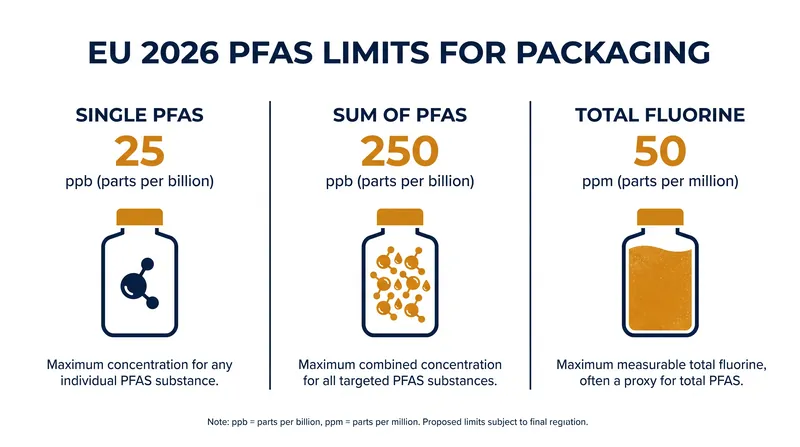
On August 12, 2026, the European Union will fundamentally alter the global packaging supply chain. Under the new Packaging and Packaging Waste Regulation (PPWR), food-contact packaging containing per- and polyfluoroalkyl substances (PFAS) above strict trace limits will be banned from the EU market. For decades, these "forever chemicals" have been the magic ingredient keeping office breakroom coffee cups from leaking and catering trays from absorbing grease. Now, manufacturers face a hard deadline with no grace period for existing inventory. Any stock failing to meet the new thresholds—25 parts per billion (ppb) for a single PFAS, 250 ppb for combined PFAS, and 50 parts per million (ppm) for total fluorine—cannot be sold.[1]
The scope of the ban extends far beyond fast-food wrappers, hitting the office products and corporate catering sectors directly. Paper cups, molded fiber plates, bakery bags, and even the adhesives used in cardboard food boxes are all in the crosshairs. Because the EU represents a massive, unavoidable market, running dual inventories—one with PFAS for the US and one without for Europe—is economically unviable for global suppliers. Consequently, the European regulation is forcing a worldwide redesign of food-contact materials.
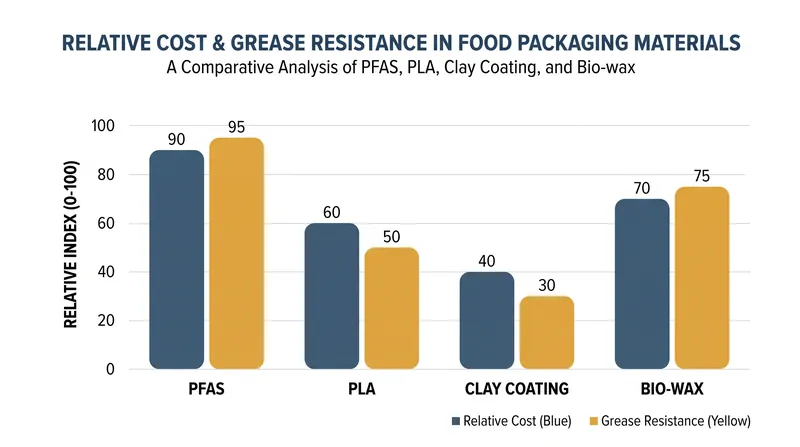
Replacing PFAS is not a simple one-to-one swap. PFAS provided a universal, low-cost shield against heat, moisture, and grease simultaneously. Without it, the industry must adopt a fragmented approach, matching specific alternative materials to specific food types. This forces procurement teams to conduct rigorous side-by-side trade-off analyses of the available alternatives: uncoated densified paper, bioplastics like PLA, clay coatings, and bio-waxes.[2][3]
The first major alternative is uncoated, mechanically densified paper, often called natural greaseproof paper. For this option, the primary advantage is that it is completely chemical-free, highly recyclable in standard paper streams, and carries zero regulatory risk regarding future chemical bans. Against it is its performance in wet environments; while it handles grease well, it struggles significantly with high moisture or hot liquids. The evidence from industry reviews and the Washington Department of Ecology indicates that while uncoated paper receives high marks for dry applications like pizza boxes and dry snacks, it fails when used for soups or hot beverages.[2]
The second alternative involves bioplastics, most notably Polylactic Acid (PLA). For PLA, the main benefit is its excellent moisture barrier, allowing it to perfectly mimic the performance of traditional plastic-lined coffee cups and soup bowls while remaining compostable under industrial conditions. Against PLA is its higher cost, heavier environmental footprint during manufacturing, and the reality that it only degrades in specialized industrial composting facilities, not in backyard bins or standard landfills. Evidence from USDA researchers highlights that while bioplastics effectively block moisture, their reliance on specific waste infrastructure and potential toxicity concerns during production remain significant hurdles for universal adoption.[2]
Clay coatings represent a third, highly scalable alternative. For clay, the advantages are clear: it is readily available, cost-effective, performs exceptionally well for rigid items like plates and food boats, and is easily recyclable in standard paper streams without specialized processing. Against clay is its physical inflexibility; it is prone to cracking if folded, making it unsuitable for flexible wrappers or folding cartons, and it offers a weaker barrier against hot, pooling oils compared to PFAS. Evidence shows that major manufacturers have successfully scaled clay-coated plates for corporate catering, proving its viability for flat, rigid surfaces that do not require complex folding.[2][3]
Clay coatings represent a third, highly scalable alternative.
Bio-wax and aqueous coatings form the fourth category. For these coatings, the benefit is their flexibility and ability to provide a strong grease barrier for wrappers, sandwich liners, and bakery bags, often while remaining biodegradable. Against them is their thermal instability—performance degrades under prolonged heat—and the risk that certain proprietary aqueous blends can interfere with paper recycling if not formulated correctly. Evidence from the fast-food and catering supply chains shows rapid adoption of bio-waxes for short-duration contact, though buyers must carefully validate the chemical makeup to ensure they do not introduce new recycling contaminants.[2]
Beyond the primary coatings, the supply chain faces a hidden trap: adhesives and cross-contamination. Even if a paper cup or box uses a PFAS-free coating, the synthetic emulsion adhesives used to glue the seams can introduce total fluorine above the 50 ppm limit. For dextrin-based natural adhesives, the advantage is that they are inherently PFAS-free by chemistry. Against them is the requirement for longer drying times on high-speed production lines, which can slow manufacturing throughput. Furthermore, the use of recycled paper pulp poses a severe risk, as legacy PFAS from older recycled materials can inadvertently contaminate new batches, triggering non-compliance under the strict EU testing protocols.[3]
The transition requires explicit guidance on where each material succeeds and fails. Uncoated densified paper fits well when packaging dry or lightly greasy office breakroom snacks, baked goods, and pizza, but does not fit when holding liquids, heavy sauces, or wet foods that compromise the paper's structural integrity.[2]
PLA and bioplastics fit well when replacing hot coffee cups, soup bowls, and clear deli containers where a perfect moisture barrier is non-negotiable. However, PLA does not fit when local waste management facilities lack industrial composting infrastructure, as the material will simply act like traditional plastic in a landfill, defeating its environmental purpose.[2][3]
Clay coatings fit well when producing rigid plates, catering trays, and flat food boats where the material remains flat and structural rigidity is required. Clay does not fit when flexible folding cartons, sandwich wraps, or intricate origami-style takeout boxes are needed, as the coating will crack along the fold lines and allow grease to leak through.[2][3]
Bio-wax fits well when wrapping short-duration items like sandwiches, muffins, and cold deli meats where flexibility and moderate grease resistance are needed. It does not fit when long-term shelf stability or prolonged exposure to high heat is required, as the wax can melt or degrade over time.[2]
Ultimately, the August 2026 PPWR deadline forces the packaging industry to abandon the "one size fits all" convenience of forever chemicals. Corporate buyers and office managers can no longer rely on a single miracle coating for all their breakroom and catering needs. Instead, they must fundamentally redesign their procurement strategies, matching the specific chemical and physical properties of the alternative material to the exact performance requirement of the food it holds.[1][3]
The stakes
The EU's strict limits apply to all products placed on the market, meaning global suppliers are redesigning their entire inventories rather than running dual supply chains. Office managers and corporate buyers will see fundamental changes in the performance, cost, and disposal requirements of everyday breakroom supplies.
The essentials
- The EU's PPWR bans PFAS in food-contact packaging starting August 12, 2026.
- The ban includes strict limits on individual PFAS, combined PFAS, and total fluorine.
- There is no single replacement for PFAS; alternatives must be matched to specific food types.
- Global suppliers are shifting their entire inventories, impacting office and catering supplies worldwide.
Timeline
Dec 2024
The EU adopts the Packaging and Packaging Waste Regulation (PPWR).
Feb 2025
The PPWR officially enters into force across all EU member states.
Jan 2026
The US FDA effectively ends the use of PFAS-based greaseproofing agents in domestic paper packaging.
Aug 2026
EU PPWR PFAS limits for food-contact packaging take full effect with no grace period.
Perspectives explored
Regulatory & Compliance Bodies
Argue that the long-term health and environmental cleanup costs of forever chemicals far outweigh the short-term supply chain friction of banning them.
Regulators emphasize that PFAS chemicals do not break down in the environment and accumulate in human tissue, leading to severe health consequences. From their perspective, the strict 50 ppm total fluorine limit is a necessary catch-all to prevent manufacturers from simply tweaking a molecule to evade the ban. They argue that the packaging industry has had ample warning to develop alternatives, and that the long-term savings in public health and water treatment costs justify the immediate logistical headaches.
Packaging & Supply Chain Industry
Focus on the technical hurdles of replacing a universal chemical with fragmented, application-specific alternatives while avoiding accidental contamination.
Manufacturers point out that PFAS was a miracle chemical that solved heat, grease, and moisture problems simultaneously. Replacing it requires a complex matrix of bioplastics, clays, and waxes, each with distinct failure points. Their primary concern is the strictness of the trace limits, noting that legacy PFAS in recycled paper pulp or trace amounts in manufacturing adhesives could trigger non-compliance even when no PFAS was intentionally added.
Environmental & Health Advocates
Push for entirely chemical-free and compostable solutions, warning against replacing PFAS with other potentially toxic bioplastics.
While celebrating the ban on forever chemicals, sustainability advocates warn against "regrettable substitutions." They argue that replacing PFAS with bioplastics like PLA merely trades a chemical problem for a microplastic and waste management problem, as PLA requires specialized industrial composting to degrade. They advocate for a return to uncoated, mechanically densified paper and reusable containers, pushing the industry to rethink single-use convenience entirely.
Open questions
- How strictly member states will enforce the 50 ppm total fluorine limit on recycled paper pulp, which often contains legacy contamination.
- Whether the increased cost of bioplastics and specialized coatings will be absorbed by manufacturers or passed entirely to corporate buyers.
- If local waste management infrastructure can scale industrial composting fast enough to handle the influx of PLA bioplastics.
Glossary
- PFAS
- Per- and polyfluoroalkyl substances, a large group of synthetic chemicals known for their grease and water resistance, often called 'forever chemicals'.
- PPWR
- The EU's Packaging and Packaging Waste Regulation, a comprehensive framework mandating circularity and banning harmful substances in packaging.
- PLA
- Polylactic acid, a compostable bioplastic derived from renewable resources like corn starch, frequently used as a moisture barrier.
- Total Fluorine
- A measurement used to detect the overall presence of fluorinated compounds, serving as a proxy to ensure no hidden PFAS are in the material.
FAQ
Does this ban apply to all office packaging?
No. The August 2026 ban specifically targets food-contact packaging, such as breakroom coffee cups, catering trays, and takeout wrappers. General shipping boxes are not included.
Can companies sell old PFAS packaging after the deadline?
No. There is no grace period for existing inventory. Any food-contact packaging placed on the EU market after August 12, 2026, must meet the new limits.
Why is total fluorine measured instead of just PFAS?
Because there are thousands of individual PFAS compounds, testing for total fluorine acts as a catch-all screening method to prevent manufacturers from simply switching to an unregulated variant.
Sources
Source coverage
3 outlets
3 viewpoints surfaced


[1]Food Safety MagazinePackaging & Supply Chain Industry
Why the PPWR Changes the Conversation in Food-Contact Packaging
Read on Food Safety Magazine →[2]Clean Production ActionEnvironmental & Health Advocates
Compostable PFAS-Free Alternatives
Read on Clean Production Action →[3]Factlen Editorial TeamEnvironmental & Health Advocates
Synthesis by Factlen editorial team
Read on Factlen Editorial Team →
Comments

Every angle. Every day.
Get shopping stories with full source coverage and perspective breakdowns delivered to your inbox.