
The Hidden Cost of Partisan Portfolios: Why Political Bias is Costing You Money
As political polarization spills into financial markets, behavioral economists warn that aligning investments with political beliefs can severely damage long-term returns.
By Factlen Editorial Team
- Mainstream Financial Advisors
- Advocate for broad diversification and ignoring political noise to capture long-term market growth.
- Behavioral Economists
- Argue that cognitive biases tied to political identity lead to irrational trading and financial losses.
- Thematic Fund Managers
- Believe investors should have the option to align their capital with their personal values and political beliefs.
What's not represented
- · Retail investors who successfully trade on political volatility
- · Political action committees (PACs) funded by thematic ETFs
Why this matters
By recognizing and correcting the cognitive biases that link political identity to financial choices, investors can prevent emotional trading, improve their portfolio diversification, and secure better long-term wealth growth.
Key points
- Aligning investment portfolios with political beliefs consistently leads to lower financial returns.
- Politically themed ETFs often suffer from severe under-diversification compared to broad market index funds.
- Confirmation bias causes investors to buy high during partisan euphoria and sell low during partisan despair.
- Historical data shows the stock market trends upward over the long term under both major political parties.
- Engaging with political opponents helps break echo chambers and prevents emotional, panic-driven financial decisions.
The intersection of the voting booth and the brokerage account has never been more crowded. In an era of intense political polarization, a growing number of retail investors are allowing their partisan identities to dictate their financial strategies. This phenomenon goes beyond simply boycotting a controversial brand; it involves fundamentally restructuring retirement accounts and investment portfolios to align with red or blue ideologies. However, as this trend accelerates, financial experts are sounding the alarm. The insistence on building a politically pure portfolio is emerging as a critical, yet largely hidden, flaw that is actively draining wealth from everyday investors.[1][5]
The financial cost of this ideological loyalty is becoming starkly apparent. According to recent analysis, investors who insist on a portfolio that strictly adheres to partisan lines are forfeiting significant returns. The stock market operates independently of political grievances, and attempting to force a portfolio to reflect a specific political stance often means missing out on broader economic growth. The reality is that the market does not care about an investor's politics, and prioritizing ideology over diversification is a reliable way to underperform the baseline averages.[1]
A primary driver of this trend is the proliferation of politically themed Exchange-Traded Funds (ETFs). These financial products are explicitly marketed to investors who want their capital to support their political views. For example, some funds exclusively track companies whose employees and political action committees are highly supportive of conservative candidates, while counterpart funds focus entirely on companies aligning with liberal policies. While these products offer a sense of moral or political satisfaction, they fundamentally alter the risk profile of a standard retirement strategy.[1][5]
The core structural issue with these thematic funds is severe under-diversification. A standard broad-market index fund, such as one tracking the S&P 500, spreads risk across five hundred of the largest companies spanning every sector of the economy. In contrast, politically themed ETFs often narrow their holdings down to a fraction of that size—sometimes as few as 150 companies. By systematically excluding vast swaths of the market based on political donations rather than financial fundamentals, investors expose themselves to concentrated sector risks and higher volatility.[1][5]

To understand why intelligent people make these sub-optimal financial choices, experts turn to the field of behavioral finance. This discipline explains how cognitive shortcuts, or heuristics, lead investors away from rational decision-making. When individuals are deeply invested in a political identity, their financial choices become plagued by the same emotions that drive their voting behavior. Recognizing these natural biases is the first crucial step toward improving decision-making processes and overcoming the hurdles that prevent long-term wealth accumulation.[2]
The most destructive of these cognitive shortcuts is confirmation bias. In the political realm, this manifests as voters consuming only news that validates their worldview while aggressively blocking out contrary data. When this behavior bleeds into investing, individuals selectively review financial information that supports their political narrative. If an investor believes a rival political party will destroy the economy, they will actively seek out bearish financial forecasts to justify moving their assets into cash, ignoring the broader data that suggests continued market resilience.[2][5]
Academic research has extensively documented the financial toll of this behavior, a phenomenon often referred to as the "partisan penalty." Studies from institutions like the National Bureau of Economic Research demonstrate that investors become highly optimistic and willing to take on risk when their preferred political party is in power. Conversely, when their party loses an election, these same investors become deeply pessimistic, often liquidating assets and retreating to the perceived safety of cash or bonds, regardless of the actual underlying economic indicators.[3]
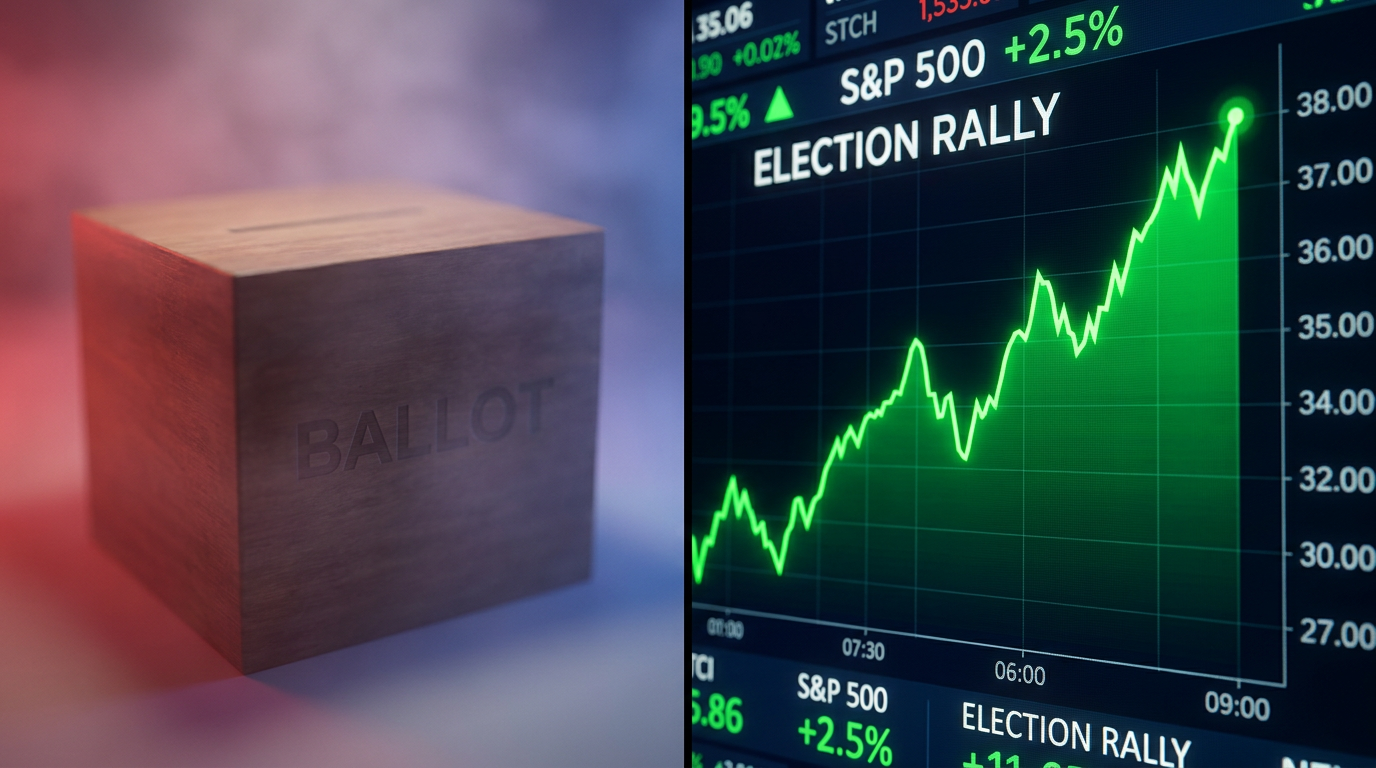
This politically induced mood swing leads directly to the cardinal sin of investing: market timing. By attempting to buy in during periods of partisan euphoria and sell out during periods of partisan despair, investors consistently execute trades at the wrong time. The data shows that individuals who adjust their portfolios based on the political climate significantly underperform those who maintain a steady, politically agnostic buy-and-hold strategy. The emotional comfort of reacting to an election result is heavily outweighed by the long-term compounding losses.[3][5]
This politically induced mood swing leads directly to the cardinal sin of investing: market timing.
Historical market data thoroughly debunks the notion that one political party holds the key to stock market success. Long-term tracking reveals that the stock market has historically risen under both Democratic and Republican administrations. The broader forces of corporate innovation, consumer demand, and global trade exert a far heavier gravitational pull on equity prices than the occupant of the Oval Office. Investors who sit on the sidelines waiting for their preferred political environment inevitably miss out on years of compounding growth.[4][5]

In fact, the baseline trajectory of the market is overwhelmingly positive, regardless of the daily political headlines that dominate the news cycle. Financial analysts note that, historically, there is roughly a 68 percent chance that the stock market will end any given year higher than it started. Allowing the chaotic, often negative noise of the daily political news cycle to disrupt a long-term portfolio strategy means betting against a historical trend that has rewarded patient investors for over a century. The math simply does not support partisan panic.[1]
So, how can an everyday investor cure this hidden behavioral flaw? The most effective, and perhaps most surprising, solution is to actively talk to political opponents. While it may seem counterintuitive in a deeply polarized society, engaging in genuine, respectful conversations with people across the political aisle serves as a powerful antidote to financial confirmation bias. By intentionally exposing oneself to differing viewpoints, an investor can break the echo chamber that fuels panic-selling or irrational exuberance, grounding their financial perspective in a more balanced reality.[1][5]
Engaging with opposing perspectives forces an investor to stress-test their own economic assumptions. If a conservative investor is convinced a liberal policy will crash the market, hearing a reasoned counter-argument can temper that absolute certainty, preventing a hasty portfolio liquidation. Similarly, a liberal investor might be cautioned against over-investing in a specific green-energy sector by listening to a conservative critique of the regulatory hurdles. The goal is not to change one's vote, but to introduce enough nuance to prevent extreme financial maneuvers.[1][5]

For those who struggle to separate their political anxieties from their financial planning, professional intervention is increasingly common. Financial advisors are now frequently acting as behavioral coaches, explicitly working to immunize their clients' portfolios from political bias. A fiduciary's role has expanded beyond simply picking stocks; it now involves talking clients off the ledge during election seasons and ensuring that emotional reactions to the political landscape do not derail decades of careful financial planning.[2]
On a practical level, investors can protect themselves by automating their contributions and focusing on broad-based index funds. By setting up automatic investments that purchase shares across the entire market at regular intervals, the investor removes the need to make active decisions during moments of political stress. This systematic approach guarantees that capital is deployed regardless of the current news cycle, capturing the growth of the overall economy rather than betting on the success of a specific political agenda.[4][5]
Ultimately, true financial empowerment requires building a firewall between the voting booth and the brokerage account. While civic engagement and political advocacy are vital components of a healthy society, they are demonstrably poor frameworks for managing retirement assets. By recognizing our inherent biases, seeking out diverse perspectives, and committing to broad market participation, investors can secure their financial futures—ensuring their wealth continues to grow, no matter which way the political winds happen to blow.[5]
How we got here
2017
Academic studies begin quantifying the 'partisan penalty' in investor behavior following highly polarized elections.
2019
Thematic ETFs explicitly tracking Republican and Democratic political action committee donations launch on major exchanges.
2024
Record election-year trading volumes highlight a surge in retail investors attempting to time the market based on polling data.
June 2026
Financial analysts issue renewed warnings that partisan-driven portfolio adjustments are significantly lagging behind broad market benchmarks.
Viewpoints in depth
Behavioral Economists
Experts who study the intersection of psychology and finance, focusing on how cognitive biases harm returns.
Behavioral economists argue that the human brain is hardwired to seek out information that confirms its existing beliefs—a phenomenon known as confirmation bias. When applied to investing, this means partisans will interpret economic data through a political lens, leading to irrational exuberance when their party is in power and unwarranted panic when it is not. They point to decades of data showing that this emotional volatility directly translates into a 'partisan penalty,' as investors buy high and sell low based on election cycles rather than corporate fundamentals.
Thematic Fund Managers
Creators of politically aligned ETFs who believe capital should reflect personal values.
Proponents of politically themed investing argue that in an era of corporate activism, neutrality is an illusion. They believe investors should have the tools to align their retirement accounts with their ethical and political convictions, rewarding companies that support their preferred policies. While acknowledging the risks of concentration, these managers argue that thematic ETFs drive higher investor engagement and allow individuals to vote with their dollars, treating the stock market as an extension of the democratic process.
Mainstream Financial Advisors
Traditional wealth managers who advocate for broad diversification and political agnosticism.
Mainstream fiduciaries and wealth managers view the injection of politics into portfolio construction as a severe uncompensated risk. Their primary directive is capital preservation and long-term growth, which relies heavily on broad diversification across all sectors of the economy. These advisors actively work to 'immunize' their clients against political noise, pointing to historical data that proves the stock market's upward trajectory outlasts any single political administration. For them, the best investment strategy is one that completely ignores Washington.
What we don't know
- Whether the rising popularity of politically themed ETFs will eventually force broader changes in corporate governance.
- How extreme political polarization in future election cycles might further distort retail trading volumes.
- If younger generations of investors will prioritize political alignment over traditional diversification strategies long-term.
Key terms
- Confirmation Bias
- The tendency to search for, interpret, and favor information that confirms one's preexisting political or financial beliefs.
- Thematic ETF
- An exchange-traded fund designed to track a specific trend, niche, or set of values, rather than a broad market index.
- Partisan Penalty
- The documented financial underperformance experienced by investors who alter their portfolios based on their political alignment.
- Behavioral Finance
- A field of study combining psychology and economics to explain why investors make irrational financial decisions.
Frequently asked
Should I change my investments before a major election?
No. Historical data shows that the stock market tends to rise over the long term regardless of which political party is in power. Attempting to time the market based on elections usually results in lower returns.
Are politically themed ETFs a good way to invest?
While they allow you to align your money with your values, they are often heavily concentrated in specific sectors and lack the broad diversification needed to weather market volatility, making them riskier than standard index funds.
How does talking to political opponents help my finances?
Engaging with people who hold different views helps break your confirmation bias. It prevents you from getting caught in an echo chamber of panic or euphoria, leading to more rational, level-headed investment decisions.
Sources
Source coverage
5 outlets
3 viewpoints surfaced





[1]MarketWatchMainstream Financial Advisors
This hidden investing flaw is costing you money. Talking to political opponents fixes it.
Read on MarketWatch →[2]MorningstarBehavioral Economists
Immunizing Client Portfolios from Political Bias
Read on Morningstar →[3]National Bureau of Economic ResearchBehavioral Economists
Political Climate, Optimism, and Investment Decisions
Read on National Bureau of Economic Research →[4]Vanguard ResearchMainstream Financial Advisors
The impact of political elections on market performance
Read on Vanguard Research →[5]Factlen Editorial TeamMainstream Financial Advisors
Synthesis by Factlen editorial team
Read on Factlen Editorial Team →


Every angle. Every day.
Get finance stories with full source coverage and perspective breakdowns delivered to your inbox.