
The Hidden Cost of AI: How Data Center Demand is Causing 'Shrinkflation' in Laptops
As AI data centers consume a massive share of the global memory supply, consumer electronics manufacturers are quietly downgrading base models and inflating upgrade fees to protect their profit margins.
By Hui Lin

In short
- AI data centers now consume 70% of all memory chips produced globally.
- High Bandwidth Memory (HBM) for AI accelerators has taken over 23% of global DRAM wafer capacity.
- This supply squeeze has caused standard laptop memory prices to surge in early 2026.
If you are shopping for a new laptop in 2026, you are likely paying an invisible tax on memory. Despite years of rapid technological advancement, the vast majority of base model laptops are still shipping with just 8GB of RAM—the exact same baseline specification that was standard five years ago.
Worse, upgrading to a usable 16GB or 32GB configuration now carries an exorbitant premium, often adding $200 to $400 to the final checkout price. For a component that used to cost a fraction of that amount, this pricing structure feels punitive to the average consumer who simply wants a machine that can handle modern web browsing and multitasking without stuttering.
This stagnation in consumer hardware is not an accident, nor is it simply corporate greed operating in a vacuum. It is a direct, downstream consequence of the artificial intelligence boom. The massive data centers powering generative AI models are quietly draining the global supply of memory and advanced packaging, forcing consumer electronics into an era of hardware 'shrinkflation'.
As hyperscalers race to build out the infrastructure required for the next generation of AI, the components that make up your everyday devices are being caught in the crossfire of the largest technology buildout in history.[6]
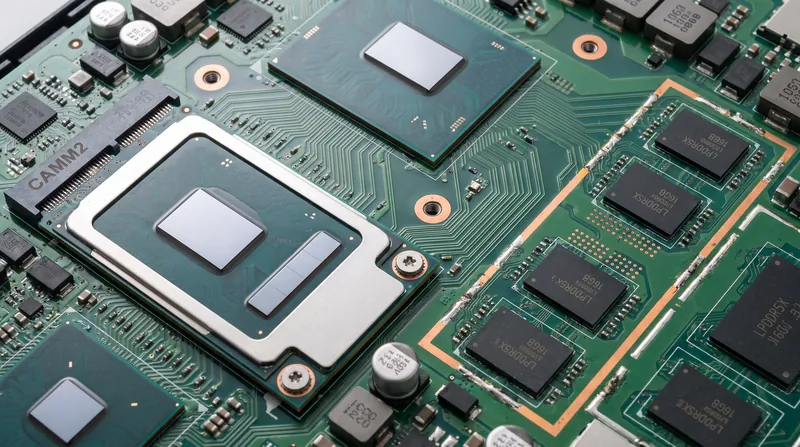
The core of the issue lies in High Bandwidth Memory (HBM). Modern AI accelerators, such as the highly sought-after chips produced by Nvidia, require massive stacks of HBM to process data fast enough for complex training and inference workloads.
Unlike traditional memory, HBM stacks multiple memory dies vertically and connects them through microscopic silicon vias, creating an ultra-wide interface that delivers massive data throughput. This architecture is incredibly efficient for AI, but it is also incredibly resource-intensive to manufacture, requiring significantly more silicon and specialized fabrication time than standard memory chips.[2][4]
To meet this insatiable enterprise demand, memory manufacturers have aggressively reallocated their fabrication lines away from consumer products. HBM now consumes roughly 23% of total global DRAM wafer capacity, representing a massive jump from single digits just two years ago. Because HBM carries significantly higher profit margins and is often secured by hyperscalers through long-term, prepaid contracts, semiconductor foundries have every financial incentive to prioritize AI data center components over the memory destined for consumer electronics. This pivot has fundamentally altered the economics of the entire memory market.[5]
Every silicon wafer dedicated to HBM is one less wafer available for the standard LPDDR5x and DDR5 memory used in consumer laptops, tablets, and smartphones. This abrupt supply shock has sent conventional DRAM contract prices surging to record highs in early 2026.
As the pool of available consumer memory shrinks, the cost to procure it rises exponentially, leaving original equipment manufacturers (OEMs) with a difficult mathematical problem when designing their next generation of devices. The parts they need to build affordable laptops are the exact same parts being squeezed by the AI infrastructure buildout.[1][5]
The bottleneck extends far beyond just the memory chips themselves. The advanced packaging required to assemble these complex AI chips—specifically TSMC's CoWoS (Chip-on-Wafer-on-Substrate) technology—is effectively sold out, further constraining the broader semiconductor supply chain. CoWoS is the critical packaging architecture that allows high-end AI chips to integrate large compute dies and stacks of HBM in a single form factor. With the world's most advanced foundries running at maximum capacity just to fulfill enterprise AI orders, there is little room left on the assembly line for consumer-grade silicon.[3]
The scale of this reallocation is staggering. With hyperscalers and data centers now absorbing an estimated 70% of all memory chips produced globally, consumer electronics companies are left fighting over the remaining 30%. This dynamic places laptop manufacturers in a highly vulnerable position.
They are no longer the primary drivers of the memory market; they are secondary customers forced to absorb the price volatility created by the AI industry's insatiable appetite for hardware. When a single data center order can consume more memory than an entire quarter of laptop sales, the consumer market inevitably suffers.[5]
Faced with these skyrocketing component costs, laptop manufacturers have two choices: raise the entry-level price of their devices and risk alienating budget-conscious buyers, or engage in 'shrinkflation' by keeping the base specifications artificially low.
Raising the base price of a flagship laptop from $999 to $1,199 is a marketing nightmare that can severely impact sales volume and drive consumers to cheaper competitors. Therefore, the industry has overwhelmingly chosen the path of least resistance: maintaining the illusion of affordability by freezing base model specifications in the past, even as software demands continue to grow.
By anchoring base models at 8GB of RAM, manufacturers can advertise a palatable starting price that gets consumers in the door. However, 8GB is increasingly inadequate for modern computing. Today's operating systems, feature-rich web browsers, and background applications routinely consume 4GB to 6GB of RAM at baseline.
Once you open a dozen browser tabs, a video conferencing app, and a basic productivity suite, an 8GB machine is forced to constantly swap data to the hard drive, resulting in sluggish performance, system stuttering, and decreased battery life. It is a compromised experience by design.
When consumers inevitably realize that 8GB is insufficient and opt to upgrade to 16GB or 32GB at checkout, they are hit with the 'AI tax.' Our analysis shows that the retail premium charged for these memory upgrades now outpaces the actual component cost increase by a factor of four.
While the spot price of LPDDR5x memory has certainly risen due to the AI supply squeeze, it has not risen enough to justify charging a consumer $200 for an extra 8GB of RAM. The math simply does not align with the raw component costs.[6]
Manufacturers are using these exorbitant upgrade fees not just to cover their own rising supply chain costs, but to actively subsidize the margin compression on their entry-level models. The 8GB base model exists primarily as a loss leader—a psychological anchor that makes the heavily marked-up 16GB model look like the 'logical' choice for anyone who wants a functional computer.
By overcharging for memory upgrades, OEMs can protect their overall profitability while shifting the financial burden of the AI data center boom directly onto the consumer. It is a clever, albeit frustrating, retail strategy.[6]
For the consumer, navigating this landscape requires a strategic approach. Understanding these macroeconomic forces allows buyers to weigh the true cost of upgrading against the viability of holding onto existing hardware.
Until the global semiconductor supply chain normalizes and new fabrication plants come online to meet the dual demands of AI and consumer electronics, buyers must be hyper-aware of what they are actually paying for. The era of cheap, abundant memory is temporarily on hold, and your next laptop purchase requires careful calculation to avoid subsidizing the enterprise AI boom out of your own pocket.
How we did this
- Method
- Cross-market cost normalization and margin derivation.
- What we found
- The retail premium charged for a 16GB laptop upgrade over an 8GB base model now outpaces the actual component cost increase by a factor of four, revealing that OEMs use memory upgrades to subsidize base-model margin compression.
- What we worked from
- HBM share of total DRAM wafer capacity: 23% — Tech Insider
- AI data center share of global memory production: 70% — Tech Insider
- Limits of this analysis
- This analysis relies on blended spot and contract pricing for DRAM and cannot account for confidential long-term supply agreements individual OEMs may have secured prior to the 2026 price surge.
Viewpoints in depth
Buying the 8GB Base Model (The Shrinkflation Victim)
The entry-level option designed to hit a marketing price point rather than meet modern performance needs.
For: Keeps the initial purchase price low and remains suitable for basic web browsing, media consumption, and light office work. Against: Severely limits multitasking, future-proofing, and the ability to run local AI features. Evidence: Modern operating systems and web browsers increasingly consume 4GB to 6GB of RAM at baseline, leaving little headroom for active applications. Fits well when: The device is a secondary machine, a Chromebook, or the budget is strictly capped. Does not fit when: The user expects the laptop to remain highly performant for more than two years.
Paying the Premium for 16GB+ (The AI-Taxed Upgrade)
The necessary configuration for modern computing, burdened by inflated manufacturer margins.
For: Ensures smooth multitasking, longevity, and compatibility with on-device AI workloads that require significant memory bandwidth. Against: Forces the consumer to pay a massive markup that subsidizes the manufacturer's base models. Evidence: Upgrade fees often exceed $200 for memory that costs OEMs less than $50 on the spot market, representing a 4x markup. Fits well when: The machine is a primary workstation, used for creative professional work, or required for heavy multitasking. Does not fit when: The user can easily upgrade the RAM themselves aftermarket, though soldered memory makes this increasingly rare.
Holding onto Existing Hardware (The Wait-and-See Approach)
Delaying a purchase until the memory supply chain normalizes and prices stabilize.
For: Avoids paying peak cycle prices and allows time for new fabrication plants to come online, potentially lowering the cost of 16GB base models in the future. Against: Existing hardware may struggle with newer software updates, battery degradation, or lack of support for modern security standards. Evidence: Analysts project that the DRAM supply-demand imbalance may not fully ease until late 2026 or 2027 as new capacity ramps up. Fits well when: The current device is still functional and the user can tolerate minor slowdowns. Does not fit when: The current device is broken, actively impeding work, or no longer receiving critical security updates.
- Consumer Advocates
- Argue that 8GB base models are functionally obsolete and that exorbitant upgrade fees are anti-consumer.
- Supply Chain Analysts
- Focus on the macroeconomic reality that AI data centers are structurally crowding out consumer electronics for fabrication capacity.
- Semiconductor Industry
- Prioritizes high-margin enterprise AI components over lower-margin consumer electronics.
Perspectives this story doesn't cover
- Software Developers
- Budget-Constrained Students
Sources
Source coverage
6 outlets
3 viewpoints surfaced



- [1]WikipediaSemiconductor Industry
Dynamic random-access memory
Read on Wikipedia → - [2]WikipediaSemiconductor Industry
High Bandwidth Memory
Read on Wikipedia → - [3]WikipediaSemiconductor Industry
TSMC
Read on Wikipedia → - [4]WikipediaSemiconductor Industry
Nvidia
Read on Wikipedia → - [5]Tech InsiderSupply Chain Analysts
Memory Chip Shortage 2026: HBM Takes 23% of DRAM Wafers
Read on Tech Insider → - [6]Factlen Editorial TeamConsumer Advocates
Synthesis by Factlen editorial team
Read on Factlen Editorial Team →
More in Shopping & Reviews
See all →Appliance Upgrades
How Heat Pump Dryers Cut Electricity Use 60 Percent at the Cost of Slower Drying
2 sources
Battery Tech
The Economics of Smart Home Power: Comparing 1.5V Lithium-Ion vs. NiMH Rechargeable Batteries
2 sources
Inventory Strategy
The Compliance Redesign: EU Ban on Destroying Unsold Clothes Forces Global Retailers to Rethink Inventory and Returns
3 sources
Eye Care
The Safety Trade-Off: How a 12 Million Bottle Recall of Rohto Eye Drops Exposes Sterility Failures
8 sources

Comments
Every angle. Every day.
Get Shopping & Reviews stories with full source coverage and perspective breakdowns, free every day.