
The AI-Sized Carry-On: How Automated Gate Scanners Are Forcing Travelers to Buy New, Precisely-Measured Luggage
Airlines are deploying AI-powered computer vision cameras at boarding gates to instantly measure carry-on bags, eliminating the leniency of human agents and forcing travelers to rethink their luggage choices.
By Tiago Sousa

Share this story
In short
- Airlines are deploying AI-powered computer vision scanners at boarding gates to instantly measure carry-on luggage dimensions.
- The technology eliminates the leniency of human gate agents, automatically flagging bags that exceed limits by even a fraction of an inch.
- Hard-shell suitcases face higher flag rates because AI scanners read their rigid outlines and protruding wheels as absolute maximum volumes.
The era of the lenient gate agent is officially over. For decades, travelers have relied on the "squish factor"—the ability to forcefully shove a slightly oversized carry-on into the metal sizer box to avoid a fee. But in 2026, airlines are replacing human judgment with artificial intelligence. Automated computer vision scanners are being deployed at boarding gates worldwide, fundamentally changing how luggage is measured and forcing a massive shift in consumer travel gear.[2]
The technology relies on advanced 3D cameras and Lidar sensors mounted directly above the boarding lanes. Systems like the NEC Baggage Counting Solution, currently being rolled out by carriers like Japan Airlines, analyze the quantity, type, and exact dimensions of every bag as passengers walk past. There is no stopping, no metal box, and no negotiation. The AI calculates the bag's volume in milliseconds, cross-references it with the aircraft's remaining overhead bin space, and instantly flags violations.
The financial stakes driving this rollout are astronomical. The US Federal Aviation Administration estimates that flight delays cost the industry $33 billion annually. A primary culprit for these delays is overhead bin overflow, which forces ground crews to gate-check bags at the last minute, extending turnaround times. By deploying AI scanners, airlines can identify oversized bags before the passenger even scans their boarding pass, eliminating the bottleneck at the aircraft door.
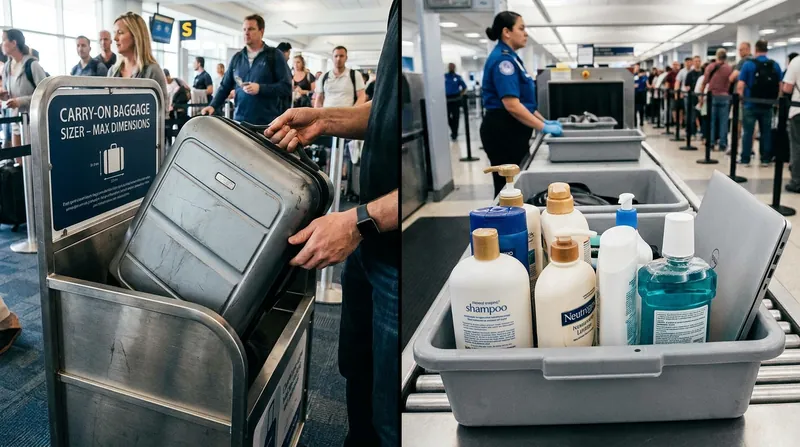
For consumers, this technological leap has created an immediate shopping dilemma. The luggage that worked perfectly in 2024 is suddenly triggering automatic $50 to $100 gate-check fees. The AI does not care if a bag can technically be squeezed into a bin; it only cares about the mathematical bounding box it draws around the item. This has sparked a fierce debate over the best type of luggage for the modern airport, boiling down to a stark trade-off: the Precisely-Measured Hard-Shell versus the Compressible Soft-Sided bag.[2]
For travelers considering the rigid hard-shell option, the trade-offs are stark. On the positive side, hard-shell bags offer maximum protection for fragile electronics and provide a guaranteed fit, provided the consumer purchases a model engineered to the exact millimeter of their preferred airline's limits. Against this benefit is a severe algorithmic penalty: the fixed volume means AI scanners read the maximum size even if the bag is half empty.
Protruding wheels and rigid handles extend the digital bounding box, leading to higher flag rates. The evidence for this shift is clear in aviation analytics, which indicate that rigid bags with external wheels are flagged significantly more often by computer vision systems, simply because the AI calculates volume from the furthest rigid points.[2]
Conversely, the soft-sided compressible bag offers a different set of advantages in the face of algorithmic scrutiny. The primary argument for this style is that malleable shapes, rounded edges, and compression straps visually soften the bag's profile. The lack of sharp, defined corners makes it harder for the AI to draw a maximum bounding box, often allowing the bag to read as smaller than its rigid counterparts.
The argument against soft bags is their lack of impact protection and the risk of unpredictable bulging; an asymmetrical overstuffed bulge will instantly trigger an AI anomaly alert. Evidence from travel gear analysts confirms that soft bags with active compression straps pass automated gate checks more reliably, as travelers can physically shrink the bag's footprint before walking under the scanner.[2]
The shift is also transforming airport security and flow. At hubs like Dubai International Airport, which is rolling out over 100 new AI-powered scanners in 2026, the goal is a "no red lights" boarding process. The AI acts as a silent filter, learning what normal, compliant bags look like and pushing only the unusual or oversized cases to a secondary check. This speeds up the line for the vast majority of passengers while ruthlessly catching violators.[1]
Beyond simply measuring size, these cameras are introducing the era of "baggage biometrics." The high-definition sensors capture a level of detail that human handlers cannot replicate, creating a unique digital fingerprint for every suitcase based on its specific dents, scratches, and texture. If an oversized bag is flagged and gate-checked, it can be tracked through the airport's subterranean conveyor systems entirely without a paper tag.
This level of precision was initially designed to rescue the industry from a staggering surge in mishandled bags, which reached 7.6 per 1,000 passengers globally in recent years. By moving away from manual logistics, carriers can now manage baggage in real-time. However, the dual-use nature of the technology—solving lost luggage while simultaneously enforcing hyper-strict size limits—has created a new friction point between airlines and their customers.
Luggage manufacturers are scrambling to adapt to the new reality. Brands are releasing "AI-optimized" lines that feature recessed wheels, flush handles, and matte finishes designed to minimize the digital bounding box. The marketing language has shifted from "fits in the overhead bin" to "guaranteed to pass automated gate scanners," reflecting the new anxiety of the modern traveler.[2]
The era of the automated gate scanner represents a permanent shift in travel logistics. While it promises fewer delays and an end to the frantic battle for overhead bin space, it requires a fundamental adjustment from passengers. The leniency of human interaction has been replaced by the cold, exact mathematics of computer vision.
Ultimately, the precisely-measured hard-shell carry-on fits well when you fly a single airline consistently, purchase a bag engineered specifically for their exact dimensions, and need to protect fragile tech. It does not fit well when you hop between budget carriers with varying size limits, where the rigid frame becomes a liability under the scanner's gaze.[2]
The soft-sided compressible bag fits well when you need flexibility across different airlines and want to minimize your digital footprint to avoid automated fees. It does not fit well if you tend to overpack to the point of bulging, as the AI will instantly catch the irregular shape and flag you for a gate check.[2]
Jargon, explained
- Computer Vision
- A field of AI that enables computers to derive meaningful information from digital images and videos, used here to measure luggage dimensions instantly.
- Bounding Box
- The digital rectangular outline an AI scanner draws around the outermost points of a suitcase to calculate its total volume.
- Turnaround Time
- The total time it takes to prepare an aircraft for its next flight after landing, which airlines are desperate to reduce.
- Baggage Biometrics
- The practice of identifying and tracking a specific piece of luggage based on its unique visual characteristics rather than a barcode tag.
Common questions
Will my current hard-shell carry-on be flagged by the new AI scanners?
If your hard-shell bag, including its wheels and handles, exceeds the airline's exact dimensions by even a fraction of an inch, the AI will flag it. The scanners read rigid shapes as absolute maximums.
How do soft-sided bags trick the automated sizing systems?
Soft bags with rounded edges and compression straps lack the sharp, defined corners that AI uses to calculate a maximum bounding box, often making them appear smaller to the sensors.
Which airlines are currently using this technology?
Major carriers like Japan Airlines and hubs like Dubai International Airport are actively deploying these systems in 2026, with US carriers rapidly adopting the technology to reduce boarding delays.
Do I still need a paper luggage tag if my bag is gate-checked?
Increasingly, no. The same AI cameras create a biometric 'fingerprint' of your bag based on its unique scratches, dents, and dimensions, allowing it to be tracked digitally.
Competing readings
Aviation Technologists
Focus on eliminating the $33 billion annual cost of delays and achieving seamless, tag-free travel through computer vision.
For the engineers and airport operators deploying these systems, the primary goal is operational efficiency. By instantly calculating overhead bin capacity and flagging oversized bags before they reach the jet bridge, airlines can drastically reduce turnaround times. They view the strict enforcement not as a penalty, but as a necessary step to modernize an archaic, error-prone boarding process.
Frequent Flyers
Concerned about hyper-strict enforcement, the loss of the 'squish factor,' and automatic gate-check fees.
Travelers argue that the AI systems lack the common sense of human gate agents. A soft bag that is technically one inch too wide but easily compressible is now flagged as a violation, triggering immediate fees. Frequent flyers feel that the technology is being weaponized as a revenue-generation tool under the guise of boarding efficiency, forcing them to purchase entirely new luggage.
Consumer Travel Analysts
Adapting to the new reality by recommending specific luggage designs engineered to beat the AI scanners' bounding boxes.
Industry analysts note that the luggage market is undergoing a rapid redesign. The focus has shifted from maximizing interior volume to minimizing the exterior digital footprint. Analysts advise consumers to avoid rigid bags with protruding wheels, as the AI calculates volume from the furthest rigid points, and instead opt for soft-sided bags with active compression straps that can visually trick the sensors.
- Aviation Technologists
- Focus on eliminating the $33 billion annual cost of delays and achieving seamless, tag-free travel through computer vision.
- Frequent Flyers
- Concerned about hyper-strict enforcement, the loss of the 'squish factor,' and automatic gate-check fees.
- Consumer Travel Analysts
- Adapting to the new reality by recommending specific luggage designs engineered to beat the AI scanners' bounding boxes.
Perspectives this story doesn't cover
- Gate Agents
- Budget Airline Operators
Sources
Source coverage
2 outlets
3 viewpoints surfaced


- [1]MediumFrequent Flyers
Dubai International Airport's New AI Luggage Scanners
Read on Medium → - [2]Factlen Editorial TeamConsumer Travel Analysts
Synthesis by Factlen editorial team
Read on Factlen Editorial Team →
More in Shopping & Reviews
See all →Smart Luggage
The Smart Luggage Graveyard: How the Unified Airline Ban on Non-Removable Batteries Reshapes Carry-On Shopping
1 sources
Luggage Standards
The 22x14x9 Rule: How Stricter Airline Carry-On Enforcement is Forcing a Luggage Upgrade
3 sources
Luggage Design
Why Two-Wheel Rollaboards Beat Four-Wheel Spinners on Packing Volume and Durability
4 sources

Backpack Biomechanics
How Torso Length, Hip Belts, and Frame Materials Dictate Backpack Load Transfer
6 sources

Comments
Every angle. Every day.
Get Shopping & Reviews stories with full source coverage and perspective breakdowns, free every day.