
The Handheld PC Revolution: How Next-Gen APUs Are Making Portable AAA Gaming a Reality
Advancements in mobile processing power and software translation layers have transformed the handheld gaming PC from a niche novelty into a mainstream powerhouse. Here is exactly how the hardware works, the engineering trade-offs involved, and why the portable form factor is reshaping the PC gaming industry.
By Factlen Editorial Team
- Seamless Experience Advocates
- Prioritize a console-like user interface, instant sleep/wake functionality, and battery life over raw performance.
- Hardware Tweakers
- Value maximum performance, native Windows compatibility, and the ability to manually adjust TDP and clock speeds.
- Open-Source Proponents
- Champion Linux-based operating systems and translation layers as a way to break free from the Windows ecosystem.
What's not represented
- · Game Developers optimizing for low-power hardware
- · Battery Chemistry Researchers
Why this matters
The ability to play demanding PC games on a portable device frees players from their desks and televisions, democratizing access to high-end gaming. Understanding the hardware limitations and software tricks behind these devices helps consumers make informed purchasing decisions in a rapidly expanding, multi-billion-dollar market.
Key points
- Handheld gaming PCs use APUs to combine CPU and GPU functions on a single, power-efficient chip.
- Hardware engineers target a 15W power limit to balance gaming performance with battery life and heat generation.
- Translation layers like Proton allow heavy Windows games to run efficiently on lightweight Linux operating systems.
- AI upscaling and frame generation software are critical for achieving smooth framerates on mobile hardware.
- OLED screens and Variable Refresh Rate (VRR) technology mask performance dips and improve visual fidelity.
For decades, PC gaming was strictly tethered to a desk. The sheer amount of electricity required to render high-fidelity graphics, coupled with the massive cooling systems needed to dissipate the resulting heat, meant that true PC gaming was inherently stationary. Laptops offered a compromise, but they remained bulky, hot, and reliant on wall power for peak performance. Today, that paradigm has entirely shifted. A new category of device—the handheld gaming PC—has exploded in popularity, offering the ability to play demanding AAA titles on a device the size of a Nintendo Switch. This is not merely a trend; it represents a fundamental leap in mobile computing architecture.[1][8]
The catalyst for this revolution was the realization that brute-forcing performance through high wattage was a dead end for portable devices. Instead, engineers had to rethink how a computer processes graphics in a constrained thermal envelope. The solution lies in the Accelerated Processing Unit, or APU. Unlike a traditional desktop PC, which features a separate Central Processing Unit (CPU) and a dedicated Graphics Processing Unit (GPU), an APU combines both onto a single piece of silicon. This integration drastically reduces the physical footprint of the motherboard and allows the two processors to communicate with unprecedented efficiency.[2]
A critical advantage of the APU architecture is Unified Memory. In a standard desktop, the CPU uses system RAM, while the GPU uses its own dedicated VRAM. Moving data between these two memory pools takes time and consumes power. In a handheld APU, the CPU and GPU share a single, high-speed pool of LPDDR5 memory. When the CPU loads a texture from the solid-state drive, the GPU can access it instantly without needing a redundant copy. This shared architecture is the secret sauce that allows a chip drawing less power than a standard lightbulb to render complex 3D environments.[2][7]

The battleground for these APUs is currently dominated by AMD and Intel. AMD's custom silicon, particularly the Z-series and the newer Strix Point architectures, set the early standard by prioritizing GPU compute units over CPU cores. Intel has aggressively countered with its Lunar Lake architecture, which integrates memory directly onto the processor package to further reduce latency and power consumption. Both companies are engaged in a fierce arms race to maximize the 'performance per watt' metric, which has become the single most important benchmark in the handheld space.[2]
Understanding performance per watt requires understanding Thermal Design Power, or TDP. TDP is a measure of the maximum amount of heat a chip is designed to generate, which directly correlates to how much electrical power it consumes. In the handheld market, engineers have discovered a strict mathematical reality known as the '15W Wall.' At 15 watts of power, modern APUs operate at peak efficiency, delivering excellent framerates without instantly draining the battery or melting the plastic chassis.[7]
Pushing a handheld beyond 15W yields severe diminishing returns. Increasing the TDP to 30W might double the power consumption and halve the battery life, but it typically only yields a 15 to 20 percent increase in actual gaming performance. The silicon simply becomes less efficient at higher voltages. Therefore, the hardware design of a handheld PC is an exercise in strict discipline: manufacturers must carefully tune their cooling fans and power delivery systems to keep the APU hovering right in that sweet spot, ensuring the device remains comfortable to hold while providing a smooth experience.[1][7]

Because battery chemistry has not advanced as rapidly as silicon efficiency, hardware alone cannot solve the portable gaming puzzle. Lithium-ion batteries are heavy, and there is a strict limit to how large a battery can be before a handheld becomes too heavy to comfortably hold for extended periods. To bridge the gap between hardware limitations and player expectations, the industry has turned to software magic. The most significant of these software breakthroughs is the translation layer.[4][8]
Because battery chemistry has not advanced as rapidly as silicon efficiency, hardware alone cannot solve the portable gaming puzzle.
Historically, PC games were built exclusively for Microsoft Windows. However, Windows is a heavy operating system, running dozens of background processes that consume precious CPU cycles and battery life. To bypass this, companies like Valve championed Linux-based operating systems paired with a translation layer called Proton. Proton acts as a real-time interpreter, taking the Windows-specific instructions generated by a game and instantly translating them into commands that the lightweight Linux kernel can understand. This allows handhelds to run games with less overhead, dedicating more power to the game itself.[3][4]
The debate between Windows and Linux remains a defining schism in the handheld market. Devices running native Windows offer absolute compatibility with every game store and anti-cheat software, appealing to users who want a pocket-sized desktop. However, they often suffer from a clunky user interface and worse battery life. Conversely, Linux-based devices offer a seamless, console-like experience with features like instant suspend-and-resume, but they may struggle to run certain multiplayer games that require intrusive Windows-level security software. Both approaches have passionate defenders.[3]
Beyond operating systems, the second software pillar of the handheld revolution is AI-driven image upscaling. Technologies like AMD's FidelityFX Super Resolution (FSR) and Intel's XeSS have fundamentally changed how games are rendered. Instead of forcing the handheld's GPU to render a game at the screen's native 1080p resolution—which is incredibly taxing—the game is rendered internally at a much lower resolution, such as 720p or even 540p. The upscaling algorithm then uses complex spatial and temporal data to reconstruct a high-resolution image before it hits the screen.[5]

The visual difference between a native 1080p image and a high-quality upscaled image on a 7-inch screen is nearly imperceptible to the human eye, but the power savings are massive. By rendering fewer pixels natively, the APU can run at a lower clock speed, saving battery life, or it can use that freed-up headroom to push higher framerates. More recently, frame generation technology has been introduced to handhelds, where the software literally invents new frames between the traditionally rendered ones, turning a choppy 30 frames-per-second experience into a fluid 60 frames-per-second.[5][6]
All of this processing power and software trickery culminates at the display. The transition from standard LCD panels to OLED (Organic Light-Emitting Diode) screens has been a watershed moment for portable hardware. Because OLED panels light each pixel individually, they can achieve perfect black levels by simply turning off the pixels in dark areas of an image. This not only provides stunning contrast and vibrant colors but also saves battery life when playing games with dark environments.[6]

Equally important to the display is the implementation of Variable Refresh Rate (VRR) technology. In a traditional display, the screen refreshes at a fixed rate, usually 60 times a second. If the handheld's APU struggles and only delivers 45 frames in a second, the mismatch causes visual stuttering and screen tearing. VRR solves this by forcing the display to dynamically match the exact framerate output of the APU in real-time. If the game drops to 48 frames per second, the screen refreshes exactly 48 times. This makes fluctuating performance feel incredibly smooth, masking the inherent limitations of mobile hardware.[6]
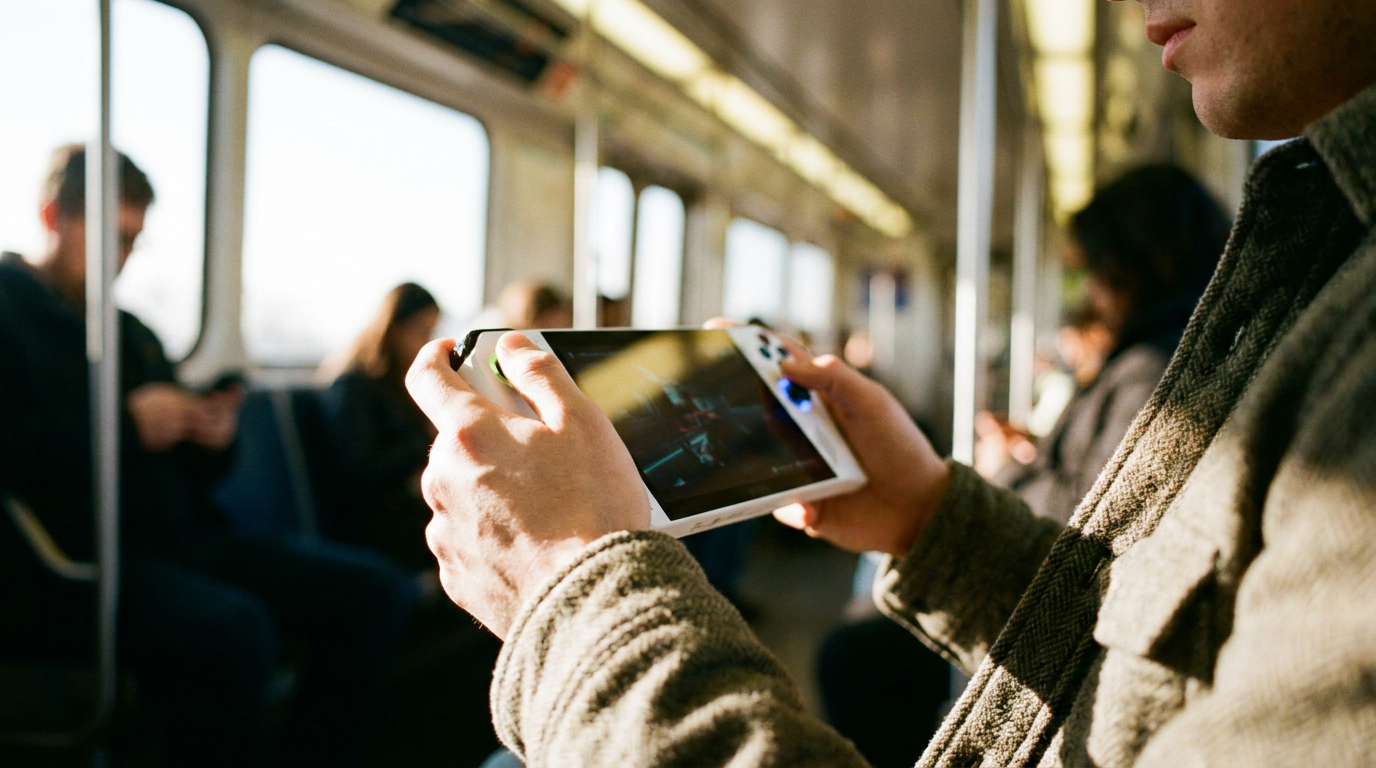
The convergence of these technologies—efficient APUs, unified memory, lightweight translation layers, AI upscaling, and VRR OLED displays—has created a golden age for portable gaming. Players are no longer compromising on their experience; they are simply shifting where that experience takes place. Commutes, flights, and living room couches have become high-end PC gaming spaces.[1][8]
Looking ahead, the trajectory of the handheld PC market points toward even deeper integration of Neural Processing Units (NPUs) to handle upscaling tasks, freeing up the GPU entirely for rendering. As solid-state battery technology matures and silicon nodes shrink further, the gap between desktop and portable performance will continue to narrow. The handheld PC is no longer a novelty; it is a foundational pillar of the gaming industry's future.[1][2][5]
How we got here
2021
Valve announces the Steam Deck, proving the viability of a Linux-based handheld PC.
2023
Asus releases the ROG Ally, bringing native Windows 11 and high-refresh-rate screens to the form factor.
2024
Manufacturers begin releasing OLED hardware revisions, significantly improving battery life and display quality.
2026
Next-generation APUs from AMD and Intel push handheld performance closer to desktop parity at lower wattages.
Viewpoints in depth
The Seamless Experience Camp
Prioritizes a console-like user interface, instant sleep/wake functionality, and battery life over raw performance.
This perspective, largely championed by users of SteamOS and similar Linux-based interfaces, views the handheld as a dedicated gaming appliance rather than a general-purpose computer. They argue that the friction of navigating a desktop operating system with a controller ruins the portable experience. For this camp, the ability to press a single button to suspend a game mid-jump, put the device in a backpack, and instantly resume playing hours later is the defining feature of the hardware. They are willing to sacrifice access to certain multiplayer games with incompatible anti-cheat software in exchange for a streamlined, battery-efficient ecosystem.
The Hardware Tweaker Camp
Values maximum performance, native Windows compatibility, and the ability to manually adjust TDP and clock speeds.
Hardware enthusiasts view handheld PCs as highly portable desktops and demand the freedom that comes with a full Windows installation. This camp prioritizes absolute compatibility—they want access to every game launcher, every modding tool, and every piece of anti-cheat software without relying on translation layers. They are often willing to tolerate a clunkier user interface and shorter battery life in exchange for the ability to manually tune their device's TDP, adjust fan curves, and squeeze every last frame out of the APU. For them, the joy of the device is in the optimization.
The Open-Source Camp
Champions Linux-based operating systems and translation layers as a way to break free from the Windows ecosystem.
This perspective views the rise of the handheld PC as a Trojan horse for Linux gaming. Advocates in this camp celebrate technologies like Proton not just for their efficiency, but for their ability to break Microsoft's historical monopoly on PC gaming. They argue that an open-source foundation leads to better long-term preservation of games, less corporate bloatware, and a more secure operating environment. They actively contribute to compatibility databases and view every game that runs flawlessly on a Linux handheld as a victory for open computing standards.
What we don't know
- Whether solid-state battery technology will mature fast enough to replace lithium-ion in the next hardware generation.
- If Microsoft will eventually release a dedicated, lightweight 'Windows Handheld Edition' to compete with SteamOS.
- How quickly game developers will begin requiring AI upscaling as a baseline, rather than an optional feature.
Key terms
- APU (Accelerated Processing Unit)
- A single processor chip that combines both the central processing unit (CPU) and the graphics processing unit (GPU).
- TDP (Thermal Design Power)
- A measurement in watts that indicates the maximum amount of heat a chip is expected to generate, which correlates to its power consumption.
- Proton
- A software compatibility tool developed by Valve that translates Windows-specific game code into instructions that a Linux operating system can run.
- VRR (Variable Refresh Rate)
- A display technology that allows a screen to dynamically adjust how often it updates its image to perfectly match the framerate output of the game, eliminating visual stutter.
- AI Upscaling
- Software techniques like FSR or DLSS that render a game at a low resolution to save power, then use algorithms to reconstruct the image to look like a higher resolution.
Frequently asked
Can a handheld PC play any game a desktop can?
Generally, yes. However, devices running Linux may struggle with games that use intrusive, Windows-only anti-cheat software, and the most graphically demanding games will require lowered settings.
How long does the battery typically last?
Battery life varies wildly based on the game and the device's TDP settings. A lightweight 2D game might run for 6 to 8 hours, while a heavy AAA 3D game might drain the battery in 90 minutes.
Can I use a handheld PC as a normal computer?
Yes. Because they are fully functional PCs, you can connect them to a monitor, keyboard, and mouse via a dock to browse the web, write documents, or watch videos.
Sources
Source coverage
8 outlets
3 viewpoints surfaced








[1]PC GamerSeamless Experience Advocates
The Handheld PC Market in 2026: A Golden Age of Portable Gaming
Read on PC Gamer →[2]Tom's HardwareHardware Tweakers
Understanding APUs: How AMD and Intel Power the Handheld Generation
Read on Tom's Hardware →[3]The VergeHardware Tweakers
Windows vs. SteamOS: The Battle for the Handheld Dashboard
Read on The Verge →[4]Ars TechnicaOpen-Source Proponents
Inside Proton: The Translation Layer That Made Linux Gaming a Reality
Read on Ars Technica →[5]EurogamerOpen-Source Proponents
Digital Foundry: Handheld Upscaling and Frame Generation on the Go
Read on Eurogamer →[6]IGNSeamless Experience Advocates
OLED and VRR: The Unsung Heroes of Handheld Gaming
Read on IGN →[7]AnandTechHardware Tweakers
Power Scaling in Mobile Architectures: Hitting the 15W Wall
Read on AnandTech →[8]DexertoSeamless Experience Advocates
Why Handheld PCs Are Replacing Consoles for Daily Commuters
Read on Dexerto →
Every angle. Every day.
Get gaming esports stories with full source coverage and perspective breakdowns delivered to your inbox.