
The Green Touring Revolution: How Major Artists Are Decarbonizing Live Music
Driven by artist activism and breakthroughs in battery technology, the live music industry is proving that massive stadium tours can drastically cut their carbon emissions without sacrificing spectacle.
By Factlen Editorial Team
- Pioneering Artists & Producers
- Major acts arguing that the industry must aggressively decarbonize its operations immediately.
- Climate Researchers
- Scientists emphasizing that true decarbonization requires addressing fan behavior, not just stage technology.
- Industry Infrastructure Groups
- Advocates focusing on the financial and contractual barriers to green touring for smaller acts.
What's not represented
- · Traditional Venue Operators
- · Independent Touring Crew Members
Why this matters
Live entertainment has historically been an environmental blind spot, generating millions of tons of carbon through fan travel, diesel generators, and plastic waste. The successful decarbonization of mega-tours proves that massive cultural events can operate sustainably, setting a new standard that will eventually reshape how local venues, sports arenas, and festivals operate in your city.
Key points
- Major artists have proven that stadium tours can cut direct carbon emissions by over 50% using current technology.
- Diesel generators are being replaced by tourable battery systems charged by renewable grid energy.
- Fan travel accounts for up to 75% of a concert's footprint, prompting zero-car-park policies and electric transit incentives.
- Mandating plant-based menus at venues can reduce catering-related greenhouse gas emissions by nearly 90%.
- New standardized booking clauses are helping mid-tier artists demand basic eco-friendly practices from venues.
The traditional stadium tour is an environmental behemoth. For decades, taking a massive pop or rock production on the road meant deploying fleets of diesel-guzzling trucks, chartering private jets, running stage lights off industrial diesel generators, and leaving behind mountains of single-use plastic cups. The sheer logistical weight of moving hundreds of crew members and thousands of tons of steel from city to city made live music one of the entertainment industry’s most carbon-intensive sectors. But a quiet, data-driven revolution is currently rewriting the rules of the road. Driven by a combination of artist activism, fan demand, and breakthroughs in portable energy storage, the live music industry is proving that mega-concerts can be aggressively decarbonized without sacrificing their visual spectacle or sonic power.
This shift marks a departure from the era of vague carbon offsetting—where tours simply bought tree-planting credits to excuse their emissions—toward hard, verifiable reductions in actual carbon output. Leading this charge are legacy acts who possess the financial leverage to force systemic changes on promoters and venues. In 2024, British rock band Coldplay released verified data showing they had reduced their direct touring carbon footprint by 59% compared to their previous world tour [1]. The data, audited by the Massachusetts Institute of Technology's Environmental Solutions Initiative, proved that sustainable touring was not just a theoretical concept, but a scalable reality [1, 6].
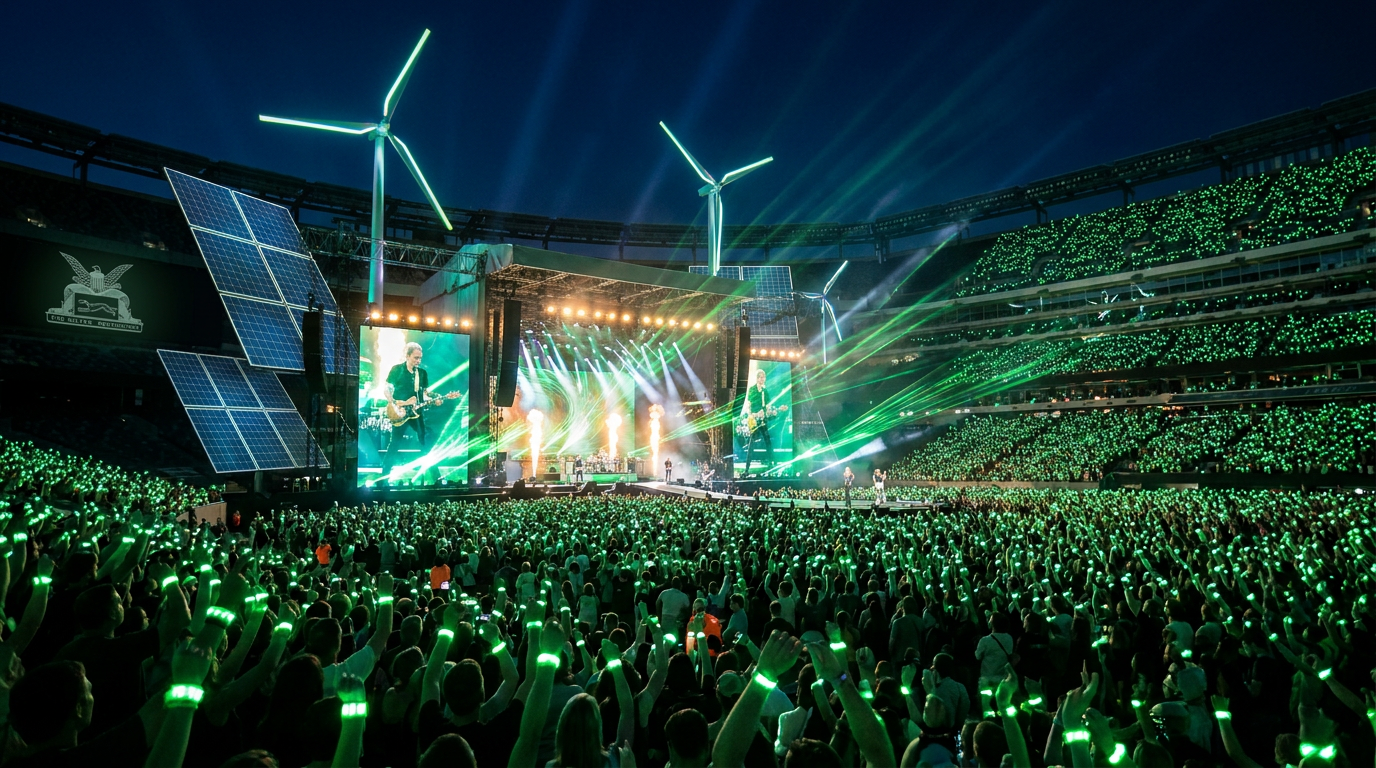
The most immediate target for decarbonization has been stage power. Historically, outdoor concerts relied on massive diesel generators that ran continuously for days to power amplifiers, video screens, and lighting rigs. Today, those fossil-fuel engines are being replaced by tourable battery systems. During their Music of the Spheres tour, Coldplay powered 18 entire shows using battery arrays constructed from recycled BMW i3 electric vehicle batteries [1]. These batteries can be charged via renewable grid energy during the day and deployed at night, providing clean, silent power to the stage.
Trip-hop pioneers Massive Attack took this energy transition even further with their "Act 1.5" concert in Bristol, designed in collaboration with the Tyndall Centre for Climate Change Research [2, 7]. The 32,000-capacity festival was powered entirely by renewable energy batteries, completely eliminating the need for diesel generators on site [3]. According to the post-event analysis, this infrastructure switch resulted in a staggering 98% reduction in power-related emissions compared to a standard outdoor live music event [3].

Beyond static batteries, artists are also experimenting with human-powered energy generation. To power their secondary stage, Coldplay installed kinetic dancefloors and electricity-generating stationary bikes inside the stadium [1]. As fans jumped on the specialized floor tiles, their kinetic energy was captured and converted into electricity, directly charging the show's batteries. While human power currently accounts for a fraction of the total energy needed for a stadium show, it serves as a highly visible, interactive mechanism to engage audiences in the decarbonization process.
Beyond static batteries, artists are also experimenting with human-powered energy generation.
However, the stage production itself is only a small piece of the puzzle. The single largest hidden emission of any live event is fan travel. A comprehensive study by MIT's Climate Machine, which analyzed over 80,000 live shows, revealed that how audiences get to the venue accounts for up to 75% of a concert's total carbon footprint [4]. Tens of thousands of people driving individual combustion-engine cars to a stadium dwarfs the emissions of the band's touring trucks.
To combat this, tours are radically rethinking ticketing and transportation logistics. For the Act 1.5 concert, Massive Attack implemented a zero-car-park policy, making it physically impossible for attendees to drive and park at the venue [3]. Instead, the band prioritized local residents for ticket presales and chartered five special electric trains to transport fans home after the show [3]. They also deployed a fleet of free electric shuttle buses connecting the venue to major transit hubs, successfully cutting audience travel emissions by 32% [3].

Food and beverage consumption represents another massive, yet often overlooked, emission driver. The MIT researchers found that meat-based dishes served at concert venues release over 13 times more greenhouse gases than plant-based alternatives [4]. Transitioning to low-carbon menus is considered one of the most effective levers for immediate emissions cuts. At the Act 1.5 festival, all vendors were mandated to serve a 100% plant-based menu, a policy that single-handedly drove an 89% reduction in catering emissions [3].
Merchandise and physical waste are also undergoing a green overhaul. The iconic glowing LED wristbands that have become a staple of modern pop concerts are traditionally made of cheap plastic and discarded after a single use. Recent tours have transitioned to wristbands made from 100% compostable, plant-based materials [1]. More importantly, artists have implemented aggressive collection programs. By asking fans to return the wristbands at the exits, crews can sterilize, recharge, and reuse them for the next city, achieving return rates as high as 86% and diverting tons of electronic waste from landfills [1, 6].
Despite these high-profile successes, the transition to sustainable touring faces significant structural hurdles. Not every artist has the financial backing or industry clout of a stadium-headlining legacy act. Mid-tier and emerging artists operate on razor-thin margins and often lack the budget to demand green riders or overhaul a venue's entrenched infrastructure. If an indie band requests plant-based catering or renewable energy, a venue locked into long-term contracts with traditional food vendors and fossil-fuel providers will likely refuse.

To bridge this gap, industry organizations are working to standardize eco-friendly practices so that the burden does not fall entirely on individual artists. The LIVE Green initiative recently introduced standardized sustainability clauses for booking contracts, providing artists of all sizes with legally sound templates to demand basic environmental standards, such as the elimination of single-use plastics and the provision of recycling facilities [5]. By normalizing these requests across thousands of contracts, the industry hopes to force venues to upgrade their baseline operations.
The blueprint for super-low carbon live music now exists, shifting the conversation from theoretical possibilities to practical implementation. While the industry is still a long way from achieving absolute zero emissions, the data proves that massive reductions are possible today using existing technology. As these practices scale from the biggest stadium acts down to local club tours, the environmental cost of live entertainment is finally beginning to drop, proving that the show can go on without costing the earth.
How we got here
2019
Coldplay pauses touring, vowing not to hit the road again until they can do so sustainably.
2021
Massive Attack commissions the Tyndall Centre to create a roadmap for super-low carbon live music.
2022
Coldplay launches the Music of the Spheres tour with a pledge to cut direct emissions by 50%.
June 2024
MIT verifies that Coldplay surpassed their goal, achieving a 59% reduction in touring emissions.
August 2024
Massive Attack hosts the Act 1.5 concert in Bristol, powered entirely by renewable energy with zero car parking.
October 2024
LIVE Green introduces standardized sustainability clauses for artist booking contracts.
Viewpoints in depth
Pioneering Artists
Major acts arguing that the industry must aggressively decarbonize its operations immediately.
Artists like Coldplay and Massive Attack argue that the live music sector has relied on the excuse of logistical complexity for too long. By funding their own research and absorbing the initial costs of battery rentals and kinetic infrastructure, they aim to prove that sustainable touring is viable at the highest levels of stadium entertainment. Their perspective is that artists with significant leverage must force promoters and venues to abandon fossil fuels, setting a new baseline that will eventually become cheaper and more accessible for smaller acts.
Climate Researchers
Scientists emphasizing that true decarbonization requires addressing fan behavior, not just stage technology.
Researchers from institutions like MIT and the Tyndall Centre point out that while solar-powered stages and battery arrays are excellent visual symbols of sustainability, they only address a fraction of a tour's total footprint. Their data reveals that up to 75% of emissions come from audience travel, and significant portions stem from meat-heavy venue catering. From this viewpoint, the most critical climate action a tour can take is routing shows near major public transit hubs, eliminating parking lots, and mandating plant-based menus.
Mid-Tier Artists & Infrastructure Groups
Advocates focusing on the financial and contractual barriers to green touring for smaller acts.
While mega-stars can dictate terms to stadiums, independent and mid-tier artists often lack the financial leverage to demand green riders. Industry groups like LIVE Green argue that sustainability cannot be a luxury reserved for the top 1% of tours. They advocate for standardized contractual clauses and venue-level infrastructure upgrades—such as permanent grid connections to replace diesel generators—so that eco-friendly practices become the default setting for every concert, regardless of the artist's budget.
What we don't know
- Whether mid-tier venues will voluntarily absorb the costs of upgrading their energy infrastructure without legislative mandates.
- How quickly tourable battery systems will drop in price to become affordable for independent artists.
- If fan behavior regarding travel and food choices will permanently shift without strict venue enforcement.
Key terms
- Scope 3 Emissions
- Indirect greenhouse gas emissions that occur in a tour's value chain, such as fans traveling to the venue or the agricultural impact of the food served.
- Kinetic Energy Harvesting
- The process of capturing physical energy generated by human movement—like dancing or pedaling a stationary bike—and converting it into usable electricity.
- Green Rider
- A set of contractual demands made by an artist requiring a venue to meet specific environmental standards, such as banning single-use plastics or providing plant-based food.
- Tourable Battery System
- Large-scale, portable energy storage units, often repurposed from electric vehicles, used to replace traditional diesel generators at outdoor events.
Frequently asked
What is a kinetic dancefloor?
It is a specialized floor that captures the physical energy of fans jumping and dancing, converting that movement into electricity to help power the concert's batteries.
Why is fan travel the biggest source of concert emissions?
Because tens of thousands of people driving individual cars or flying to a single location generates significantly more carbon than the trucks transporting the stage production.
Are sustainable concerts more expensive for fans?
Currently, ticket prices remain comparable. Major artists are absorbing the initial research and development costs, and savings on diesel fuel help offset the price of battery rentals.
What happens to the glowing LED wristbands after the show?
At sustainable shows, the wristbands are made from compostable materials and collected at the exits. They are then sterilized, recharged, and reused in the next city.
Sources
Source coverage
7 outlets
3 viewpoints surfaced




[1]The GuardianPioneering Artists & Producers
Coldplay announces carbon footprint after two years of touring is 59% lower
Read on The Guardian →Massive Attack prepare for Act 1.5, aiming for lowest emissions of any big music event
Read on The Guardian →[3]Green QueenClimate Researchers
Massive Attack’s Act 1.5 Bristol Concert Produced Lowest Emissions Ever
Read on Green Queen →Fan Travel & Food the Largest Sources of Live Music’s Climate Footprint, Finds MIT Study
Read on Green Queen →[5]Music WeekIndustry Infrastructure Groups
LIVE unveils new sustainability initiative for artists
Read on Music Week →[6]MIT Environmental Solutions InitiativeClimate Researchers
Coldplay Tour Emissions Update and Verification
Read on MIT Environmental Solutions Initiative →[7]Tyndall Centre for Climate Change ResearchClimate Researchers
Super Low Carbon Live Music Roadmap
Read on Tyndall Centre for Climate Change Research →
Every angle. Every day.
Get entertainment stories with full source coverage and perspective breakdowns delivered to your inbox.