
The Green Collar Boom: How Clean Energy is Rewriting the Rules of Vocational Education
As the demand for electric vehicles and renewable energy surges, a new generation of workers is bypassing traditional four-year colleges for high-paying, zero-debt apprenticeships in the green economy.
By Factlen Editorial Team
- Clean Energy Employers
- Companies view the skills shortage as the primary bottleneck to scaling the green transition.
- Workforce Development Advocates
- Advocates see green apprenticeships as a powerful engine for middle-class economic mobility.
- Vocational Educators
- Instructors emphasize the high-tech evolution and rigorous safety demands of modern trade skills.
What's not represented
- · Traditional four-year universities facing enrollment declines
- · Independent auto repair shops struggling to afford EV training equipment
Why this matters
The transition to renewable energy is creating a massive, highly lucrative job market that doesn't require a traditional college degree. For students, career-switchers, and policymakers, understanding this shift is crucial for navigating the future of economic mobility and workforce development.
Key points
- Registered Apprenticeship Program graduates earn an average of $77,000 in their first year, significantly outpacing recent college graduates.
- Demand for electric vehicle technicians is projected to grow by 36% by 2030, yet currently, only 3% of mechanics are proficient in EV service.
- Modern vocational training has evolved into a high-tech discipline, requiring fluency in software diagnostics and high-voltage electrical safety.
- Employers and national coalitions are rapidly expanding 'earn while you learn' models to bypass traditional educational bottlenecks and build proprietary talent pipelines.
The traditional narrative of high school graduates reflexively heading to four-year colleges is facing a powerful counter-current. Driven by the transition to renewable energy and the electrification of transportation, a new class of "green collar" jobs is fundamentally reshaping vocational education.[6]
This shift is not merely a rebranding of traditional trades; it represents a high-tech evolution of the workforce. Today's vocational students are trading student debt for paid apprenticeships, learning to diagnose high-voltage battery systems, program smart grids, and install utility-scale solar arrays.[6]
The financial incentives driving this migration are stark. According to the U.S. Department of Energy, workers who complete a Registered Apprenticeship Program (RAP) earn an average of $77,000 in their first year on the job.[1]
To put that figure into perspective, the average starting salary for a worker in their twenties with a four-year college degree hovers around $52,000—often accompanied by significant student loan debt. Over the course of a career, RAP graduates can expect to earn approximately $300,000 more in wages and benefits than their peers who do not complete such programs.[1]

Nowhere is the demand for these specialized skills more acute than in the automotive sector. As global electric vehicle sales continue to surge, the industry is confronting a massive skills gap.[2]
Projections indicate that the demand for automotive service technicians specializing in EVs will jump by a staggering 36% by 2030, a growth rate that vastly outpaces the national average for other professions.[2]
Yet, the current workforce is woefully underprepared for this transition. Industry data reveals that only about 3% of auto technicians are truly proficient in EV service, and fewer than 10% are qualified to safely handle high-voltage battery systems.[2]

Yet, the current workforce is woefully underprepared for this transition.
The daily reality of an EV technician looks vastly different from that of a traditional mechanic. The modern role is a hybrid of mechanic, electrician, and software engineer, where a diagnostic laptop is just as crucial as a wrench.[2]
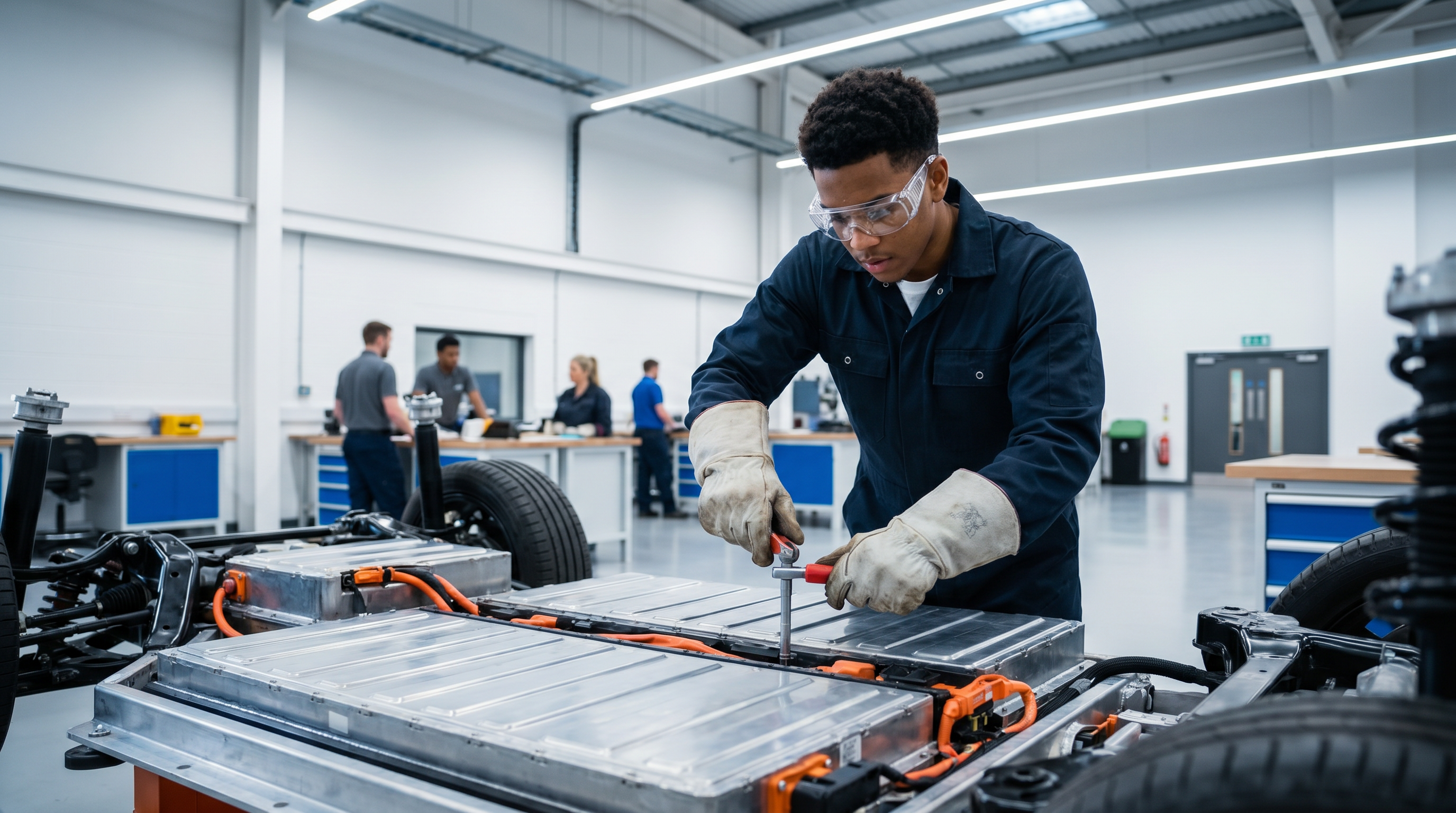
Vocational educators emphasize that this new curriculum requires rigorous safety protocols. High-voltage power-down procedures, the use of specialized personal protective equipment, and an understanding of the fire risks associated with lithium-ion batteries are now mandatory components of training.[5]
Students are learning advanced diagnostic techniques, such as battery stress testing and using oscilloscopes to evaluate power inverters. Because of the specialized nature of these high-voltage systems, entry-level EV technicians can often start around $50,000, with seasoned master technicians in major markets earning well over $100,000 annually.[2][5]

Beyond the automotive bay, the broader clean energy sector is also racing to build its workforce. The United States is currently projected to have only 40% of the licensed electricians required to meet its 2030 climate goals.[4]
To bridge this gap, companies are taking workforce development into their own hands. For example, ReVision Energy launched the first employer-based solar apprenticeship program in the nation, allowing employees to complete the 8,000 hours of paid work experience and 600 hours of classroom instruction required for electrical licensure entirely in-house.[4]
This "earn while you learn" model allows licensed electricians to supervise and mentor new apprentices on active solar projects, creating an exponential growth curve for the company's skilled workforce.[4]
National coalitions are also stepping in to scale these efforts. The Apprenticeships in Clean Energy (ACE) Network, led by the Interstate Renewable Energy Council, provides free technical assistance to employers looking to establish their own registered apprenticeship programs.[3]

In just nine months, the ACE Network helped expand a single employer's program of 20 apprentices into a robust pipeline supporting 11 employer partners and 160 apprentices.[3]
As the green transition accelerates, the stigma once associated with vocational education is rapidly dissipating. For a new generation of workers, the path to middle-class stability and a six-figure salary no longer requires a university lecture hall—it requires a hard hat, a diagnostic tablet, and a willingness to build the infrastructure of the future.[6]
How we got here
2020
Electric vehicle market share begins rapid acceleration, exposing early shortages in qualified maintenance technicians.
2022
The Inflation Reduction Act passes, tying significant clean energy tax incentives to the use of registered apprentices.
2023
The U.S. Department of Labor selects the Interstate Renewable Energy Council to serve as the national Industry Intermediary for clean energy apprenticeships.
2025
Trade schools and community colleges report record enrollment in specialized high-voltage and renewable energy programs.
2030 (Projected)
The U.S. faces a critical deadline to scale its electrical workforce to meet national climate and emissions targets.
Viewpoints in depth
Clean Energy Employers
Companies view the skills shortage as the primary bottleneck to scaling the green transition.
For solar installers and EV manufacturers, consumer demand is no longer the limiting factor—workforce capacity is. Employers argue that without a massive influx of qualified technicians, the deployment of charging networks and utility-scale solar projects will stall. To combat this, many are internalizing their training pipelines, creating proprietary apprenticeship programs to ensure a steady stream of licensed talent that meets their specific operational needs.
Workforce Development Advocates
Advocates see green apprenticeships as a powerful engine for middle-class economic mobility.
Government agencies and labor advocates emphasize the stark financial contrast between traditional higher education and the trades. By offering an 'earn while you learn' model, Registered Apprenticeship Programs eliminate the burden of student debt while providing starting salaries that frequently outpace those of recent college graduates. This camp views the green transition as a generational opportunity to rebuild the blue-collar middle class.
Vocational Educators
Instructors emphasize the high-tech evolution and rigorous safety demands of modern trade skills.
Educators are quick to dispel the outdated stereotype of the 'grease monkey' mechanic. They highlight that today's green collar workers must be fluent in software diagnostics, electrical engineering principles, and high-voltage safety protocols. For these instructors, the challenge lies in rapidly updating curricula and acquiring expensive, cutting-edge training equipment so students are prepared for the complex realities of modern energy systems.
What we don't know
- Whether the current expansion of vocational training centers can scale fast enough to meet the 2030 emissions and infrastructure targets set by federal and state governments.
- How the integration of artificial intelligence into diagnostic tools will alter the curriculum and daily workflow of green collar technicians over the next decade.
Key terms
- Registered Apprenticeship Program (RAP)
- A federally or state-recognized training model that combines paid on-the-job learning with technical classroom instruction.
- Green Collar Worker
- A professional employed in the environmental sectors of the economy, particularly in renewable energy, energy efficiency, and electrification.
- High-Voltage System
- In electric vehicles, the electrical architecture (typically 400 to 800 volts) that powers the drivetrain, requiring specialized safety training to service.
- Power Inverter
- A critical EV component that converts direct current (DC) from the battery into alternating current (AC) to drive the electric motor.
Frequently asked
Do I need a college degree to work in renewable energy?
No. Many of the highest-demand roles, such as EV technicians and solar electricians, prioritize hands-on certifications and apprenticeships over four-year degrees.
Are green collar apprenticeships paid?
Yes. Registered Apprenticeship Programs operate on an 'earn while you learn' model, meaning participants are paid employees from day one, with wages increasing as they gain skills.
Is it dangerous to work on electric vehicles?
EVs utilize high-voltage systems that require extreme care. However, modern training programs mandate rigorous safety protocols and specialized protective equipment to mitigate these risks.
Sources
Source coverage
6 outlets
3 viewpoints surfaced






[1]U.S. Department of EnergyWorkforce Development Advocates
Why DOE is Focused on Registered Apprenticeships
Read on U.S. Department of Energy →[2]Solana EVClean Energy Employers
Electric Vehicle Technician Training: Your Path to Success
Read on Solana EV →[3]Interstate Renewable Energy CouncilWorkforce Development Advocates
Apprenticeships in Clean Energy (ACE) Network
Read on Interstate Renewable Energy Council →[4]ReVision EnergyClean Energy Employers
ReVision Energy Electrical Apprenticeship Program
Read on ReVision Energy →[5]MOTOR MagazineVocational Educators
MOTOR talks to EV educators about in-demand technical skills
Read on MOTOR Magazine →[6]Factlen Editorial Team
Synthesis by Factlen editorial team
Read on Factlen Editorial Team →


Every angle. Every day.
Get education stories with full source coverage and perspective breakdowns delivered to your inbox.