
The Global Rise of Repair Cafes and Tool Libraries
As global e-waste surges, communities are fighting back by launching free repair cafes and tool libraries to fix broken goods and share resources. These grassroots hubs are saving money, reducing emissions, and fostering deep social connections.
By Factlen Editorial Team
- Community Fixers & Volunteers
- Focuses on skill-sharing, building local social cohesion, and empowering individuals to fix their own belongings.
- Environmental & Circular Economy Advocates
- Emphasizes the macro impact of reducing the 62 million tonnes of global e-waste and lowering manufacturing emissions.
- Right-to-Repair Policymakers
- Argues for systemic legislative changes to force manufacturers to end planned obsolescence and design repairable goods.
What's not represented
- · Consumer Electronics Manufacturers
- · Municipal Waste Management Officials
Why this matters
With inflation squeezing household budgets and e-waste polluting the environment, learning to repair and share resources offers a practical way to save money while actively combating climate change. These community hubs also provide a vital antidote to modern social isolation.
Key points
- The global Repair Cafe network has grown to over 4,000 locations, successfully repairing an estimated 850,000 items annually.
- Community tool libraries are expanding, allowing residents to borrow expensive equipment and democratizing access to home maintenance.
- Researchers have found that participating in community repair activities provides measurable mental health benefits and reduces social isolation.
- Grassroots fixers are increasingly aligning with the Right to Repair movement to combat planned obsolescence at the manufacturing level.
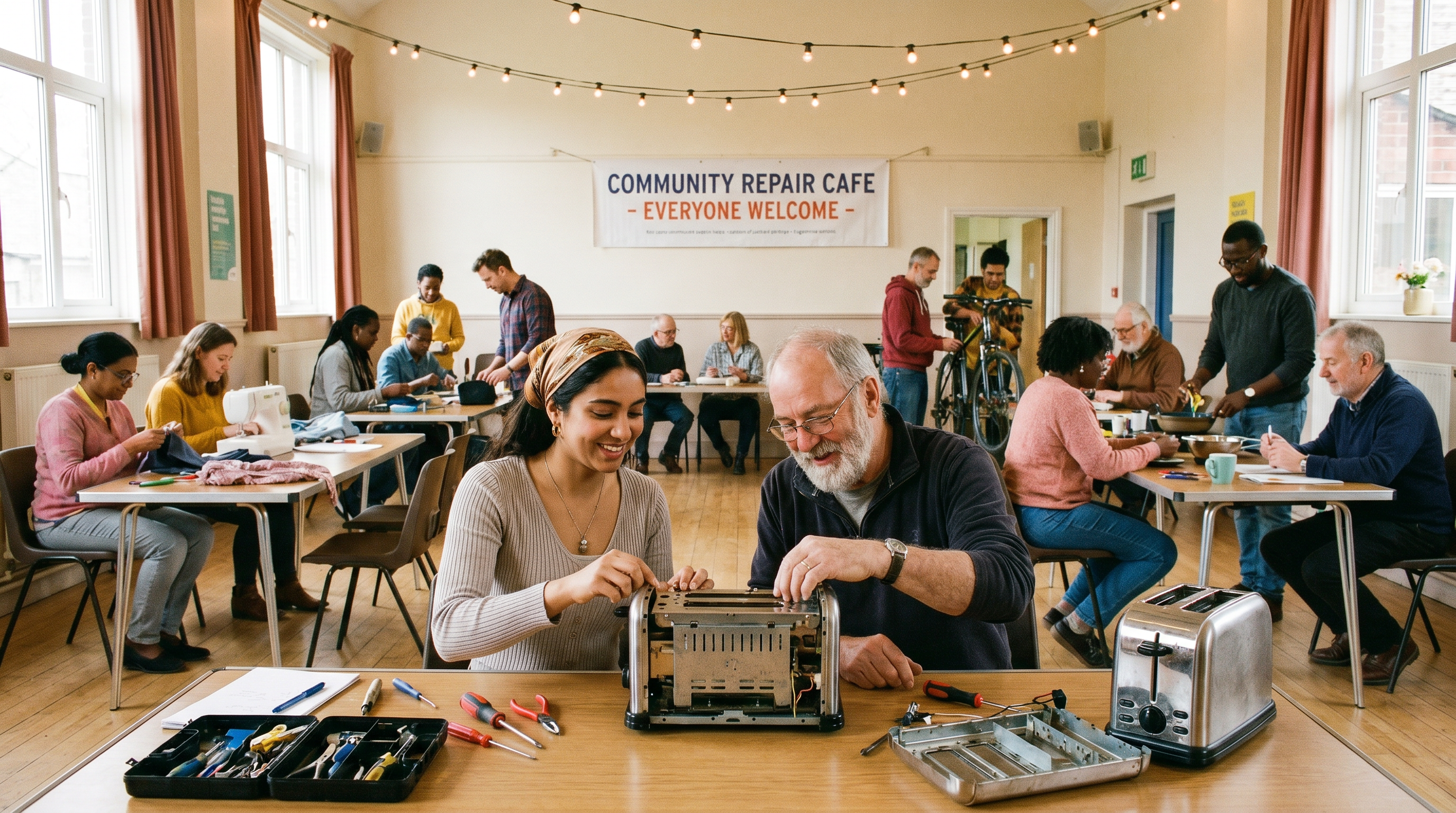
Welcome to the community center on a Saturday morning, where locals aren't gathering to throw away their weathered wares, but to resurrect them. People arrive carrying broken toasters, torn sweaters, wobbly chairs, and malfunctioning lamps. This is a "Repair Cafe," part of a rapidly expanding global network where skilled volunteers fix broken household items for free. What started as a niche environmental initiative has blossomed into a mainstream community movement aimed at combating a staggering global crisis. In our fast-paced, convenience-driven world, consumer goods are frequently discarded at the first sign of malfunction. Globally, electronic waste is one of the fastest-growing waste streams, generating over 62 million tonnes annually. Only a fraction of that e-waste—roughly 12 percent—is properly recycled. The rest ends up in landfills, leaking harmful metals and plastics into the environment, while the manufacturing of replacement goods drives up greenhouse gas emissions.[1][2][4]
The community repair movement offers a tangible, grassroots antidote to this throwaway culture. The concept was pioneered in 2009 by journalist Martine Postma in Amsterdam, and today, the Repair Cafe International Foundation tracks more than 4,000 locations worldwide, which collectively repair an estimated 850,000 items every year. The success rates at these local events are remarkably high. A recent Repair Cafe hosted by the University of Auckland saw skilled volunteers successfully fix 80 percent of the items brought in, ranging from electric scooters to jewelry. Similarly, organizers in Lambeth, UK, report safely fixing 91 percent of everything that comes through their doors. The most common items include lamps, kitchen appliances, and heaters—everyday objects that are often cheaper to replace than to have professionally repaired. By keeping these items in circulation, communities are directly reducing the demand for new raw materials and manufacturing.[1][2][3][4]
The items brought to these cafes often carry a value that far exceeds their financial cost. While many visitors arrive hoping to salvage an expensive vacuum cleaner or a vital space heater, others bring objects steeped in personal history. At a recent event in New York, one attendee brought in a family heirloom clock dating back to the 1930s; after several hours of meticulous work by a volunteer engineer, the clock was ticking again, drawing cheers from the room. Similarly, volunteers frequently mend moth holes in beloved sweaters or rewire vintage stereograms that have been in families for generations. This emotional dimension is a crucial driver of the movement. As researchers note, the repair process is not just about waste diversion; it is an act of care that honors the sentimental weight of our possessions, proving that not everything broken is destined for the scrap heap.[1][2][4]

The movement extends far beyond just fixing broken electronics; it has spawned a thriving sister initiative in the form of the community tool library. Operating much like traditional book libraries, these spaces allow community members to borrow expensive or rarely used tools for home DIY projects, gardening, and repairs. At the Station North Tool Library in Baltimore, for example, members have access to over 3,000 tools and dedicated workspaces. As organizers note, it is incredibly common for a first-time borrower to check out a $265 ladder just to reach a high ceiling fixture once. By sharing these resources, communities save money and prevent the manufacture of bulky items that would otherwise sit unused in a garage for years. Tool libraries democratize access to home maintenance, allowing renters and lower-income households to cultivate self-sufficiency and improve their living conditions without taking on financial burdens.[2][5]
Beyond the clear environmental and economic benefits, researchers are uncovering profound social impacts stemming from these initiatives. These spaces function as vital "third places"—environments outside of home and work where people can interact, learn, and build relationships. A 2024 report by researchers at University College London found that participating in community repair activities yields measurable mental health benefits. The collaborative environment fosters skills development, social inclusion, and a general sense of wellbeing. The atmosphere at these events is intentionally collaborative; retired engineers sit alongside young students, demystifying the repair process. Volunteers do not simply take an item and fix it behind a curtain. Instead, they sit with the owner, explain the fault, and teach them how to repair it themselves in the future. This hands-on education builds confidence and creates intergenerational connections that strengthen the social fabric of the neighborhood.[1][5][6]

Beyond the clear environmental and economic benefits, researchers are uncovering profound social impacts stemming from these initiatives.
Tool libraries and repair cafes also actively work to break down societal barriers and challenge traditional gender roles. Organizers report that these spaces provide a welcoming, non-judgmental environment for women, queer individuals, and novices who might otherwise feel intimidated in traditionally masculine hardware stores or commercial workshop settings. By prioritizing education and mutual aid over profit, these hubs strip away the gatekeeping often associated with trades and DIY work. If a member has a question about how to use a power drill or a sewing machine, volunteer librarians and fixers are there to help without judging anyone's baseline skill level. This inclusive approach ensures that the empowerment of learning to fix and build is accessible to the entire community, regardless of background or prior experience.[5][7]
The environmental stakes of overcoming these manufacturing barriers are immense. According to the United Nations Resource Panel, reusing and sharing products, rather than purchasing them new, can reduce greenhouse gas emissions by up to 99 percent for certain categories of goods. Producing new appliances requires the extraction of raw materials, energy-intensive manufacturing processes, and global transportation networks that heavily rely on fossil fuels. Repairing an existing product entirely bypasses this supply chain. When a community repair group successfully fixes a lawnmower or a laptop, they are not just saving the physical materials from a landfill; they are erasing the carbon footprint that would have been generated by manufacturing its replacement. This localized, low-tech approach to climate action empowers everyday citizens to make a measurable impact on global emissions without waiting for top-down corporate reform.[4][5][7]
Despite the grassroots success of these community hubs, volunteer fixers frequently run into systemic roadblocks that make their work unnecessarily difficult. Many modern appliances and electronics are deliberately manufactured with glued casings, proprietary screws, or software locks that prevent third-party intervention. Furthermore, manufacturers often refuse to sell spare parts to consumers, a practice widely criticized as planned obsolescence. When a perfectly functional blender must be thrown away simply because a small plastic gear cannot be replaced, the limitations of individual action become glaringly apparent. Fixers at repair cafes often have to get creative, using 3D printers or improvised solutions to bypass these artificial barriers, but the frustration on the repair tables highlights the need for broader systemic change in how consumer goods are designed and regulated.[1][4][7]

This frustration has fueled the broader "Right to Repair" political movement, which seeks to mandate that manufacturers design products that can be easily disassembled and repaired by consumers or independent shops. Progress is being made on the legislative front; the European Union passed a comprehensive Repair Directive in 2024, and several U.S. states have enacted similar laws targeting electronics, home appliances, and agricultural equipment. However, data from community repair events reveals that less than 4 percent of items currently brought in are covered by these new Right to Repair laws, as many of the broken goods are older models. This underscores the necessity for policymakers to be more ambitious, ensuring that legislation covers existing products and forces a true transition toward a circular economy where repairability is the default, not a luxury.[2][4][6]
Ultimately, the global rise of the community repair movement is about much more than just keeping a toaster out of a landfill or saving a few dollars on a home repair. It represents a fundamental shift in how communities view their relationship with the material world and with each other. By choosing to repair, borrow, and share, participants are actively rejecting a culture of disposable consumption and isolation. They are transforming themselves from passive consumers into active caretakers of their possessions. In a world increasingly defined by digital disconnection and environmental anxiety, the simple act of sitting across a table from a neighbor to fix a broken clock is proving to be a powerful tool for building resilience, sustainability, and hope.[1][6][7]
How we got here
2009
Journalist Martine Postma organizes the first official Repair Cafe in Amsterdam, sparking a global movement.
2013
The Station North Tool Library opens in Baltimore, helping popularize the tool-sharing model in the United States.
2022
Global electronic waste generation hits a record 62 million tonnes, highlighting the urgent need for repair and recycling initiatives.
2024
The European Union passes the comprehensive Repair Directive, a major legislative victory for the Right to Repair movement.
2026
The Repair Cafe International Foundation reports over 4,000 active locations worldwide, successfully repairing hundreds of thousands of items annually.
Viewpoints in depth
Community Fixers & Volunteers
Grassroots organizers who view repair as a tool for social connection and personal empowerment.
For the volunteers staffing tool libraries and repair cafes, the primary victory is often social rather than strictly environmental. They argue that modern society suffers from a profound lack of "third places" where people can gather without spending money. By teaching a neighbor how to rewire a lamp or safely operate a power drill, fixers believe they are building community resilience and breaking down barriers of isolation, age, and gender. The act of repairing is seen as a vehicle for transferring knowledge and fostering self-sufficiency.
Environmental & Circular Economy Advocates
Researchers and climate activists focused on the urgent need to divert e-waste and reduce manufacturing emissions.
This camp views the community repair movement through the lens of global resource management. With over 62 million tonnes of e-waste generated annually and only 12 percent properly recycled, they argue that extending the lifespan of consumer goods is a critical climate intervention. Every repaired vacuum cleaner or borrowed ladder represents a direct reduction in the raw materials mined and the greenhouse gases emitted to manufacture a replacement. They advocate for scaling these local initiatives into formalized municipal circular economy programs.
Right-to-Repair Policymakers
Legislators and consumer rights groups fighting against planned obsolescence at the corporate level.
While applauding grassroots efforts, this perspective argues that volunteer fixers cannot solve the e-waste crisis alone as long as corporations actively design unrepairable products. They point to glued casings, proprietary screws, and the restriction of spare parts as deliberate tactics to force new purchases. This camp focuses on passing binding legislation—like the EU's Repair Directive—that mandates repairability standards at the point of manufacture, ensuring that the burden of sustainability falls on the producers rather than solely on consumers.
What we don't know
- How quickly Right to Repair legislation will force major electronics manufacturers to redesign their products for easier consumer access.
- Whether municipal governments will begin formally funding and integrating community repair hubs into their standard waste management infrastructure.
- The long-term impact of 3D printing technology on the ability of local repair cafes to manufacture their own replacement parts for obsolete appliances.
Key terms
- Circular Economy
- An economic system aimed at eliminating waste and the continual use of resources by reusing, repairing, refurbishing, and recycling existing materials and products.
- E-waste
- Discarded electrical or electronic devices, which often contain hazardous materials that can leach into the environment if not properly recycled.
- Right to Repair
- A legislative movement advocating for laws that require manufacturers to make parts, tools, and repair manuals available to consumers and independent repair shops.
- Third Place
- A sociological term for social surroundings separate from the two usual social environments of home and the workplace, which are crucial for community building.
- Planned Obsolescence
- The practice of designing products to break quickly or become obsolete, ensuring that consumers will have to purchase new ones.
Frequently asked
What exactly is a Repair Cafe?
A Repair Cafe is a free community gathering where skilled volunteers help residents fix broken household items, such as electronics, clothing, and furniture, to prevent them from being thrown away.
How does a tool library work?
Similar to a traditional book library, a tool library allows community members to borrow expensive or rarely used tools—like power drills, ladders, or gardening equipment—usually for free or a small annual membership fee.
Can repairing items really impact climate change?
Yes. Extending the life of a product prevents it from entering a landfill and eliminates the greenhouse gas emissions and raw material extraction required to manufacture and ship a replacement.
What is planned obsolescence?
Planned obsolescence is a manufacturing strategy where products are deliberately designed with a limited lifespan or made difficult to repair, forcing consumers to buy replacements more frequently.
Sources
Source coverage
7 outlets
3 viewpoints surfaced







[1]Inside Climate NewsCommunity Fixers & Volunteers
A Growing Number of 'Repair Cafes' Are Popping Up Around the World to Curb Consumer Waste
Read on Inside Climate News →[2]Associated PressRight-to-Repair Policymakers
Community repair movement tackles inflation and e-waste
Read on Associated Press →[3]University of Auckland
Repair cafe a 'huge hit' with 80 percent success rate
Read on University of Auckland →[4]Green Network AsiaEnvironmental & Circular Economy Advocates
Community Repair: A Rising Trend Towards Circular Economy
Read on Green Network Asia →[5]Green AmericaCommunity Fixers & Volunteers
Tool Libraries Build Community and Cut Waste
Read on Green America →[6]Open Research AmsterdamEnvironmental & Circular Economy Advocates
Circular economy imaginaries through the analysis of community repair
Read on Open Research Amsterdam →[7]Factlen Editorial TeamRight-to-Repair Policymakers
Synthesis by Factlen editorial team
Read on Factlen Editorial Team →
Every angle. Every day.
Get community stories with full source coverage and perspective breakdowns delivered to your inbox.