
The Global Megaphone: How Television Broadcasts Transformed the FIFA World Cup
From the first grainy transmissions in 1954 to the vibrant color of 1970 and today's digital ecosystems, broadcast technology has turned the World Cup into humanity's largest shared experience.

Share this story
When the 2026 FIFA World Cup kicks off across the United States, Canada, and Mexico, billions of people will tune in through fiber-optic streams, 4K satellite feeds, and spatial computing headsets. The tournament has become a synchronous global heartbeat, a rare moment when a significant percentage of humanity focuses its attention on a single patch of grass. Yet, this unparalleled global reach is a relatively modern invention, born from decades of relentless technological innovation in sports broadcasting.[1][4]
For the first two decades of its existence, the World Cup was largely a localized experience, disseminated to the rest of the world through radio waves and delayed newsreels. When Uruguay hosted and won the inaugural tournament in 1930, fans who could not attend the matches relied on print journalists and telegraph updates. By the 1934 and 1938 editions, radio broadcasts had become the primary medium, allowing families to gather around wooden receivers to listen to crackling, impassioned commentary.[1][3]
Radio fundamentally changed the emotional relationship fans had with the national teams, turning distant athletes into household names. However, the true transformation of the World Cup from a popular sporting competition into a global cultural religion required the advent of the televised image. That monumental shift finally arrived in the aftermath of the Second World War, as television sets began to populate living rooms across Europe and the Americas.[3][4]
The 1954 World Cup in Switzerland marked the dawn of the television era for the tournament. The newly formed Eurovision network—a consortium of European public broadcasters—managed to transmit live images of eight matches to neighboring countries. The broadcasts were in grainy black-and-white, captured by heavy, immobile cameras that struggled to track the fast-paced movement of the ball.[1][3]
Despite the technical limitations, the impact was immediate and profound. An estimated four million people watched West Germany defeat Hungary in the 1954 final, a match famously dubbed the 'Miracle of Bern.' For the first time, fans outside the host nation could witness the tactical formations, the physical exertion, and the raw emotion of the players in real time. The visual medium proved intoxicating.[1][4]
By the 1966 World Cup in England, the broadcast infrastructure had matured significantly. The BBC and ITV utilized multiple camera angles, allowing for a more dynamic presentation of the matches. More importantly, 1966 saw the nascent use of videotape replay, a technology that would forever alter how sports were consumed. When Geoff Hurst scored his controversial goal in the final against West Germany, the ability to replay the footage—even if inconclusive—sparked global debates that endure to this day.[3]
If 1954 was the birth of the televised World Cup, 1970 in Mexico was its coming of age. The 1970 tournament is widely regarded by broadcast historians as the most important technological watershed in the history of sports media. It was the first World Cup broadcast live in color, and crucially, the first to be beamed globally via the Telstar satellite network.[2]
The shift to color television was revolutionary. The vibrant yellow shirts of the Brazilian national team, set against the lush green grass of the Estadio Azteca and the blazing Mexican sun, created an aesthetic that captivated the world. Pelé, Jairzinho, and Carlos Alberto were no longer just names on a radio or gray figures on a screen; they were vivid, larger-than-life icons performing on a brilliantly illuminated stage.[2][4]
Satellite technology meant that for the first time, audiences in South America, Europe, and parts of North America were watching the exact same images simultaneously. The 1970 World Cup proved that a live sporting event could command a truly global audience, laying the commercial and cultural groundwork for the modern mega-event. The tournament's visual legacy is so strong that the iconic Telstar match ball was designed specifically with black and white panels to stand out on television screens.[1]
Throughout the 1980s, the broadcast narrative became increasingly sophisticated. Directors learned to use the slow-motion replay not just as an officiating tool, but as a dramatic device. The beads of sweat on a player's forehead, the agonizing grimace of a missed penalty, the balletic grace of a bicycle kick—these moments were isolated, slowed down, and replayed to heighten the emotional stakes of the match.[3][4]
The 1986 World Cup, also held in Mexico, showcased the power of this narrative focus. Diego Maradona's infamous 'Hand of God' goal, and his subsequent 'Goal of the Century' against England, were captured from multiple angles and endlessly dissected on television screens worldwide. The broadcast had become the definitive record of truth, capable of elevating a player to mythical status in a matter of seconds.[2]
The 1990s introduced the digital revolution to the World Cup broadcast. On-screen graphics, which had previously been rudimentary and sparingly used, became a staple of the viewing experience. The continuous on-screen clock and score bug—innovations that seem entirely basic today—were revolutionary additions that allowed viewers to drop into a match at any moment and instantly understand the context.[3][4]
By the time France hosted the tournament in 1998, the FIFA World Cup had crossed a staggering threshold: cumulative global viewership was measured in the tens of billions, with the final alone drawing over a billion viewers. The broadcast operation had become a massive logistical undertaking, requiring host broadcasting services to lay thousands of miles of cable and coordinate dozens of camera operators per stadium.[1][2]
The turn of the millennium brought High Definition (HD) broadcasting, fundamentally changing the clarity and depth of the televised image. The 2002 World Cup in South Korea and Japan was the first to be produced entirely in digital HD, offering viewers unprecedented detail. This tournament also proved the resilience of the global broadcast model, as billions tuned in despite the challenging time-zone differences for European and American audiences.[1][4]
In recent tournaments, the broadcast has evolved from a passive viewing experience into an interactive and analytical ecosystem. The introduction of Spidercams—cameras suspended on cables that 'fly' over the pitch—provided video-game-like perspectives that immersed the viewer in the spatial geometry of the match. Tactical feeds, offering wide-angle views of all 22 players, became available for dedicated analysts and hardcore fans.[4]
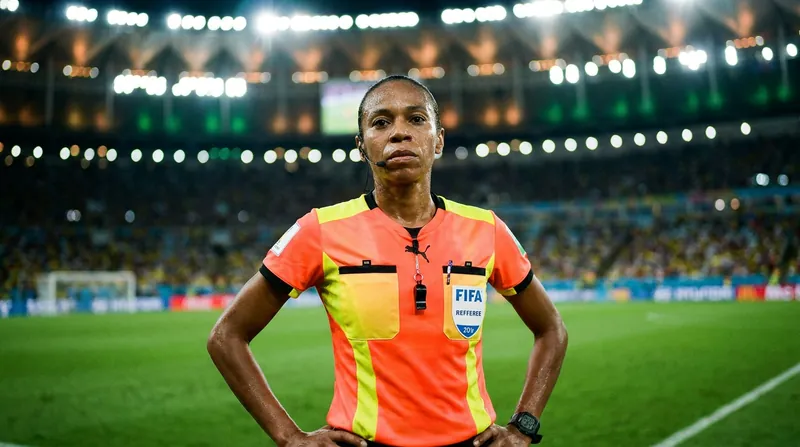
Perhaps the most significant recent development is how the broadcast technology has been integrated into the actual officiating of the sport. The implementation of the Video Assistant Referee (VAR) system in 2018 meant that the camera lenses were no longer just documenting the game; they were actively refereeing it. The broadcast booth and the referee's whistle became inextricably linked.[1][2]
By 2022, this integration reached new heights with semi-automated offside technology, which used dedicated tracking cameras and artificial intelligence to render 3D animations of offside decisions in real-time. These animations were then fed directly into the global television broadcast, turning complex data points into instantly digestible visual narratives for the home viewer.[2][4]
As the 2026 World Cup approaches, the broadcast landscape is undergoing another seismic shift. The traditional linear television model is rapidly giving way to streaming platforms, mobile consumption, and personalized viewing experiences. Fans can now choose their preferred commentary language, switch between camera angles on their tablets, and overlay real-time player statistics onto their screens.[3][4]
The sheer scale of the 2026 tournament—48 teams playing 104 matches across a continent-sized footprint—relies entirely on a cloud-based, decentralized broadcast infrastructure. The days of shipping massive physical tape reels across the Atlantic are long gone, replaced by instantaneous fiber-optic data transfers that can beam a goal from a stadium in Mexico City to a smartphone in Tokyo in milliseconds.[1][4]
Ultimately, the history of the World Cup is the history of its broadcast. The technology has not merely reflected the growth of the sport; it has actively catalyzed it. By transforming a local athletic contest into a vibrant, emotional, and globally accessible spectacle, television and digital media have ensured that the World Cup remains the undisputed pinnacle of shared human experience.[2][4]
Key points
- The 1954 World Cup in Switzerland was the first to be televised, reaching a few million European viewers.
- The 1970 tournament in Mexico revolutionized the sport with live, global color broadcasts via satellite.
- On-screen graphics like the time and score bug became standard in the 1990s, enhancing viewer accessibility.
- Modern broadcasts utilize over 40 cameras per match, including aerial Spidercams and tactical wide-angle lenses.
- Broadcast technology is now actively used in officiating through the VAR system and semi-automated offside tracking.
How we got here
1930
The inaugural World Cup in Uruguay is followed globally via telegraph and print newsreels.
1954
The Eurovision network broadcasts eight World Cup matches live to European television sets.
1966
Videotape replay is utilized during the World Cup in England, changing how controversial moments are viewed.
1970
The Mexico World Cup is broadcast live in color globally via the Telstar satellite network.
1998
The tournament in France crosses the one-billion viewer mark for the final, utilizing advanced digital graphics.
2018
The Video Assistant Referee (VAR) system is introduced, permanently linking the broadcast feed to on-field officiating.
- Broadcast Historians
- Focuses on the technological leaps, such as the 1970 satellite transmissions, that turned the tournament into a global cultural phenomenon.
- Tactical Analysts
- Values the evolution of wide-angle feeds, data integration, and high-definition clarity that allows for deep dissection of the sport.
- Football Traditionalists
- Appreciates the romanticism of early radio and television, while occasionally expressing concern over how modern broadcast technology like VAR interrupts the game's natural flow.
Perspectives this story doesn't cover
- Early radio commentators who pioneered sports broadcasting
- Engineers who laid the physical infrastructure for stadium broadcasts
Sources
Source coverage
4 outlets
3 viewpoints surfaced




- [1]FIFA Official ArchivesFootball Traditionalists
The Evolution of the FIFA World Cup Broadcast
Read on FIFA Official Archives → - [2]Journal of Global Sports MediaTactical Analysts
Transmitting the Beautiful Game: Satellite Technology and Global Fandom
Read on Journal of Global Sports Media → - [3]National Science and Media MuseumBroadcast Historians
The History of Sports Broadcasting and Television
Read on National Science and Media Museum → - [4]Factlen Editorial TeamTactical Analysts
Synthesis by Factlen editorial team
Read on Factlen Editorial Team →
More in Sports
See all →History
The Giant-Killers: The Anatomy and Evolution of the World Cup Upset
5 sources
History
The Tactical Metamorphosis: How the World Cup Forged Football's Greatest Formations
7 sources
History
The Canvas of Commerce: How the World Cup Mascot Evolved from a Five-Minute Sketch to a Billion-Dollar Empire
5 sources
History
The Athletic Arbiters: How the World Cup Referee Evolved from Amateur to Elite Athlete
3 sources
Comments
Every angle. Every day.
Get Sports stories with full source coverage and perspective breakdowns, free every day.