
The Food Science of the Fast-Food French Fry: How Chains Engineer the Perfect Crunch
The modern fast-food french fry is a marvel of food engineering, relying on precise starch retrogradation, chemical balancing, and a multi-stage thermal process to achieve its signature texture.
By Factlen Editorial Team
- Food Scientists & Engineers
- Focus on consistency, scale, and the precise thermal control required to replicate the product globally.
- Delivery Innovators
- Focused on modifying the fry's exterior structure to survive the humid environment of a delivery bag.
- Culinary Traditionalists
- Advocate for fresh-cut, minimally processed potatoes, prioritizing natural flavor over structural perfection.
What's not represented
- · Potato Farmers
- · Public Health Advocates
Why this matters
Understanding the science behind ultra-processed foods demystifies what we eat, revealing the incredible industrial engineering required to deliver identical culinary experiences to millions of people daily.
Key points
- Fast-food fries are engineered from Russet Burbank potatoes, chosen for their high starch and low moisture content.
- A hot water blanching process removes excess sugars and begins gelatinizing the exterior starches.
- Fries are dipped in dextrose for uniform browning and Sodium Acid Pyrophosphate to prevent gray discoloration.
- Flash-freezing is a mandatory culinary step that triggers starch retrogradation, ensuring a fluffy interior.
- The optimal 'hold time' for a standard fast-food fry is just seven minutes before internal moisture ruins the crust.
- Chains are now developing invisible starch 'clear coats' to keep fries crispy during 30-minute delivery transit times.
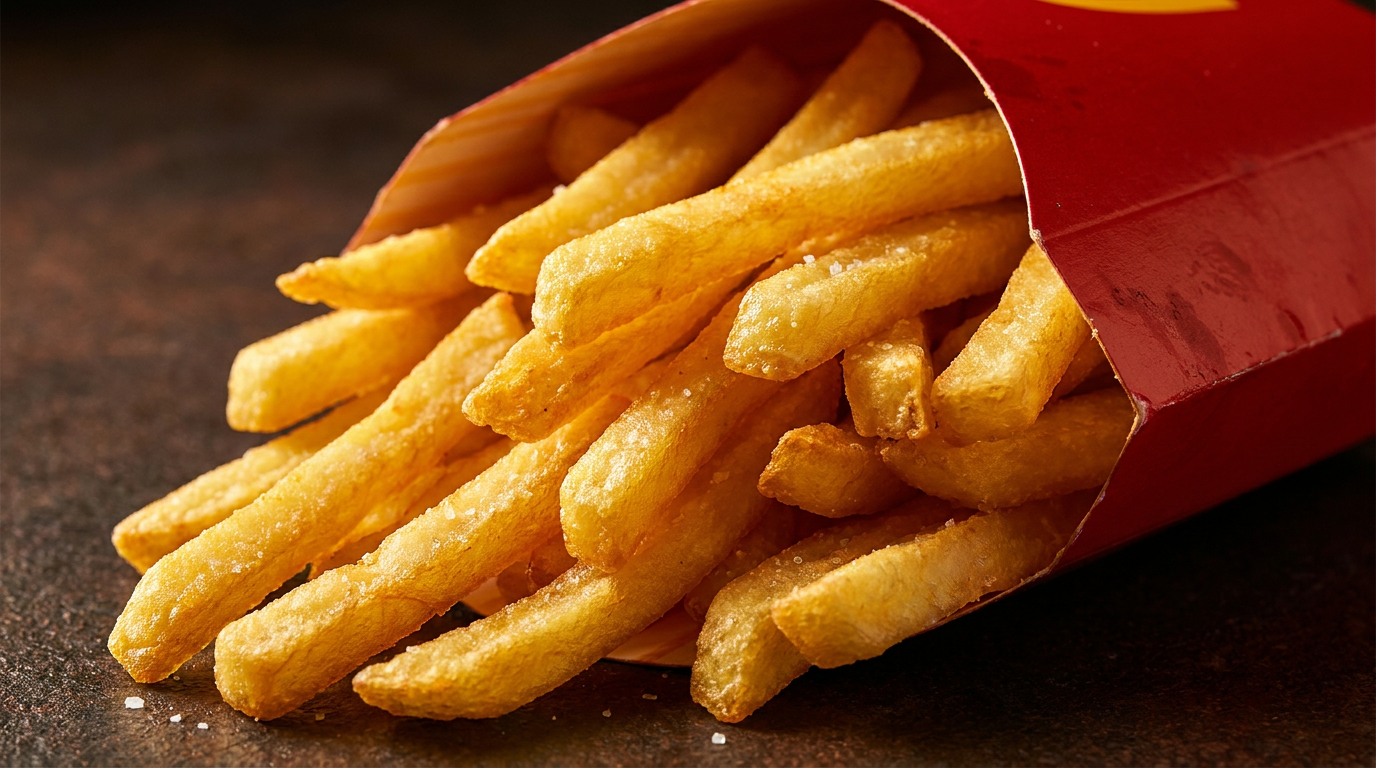
The modern fast-food french fry is a triumph of industrial engineering masquerading as a simple side dish. While the average consumer sees only a golden, salty sliver of potato, food scientists see a complex matrix of gelatinized starches, precisely calibrated moisture gradients, and carefully managed chemical reactions. Achieving the exact same crunch, interior fluffiness, and golden hue in tens of thousands of locations worldwide requires a manufacturing process that leaves nothing to chance.[4]
The journey begins long before the potato reaches the fryer, starting with the genetic selection of the tuber itself. The industry standard remains the Russet Burbank, a late-maturing variety prized for its unusually high starch content and low moisture. Moisture is the enemy of crispiness; a watery potato will steam from the inside out, resulting in a limp, soggy fry. By starting with a dense, starchy base, processors ensure the structural integrity needed to survive the violent thermal shocks to come.[1][3]
Once harvested, the potatoes are stored in massive climate-controlled facilities. Here, temperature management is critical. If potatoes get too cold, their starches convert into sugars. When these high-sugar potatoes hit hot oil, they undergo an accelerated Maillard reaction—the chemical process responsible for browning—resulting in fries that look burnt before they are fully cooked. Processors carefully monitor storage conditions to maintain the perfect starch-to-sugar ratio.[1][2]
At the processing plant, the potatoes are washed, peeled via high-pressure steam, and shot through water-propelled cutting grates at speeds exceeding 60 miles per hour. This creates the uniform shoestring shape essential for consistent cooking times. However, cutting the potato ruptures its cellular walls, releasing free starches and exposing naturally occurring sugars. If fried immediately, these raw sticks would brown unevenly and stick together in the fryer.[5]

To solve this, the raw fries undergo blanching—a precisely timed bath in hot water. Blanching serves multiple mechanical purposes. First, it washes away the excess surface sugars, creating a blank canvas for uniform browning. Second, it deactivates enzymes that cause discoloration. Most importantly, the hot water begins to gelatinize the starches on the exterior of the fry, swelling them into a sticky gel that will eventually form the crispy outer crust.[1][3]
Following the blanching process, the fries are subjected to a chemical dip that standardizes their appearance. Because natural sugar levels vary depending on the growing season and soil conditions, processors cannot rely on the potato's inherent chemistry for a consistent color. Instead, they bathe the fries in a weak solution of dextrose—a simple sugar. This microscopic coating of sugar guarantees that every fry will achieve the exact same golden-blonde hue when it finally hits the hot oil.[4][6]
Alongside the dextrose, the dip contains a crucial additive: Sodium Acid Pyrophosphate, or SAPP. Potatoes naturally contain iron, which can react with phenolic compounds during cooking to create an unappetizing gray or black discoloration. SAPP acts as a chelating agent, binding to the iron ions and preventing them from oxidizing. This ensures the fries remain bright and appetizing, even after months in deep freeze.[1][2]

After the chemical dip, the fries must be thoroughly dried. Any residual surface moisture would cause the temperature of the frying oil to plummet and create a barrier of steam, preventing the formation of a crust. Massive convection dryers blast the fries with hot air, removing a significant percentage of their water weight and shrinking the gelatinized exterior into a tight, leathery skin.[5]
Any residual surface moisture would cause the temperature of the frying oil to plummet and create a barrier of steam, preventing the formation of a crust.
Next comes the par-fry, a brief plunge into hot oil at the factory. This step is not meant to cook the potato entirely, but rather to set the exterior structure. The par-fry dehydrates the surface further and creates a rigid, microscopic sponge-like network on the crust. This network will eventually absorb just enough oil during the final fry to carry flavor, without allowing the oil to penetrate the fluffy interior.[3][6]
What follows is perhaps the most counterintuitive, yet essential, step in the entire engineering process: flash freezing. For decades, consumers assumed freezing was merely a logistical necessity for global distribution. In reality, freezing is a critical culinary step that fundamentally alters the potato's molecular structure.[4]
When the par-fried potatoes are blasted with sub-zero air, the moisture inside the fry turns into jagged ice crystals. These crystals puncture the potato's cellular walls, creating a softer, fluffier interior texture. More importantly, the freezing process triggers a phenomenon known as starch retrogradation. The gelatinized starches realign and crystallize, locking the fry's structure into place. Without this freezing step, the interior of the fry would turn gummy and dense.[2][3]

The frozen fries are then shipped globally, acting as dormant flavor delivery vehicles waiting for their final thermal shock. At the restaurant level, the cooking process is highly automated. The frozen fries are dropped directly into vats of oil heated to exactly 340 to 350 degrees Fahrenheit. The extreme temperature differential instantly vaporizes the remaining surface moisture, creating a violent bubbling action that crisps the exterior.[5][6]
The composition of the frying oil is just as engineered as the potato itself. Historically, major chains used beef tallow, which imparted a rich, savory flavor and a distinctively crisp texture due to its high saturated fat content. Following health campaigns in the 1990s, the industry shifted to vegetable oils. To replicate the lost flavor, scientists developed proprietary beef flavorings—often derived from hydrolyzed wheat and milk proteins—which are added directly to the oil blend.[3][4]
The oil also contains anti-foaming agents, such as dimethylpolysiloxane, which prevent the oil from bubbling over when the ice-cold fries are submerged. This ensures a safe working environment for employees and maintains the thermal efficiency of the fryers, allowing the oil to recover its temperature rapidly for the next batch.[1]
Once pulled from the oil, the fries enter their most vulnerable phase. They are immediately tossed with a precisely calibrated dose of salt. The timing here is critical: the salt must hit the fries while the surface oil is still hot and liquid, allowing the microscopic salt crystals to adhere perfectly to the crust. If salted even a minute too late, the salt will simply bounce off the dry exterior.[5]
The perfect fast-food fry has a shockingly short lifespan. Food scientists refer to this as the 'hold time,' which typically maxes out at seven minutes. As the fry cools, the steam trapped inside the fluffy interior begins to condense into water. This moisture inevitably migrates outward, softening the crispy exterior crust. Within ten minutes, the structural integrity collapses, leaving a limp, starchy shell.[2][4]

Today, the rise of food delivery apps has forced the industry into a new era of fry engineering. A product designed to be consumed within seven minutes cannot survive a thirty-minute ride in a humid delivery bag. In response, food scientists are developing new 'clear coat' batters—microscopic layers of potato starch and rice flour applied before the par-fry. These invisible coatings act as a moisture barrier, extending the crunch window by up to twenty minutes.[1][6]
Ultimately, the fast-food french fry is a masterclass in mass-market food science. It represents the perfect synchronization of agriculture, chemistry, thermodynamics, and logistics. By controlling every variable from the genetic makeup of the seed to the exact mineral content of the cooking oil, the industry has managed to turn a humble root vegetable into one of the most consistently replicated culinary experiences in human history.[4][6]
How we got here
1940s
The Russet Burbank potato becomes the industry standard due to its high starch and low moisture content.
1950s
Flash-freezing is introduced to the supply chain, inadvertently improving fry texture through starch retrogradation.
1990s
Major chains transition away from beef tallow to vegetable oils, introducing proprietary beef flavorings to compensate.
2020s
The rise of delivery apps prompts the development of invisible starch 'clear coats' to extend the fry's crunch window.
Viewpoints in depth
Food Scientists & Engineers
Focus on consistency, scale, and the precise thermal control required to replicate the product globally.
For industrial food scientists, the french fry is a triumph of mass-manufacturing. Their primary goal is eliminating the natural variability of agriculture. Because potatoes change their sugar content based on soil, weather, and storage temperature, engineers rely on blanching and dextrose dips to create a standardized baseline. They view the freezing process not just as a logistical tool, but as a mandatory structural step that forces starch retrogradation, ensuring the product behaves identically whether it is fried in Tokyo or New York.
Culinary Traditionalists
Advocate for fresh-cut, minimally processed potatoes, prioritizing natural flavor over structural perfection.
Traditional chefs and culinary purists often reject the highly engineered fast-food model. They argue that fresh-cut potatoes, fried twice (once at a lower temperature to cook the interior, and again at a high temperature to crisp the exterior), offer a superior, more authentic potato flavor. While they acknowledge that fresh-cut fries suffer from inconsistent browning and a shorter shelf life, they view the addition of dextrose, SAPP, and artificial beef flavorings as an unnecessary masking of the ingredient's natural profile.
Delivery Innovators
Focused on modifying the fry's exterior structure to survive the humid environment of a delivery bag.
With the explosion of third-party delivery apps, a new camp of food technologists has emerged, focused entirely on the 'hold time' problem. Because traditional fast-food fries turn soggy within ten minutes, these innovators are reformulating the product with invisible 'clear coats' made from modified potato starches, rice flour, and dextrins. These microscopic batters create an impermeable moisture barrier, sacrificing a small amount of traditional texture to guarantee the fry remains rigid after a thirty-minute transit.
What we don't know
- The exact proprietary chemical composition of the 'beef flavoring' used by major chains like McDonald's.
- Whether new clear-coat delivery batters will permanently replace the traditional fry recipe across all dine-in locations.
Key terms
- Maillard Reaction
- A chemical reaction between amino acids and reducing sugars that gives browned food its distinctive flavor and color.
- Starch Retrogradation
- A process where gelatinized starch molecules realign into crystalline structures upon cooling, which gives frozen fries their fluffy interior.
- Par-frying
- The process of partially frying food at the factory to set its exterior structure before it is frozen and shipped.
- Chelating Agent
- A chemical compound that binds to metal ions; used in fries to bind to iron and prevent discoloration.
- Clear Coat
- An invisible batter made of modified starches applied to fries to extend their crispiness during food delivery.
Frequently asked
Why do fast-food fries taste bad when reheated?
When fries cool, the moisture inside the fluffy core migrates to the dry crust, making it soggy. Reheating them in a microwave only steams them further; they must be reheated in an air fryer or oven to re-evaporate that moisture.
Why is sugar added to fast-food french fries?
A weak dextrose (sugar) solution is applied to ensure uniform browning. Natural potato sugar levels vary by season, so the dextrose dip guarantees every fry achieves the exact same golden color in the hot oil.
What is Sodium Acid Pyrophosphate (SAPP)?
SAPP is a safe food additive used as a chelating agent. It binds to the natural iron in the potato, preventing the fry from oxidizing and turning gray or black after it is cut and cooked.
Do fast-food fries still contain beef fat?
Most major chains stopped using beef tallow in the 1990s due to health concerns. Today, they use vegetable oil blends infused with proprietary, often plant-derived, 'beef flavorings' to replicate the original taste.
Sources
Source coverage
6 outlets
3 viewpoints surfaced






[1]Institute of Food TechnologistsFood Scientists & Engineers
The Processing of French Fries
Read on Institute of Food Technologists →[2]Journal of Agricultural and Food ChemistryFood Scientists & Engineers
Effect of Freezing on Starch Retrogradation in Potatoes
Read on Journal of Agricultural and Food Chemistry →[3]Serious EatsCulinary Traditionalists
The Burger Lab: How to Make Perfect Thin and Crisp French Fries
Read on Serious Eats →[4]Factlen Editorial TeamFood Scientists & Engineers
Synthesis by Factlen editorial team
Read on Factlen Editorial Team →[5]WiredDelivery Innovators
The High-Tech Quest to Build a Better French Fry
Read on Wired →[6]EaterCulinary Traditionalists
Why McDonald’s French Fries Are So Delicious
Read on Eater →
Every angle. Every day.
Get food drink stories with full source coverage and perspective breakdowns delivered to your inbox.