
The Evidence Pack: How Zoning Reforms in Auckland, Minneapolis, and Austin Are Successfully Lowering Rents
A growing body of empirical research confirms that cities eliminating restrictive zoning laws are seeing historic surges in housing supply and significant drops in rent prices.
By Factlen Editorial Team
- Housing Supply Economists
- Argue that restrictive zoning is the primary driver of the housing shortage and that unleashing private construction lowers costs across the board.
- Targeted Affordability Advocates
- Emphasize that while market-rate supply helps the middle class, upzoning must be paired with direct subsidies to help the lowest-income residents.
- Civic Policy Observers
- Focus on the political mechanics, local government implementation, and civic outcomes of passing sweeping land-use reforms.
What's not represented
- · Existing homeowners concerned about property values and neighborhood character
- · Local infrastructure planners managing the strain on water and transit systems
Why this matters
For decades, the assumption that new construction causes gentrification and higher rents has blocked housing development. This new empirical evidence proves the exact opposite: building more homes is the most effective way to lower rent and reduce homelessness.
Key points
- Auckland's 2016 decision to upzone 75% of its residential land resulted in rents for family homes dropping 22 to 35% compared to a no-reform scenario.
- Minneapolis eliminated single-family exclusive zoning and parking minimums, successfully growing its housing stock by 12% while keeping rent growth to just 1%.
- Austin added 120,000 new homes over the past decade, leading to a 16% drop in median rents between 2021 and 2026.
- Increased housing supply in Hennepin County, Minnesota, correlated with a 12% drop in homelessness, defying statewide trends.
- While upzoning significantly improves middle-class affordability, researchers note that direct public subsidies are still required to house extremely low-income renters.
For the better part of a decade, the housing affordability crisis has been the defining economic anxiety for the American middle class and a primary driver of poverty. Across the developed world, a chronic shortage of homes has pushed rents to record highs, locking a generation out of homeownership and accelerating homelessness. But a powerful counter-narrative is now emerging from a handful of cities that fundamentally rewrote their urban rulebooks.[9]
The thesis of the "YIMBY" (Yes In My Backyard) movement—that legalizing and building more housing of any kind will lower costs for everyone—is no longer just an economic theory. It has been rigorously field-tested. By tracking cities that passed sweeping zoning reforms, economists and policy researchers are compiling a robust evidence pack that points to a clear conclusion: supply-side reforms work.[6][9]
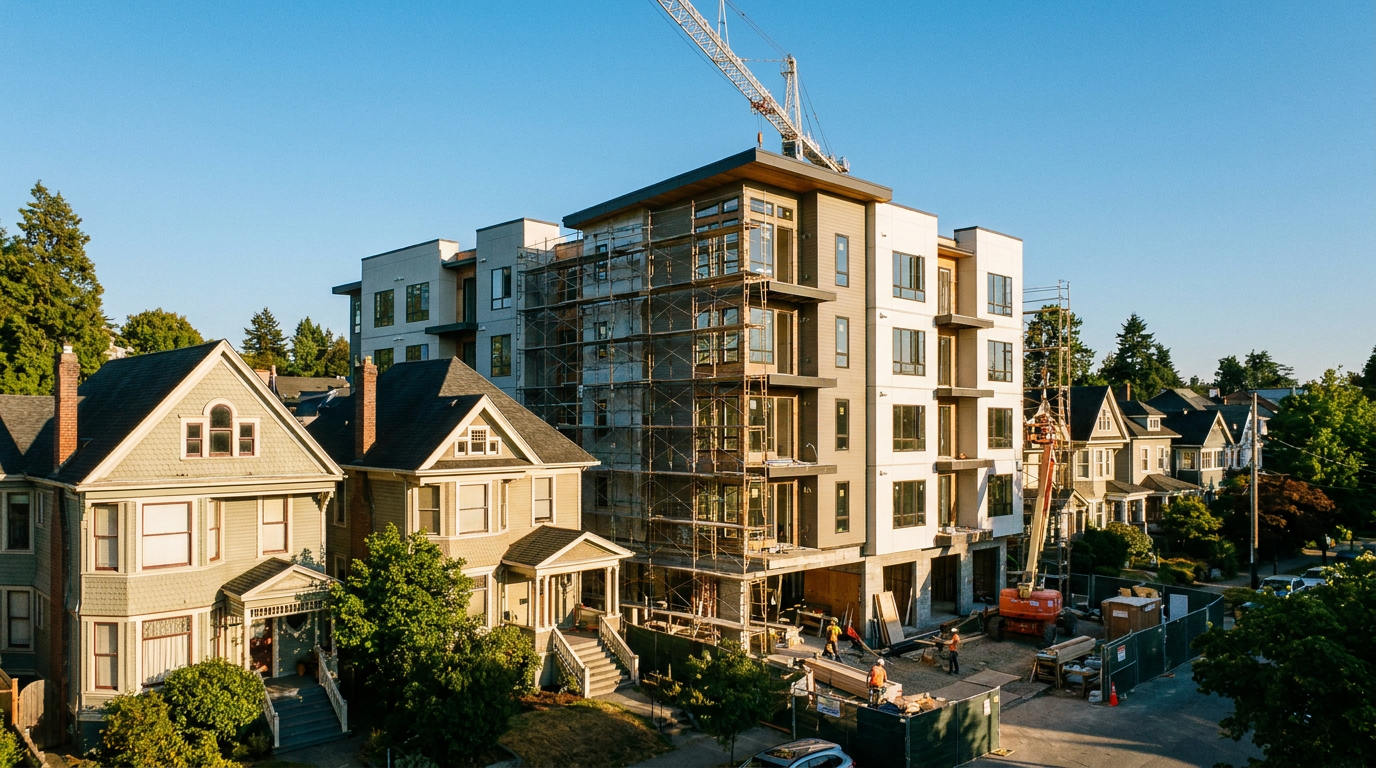
The evidence rests on three primary case studies—Auckland, Minneapolis, and Austin—where local governments systematically dismantled the regulatory barriers that made it illegal to build dense housing. These cities eliminated single-family exclusive zoning, abolished parking minimums, and allowed mid-rise apartments along transit corridors. The resulting data provides a rare, real-world look at the mechanics of housing supply and demand.[1][4]

The most comprehensive international evidence that upzoning directly and measurably increases housing construction comes from Auckland, New Zealand. In 2016, the city enacted a sweeping policy experiment, upzoning approximately three-quarters of its residential land to allow medium- and high-density housing where only detached homes were previously permitted.[2]
Researchers at the University of Auckland applied synthetic control methods to isolate the effect of this policy change. They found that the zoning reform directly precipitated a historic building boom, with housing construction surging to a record high of 12 consented dwellings per thousand residents by 2022. For the first time in a generation, Auckland's housing supply outstripped its population growth.[2]
A similar supply shock occurred in the United States. In Austin, Texas, a wave of pro-housing policy reforms and streamlined permitting helped the city add 120,000 new homes between 2015 and 2024. This represented a staggering 30 percent increase in the city's total housing stock, far outpacing the national average growth rate of 9 percent over the same period.[8]
In Minneapolis, which made national headlines in 2019 by becoming the first major U.S. city to end single-family zoning, the results were equally pronounced. A comprehensive study by the Pew Charitable Trusts found that between 2017 and 2022, Minneapolis increased its housing stock by 12 percent. By comparison, the rest of Minnesota added only 4 percent to its housing stock during that time.[1][3]

The central debate in housing policy has long been whether this new supply actively suppresses rent growth, or if building market-rate apartments only induces luxury demand. The empirical evidence from these upzoned cities strongly suggests that it does suppress rent, operating through a mechanism economists call "filtering."[6][9]
The empirical evidence from these upzoned cities strongly suggests that it does suppress rent, operating through a mechanism economists call "filtering."
In Auckland, six years after the upzoning policy was fully implemented, rents for three-bedroom family homes were between 22 and 35 percent lower than they would have been under a counterfactual scenario with no reform. Rents for two-bedroom dwellings were 14 to 22 percent lower than the synthetic control group, proving that the influx of new supply significantly enhanced affordability.[2]
The divergence in the American Midwest is even more striking. While Minneapolis grew its housing stock by 12 percent, its rents grew by just 1 percent over a five-year period. Meanwhile, in the rest of Minnesota—which maintained restrictive zoning—rents surged by 14 percent. In income-adjusted terms, rents in Minneapolis have actually dropped by more than 20 percent over the last seven years.[1][7]
Austin provides the most dramatic recent example of supply crushing prices. After experiencing some of the highest pandemic-era rent inflation in the country, the sheer volume of new apartments opening their doors forced landlords to compete for tenants. Between 2021 and 2026, Austin's median rent plummeted by 16 percent, bringing prices back to pre-pandemic levels in inflation-adjusted terms.[4][8]

Beyond the middle class, researchers are closely tracking how zoning reform impacts the most vulnerable populations. The most profound consequence of stabilizing rents is its impact on homelessness. According to Pew's analysis, homelessness in Hennepin County, which encompasses Minneapolis, dropped by 12 percent between 2017 and 2022. During that exact same window, homelessness rose by 14 percent in the rest of the state.[1][7]
However, researchers emphasize transparent uncertainty regarding the lowest income brackets. A study by the Urban Institute evaluated land-use reforms across 1,136 cities and confirmed that loosening restrictions reliably increases housing supply and significantly boosts the number of units affordable to middle- and higher-income renters.[5]
Yet, the Urban Institute found that the impact on units affordable to extremely low-income renters, while positive, was not statistically significant on its own. The evidence indicates that while the private market can solve the middle-class housing shortage, land-use reforms must be paired with direct public investments and rental subsidies to fully address the needs of the poorest households.[5]

Despite these successes, economists note there is a natural ceiling to how much the private sector will build. As rents fall and vacancy rates rise, the financial incentive for developers to break ground on new projects diminishes. In Austin, the pipeline of new construction is already beginning to thin out in 2026, as builders pull back in response to the very rent declines their previous projects caused.[4][9]
High interest rates further complicate the equation, making it expensive to finance new construction even when zoning allows it. This cyclical reality means that while zoning reform is a prerequisite for housing abundance, it does not guarantee a permanent state of hyper-construction. The market will only build until supply and demand reach a new, more affordable equilibrium.[8][9]
Despite these caveats, the macroeconomic consensus is solidifying. The National Bureau of Economic Research has published extensive literature demonstrating that in regions where housing is exceptionally expensive, restrictive zoning and land-use controls are the primary culprits. The physical cost of construction cannot explain the massive price premiums seen in highly regulated coastal cities.[6]

The evidence pack from Auckland, Minneapolis, and Austin provides a clear blueprint for policymakers. While it takes years for zoning changes to permeate the development ecosystem and translate into finished apartments, the causal link is now undeniable. Legalizing density does not just change the physical shape of a city; it fundamentally rewrites its economic future, proving that the housing crisis is a policy choice that can be unmade.[1][2][9]
How we got here
2016
Auckland, New Zealand implements sweeping zoning reforms, upzoning 75% of its residential land.
2019
Minneapolis becomes the first major U.S. city to vote to end single-family exclusive zoning.
2021
Minneapolis completely eliminates minimum parking requirements for new developments citywide.
2022
Auckland's housing construction surges to a record high of 12 consented dwellings per thousand residents.
2024
Austin's housing stock reaches a milestone of 120,000 new units added over the previous decade.
2026
Austin records a 16% drop in median rents from its pandemic peak, leading the nation in rent deflation.
Viewpoints in depth
Housing Supply Economists
The macroeconomic consensus that restrictive zoning artificially inflates the cost of living.
Economists and researchers from institutions like the NBER and the University of Auckland argue that the housing crisis is fundamentally a math problem created by artificial scarcity. By making it illegal to build dense housing on the majority of urban land, cities have forced a growing population to bid up the price of a static number of homes. This camp points to the synthetic control data from Auckland and the rent deflation in Austin as definitive proof that when the private market is unleashed from regulatory constraints, it will build enough supply to force landlords to compete for tenants, thereby driving down median rents across the entire metropolitan area.
Targeted Affordability Advocates
The argument that market-rate construction alone cannot house the poorest demographics.
While acknowledging that upzoning lowers median rents and helps the middle class, housing advocates and researchers at the Urban Institute caution against viewing deregulation as a silver bullet. They argue that the cost of land, labor, and materials means that new private construction will almost never be affordable to households earning below 30 percent of the area median income. From this perspective, YIMBY reforms are a necessary foundation, but they must be aggressively paired with direct public interventions—such as Section 8 vouchers, social housing construction, and robust tenant protections—to prevent the most vulnerable residents from falling through the cracks.
Civic Policy Observers
The focus on the political friction of passing and sustaining land-use reforms.
Policy analysts and local government observers highlight the immense political difficulty of enacting these changes. Upzoning often faces fierce resistance from existing homeowners who fear that increased density will alter neighborhood character, strain local infrastructure, and negatively impact their property values. This camp notes that Minneapolis's reforms were tied up in court battles for years, and Austin's progress required a concerted electoral shift to vote in pro-housing city council members. They emphasize that passing the laws is only the first step; sustaining the political will to keep them in place while waiting years for the construction pipeline to deliver results is the true civic challenge.
What we don't know
- How long the current construction boom in cities like Austin will last now that falling rents and high interest rates are compressing developer profit margins.
- Whether the political coalitions that passed these zoning reforms can survive the inevitable backlash from neighborhood preservationist groups over the long term.
- The exact threshold of new construction required in severely supply-constrained coastal cities like New York or San Francisco to achieve the rent deflation seen in the Midwest and Texas.
Key terms
- Upzoning
- The process of changing local zoning codes to allow for higher-density development, such as apartments or duplexes, on land previously restricted to smaller structures.
- Synthetic Control Method
- A statistical technique used by researchers to evaluate the effect of a policy by comparing the actual outcome to a mathematically constructed counterfactual scenario of what would have happened without the policy.
- Filtering
- The economic process where aging housing stock becomes more affordable over time as wealthier residents move into newly constructed market-rate units.
- YIMBY
- An acronym for 'Yes In My Backyard,' a pro-housing movement that advocates for increasing the supply of housing to lower costs and improve urban density.
- Parking Minimums
- Local laws requiring developers to provide a set number of off-street parking spaces for every new housing unit, which significantly increases the cost of construction.
Frequently asked
Does building luxury apartments lower my rent?
Yes, through a process called filtering. As wealthier renters move into new luxury units, they vacate older apartments, increasing supply and lowering prices across the broader market.
Why is my city's rent still going up if we are building?
Housing markets are regional, and it takes years for construction to catch up with deep historical deficits. If job growth and population influx outpace new building permits, rents will continue to rise.
Did Minneapolis abolish single-family homes?
No. The city abolished single-family exclusive zoning, meaning property owners are now legally allowed to build duplexes or triplexes on their lots, but existing single-family homes remain intact.
Will the private market build affordable housing for low-income earners?
Generally, no. Evidence shows that while upzoning lowers median rents, direct public subsidies and vouchers are still required to house extremely low-income residents.
Sources
Source coverage
9 outlets
3 viewpoints surfaced









[1]Pew Charitable TrustsHousing Supply Economists
Minneapolis Land Use Reforms Offer a Blueprint for Housing Affordability
Read on Pew Charitable Trusts →[2]University of AucklandHousing Supply Economists
Will Upzoning Deliver Housing Affordability for Everyone? Evidence from Auckland
Read on University of Auckland →[3]MPR NewsCivic Policy Observers
Minneapolis' contentious housing policy continues to draw national attention
Read on MPR News →[4]VoxHousing Supply Economists
How Austin's stunning drop in rents explains housing in America
Read on Vox →[5]Urban InstituteTargeted Affordability Advocates
Land-Use Reforms and Housing Costs: Does Allowing for Increased Density Lead to Greater Affordability?
Read on Urban Institute →[6]National Bureau of Economic ResearchHousing Supply Economists
Housing Supply and Housing Affordability
Read on National Bureau of Economic Research →[7]Route FiftyCivic Policy Observers
Do land-use reforms spur housing development? You betcha.
Read on Route Fifty →[8]Davis VanguardHousing Supply Economists
Austin Built Housing. Then Rents Fell.
Read on Davis Vanguard →[9]Factlen Editorial TeamHousing Supply Economists
Synthesis by Factlen editorial team
Read on Factlen Editorial Team →
Every angle. Every day.
Get real estate stories with full source coverage and perspective breakdowns delivered to your inbox.