
The Evidence Pack: How AI and Macro X-Ray Fluorescence Are Uncovering Art History's Hidden Masterpieces
By combining advanced chemical X-rays with deep neural networks, researchers are separating overlaid paint layers, authenticating brushstrokes, and resurrecting lost artworks hidden beneath famous masterpieces.
By Factlen Editorial Team
- Computational Art Historians
- Advocates for using AI and chemical imaging to establish objective, mathematical proof of authorship.
- Traditional Conservators
- Experts who value the new scanning tools but caution against over-relying on algorithmic inferences.
- Commercial Art Technologists
- Startups and collectives focused on resurrecting and commercializing lost artworks hidden beneath masterpieces.
What's not represented
- · Museum Curators
- · Art Market Appraisers
Why this matters
For centuries, art authentication relied on the subjective opinions of human experts, leaving the true authorship of many masterpieces in doubt. By combining chemical X-rays with artificial intelligence, researchers are now establishing an objective, mathematical record of art history—uncovering lost paintings and settling centuries-old debates without ever touching the canvas.
Key points
- Macro X-Ray Fluorescence (MA-XRF) allows conservators to map the chemical elements of a painting without taking physical samples.
- Traditional X-rays compress multiple layers of paint into a jumbled image, making complex works difficult to decipher.
- Neural networks can now separate these overlaid X-ray images, revealing hidden sketches and double-sided panels.
- Deep feature analysis algorithms can authenticate brushstrokes with up to 98% accuracy, identifying where studio assistants contributed to masterpieces.
- AI and 3D printing are being used to physically reconstruct lost paintings hidden beneath famous works, sparking ethical debates.
- Experts caution that AI is an assistive tool that provides statistical inferences, not a replacement for human art historians.
For centuries, the history of art has been limited by a fundamental physical constraint: the human eye can only see the topmost layer of paint. Masterpieces hanging in institutions like the Louvre, the Prado, or the Uffizi have long been treated as static, finished objects. We observe the final decisions of the artist, but the initial drafts, the structural mistakes, and the hidden collaborations remain locked beneath the surface. Because traditional analysis relies entirely on what is visible to the naked eye, historians have been forced to guess at how these iconic works actually came together, leaving massive gaps in our understanding of the creative process.[3]
But beneath the visible surface of many iconic works lies a hidden, three-dimensional archive of the artist's process. Throughout history, painters frequently reused canvases to save money on expensive materials, painted over entire compositions they ultimately abandoned, or collaborated with junior studio assistants whose specific contributions were never formally recorded. Unlocking these buried secrets has always been the holy grail of art conservation, as it allows researchers to trace the exact evolution of a painting from the first charcoal sketch to the final layer of varnish. Until recently, however, accessing that hidden history without destroying the artwork was nearly impossible.[6]
While traditional X-rays have been used by museums since the 1890s to peer beneath the paint, they suffer from a major technological limitation. When a standard X-ray penetrates a canvas with multiple dense layers of paint, or a wooden altarpiece panel that has been painted on both sides, it compresses all of that visual data into a single, jumbled grayscale image. For complex historical works, this results in a chaotic visual overlap that is nearly impossible for human conservators to decipher. The front and back images merge into an unreadable mess of shadows, obscuring the very details the X-ray was meant to reveal.[1][6]
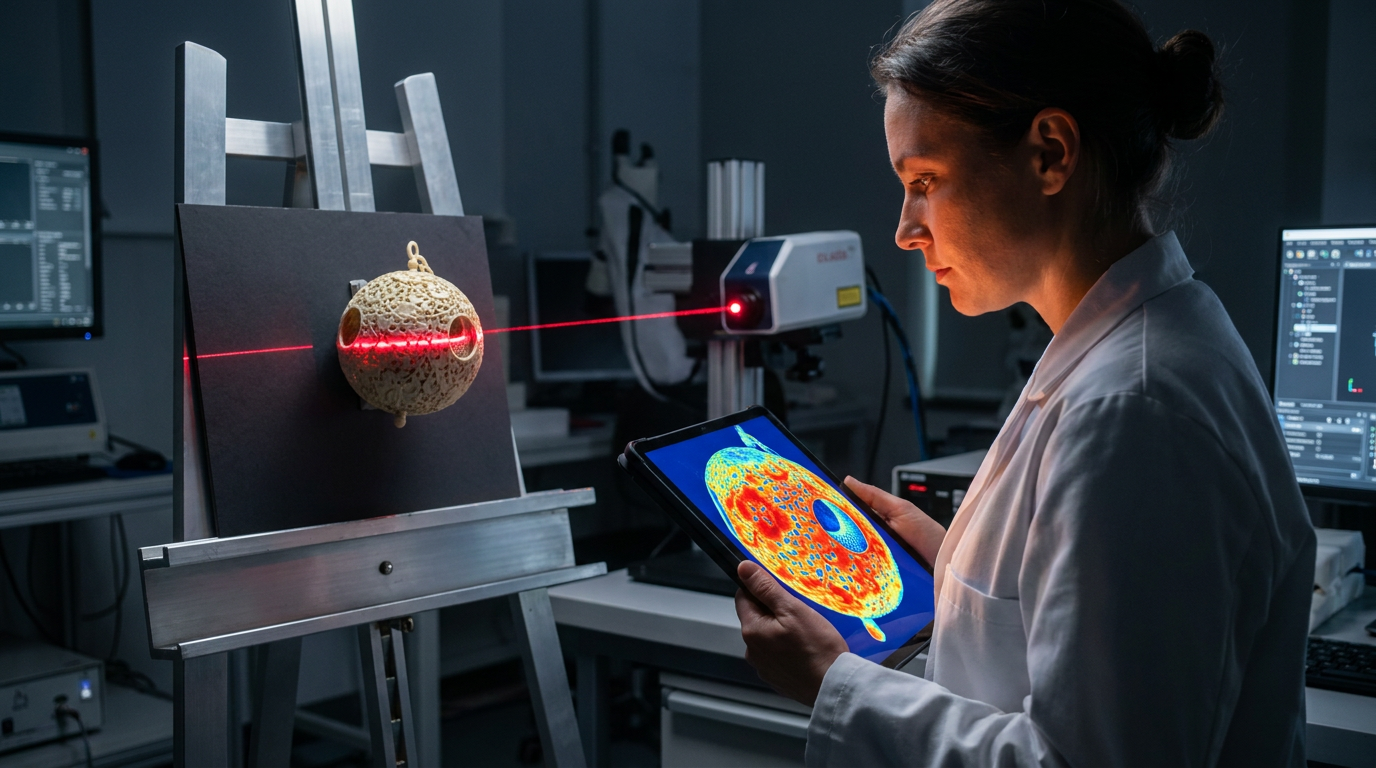
Now, a convergence of two cutting-edge technologies—Macro X-Ray Fluorescence (MA-XRF) and deep neural networks—is solving this problem. By combining advanced chemical imaging with artificial intelligence, researchers are effectively giving art historians a high-resolution medical scan of the world's most famous paintings. This dual approach is allowing scientists to separate overlaid images, authenticate individual brushstrokes, and even reconstruct lost artworks that haven't been seen in centuries.[3][4]

The mechanism begins with MA-XRF, a highly advanced, non-invasive scanning technique. The process involves bombarding a painting with X-rays, which causes the specific chemical elements within the historical pigments to emit their own secondary fluorescent light. Because the energy of the emitted light is unique to each element, the scanner can perfectly identify the chemical makeup of every millimeter of the canvas.[7]
Because different historical pigments rely on specific chemical elements—lead for white, mercury for red vermilion, and copper for green azurite—MA-XRF creates a highly detailed elemental map of the artwork. It allows scientists to see exactly where specific colors were applied, layer by layer, without requiring a single physical sample to be taken from the fragile canvas. This ensures the painting remains completely unharmed during the investigation.[3][7]
However, MA-XRF generates a staggering volume of data. A single scan of a large altarpiece can produce millions of distinct chemical spectra. For human analysts, manually sorting through this mountain of elemental data to reconstruct a coherent image is an overwhelming, if not impossible, task. The sheer density of the information requires a computational approach to make sense of the overlapping chemical signatures.[1][6]
This is where artificial intelligence enters the conservation studio. Researchers are training convolutional neural networks on massive synthetic datasets. By feeding the AI hundreds of thousands of authenticated Renaissance paintings and the chemical spectra of dozens of historical pigments, the models learn to recognize the precise material signatures and stylistic habits of different artists. The algorithm learns how a specific painter mixed their lead whites or layered their copper greens.[1][3]
These AI models act as a powerful translation layer. They can sift through the chaotic, overlaid X-ray data and mathematically separate the distinct layers of paint. By isolating the chemical signatures, the neural networks can reconstruct the hidden images with startling clarity, cleanly separating the final visible layer from the hidden drafts beneath it, or untangling the front and back of a double-sided panel.[1]
They can sift through the chaotic, overlaid X-ray data and mathematically separate the distinct layers of paint.
The power of this approach was recently demonstrated on the Ghent Altarpiece, a massive 15th-century polyptych by Hubert and Jan van Eyck. The altarpiece features wooden panels painted on both sides, which previously resulted in hopelessly tangled X-ray images that frustrated historians for decades. Every attempt to analyze the underlying sketches was thwarted by the visual interference of the opposing side.[1][6]

By applying a self-supervised neural network trained on high-resolution color images of the panels, researchers successfully separated the mixed X-ray data into two distinct, near-perfect images. The AI revealed the underlying sketches and structural changes made by the Van Eyck brothers, offering unprecedented insight into their creative process and allowing conservators to plan their physical restoration work with pinpoint accuracy.[1][6]
Beyond separating layers, AI is also revolutionizing art authentication through a technique known as deep feature analysis. A custom algorithm developed by researchers in the UK and the US was trained specifically on the authenticated brushstrokes, shading gradients, and color palettes of the Italian master Raphael. The model was designed to look at the microscopic depth and angle of the paint, rather than just the overall composition.[2][4]
When the team unleashed the algorithm on Raphael's 'Madonna della Rosa'—a painting whose exact authorship has been fiercely debated by scholars since the mid-1800s—the AI provided a definitive answer. The neural network confirmed that while the Madonna, the Child, and St. John were painted by Raphael, the face of St. Joseph was not. The machine settled a century of debate in a matter of minutes.[4][8]
The algorithm detected microscopic deviations in the brushwork and depth of St. Joseph's face, operating at a level of detail invisible to the human eye. This mathematical analysis strongly supported the long-held theory that the fourth face was completed by one of Raphael's studio assistants, likely Giulio Romano. It proved that AI could differentiate between a master and an apprentice working on the exact same canvas.[2][4]

In some cases, the technology is literally resurrecting lost art. Beneath Pablo Picasso's Blue Period masterpiece 'The Crouching Beggar', MA-XRF scans revealed the faint, ghostly outline of an entirely different landscape painting. Picasso had simply rotated a discarded canvas and painted his new subject directly over the old one, burying the original work for over a century.[5]
An art collective known as Oxia Palus used AI to analyze the hidden contours, matching them to the style of Santiago Rusiñol, a Catalan modernist and friend of Picasso. The AI then generated a full-color reconstruction of the lost landscape, which was subsequently 3D-printed with textured brushstrokes to match the original depth of the paint, bringing a lost piece of art history back into the physical world.[5]
Despite these massive breakthroughs, experts caution that AI is an assistive tool, not a wholesale replacement for human connoisseurship. The algorithms can only reconstruct missing colors or attribute brushstrokes based on the data they have been trained on, meaning their outputs are highly educated statistical inferences rather than absolute historical truths. The machine still requires a human historian to interpret the context of its findings.[4]

Furthermore, the use of AI to commercialize 'lost' artworks via 3D printing and digital tokens has sparked ethical debates within the conservation community. Many historians question whether it is appropriate to resurrect and sell an artist's discarded drafts, which the creator intentionally chose to paint over and hide from the world. It raises fundamental questions about an artist's right to edit their own legacy.[5]
Nevertheless, the integration of artificial intelligence and chemical imaging marks a profound shift in the discipline of art history. It is transitioning the field from subjective visual analysis and endless academic debate into the realm of objective, data-driven material science. Conservators now have the tools to prove what was previously only suspected.[7][8]
As these tools become standard in museums and conservation labs worldwide, the very definition of a masterpiece is expanding. Paintings are no longer viewed merely as the final image resting on the surface, but as deep, three-dimensional archives of human creativity, hesitation, and revision. The canvas has become a hard drive, and we finally have the technology to read the data.[3][6]
How we got here
1890s
Museums first begin using traditional X-rays to look beneath the surface of classical paintings.
2008
Researchers use early X-ray fluorescence to uncover a hidden portrait beneath a Van Gogh masterpiece.
2019
Scientists successfully use neural networks to separate the overlaid X-ray images of the Ghent Altarpiece.
2021
AI and 3D printing are used to physically reconstruct a lost landscape hidden beneath a Picasso.
2024
Deep feature analysis confirms that the face of St. Joseph in Raphael's Madonna della Rosa was painted by an assistant.
Viewpoints in depth
Computational Art Historians
Advocates for using AI and chemical imaging to establish objective, mathematical proof of authorship.
For computational scientists and progressive art historians, the integration of AI is a necessary evolution that moves art authentication out of the realm of subjective opinion. For centuries, attributing a painting to a specific master relied on 'connoisseurship'—the trained, but ultimately subjective, eye of an expert. By training neural networks to analyze the microscopic depth, angle, and chemical composition of individual brushstrokes, this camp argues that we can finally establish an objective, data-driven record of art history. They point to the resolution of the Madonna della Rosa debate as proof that algorithms can detect collaborative studio work that human eyes simply cannot see.
Traditional Conservators
Experts who value the new scanning tools but caution against over-relying on algorithmic inferences.
Traditional museum conservators widely embrace Macro X-Ray Fluorescence as a revolutionary, non-invasive tool that protects fragile artworks from physical sampling. However, they remain highly skeptical of treating AI reconstructions as absolute historical truth. This camp emphasizes that while a neural network can accurately map chemical elements, any full-color reconstruction of a hidden painting is ultimately an educated statistical guess based on the artist's other works. They argue that algorithms cannot capture the emotional intent, the specific lighting conditions of the studio, or the historical context of a piece, insisting that AI must remain a supportive tool rather than the final arbiter of authenticity.
Commercial Art Technologists
Startups and collectives focused on resurrecting and commercializing lost artworks hidden beneath masterpieces.
A new wave of art technologists sees AI not just as an analytical tool, but as an engine for creation and commercialization. Groups like the Oxia Palus collective are actively using neural networks and 3D printing to physically resurrect the lost paintings discovered beneath famous works, such as the landscape hidden under Picasso's The Crouching Beggar. This camp argues that bringing these discarded drafts into the physical world democratizes art history and allows the public to experience lost masterpieces. However, their practice of selling these AI-generated reconstructions—often accompanied by digital tokens—has sparked intense ethical debates about commercializing an artist's intentionally abandoned work.
What we don't know
- Whether AI reconstructions of lost paintings accurately reflect the original artist's intended color palette.
- How the widespread use of AI authentication will impact the financial valuation of debated masterpieces in the global art market.
- If future algorithms will be able to differentiate between a master's intentional stylistic shift and the work of a highly skilled forger.
Key terms
- Macro X-Ray Fluorescence (MA-XRF)
- A non-invasive scanning technique that uses X-rays to map the specific chemical elements present in a painting's pigments.
- Deep Feature Analysis
- An AI technique that examines images at a microscopic level, analyzing the depth, angle, and texture of individual brushstrokes to identify an artist's unique style.
- Polyptych
- A painting, typically an altarpiece, consisting of more than three panels joined by hinges or folds.
- Convolutional Neural Network (CNN)
- A type of artificial intelligence specifically designed to process and analyze visual imagery and recognize complex patterns.
- Pentimento
- An alteration in a painting, evidenced by traces of previous work, showing that the artist changed their mind during the creative process.
Frequently asked
Does the X-ray scanning process damage the paintings?
No. Macro X-Ray Fluorescence (MA-XRF) is entirely non-invasive. It maps the chemical composition of the paint using light, without requiring conservators to take physical samples or touch the canvas.
Can AI perfectly recreate a lost painting?
Not perfectly. While AI can map the physical contours and infer colors based on an artist's other works, the final reconstruction is an educated statistical guess rather than an exact replica of the original artist's intent.
Will AI replace human art authenticators?
Experts emphasize that AI is an assistive tool. Authentication still requires human experts to analyze a painting's provenance, historical context, and physical condition alongside the algorithm's data.
Sources
Source coverage
8 outlets
3 viewpoints surfaced








[1]Science AdvancesComputational Art Historians
Artificial intelligence for the separation of overlaid X-ray images
Read on Science Advances →[2]Heritage ScienceComputational Art Historians
Deep facial feature analysis for authenticating the Madonna della Rosa
Read on Heritage Science →[3]GizmodoTraditional Conservators
X-Rays and AI Reveal Lost Details in Famous Raphael Paintings
Read on Gizmodo →[4]ScienceAlertComputational Art Historians
AI Detects an Unusual Detail Hidden in a Famous Raphael Masterpiece
Read on ScienceAlert →[5]The Next WebCommercial Art Technologists
AI resurrects lost painting hidden under a Picasso masterpiece
Read on The Next Web →[6]Courthouse NewsTraditional Conservators
AI Reveals Long-Hidden Secrets of World's Art Masterpieces
Read on Courthouse News →[7]ForbesTraditional Conservators
How Chemistry And Art History Meet In The Museum
Read on Forbes →[8]TweakTownCommercial Art Technologists
AI discovers hidden details in famous painting that humans couldn't detect
Read on TweakTown →
Every angle. Every day.
Get culture stories with full source coverage and perspective breakdowns delivered to your inbox.