
The Evidence on Upzoning: Does Building 'Missing Middle' Housing Actually Lower Rents?
A growing body of empirical research from cities like Auckland and Minneapolis reveals that large-scale zoning reforms successfully increase housing supply and significantly slow rent growth.
By Factlen Editorial Team
- Supply-Side Reformers
- Argue that removing zoning barriers and increasing overall housing supply is the primary solution to affordability.
- Targeted Affordability Advocates
- Emphasize that market-rate supply must be paired with direct subsidies for low-income populations.
- Evidence Synthesis
- Evaluates the empirical outcomes of implemented policies to separate theoretical claims from actual results.
What's not represented
- · Local municipal officials managing infrastructure strain
- · First-time homebuyers priced out of current markets
Why this matters
For decades, the debate over housing affordability has relied on economic theory and localized anecdotes. Now, with a critical mass of cities having implemented large-scale zoning reforms, hard data is finally available to show exactly which policies successfully lower housing costs for residents.
Key points
- Auckland's 2016 upzoning of 75% of its residential land resulted in rents being 22-35% lower than projected counterfactuals.
- Minneapolis increased its housing stock by 12% between 2017 and 2022, keeping rent growth to just 1% despite national inflation.
- Reducing minimum lot sizes in Houston spurred the construction of 80,000 starter homes that cost 40% less than large-lot alternatives.
- Research confirms that adding market-rate housing relieves pressure on older, more affordable units, benefiting low-income renters.
- Upzoning is highly effective in strong markets but does not automatically trigger new construction in weak-market neighborhoods.
- Market-rate supply additions must still be paired with subsidies to adequately house the lowest-income populations.
The severe housing shortage across the developed world has pushed rents and home prices to record highs, prompting a desperate search for policy solutions that can deliver tangible relief to cost-burdened residents. For years, the conversation has been dominated by theoretical debates, but a new wave of empirical data is finally providing concrete answers.[1]
For decades, urban planners and economists have pointed to restrictive local zoning—specifically, the widespread legal banning of anything other than single-family detached homes—as the primary culprit behind the affordability crisis. By artificially capping the number of homes that can be built on a given plot of land, these regulations have severely constrained supply in high-demand areas.[4]
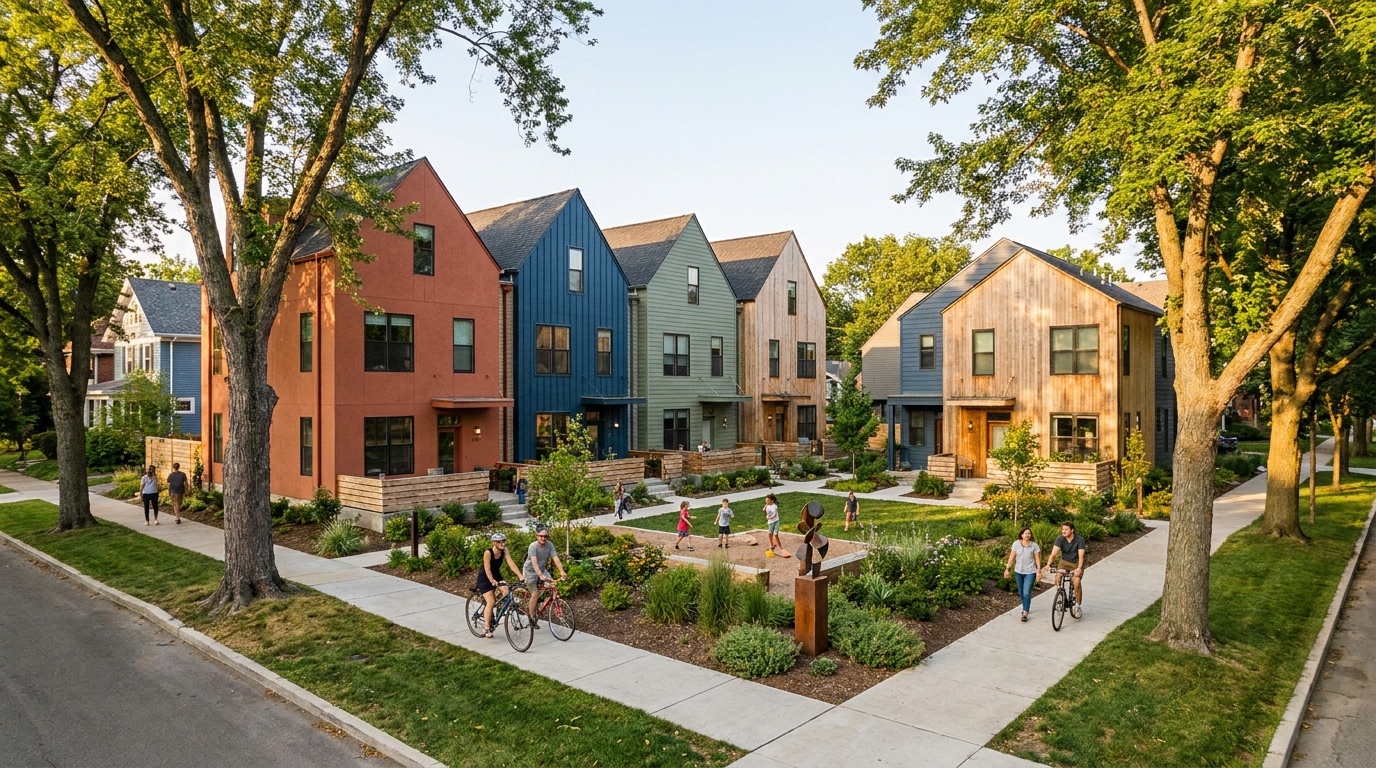
This realization has led to a growing, bipartisan movement to legalize missing middle housing. This category encompasses duplexes, triplexes, courtyard apartments, and townhomes—structures that bridge the density gap between sprawling single-family subdivisions and towering high-rise apartment complexes, offering a gentle increase in neighborhood density.[4]
Until recently, the debate over the efficacy of missing middle housing relied heavily on economic modeling rather than empirical data, simply because very few major cities had actually attempted large-scale zoning reform. Policymakers were essentially flying blind, hoping that deregulation would yield the promised affordability.[6]
That landscape has fundamentally changed. With early-adopter cities like Auckland, New Zealand, and Minneapolis, Minnesota, now several years into sweeping land-use reforms, economists finally have the rigorous, peer-reviewed data required to measure the real-world impact of upzoning on housing supply and rental costs.[5][6]
The most robust evidence regarding broad upzoning comes from the Southern Hemisphere. In 2016, the city of Auckland implemented the Auckland Unitary Plan, a landmark policy that upzoned approximately 75 percent of its residential land to allow for greater density by right.[2]
A comprehensive synthetic control study conducted by researchers at the University of Auckland evaluated the policy's impact six years post-implementation. The results were striking: the reforms triggered a historic construction boom, peaking at 12 consented dwellings per thousand residents in 2022, vastly outpacing neighboring regions.[2]
This unprecedented surge in housing supply had a profound and measurable impact on affordability. The researchers found that rents for three-bedroom dwellings in Auckland are now 22 to 35 percent lower than they would have been in a statistically constructed counterfactual scenario where the upzoning never occurred.[2][5]

In the United States, Minneapolis serves as the premier case study for how eliminating parking minimums and single-family mandates can stabilize costs. The city's 2040 Plan, enacted in 2020, made international headlines for effectively ending exclusive single-family zoning citywide, allowing triplexes on standard residential lots.[1]
In the United States, Minneapolis serves as the premier case study for how eliminating parking minimums and single-family mandates can stabilize costs.
However, researchers note that the city's success actually stems from a cascading series of reforms beginning as early as 2009. These foundational changes notably included the elimination of costly parking minimums for new developments, which drastically reduced the overhead costs of constructing multi-family housing near transit corridors.[1]
The empirical outcomes in Minneapolis have been remarkably positive. According to comprehensive data analyzed by The Pew Charitable Trusts, Minneapolis successfully increased its total housing stock by 12 percent between 2017 and 2022, a rate of growth that far outpaced its regional peers.[1]
During that same five-year period—an era characterized by rampant national inflation and skyrocketing housing costs across the United States—rents in Minneapolis grew by a mere 1 percent. This outcome vastly outperformed both the national average and neighboring Midwestern cities that maintained restrictive zoning codes.[1][5]

While density often conjures images of mid-rise apartment buildings, evidence from Texas demonstrates that land-use reform can also successfully revive the traditional starter home. Reducing minimum lot sizes is a proven catalyst for creating affordable, entry-level homeownership opportunities.[1]
When Houston reduced its minimum residential lot size requirement to just 1,400 square feet, developers responded enthusiastically by building 80,000 starter homes over the subsequent 25 years. These smaller-lot homes cost approximately 40 percent less than traditional large-lot houses, bringing homeownership back within reach for middle-income families.[1]

A common critique of new market-rate development is that it primarily yields luxury units that do not help working-class residents. However, recent macroeconomic analyses confirm the economic theory of filtering, demonstrating that broad regional supply additions relieve pressure on lower-income housing.[1]
Pew's research indicates that every 10 percent increase in a metropolitan area's housing stock is associated with a 5 percent reduction in overall rent growth. Crucially, this broad supply increase disproportionately benefits low-income renters by drawing high-income earners out of older, more affordable buildings, thereby reducing competition at the lower end of the market.[1]
Despite these documented successes, the data also reveals the limitations of zoning reform, highlighting areas where the evidence is weak or highly conditional. Upzoning is not a magic wand that instantly produces housing in all economic environments.[3]
Research from the Urban Institute highlights that upzoning in weak-market neighborhoods—areas with low existing rents and depressed property values—rarely triggers new construction. Developers still require a baseline level of market demand to secure bank financing and cover the hard costs of construction.[3]

Furthermore, empirical reviews consistently show that while adding market-rate supply improves overall affordability and slows rent growth, it is insufficient on its own to house the lowest-income populations. Direct financial subsidies and social housing programs remain absolutely necessary to support those facing deep poverty.[3][6]
Ultimately, the compiled evidence pack is clear: while it is not a standalone cure for all housing woes, legalizing missing middle housing and removing artificial regulatory barriers to construction is a highly effective, empirically proven foundation for stabilizing housing costs and expanding access to shelter.[6]
How we got here
2016
Auckland, New Zealand, implements the Auckland Unitary Plan, upzoning approximately 75% of its residential land.
2018
Minneapolis passes the 2040 Plan, becoming the first major U.S. city to vote to end exclusive single-family zoning.
2019
Oregon passes House Bill 2001, effectively banning single-family-only zoning in cities with over 10,000 residents.
2022
Housing construction in Auckland peaks at a record 12 consented dwellings per thousand residents.
2024
Pew Charitable Trusts releases data showing Minneapolis grew its housing stock by 12% while keeping rent growth to just 1% over five years.
Viewpoints in depth
YIMBYs and Urban Planners
Advocates for broad upzoning to increase housing supply and density.
The 'Yes In My Back Yard' (YIMBY) movement and many urban economists argue that the housing crisis is fundamentally a math problem: demand has vastly outpaced legally permissible supply. They point to the data from Auckland and Minneapolis as vindication of their core thesis. By removing artificial regulatory caps—such as single-family zoning mandates and parking minimums—cities can unleash private capital to build the homes people need, naturally stabilizing prices without requiring massive public expenditures.
Neighborhood Preservationists
Residents concerned about the impact of density on local infrastructure and character.
Many existing homeowners and local advocacy groups remain skeptical of sweeping upzoning policies. They argue that blanket density increases can alter the historic character of neighborhoods, strain local infrastructure like sewer systems and schools, and exacerbate street parking shortages. Furthermore, some preservationists argue that upzoning primarily enriches land speculators and developers, pointing to instances where older, naturally affordable homes are demolished to make way for expensive, market-rate townhomes.
Housing Equity Advocates
Focuses on the need for subsidized affordable housing alongside market-rate supply.
While acknowledging that increasing overall supply is beneficial, housing equity and anti-displacement advocates caution that market-rate construction is not a panacea. They emphasize the data showing that new supply alone does not reach the lowest-income brackets. This camp argues that zoning reform must be paired with robust tenant protections, anti-displacement measures, and significant public investment in subsidized, deeply affordable housing to ensure that vulnerable populations are not left behind in the push for density.
What we don't know
- How long it will take for newly implemented zoning reforms in other major cities to produce statistically significant impacts on regional rent prices.
- The exact threshold of upzoning required to trigger a market response in mid-sized or weak-market cities.
- The long-term impact of widespread upzoning on municipal infrastructure, such as water and transit systems, over a multi-decade horizon.
Key terms
- Upzoning
- Changing local zoning codes to allow for higher-density development, such as permitting duplexes or apartment buildings on land previously restricted to single-family homes.
- Missing Middle Housing
- A range of multi-unit or clustered housing types compatible in scale with single-family homes, such as townhouses, duplexes, and cottage courts.
- Synthetic Control
- A statistical method used by researchers to evaluate policy impacts by comparing a city that implemented a reform to a mathematically constructed 'synthetic' version of that city that did not.
- Filtering
- The process by which older housing becomes more affordable as higher-income residents move into newly constructed homes, freeing up existing units.
- Parking Minimums
- Local laws requiring developers to provide a specific number of off-street parking spaces per residential unit, which often significantly increases the cost of construction.
Frequently asked
What exactly is 'Missing Middle' housing?
Missing Middle housing refers to multi-unit residential buildings that fall between single-family homes and large apartment complexes. This includes duplexes, triplexes, townhomes, and courtyard apartments.
Did upzoning in Auckland actually lower rents?
Yes. Empirical research shows that six years after Auckland upzoned 75% of its residential land, rents for three-bedroom units were 22% to 35% lower than they would have been without the reforms.
Does building luxury apartments help low-income renters?
Evidence suggests it does. Building new market-rate housing absorbs high-income renters, which reduces competition for older, more affordable units—a process economists call 'filtering.'
Is zoning reform enough to solve homelessness?
No. While increasing the housing supply lowers overall costs, research consistently shows that direct subsidies and social housing are still required to support the lowest-income populations.
Sources
Source coverage
6 outlets
3 viewpoints surfaced






[1]Pew Charitable TrustsSupply-Side Reformers
Minneapolis Land Use Reforms Offer a Blueprint for Housing Affordability
Read on Pew Charitable Trusts →[2]University of AucklandSupply-Side Reformers
The Impact of Upzoning on Housing Construction in Auckland
Read on University of Auckland →[3]Urban InstituteTargeted Affordability Advocates
Land-Use Reforms and Housing Costs
Read on Urban Institute →[4]Reason FoundationSupply-Side Reformers
Missing middle housing policies
Read on Reason Foundation →[5]One Final EffortSupply-Side Reformers
The Impact of Prices and Rents: Auckland and Minneapolis
Read on One Final Effort →[6]Factlen Editorial TeamEvidence Synthesis
Synthesis by Factlen editorial team
Read on Factlen Editorial Team →
Every angle. Every day.
Get real estate stories with full source coverage and perspective breakdowns delivered to your inbox.