
The Evidence on Office-to-Residential Conversions: Costs, Viability, and Scale in 2026
A comprehensive review of 2026 data reveals that while office-to-apartment conversions have hit a record high, structural constraints and steep costs keep the strategy reliant on public subsidies.
By Factlen Editorial Team
- Commercial Developers
- Focuses on the financial viability, structural challenges, and acquisition costs of adaptive reuse.
- Urban Planners & Policymakers
- Views conversions as a vital tool for downtown revitalization and preventing urban decay.
- Housing Market Analysts
- Tracks the scale of the conversion pipeline and cautions against viewing it as a standalone affordability solution.
What's not represented
- · Existing commercial tenants who face displacement or endless construction noise as their partially-empty buildings are converted around them.
- · Suburban commuters whose transit networks may face funding cuts as downtowns shift from commercial tax bases to residential ones.
Why this matters
As remote work leaves downtown office towers permanently empty and the national housing shortage drives rents to record highs, adaptive reuse offers a rare dual-solution. Understanding the physical limits and true costs of these conversions reveals whether your city's downtown is destined for a vibrant residential renaissance or a prolonged economic 'doom loop'.
Key points
- The U.S. office-to-residential conversion pipeline reached a record 90,300 units in 2026, a 28% increase from the previous year.
- Despite the boom, only an estimated 14% of existing commercial office stock is structurally viable for residential adaptation.
- Deep floorplates and centralized plumbing make conversions highly complex, often costing between $100 and $500 per square foot.
- Experts warn that conversions will not single-handedly solve the housing shortage, but they are highly effective at revitalizing empty downtowns.
- Municipal tax incentives, such as New York's 467M program and Boston's abatement pilot, remain the critical deciding factor for project viability.
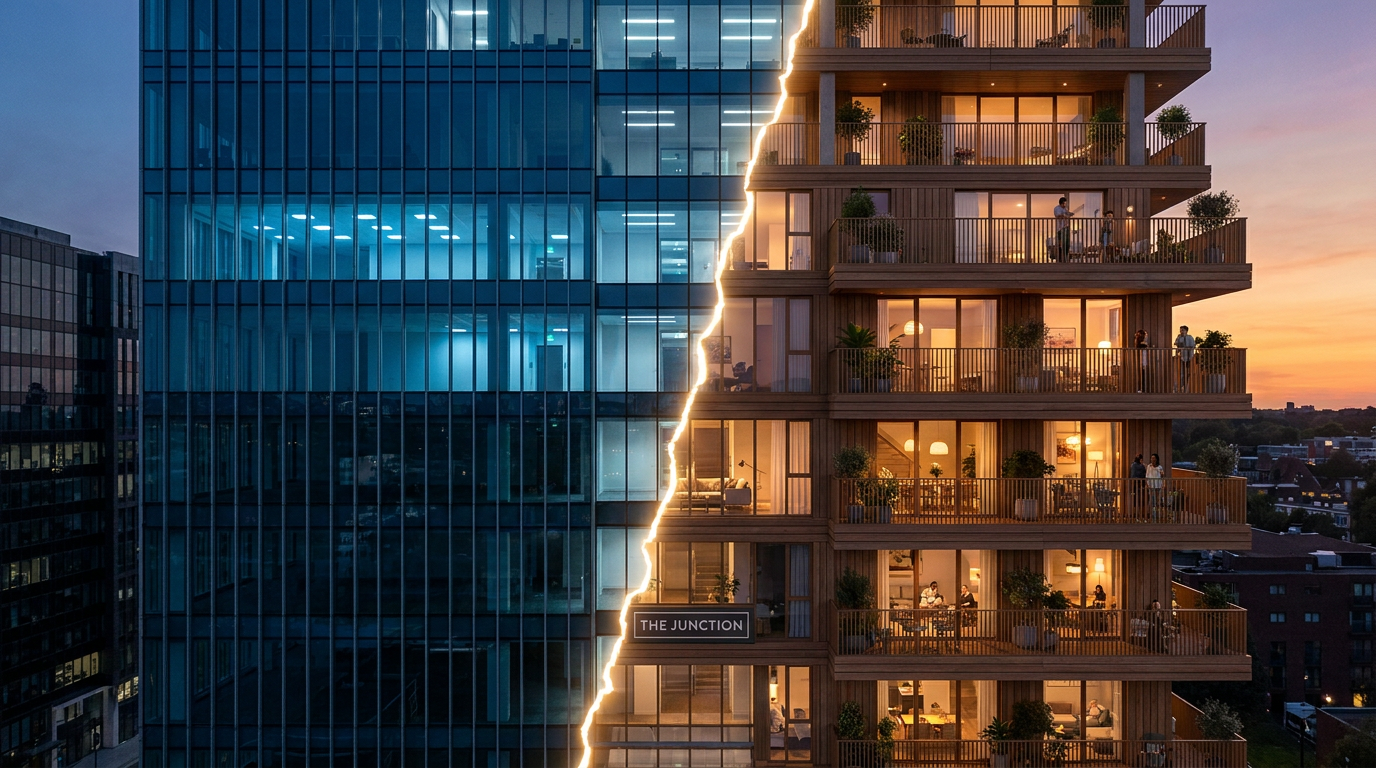
The collision of two generational real estate crises—record-high office vacancies and a severe national housing shortage—has transformed adaptive reuse from a niche architectural experiment into a market-defining trend. By mid-2026, the U.S. office vacancy rate surpassed 20%, leaving millions of square feet of commercial space underutilized in major urban centers. Simultaneously, cities are grappling with an affordability crisis driven by decades of underbuilding. In response, developers and policymakers have increasingly turned to office-to-residential conversions as a dual-purpose solution. This evidence pack examines the current data, structural limitations, and economic realities of the 2026 conversion boom, mapping the claims surrounding adaptive reuse against the latest market research and policy outcomes to separate the hype from the physical reality.[6]
Claim: The conversion pipeline is experiencing unprecedented growth. The evidence strongly supports this assertion. According to a March 2026 report by RentCafe, there are currently 90,300 apartment units in the office-to-residential conversion pipeline nationwide. This represents a 28% year-over-year increase and a staggering fourfold jump since 2022. Office conversions now account for nearly 47% of all planned adaptive reuse projects in the United States, outpacing the repurposing of hotels, factories, and warehouses. The momentum is largely concentrated in major metropolitan areas that suffered the steepest declines in return-to-office rates, with New York City, Washington, D.C., and Chicago leading the nation in planned units and active construction sites.[1][8]

The scale of individual projects has also expanded dramatically, moving far beyond boutique historic renovations. In Lower Manhattan, developers are executing the largest office-to-residential conversion in history at 25 Water Street. The former 1.1 million-square-foot office tower is being stripped to its structural skeleton, re-clad with a new window wall, and expanded vertically to create over 1,300 residential apartments. By achieving an 85% floorplate efficiency ratio—comparable to ground-up new construction—the project demonstrates that massive, obsolete commercial assets can be successfully repositioned into world-class residential properties when acquired at the right basis and engineered with precision.[2][7]
Claim: Adaptive reuse will solve the urban housing crisis. The evidence here is weak; conversions remain a niche solution rather than a panacea. While 90,300 units is a record high for the sector, it represents a fraction of the millions of homes needed to balance the U.S. housing market. Furthermore, the physical inventory available for conversion is highly constrained. Research from CommercialEdge indicates that fewer than one in six office properties across the U.S.—approximately 1.25 billion square feet, or just 14% of the country's total stock—are strong candidates for residential adaptation. The vast majority of modern office buildings simply do not possess the good bones required for a viable transition.[4]

A 2026 simulation by the Brookings Institution further contextualizes the impact of these projects. The report concluded that in most market contexts, office-to-residential conversion does not match the scale of the broader housing crisis and does little to improve citywide affordability unless paired with aggressive inclusionary zoning or low-income housing tax credits. However, the evidence shows that conversions are highly effective at placemaking. In cities like Pittsburgh and Houston, aggressive conversion strategies have the potential to double the downtown housing supply, fundamentally altering neighborhood dynamics, driving retail demand, and transforming 9-to-5 business districts into vibrant 24-hour communities.[3]
A 2026 simulation by the Brookings Institution further contextualizes the impact of these projects.
Claim: The physical and structural constraints of modern offices make conversions prohibitively difficult. The evidence strongly supports this, highlighting exactly why only 14% of buildings qualify. Post-1970s office towers were designed with massive, deep floorplates to maximize cubicle density. Residential building codes, however, require natural light and operable windows for every bedroom. Carving out the center of a massive office building to create a light well is structurally complex and destroys rentable square footage. Additionally, commercial buildings feature centralized plumbing and HVAC systems stacked around a central elevator core, whereas residential buildings require decentralized plumbing routed to hundreds of individual kitchens and bathrooms.[2][9]
Regulatory friction compounds these physical challenges, often threatening project viability. A May 2026 report from the D.C. Policy Center highlighted how local building codes and accessibility standards elevate costs without proportional risk reduction. Converting a commercial space to residential use triggers stringent new requirements for fire safety, egress routes, and seismic compliance. In London and major U.S. metros, building surveyors note that without rigorous, RICS-aligned protocols, developers frequently uncover hidden structural defects or asbestos contamination only after purchase, potentially adding 15% to 30% to projected conversion costs. The construction phase is often the easiest part; navigating the regulatory and structural labyrinth is where projects succeed or fail.[5][9]
Claim: Conversions are cheaper than new construction. The evidence is mixed and highly dependent on public subsidies. CBRE estimates that conversion and renovation costs range broadly from $100 to $500 per square foot, depending on the building's condition and local labor markets. In high-cost metros like New York City, developers consistently report conversion rates at the top end of that spectrum, hovering between $300 and $500 per square foot. While reusing an existing structure can sometimes yield housing 20% to 30% cheaper than ground-up development, the massive capital required for new plumbing, HVAC, and facade replacement means these projects rarely pencil out based on free-market rents alone.[2][8]

Because the financial margins are so tight, the evidence shows that tax incentives are the deciding factor in whether a conversion is viable. Cities that have successfully catalyzed adaptive reuse have done so through aggressive policy intervention. Boston's highly successful pilot program offered developers a 75% property tax abatement for up to 29 years, resulting in double the city's original annual unit goal. Similarly, New York's new 467M program offers substantial tax abatements in exchange for dedicating 25% of the converted units to affordable housing, while Washington, D.C., introduced a 20-year tax abatement program for downtown conversions to stop the bleeding of commercial tax revenue.[2][7][8]
Uncertainty: Can the momentum survive without permanent subsidies? The primary unknown in 2026 is whether the adaptive reuse boom can sustain itself if municipal tax incentives expire or if distressed office valuations begin to recover. Currently, developers are acquiring obsolete Class B and C office buildings at steep discounts—sometimes 80% below their 2019 peaks. This adaptive reuse arbitrage relies on a specific macroeconomic window: distressed acquisition costs combined with government subsidies. If office values stabilize or cities pull back their tax abatements due to fiscal pressure, the financial math for conversions could quickly deteriorate, stalling the pipeline.[6][7]

The trajectory of mortgage and interest rates will also dictate the sector's future. As the 30-year fixed mortgage rate dips below the critical 6% threshold in mid-2026, capital is selectively flowing back into commercial real estate. However, institutional investors are demanding a flight to quality, shunning obsolete assets in favor of specialized industrial, digital infrastructure, and multifamily housing. For adaptive reuse to remain a dominant strategy, developers must continue to prove that they can execute these highly bespoke, complex projects efficiently, turning the stranded assets of the remote-work era into the premium housing of the future.[6]
How we got here
March 2020
The onset of the COVID-19 pandemic triggers a massive shift to remote work, emptying urban central business districts.
Late 2022
Office vacancy rates begin to permanently stabilize at record highs as hybrid work becomes entrenched, plummeting commercial property valuations.
2023–2024
Major cities like Boston and Washington, D.C., launch aggressive tax abatement pilot programs to incentivize developers to convert empty offices.
2025
New York introduces the 467M program, offering tax breaks for conversions that include a 25% affordable housing mandate.
Mid-2026
The national conversion pipeline hits a record 90,300 units, representing a 400% increase since 2022.
Viewpoints in depth
Commercial Developers
Focuses on the financial viability, structural challenges, and acquisition costs of adaptive reuse.
For developers, the office-to-residential transition is an exercise in arbitrage and risk management. They argue that while the demand for housing is infinite, the capital required to gut a commercial building—often $300 to $500 per square foot in major metros—makes most projects unfeasible without steep discounts on the initial purchase price. Developers emphasize that modern office floorplates are fundamentally hostile to residential layouts, requiring massive structural interventions like coring out light wells. Consequently, they view municipal tax abatements not as a bonus, but as a mandatory prerequisite to secure financing.
Urban Planners & Policymakers
Views conversions as a vital tool for downtown revitalization and preventing urban decay.
City planners approach adaptive reuse through the lens of 'placemaking' and municipal tax revenues. With remote work permanently depressing commercial property values, planners warn of a 'doom loop' where empty downtowns lead to plummeting tax receipts and failing local retail. They argue that injecting thousands of residents into former business districts transforms 9-to-5 monocultures into vibrant, 24-hour neighborhoods. For policymakers, subsidizing these conversions through tax breaks is a necessary investment to stabilize the urban core, even if it doesn't single-handedly solve the broader affordable housing crisis.
Housing Advocates
Cautions that luxury conversions do little to solve the affordability crisis without strict inclusionary zoning.
Housing advocates maintain a skeptical view of the adaptive reuse boom, pointing out that the vast majority of converted units are priced at market or luxury rates to offset high construction costs. They argue that simply adding high-end inventory to downtowns does not help the working-class renters most affected by the housing shortage. This camp strongly advocates for policies like New York's 467M program, insisting that any public tax subsidies given to developers must be explicitly tied to strict inclusionary zoning requirements, ensuring that at least 20% to 25% of the new units are permanently affordable.
What we don't know
- Whether the pace of conversions will collapse if municipal tax abatement programs are allowed to expire.
- How the influx of thousands of new residents will permanently alter the retail and transit needs of traditionally 9-to-5 central business districts.
- If future innovations in architectural engineering will make the remaining 86% of 'unviable' office buildings cheaper to convert.
Key terms
- Adaptive Reuse
- The process of repurposing an existing building for a use other than what it was originally designed for, such as turning an office tower into an apartment complex.
- Floorplate
- The total leasable square footage of a single floor in a commercial building; deep floorplates make it difficult to get natural light into residential bedrooms.
- Inclusionary Zoning
- Municipal policies that require a certain percentage of new construction to be affordable to people with low to moderate incomes.
- Light Well
- An unroofed external space provided within the volume of a large building to allow light and air to reach what would otherwise be a dark interior.
- Class B and C Office Space
- Older, less desirable commercial buildings that lack modern amenities, making them prime candidates for vacancy and subsequent conversion.
Frequently asked
Can any empty office building be turned into apartments?
No. Research shows that only about 14% of U.S. office buildings are structurally viable for residential conversion, largely due to deep floorplates that prevent natural light from reaching interior rooms.
Are converted apartments cheaper to rent?
Generally, no. Because the cost of gutting and retrofitting commercial buildings is so high (often $300 to $500 per square foot), developers typically price the resulting apartments at market or luxury rates to recoup their investment.
Why do developers need tax breaks to do this?
The financial margins on adaptive reuse are incredibly tight. Without municipal tax abatements, the cost of installing decentralized plumbing, new HVAC systems, and altering facades often exceeds the potential rental income.
Which cities are leading the conversion trend?
New York City, Washington, D.C., and Chicago currently have the largest pipelines of office-to-residential conversions, driven by high office vacancy rates and aggressive local policy incentives.
Sources
Source coverage
9 outlets
3 viewpoints surfaced









[1]RentCafeHousing Market Analysts
Adaptive Reuse Report 2026: Office-to-Residential Conversions Hit Record 90,300 Units
Read on RentCafe →[2]CBRECommercial Developers
U.S. Real Estate Market Outlook 2026
Read on CBRE →[3]Brookings InstitutionUrban Planners & Policymakers
The promises—and realities—of converting offices into housing
Read on Brookings Institution →[4]CommercialEdgeCommercial Developers
Office-to-Residential Conversion Viability Report
Read on CommercialEdge →[5]D.C. Policy CenterUrban Planners & Policymakers
Breaking the scarcity-subsidy cycle: A new housing vision for the District of Columbia
Read on D.C. Policy Center →[6]Factlen Editorial TeamUrban Planners & Policymakers
Synthesis by Factlen editorial team
Read on Factlen Editorial Team →[7]KBSCommercial Developers
How the Office-to-Residential Boom May Ease New York City's Housing Shortage
Read on KBS →[8]CaliberCommercial Developers
Rising Trend of Office Space Conversion to Multifamily Residential Units
Read on Caliber →[9]Prince SurveyorsCommercial Developers
Building Survey Protocols for Office-to-Residential Conversions: Spotting Risks in 2026
Read on Prince Surveyors →
Every angle. Every day.
Get real estate stories with full source coverage and perspective breakdowns delivered to your inbox.