
The End of the Cloud Dependency: How On-Device AI is Rewriting Personal Computing in 2026
Breakthroughs in neural processing hardware and model compression have brought powerful AI directly to phones and laptops, eliminating cloud latency and securing user privacy.
By Factlen Editorial Team
- Hardware Ecosystem Builders
- Tech giants view on-device AI as a hardware supercycle, using strict NPU requirements to drive device upgrades.
- Privacy & Compliance Advocates
- Value local AI primarily for keeping sensitive data on-device and avoiding regulatory risks associated with cloud processing.
- Independent App Developers
- Focused on eliminating API costs, reducing latency, and utilizing cross-platform SDKs for offline functionality.
- Open-Source AI Community
- Prioritize small model optimization and democratized access across older hardware, rather than strict NPU exclusivity.
What's not represented
- · Cloud infrastructure providers losing API revenue
- · Users with older hardware unable to access local AI features
Why this matters
By moving artificial intelligence from remote data centers directly onto your personal devices, local AI eliminates the frustrating lag of cloud processing, guarantees that sensitive data never leaves your hardware, and drastically reduces the subscription costs associated with API calls.
Key points
- On-device AI shifts processing from cloud servers to local hardware, eliminating latency and ensuring data privacy.
- Neural Processing Units (NPUs) have become a standard component in modern chips, alongside CPUs and GPUs.
- Small Language Models (SLMs) are compressed using quantization to fit within the limited RAM of smartphones.
- Apple Intelligence integrates AI deeply into the OS, using Private Cloud Compute for heavy tasks.
- Microsoft's Copilot+ PC standard requires 40 TOPS of NPU performance and 16GB of RAM.
- Local AI fundamentally changes the economics of app development by eliminating per-request cloud API costs.
For the past three years, artificial intelligence has operated on a simple, restrictive premise: your data leaves your device, travels to a massive data center, gets processed, and returns. This cloud-first model fueled the generative AI boom, but it introduced a host of compromises. Every interaction carried a latency penalty of 200 to 800 milliseconds, rendering real-time voice conversations unnatural and frustrating. More importantly, it required users to hand over their most sensitive personal and corporate data to third-party servers, creating a single point of dependency and a massive privacy liability.[1][6]
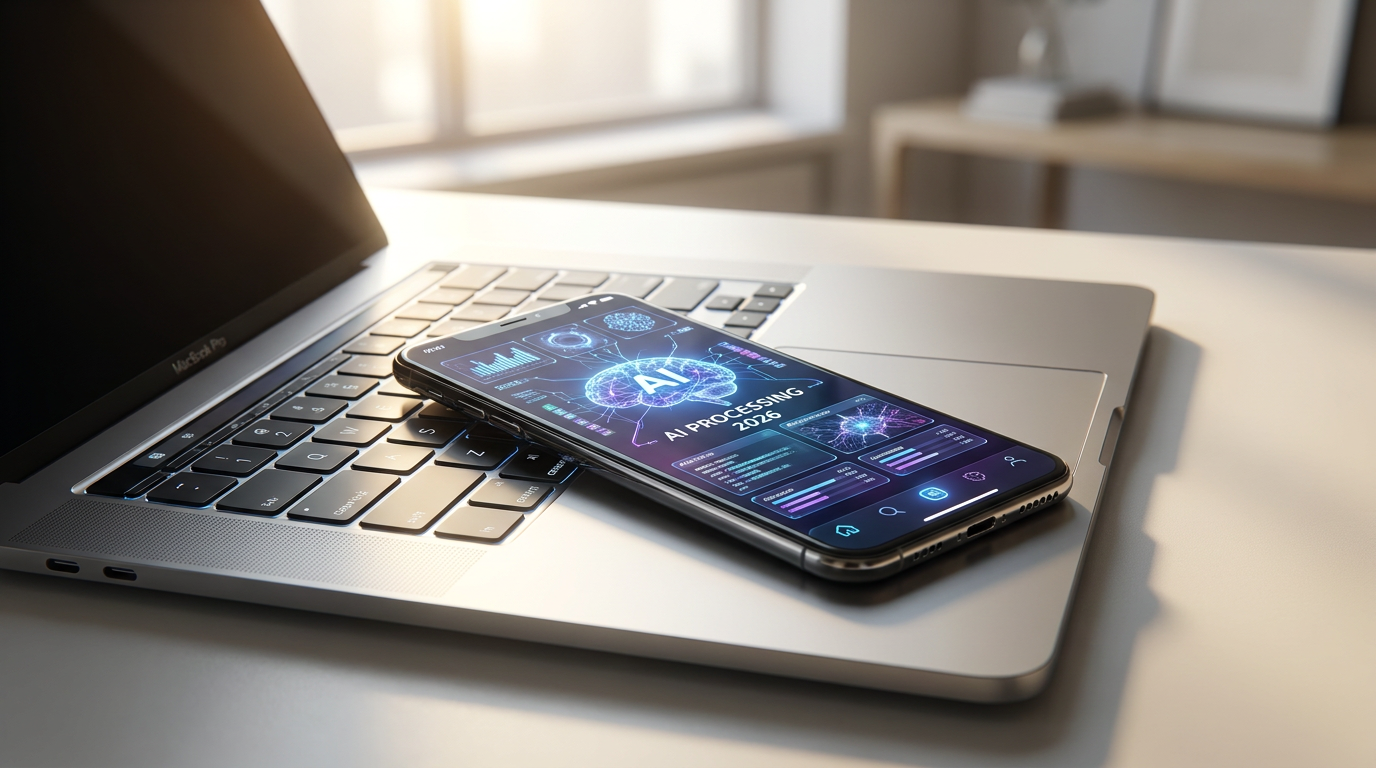
In 2026, the architecture of artificial intelligence is undergoing a structural reversal. The industry is rapidly shifting toward "on-device AI"—running large language models (LLMs) and computer vision systems directly on the smartphones and laptops users already own. This transition is not merely an incremental software update; it represents a fundamental change in how computing power is distributed. Driven by breakthroughs in specialized silicon and aggressive model compression, the intelligence that once lived exclusively in the cloud is now moving to the edge.[1][8]
The most immediate and visceral benefit of local AI is the complete elimination of network latency. When an AI model runs directly on a device's memory, the round-trip delay to a cloud server disappears, allowing tokens to generate in under 20 milliseconds. This speed is the critical threshold required for seamless live translation, augmented reality overlays, and voice assistants that can interrupt and be interrupted naturally. For applications where delay breaks the user experience, local processing is no longer a luxury—it is a strict requirement.[1][6]
Beyond speed, on-device processing solves the most intractable problem in enterprise and personal AI: data privacy. Regulations like the EU AI Act and strict compliance rules in healthcare and finance have made data residency a massive liability for organizations. When inference happens locally, sensitive data never leaves the hardware. There are no API calls to intercept, no server logs to secure, and no third-party data processing agreements to negotiate, allowing highly regulated industries to finally embrace AI without regulatory exposure.[1][5]

The hardware enabling this shift centers on the Neural Processing Unit (NPU). Unlike Central Processing Units (CPUs) that handle general tasks or Graphics Processing Units (GPUs) built for parallel rendering, NPUs are purpose-built to execute the specific mathematical operations required by machine learning models with extreme power efficiency. In 2026, the NPU has officially joined the CPU and GPU as the third indispensable pillar of personal computing architecture, shipping standard in chips from Apple, Qualcomm, and Intel.[3][8]
Microsoft has aggressively formalized this hardware standard with its "Copilot+ PC" designation. To qualify for this badge, a Windows laptop must feature an NPU capable of at least 40 Trillion Operations Per Second (TOPS), alongside a strict minimum of 16 gigabytes of RAM and a 256-gigabyte solid-state drive. These specifications ensure the device has the raw throughput and memory bandwidth to run local AI features—like real-time audio translation and the semantic timeline search feature known as Recall—without draining the battery or crippling system performance.[3]
However, the Windows ecosystem is already expanding beyond strict NPU exclusivity. At its Build 2026 conference, Microsoft updated Windows 11 to allow its local Language Model APIs to run on older machines equipped with NVIDIA RTX 30-series GPUs and at least 6GB of video RAM. This strategic move democratizes access to local AI, acknowledging that while NPUs are essential for battery-efficient laptop inference, the massive parallel compute power of existing desktop GPUs is more than capable of handling heavy local workloads for developers and enthusiasts.[4]
However, the Windows ecosystem is already expanding beyond strict NPU exclusivity.
Apple has taken a deeply integrated approach with its "Apple Intelligence" framework, which matured significantly in the iOS 18 and 2026 updates. Rather than treating AI as a standalone chatbot application, Apple has woven its foundation models directly into the core operating system. This allows the system to maintain "on-screen awareness," understanding the context of the active application and executing multi-step actions across different apps—a major shift from simple generative AI to highly capable "agentic" AI.[2][8]

A key differentiator in Apple's strategy is the unified memory architecture found in its M-series and A-series chips. Because the CPU, GPU, and Neural Engine share the exact same pool of memory, the system avoids the severe bottleneck of copying massive AI model weights back and forth between different components. This architectural advantage allows flagship iPhones and Macs to run billion-parameter models smoothly, handling roughly 80% of daily user requests entirely on-device with zero network connectivity.[1][5]
For tasks that exceed the computational limits of a phone or laptop, Apple relies on a hybrid fallback called "Private Cloud Compute" (PCC). This architecture routes complex queries to Apple-designed servers that cryptographically guarantee user data is never stored or accessible to Apple itself. Furthermore, Apple has partnered with Google to leverage custom Gemini models for heavy reasoning tasks, blending the speed and privacy of local execution with frontier-level cloud intelligence when absolutely necessary.[2][5]
Of course, the hardware is only half the equation; the models themselves had to shrink drastically. A frontier model like GPT-4 requires clusters of massive server GPUs to run, making it physically impossible to fit on a smartphone. The solution has been the rapid development of Small Language Models (SLMs) like Meta's Llama 3.2, Microsoft's Phi-3.5, and Google's Gemma 2. These models, ranging from 1 to 8 billion parameters, are specifically trained on highly curated data to punch far above their weight class in reasoning and summarization.[7]
To fit these models into the limited RAM of a smartphone, researchers rely on a mathematical compression technique called quantization. By reducing the precision of the model's weights from 16-bit floating-point numbers to 4-bit integers (INT4), developers can slash the model's memory footprint and bandwidth requirements by 75%. While this introduces a slight degradation in nuanced reasoning, the trade-off is what allows a highly capable 3-billion-parameter model to run flawlessly on a phone with just 6GB of RAM.[1][7]

The software tooling required to deploy these models has also matured from experimental scripts into production-ready platforms. Frameworks like ONNX Runtime, Apple's Core ML, and open-source engines like llama.cpp now intelligently distribute AI workloads across a device's CPU, GPU, and NPU without requiring developer intervention. For app builders, platforms like RunAnywhere provide mobile-native SDKs that make it trivial to embed local speech-to-text, text-to-speech, and language models directly into consumer applications.[1][6]
This shift to local inference is fundamentally disrupting the economics of the broader AI industry. For the past few years, AI providers have relied heavily on a usage-based revenue model, charging developers for every single API call made to the cloud. By moving the processing to the user's own hardware, application developers can offer unlimited AI features without incurring massive, unpredictable cloud hosting costs, making AI-powered applications financially sustainable at a global scale.[1][6]

Ultimately, the rise of on-device AI in 2026 marks the end of the "loading spinner" era of artificial intelligence. By combining powerful neural silicon, highly optimized small models, and seamless operating system integration, the tech industry has solved the latency and privacy bottlenecks that held the technology back. AI has transformed from a remote, cloud-tethered oracle into a fast, private, and deeply personal utility that works wherever you are—even on an airplane without Wi-Fi.[1][7][8]
How we got here
June 2024
Microsoft introduces the Copilot+ PC standard, requiring a 40 TOPS NPU for local AI features.
Late 2024
Apple rolls out the first wave of Apple Intelligence, introducing the Private Cloud Compute architecture.
Early 2026
Small Language Models (SLMs) like Llama 3.2 and Gemma 2 reach performance parity with older cloud models.
June 2026
Microsoft expands local Windows AI support to older RTX 30-series GPUs, democratizing access beyond NPUs.
June 2026
Apple unveils its deeply integrated, agentic Siri architecture powered by on-device processing and Google Gemini.
Viewpoints in depth
Hardware Ecosystem Builders
Tech giants view on-device AI as a hardware supercycle.
Microsoft and Apple are leveraging local AI to drive massive device upgrade cycles. By setting strict hardware floors—like Microsoft's 40 TOPS NPU requirement for Copilot+ PCs or Apple's A17 Pro baseline for iPhones—they are positioning older devices as functionally obsolete for the AI era. For these companies, local AI is not just a privacy feature; it is a massive revenue driver for new silicon and a way to lock users deeper into their respective hardware ecosystems.
Privacy and Enterprise Compliance
Local AI solves the fundamental data sovereignty problem.
For the healthcare, finance, and legal sectors, cloud AI has been a compliance nightmare. Sending proprietary data to third-party servers risks violating the EU AI Act, HIPAA, and strict client confidentiality agreements. This camp views on-device inference as the ultimate architectural fix: if the data never leaves the laptop or smartphone, the regulatory exposure drops to zero. They argue that local AI is the only way enterprise organizations can safely deploy generative tools at scale.
Independent App Developers
Shifting compute costs to the user changes the business model.
Independent developers have struggled with the unpredictable costs of cloud AI, where every user prompt incurs an API fee that eats into profit margins. By utilizing on-device models, developers can offer unlimited AI features without paying for server time. They rely heavily on open-source tools like llama.cpp and aggressive quantization techniques to make these models run smoothly on mid-range phones, prioritizing offline reliability and cost-efficiency over frontier-level reasoning.
What we don't know
- How quickly software developers will abandon cloud APIs in favor of local SDKs for their core features.
- Whether the 16GB RAM baseline will quickly become obsolete as users demand larger, more capable local models.
- How regulators will treat hybrid AI systems that seamlessly hand off tasks between local hardware and secure cloud servers.
Key terms
- NPU (Neural Processing Unit)
- A specialized hardware chip designed specifically to accelerate machine learning tasks with high efficiency and low power consumption.
- TOPS (Trillions of Operations Per Second)
- A metric used to measure the processing power of an NPU, with 40 TOPS currently serving as the baseline for advanced local AI.
- Quantization
- A compression technique that reduces the precision of an AI model's weights (e.g., from 16-bit to 4-bit) so it can fit into a device's limited memory.
- SLM (Small Language Model)
- A compact AI model, typically between 1 and 8 billion parameters, designed to run efficiently on consumer hardware rather than massive servers.
- Private Cloud Compute (PCC)
- Apple's architecture that routes complex AI tasks to secure servers that cryptographically guarantee data privacy and immediate deletion.
Frequently asked
Do I need to buy a new computer to use local AI?
While new Copilot+ PCs with dedicated NPUs offer the best battery efficiency, recent updates allow older PCs with powerful GPUs (like the NVIDIA RTX 30-series) to run local AI models.
Will on-device AI drain my phone's battery?
Running AI models locally does consume power, but modern NPUs are highly optimized for these tasks, making them far more battery-efficient than using the main CPU or GPU.
Is local AI as smart as ChatGPT?
Local models are smaller and less capable of complex, frontier-level reasoning than massive cloud models, but they are highly effective for everyday tasks like summarizing text, drafting emails, and real-time translation.
Does Apple Intelligence send my data to Google?
Apple processes most requests on-device. For complex tasks routed to Google's Gemini, Apple uses its Private Cloud Compute architecture to ensure your personal data is not stored or used to train external models.
Sources
Source coverage
8 outlets
4 viewpoints surfaced








[1]Towards Data SciencePrivacy & Compliance Advocates
On-Device AI in 2026: Running LLMs Locally on Your Phone, Laptop, and IoT Devices
Read on Towards Data Science →[2]Apple NewsroomHardware Ecosystem Builders
Apple Intelligence brings powerful AI capabilities into everyday experiences
Read on Apple Newsroom →[3]ThurrottHardware Ecosystem Builders
Copilot+ PC vs. Regular Windows 11 Laptops: Worth It in 2026?
Read on Thurrott →[4]Windows LatestHardware Ecosystem Builders
Microsoft brings Windows 11's local AI to RTX 30+ PCs with 6GB vRAM
Read on Windows Latest →[5]The ElecPrivacy & Compliance Advocates
[Apple's AI Strategy] iPhone Evolves Into an AI Platform
Read on The Elec →[6]RunAnywhere BlogIndependent App Developers
Best AI Platforms for Local LLMs in 2026
Read on RunAnywhere Blog →[7]aiME JournalOpen-Source AI Community
Best AI Models for On-Device, Real-Time, and Offline Use
Read on aiME Journal →[8]AI.ccIndependent App Developers
How to Use Apple AI in 2026: Complete Guide to Apple Intelligence
Read on AI.cc →
More in ai
See all 5 stories →On-Device AI
How Local AI Replaced the Cloud: Running Frontier Models on Your Laptop
0 sources
Enterprise AI
The Rise of Small Language Models: How Enterprises Are Running AI Locally in 2026
0 sources
Drug Discovery
New AI Model Accelerates Molecular Simulations 10,000-Fold, Slashing Drug Discovery Timelines
0 sources

Every angle. Every day.
Get ai stories with full source coverage and perspective breakdowns delivered to your inbox.