
The End of 'Forever': How 2026 Chemistry Breakthroughs Are Finally Destroying PFAS
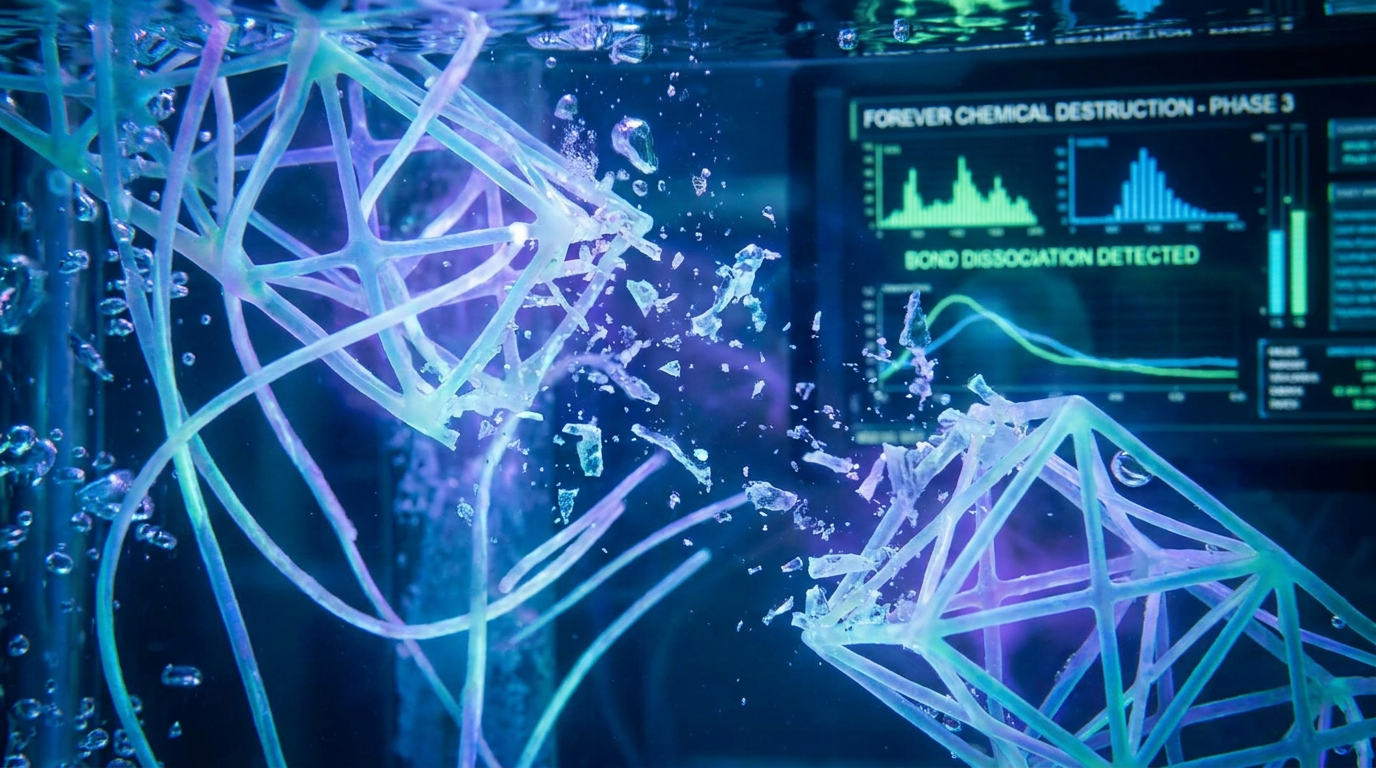
A wave of new peer-reviewed research demonstrates that the unbreakable carbon-fluorine bonds of PFAS can be efficiently dismantled using light, electricity, and novel catalysts. These scalable methods mark a critical shift from merely capturing 'forever chemicals' to permanently destroying them.
By Factlen Editorial Team
- Materials Scientists
- Focus on the chemical mechanisms, catalyst design, and lowering the energy required to break the carbon-fluorine bond.
- Water Treatment Industry
- Prioritize cost, scalability, and the ability to integrate these technologies into existing municipal infrastructure.
- Environmental Regulators
- Emphasize 'true defluorination' and zero-discharge mandates over legacy capture-and-store methods.
What's not represented
- · Communities affected by PFAS contamination
- · Chemical manufacturers producing PFAS
Why this matters
For decades, water treatment facilities could only capture toxic PFAS chemicals and move them to landfills, where they remained an environmental threat. These new destruction technologies provide the first viable path to permanently eliminating forever chemicals from the global water supply.
Key points
- Multiple peer-reviewed studies in 2026 have demonstrated new methods to permanently break the notoriously strong carbon-fluorine bonds in PFAS.
- A novel copper-aluminum material can capture forever chemicals at 1,000 times the efficiency of traditional sorbents and thermally destroy them.
- Researchers have successfully used UV light and electrocatalysis to dismantle PFAS molecules at room temperature without creating toxic byproducts.
- The water treatment industry is rapidly shifting from legacy 'capture and store' methods to 'true defluorination' technologies.
The carbon-fluorine bond is one of the strongest in organic chemistry, a molecular fortress that gives per- and polyfluoroalkyl substances (PFAS) their famous heat, water, and grease resistance. For decades, this same durability has made them an environmental nightmare, earning them the moniker "forever chemicals" because they refuse to break down in nature. Traditional water treatment facilities have been largely powerless to destroy them, relying instead on capturing the chemicals with activated carbon or ion-exchange resins. This legacy approach merely moves the problem from the water supply to solid waste, which is eventually incinerated or sent to landfills where the chemicals can leach back into the environment.[2][3]
However, a convergence of peer-reviewed breakthroughs in the first half of 2026 has fundamentally altered the landscape of environmental chemistry. Researchers across multiple international institutions have published evidence demonstrating that the unbreakable carbon-fluorine bond can, in fact, be cleaved efficiently and at scale. Rather than relying on the extreme heat and pressure of legacy incineration—which often generates toxic byproducts—these new methods utilize targeted catalysts, photochemistry, and electrochemistry to dismantle the molecules at the atomic level.[1][3][4][5][6]
The central claim emerging from this new wave of research is that "true defluorination"—the complete separation of fluorine atoms from the carbon backbone—is now achievable under mild conditions. This represents a paradigm shift for the water treatment industry, which is facing increasingly stringent regulations from the US Environmental Protection Agency and the European Union's REACH framework. Regulators are no longer satisfied with simply concentrating PFAS waste; they are demanding technologies that neutralize the threat entirely.[2][3][4]

One of the most robust pieces of evidence for this shift comes from a collaborative study published in Advanced Materials by researchers at Rice University and international partners. The team developed a novel layered double hydroxide (LDH) material composed of copper and aluminum. According to the published data, this specific formulation adsorbs PFAS from contaminated water with an efficiency more than 1,000 times greater than standard materials currently used in municipal treatment plants.[5][7]
Crucially, the Rice University team solved the secondary problem of what to do with the captured chemicals. By heating the PFAS-saturated LDH material in the presence of calcium carbonate, the researchers successfully induced thermal decomposition. The evidence shows that this process destroys the captured forever chemicals without releasing toxic gaseous byproducts. Furthermore, the thermal treatment regenerates the LDH material, allowing it to be reused for at least six full capture-and-destruction cycles with no measurable loss in efficacy.[2][5][7]

A parallel breakthrough, published in Nature Communications by a team led by Clarkson University, provides strong evidence for an entirely different destruction mechanism: electrocatalysis. The Clarkson researchers designed a specialized material that combines light and electricity to attract PFAS molecules to its surface via cathodic adsorption. Once the chemicals are concentrated on the material, high-energy "hot electrons" generated by light are deployed to systematically break the carbon-fluorine bonds.[4][6]
The strength of the Clarkson study lies in its application to complex, real-world water matrices. The hot-electron mechanism proved highly effective not just in pristine laboratory water, but in concentrated brine streams and water heavily contaminated by firefighting foam. Because the system operates at room temperature and avoids harsh oxidative conditions, the researchers demonstrated that it eliminates the PFAS without inadvertently synthesizing new, unregulated toxic compounds.[4][6]
The strength of the Clarkson study lies in its application to complex, real-world water matrices.
Adding to the arsenal of destruction techniques, researchers at Aarhus University recently uncovered a hidden vulnerability in the PFAS molecular structure using ultraviolet light. While UV degradation of pollutants is a well-known concept, the Aarhus team identified the specific chemical driver responsible for breaking down forever chemicals without the need for added chemical reagents.[1][8]
According to the findings, exposing water to intense UV light generates highly reactive hydrogen radicals. The evidence pinpoints these specific radicals as the primary force capable of dismantling the stubborn PFAS molecules. This challenges previous assumptions that other reactive oxygen species were doing the heavy lifting, providing chemists with a precise target for optimizing future UV-based reactor designs.[1][8]

The commercial implications of these peer-reviewed discoveries are already materializing. Industrial water treatment companies are moving rapidly to scale these laboratory successes into deployable infrastructure. Advanced photochemical processes, which leverage the UV and radical mechanisms identified by researchers, are slated for commercial scaling by late 2026. Industry analysts note that these systems offer a significant advantage over energy-intensive thermal incineration, particularly in markets sensitive to high energy costs and carbon footprints.[3]
Despite the overwhelming optimism surrounding these breakthroughs, transparent uncertainties remain regarding their universal application. The PFAS chemical family encompasses more than 10,000 distinct compounds, ranging from long-chain legacy chemicals to highly mobile ultra-short-chain species like trifluoroacetic acid (TFA). While the new catalytic and photochemical methods show exceptional efficacy against targeted subsets, comprehensive data proving their ability to destroy every variant with equal efficiency is still being gathered.[3][4][5]
The challenge of ultra-short-chain compounds is particularly pressing in European regulatory discussions. Because these smaller molecules are highly water-soluble and mobile, they easily slip through traditional filtration systems and are notoriously difficult to capture for subsequent destruction. The latest generation of photochemical reactors is specifically being engineered to target these elusive ultra-short chains, aiming to achieve the "Sum of 20 PFAS" regulatory standard that is expected to define future compliance.[3]

Another area of ongoing research is the energy balance of these new systems. While the hot-electron and UV-radical methods operate at milder temperatures than legacy incineration, generating intense UV light and maintaining electrocatalytic currents still requires continuous power. Engineers are currently analyzing the life-cycle carbon footprint of these destruction technologies to ensure that solving the PFAS crisis does not inadvertently exacerbate energy consumption.[3][4][8]
Furthermore, the economic viability of scaling these advanced materials—such as the copper-aluminum LDHs or specialized electrocatalytic surfaces—to handle the millions of gallons processed daily by municipal wastewater plants remains untested. The initial capital expenditure for retrofitting existing infrastructure with photochemical reactors or hot-electron systems will require substantial investment from both public utilities and private industry.[2][3]
Nevertheless, the evidence overwhelmingly indicates that the era of merely shuffling forever chemicals from water to landfills is ending. By proving that the carbon-fluorine bond can be broken safely, efficiently, and sustainably, chemists have provided the foundational tools needed to close the loop on one of the most pervasive environmental crises of the modern industrial age.[2][6][7]
How we got here
1940s
PFAS chemicals are first synthesized and introduced into consumer products for their heat and water resistance.
Early 2000s
Global recognition of the environmental persistence and health risks associated with forever chemicals.
2021
Initial discovery of copper-aluminum layered double hydroxides (LDH) for chemical capture.
2024-2025
Regulatory bodies in the US and EU propose strict limits on PFAS in drinking water and industrial discharge.
Early 2026
Multiple peer-reviewed studies demonstrate scalable, low-energy methods for breaking the carbon-fluorine bond.
Late 2026
First commercial-scale advanced photochemical PFAS destruction reactors expected to come online.
Viewpoints in depth
Materials Scientists
Focusing on the atomic mechanisms of breaking the carbon-fluorine bond.
Researchers at institutions like Rice, Clarkson, and Aarhus prioritize understanding the fundamental chemistry of defluorination. By isolating the specific mechanisms—whether hot electrons, hydrogen radicals, or thermal decomposition—they aim to lower the energy barriers required to destroy PFAS, moving away from brute-force incineration toward elegant, targeted catalysis.
Water Treatment Industry
Prioritizing the scalability, cost, and integration of new technologies.
For commercial operators and municipal utilities, a chemical breakthrough is only valuable if it can be scaled to process millions of gallons of water daily. The industry is focused on the capital expenditure of retrofitting existing plants, the energy costs of running UV or electrocatalytic reactors, and ensuring these systems can handle complex, muddy water matrices without fouling the new catalysts.
Environmental Regulators
Demanding true defluorination and zero-discharge compliance.
Regulatory bodies in the EU and US are shifting their focus from merely filtering PFAS out of drinking water to ensuring the chemicals are permanently eliminated from the ecosystem. Regulators are increasingly skeptical of 'capture and store' methods that risk future leakage from landfills, driving the legislative push toward technologies that guarantee the complete destruction of both long-chain and ultra-short-chain forever chemicals.
What we don't know
- Whether these targeted destruction methods are equally effective across all 10,000+ distinct compounds in the PFAS family, particularly ultra-short-chain variants.
- The exact capital costs required to retrofit existing municipal wastewater treatment plants with advanced photochemical or electrocatalytic reactors.
- How the life-cycle energy consumption of these new destruction technologies will compare to traditional filtration methods at a global scale.
Key terms
- PFAS
- Per- and polyfluoroalkyl substances, a large group of synthetic chemicals known for their extreme durability and resistance to breaking down.
- Carbon-Fluorine Bond
- One of the strongest chemical bonds in nature, responsible for both the useful properties and the environmental persistence of PFAS.
- Defluorination
- The chemical process of completely detaching fluorine atoms from a carbon backbone, effectively destroying the PFAS molecule.
- Layered Double Hydroxides (LDH)
- A class of synthetic materials with a layered crystal structure, highly effective at trapping specific molecules like PFAS.
- Hydrogen Radicals
- Highly reactive, uncharged hydrogen atoms generated by intense light that can aggressively attack and break strong chemical bonds.
- Electrocatalysis
- A process that uses electricity to accelerate a chemical reaction, such as the breakdown of pollutants on a specialized surface.
Frequently asked
Why are PFAS called 'forever chemicals'?
They contain carbon-fluorine bonds, which are among the strongest in chemistry. This makes them highly resistant to natural degradation, allowing them to persist in the environment for decades or longer.
How were PFAS treated before these breakthroughs?
Historically, water treatment plants used activated carbon or resins to filter PFAS out of the water. However, this only captured the chemicals, transferring them to solid waste that eventually ended up in landfills.
Are these new destruction methods safe?
Yes. Unlike legacy incineration, which can release toxic gases, these new catalytic and photochemical methods operate under milder conditions and are designed to break down PFAS without creating harmful byproducts.
When will these technologies be used in city water systems?
While the fundamental chemistry has been proven in labs, commercial scaling is just beginning. Advanced photochemical reactors are expected to enter the industrial market by late 2026, with broader municipal adoption following as costs decrease.
Sources
Source coverage
8 outlets
3 viewpoints surfaced







[1]ScienceDailyEnvironmental Regulators
Hidden Weakness Found in Forever Chemicals
Read on ScienceDaily →[2]SelectScienceEnvironmental Regulators
Breakthrough in eco-friendly removal of toxic forever chemicals
Read on SelectScience →[3]AquatechWater Treatment Industry
PFAS destruction technologies: The shift to true defluorination
Read on Aquatech →[4]Nature CommunicationsMaterials Scientists
Cathodic adsorption and hot-electron mechanism for PFAS elimination
Read on Nature Communications →[5]Advanced MaterialsMaterials Scientists
Layered Double Hydroxides for the Capture and Thermal Decomposition of PFAS
Read on Advanced Materials →[6]Clarkson UniversityMaterials Scientists
Clarkson Researchers Report Breakthrough in PFAS Destruction
Read on Clarkson University →[7]Rice UniversityMaterials Scientists
Breakthrough in eco-friendly removal of toxic forever chemicals
Read on Rice University →[8]Aarhus UniversityMaterials Scientists
Hydrogen radicals break down stubborn PFAS forever chemicals
Read on Aarhus University →
Every angle. Every day.
Get science stories with full source coverage and perspective breakdowns delivered to your inbox.