
The Emerging Consensus: Why Editorial Boards and Lawmakers Are Uniting Behind Phone-Free Schools
A rare bipartisan and editorial consensus has rapidly formed around 'bell-to-bell' smartphone bans in schools. Driven by evidence of improved mental health and academic focus, 31 states are now reclaiming the school day from digital distraction.
By Factlen Editorial Team
- Bell-to-Bell Advocates
- Argue that complete physical separation from devices is necessary to restore focus and mental health.
- Implementation Watchdogs
- Focus on the logistical realities, warning that unfunded mandates and loopholes undermine the effectiveness of the bans.
- Digital Integrationists
- Believe that outright bans miss an opportunity to teach responsible technology use and digital citizenship.
What's not represented
- · Students who rely on smartphones for translation or accessibility tools.
- · Low-income families where a student's smartphone is their primary internet access point.
Why this matters
The rapid adoption of phone-free school policies is fundamentally reshaping the daily lives of millions of teenagers. By breaking the cycle of constant digital connectivity, this movement aims to reverse a decade-long decline in youth mental health and restore face-to-face social skills.
Key points
- By 2025, 31 states had enacted or planned legislation to restrict student smartphone use.
- Editorial boards nationwide are uniting behind 'bell-to-bell' bans to improve mental health.
- Classroom-only bans are largely viewed as ineffective due to enforcement difficulties.
- Security experts warn that phones actually decrease student safety during active emergencies.
- Early data shows significant drops in bullying and improvements in academic focus.
Walk into a typical American high school cafeteria today, and you might notice something that has been missing for over a decade: a deafening roar of conversation. In the span of just two academic years, the public school experience has undergone its most dramatic physical transformation since the introduction of the laptop. The glowing screens that once commanded the attention of millions of teenagers between classes have been systematically powered down, locked away, and removed from the educational equation.
What began as a scattering of localized pilot programs has rapidly crystallized into a formidable national consensus. By the start of the 2025 academic year, 31 states had either passed or planned legislation to severely restrict or outright ban students from using personal digital devices on school grounds. This sweeping legislative wave marks a profound pivot from the previous decade, where schools largely capitulated to the ubiquity of smartphones, placing the impossible burden of enforcement on individual teachers.[1]
Driving this legislative momentum is a rare, unified chorus from the nation's editorial boards. From the Los Angeles Times to the Pittsburgh Post-Gazette, opinion pages across the political spectrum have forcefully endorsed comprehensive bans. These boards argue that the evidence is now overwhelming: curbing phone use not only drastically improves academic performance but also serves as a critical intervention against rising rates of cyberbullying and adolescent anxiety.[2][4]

The intellectual architecture of this movement was largely drafted by social psychologist Jonathan Haidt, whose work highlighted the correlation between the 2012 saturation of smartphones and a global spike in youth mental illness. Haidt framed the issue not as an individual failing of willpower, but as a classic 'collective action problem.' If only a few parents withhold smartphones, their children face social ostracization; but if a school mandates a phone-free environment, it breaks the cycle of peer pressure for everyone simultaneously.[7]
A crucial evolution in this debate has been the distinction between a 'classroom ban' and a 'bell-to-bell' policy. For years, schools attempted a middle-ground approach, demanding phones be silenced during instruction but allowing them in hallways and at lunch. Educators quickly realized this was a losing battle. When phones are merely resting in pockets, the cognitive load remains, and teachers are forced to act as digital police, constantly monitoring laps and bathroom breaks for illicit scrolling.[7]
Consequently, the editorial and legislative consensus has shifted toward absolute physical separation. Successful implementations, like the statewide initiative championed by New York Governor Kathy Hochul, require devices to be entirely inaccessible from the opening bell to final dismissal. Early evaluations of these strict bell-to-bell mandates have yielded overwhelmingly positive feedback from administrators, who report a near-instantaneous improvement in school climate and student engagement.[3]
The data supporting these comprehensive bans is increasingly robust. Proponents frequently point to international precedents, such as a landmark Norwegian study that recorded a 60 percent drop in mental health consultations among girls following the implementation of strict school phone bans. Domestically, schools enforcing bell-to-bell policies are reporting significant decreases in disciplinary referrals, physical altercations, and classroom disruptions.[4]
The data supporting these comprehensive bans is increasingly robust.
Beyond the metrics, educators are witnessing a profound social transformation. Without the constant pull of notifications or the fear of being recorded and mocked online, students are relearning how to interact face-to-face. The phenomenon of 'phubbing'—snubbing a peer to look at a screen—is evaporating from school grounds, forcing teenagers to navigate boredom and social friction through actual conversation rather than digital escapism.[7]

This cultural correction enjoys massive public backing. A late 2025 survey conducted by the Institute for Families and Technology found that 80 percent of registered voters support bell-to-bell smartphone bans. Even more telling, 91 percent of parents whose children currently attend schools with such policies in place report high satisfaction, noting that removing the devices helps their children focus on learning rather than social media drama.[8]
Yet, the transition has not been entirely frictionless. The most visceral resistance often comes not from the students, but from their parents. In an era marked by high-profile school tragedies, many parents view the smartphone as an essential, non-negotiable lifeline. The prospect of being unable to instantly text their child during a lockdown or emergency has sparked intense pushback at local school board meetings across the country.[1]
Security professionals, however, offer a starkly counter-intuitive assessment of this fear. The National Association of School Resource Officers has explicitly endorsed phone-free schools, warning that a proliferation of devices actually makes active emergencies more dangerous. A ringing phone can alert an intruder to a hiding student's location, while the rapid spread of misinformation on social media can draw panicked parents to the campus, severely impeding the response of law enforcement.[4][5]
Beyond physical safety, a secondary critique comes from pedagogical integrationists. Some researchers argue that outright bans are a blunt instrument that fails to prepare students for a digitally saturated world. A study highlighted by the London School of Economics suggested that when teachers are trained to guide smartphone use constructively, the devices can actually narrow educational gaps. From this perspective, banning phones abdicates the school's responsibility to teach digital citizenship and self-regulation.[6]

Despite these critiques, the momentum for prohibition continues to accelerate, though the quality of implementation varies wildly. A 2026 'Phone-Free Schools State Report Card' revealed that while many states have passed laws, only North Dakota and Rhode Island earned 'A' grades for mandating that devices be stored in completely inaccessible locations. Many other states left loopholes that allowed districts to pass weak, unenforceable policies.[5]
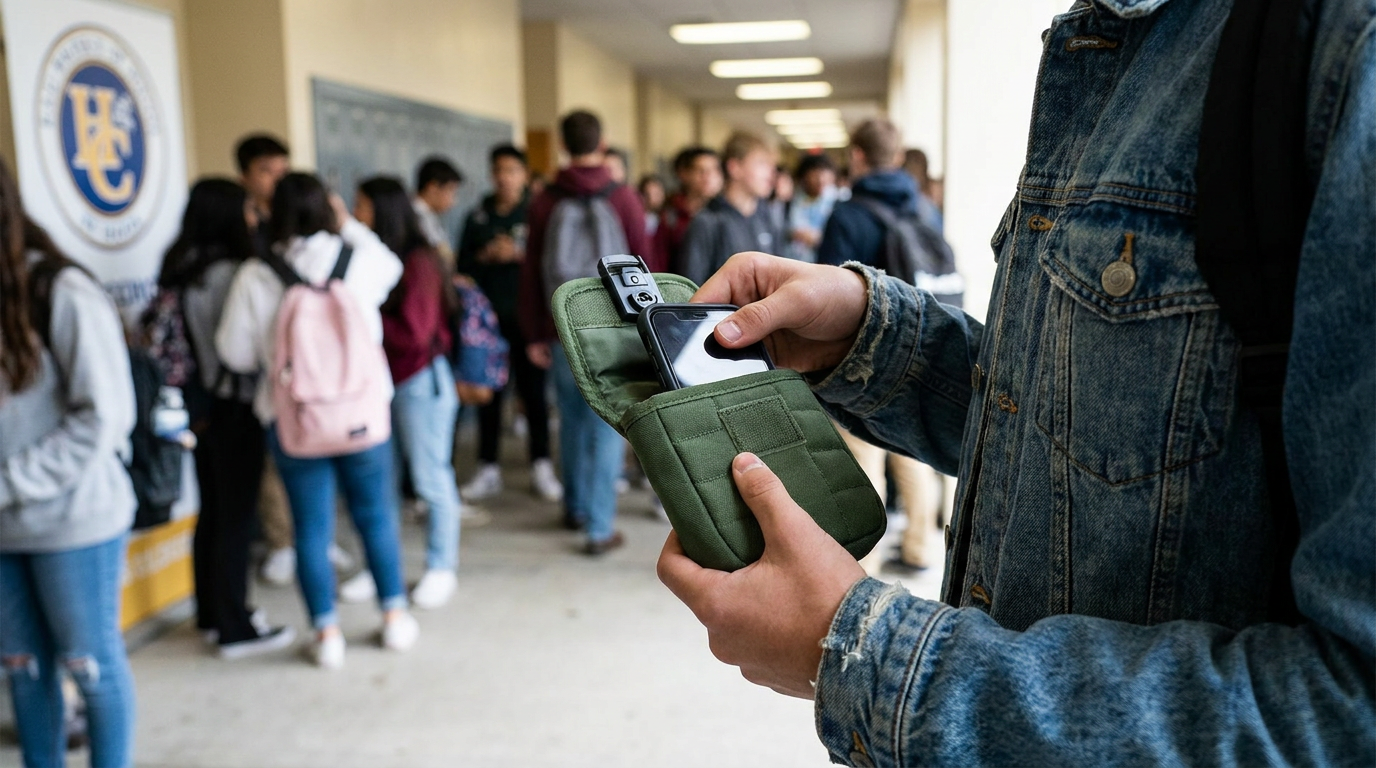
To close these gaps, policymakers are beginning to put funding behind their mandates. Recognizing that physical separation requires infrastructure, leaders like Governor Hochul have proposed millions in state funding to help districts purchase lockable magnetic pouches or centralized storage cubbies. This financial support removes a major logistical hurdle for underfunded districts attempting to enforce the new rules.[3]
Ultimately, the phone-free school movement represents one of the most rapid and unified policy shifts in modern educational history. By treating the smartphone not as a neutral tool, but as an active impediment to adolescent development, editorial boards and lawmakers have given schools the political cover they desperately needed. The result is a reclaiming of the school day—a forced digital detox that is quietly giving a generation of anxious students their childhoods back.
How we got here
2012
Smartphone ownership crosses the 50% threshold in the US, correlating with a sharp rise in youth anxiety.
May 2023
Florida becomes the first state to mandate a statewide ban on student cellphones during instructional time.
March 2024
Jonathan Haidt publishes 'The Anxious Generation', catalyzing a national movement for bell-to-bell school bans.
July 2025
Education Week reports that 31 states have passed or planned legislation restricting cellphones in schools.
January 2026
The 'Phone-Free Schools State Report Card' is released, pushing states to close loopholes and mandate physical storage.
Viewpoints in depth
Bell-to-Bell Advocates
Argue that complete physical separation from devices is necessary to restore focus and mental health.
This camp, heavily influenced by social psychologists like Jonathan Haidt and supported by numerous editorial boards, argues that the smartphone is not a neutral tool but an addictive impediment to adolescent development. They point to data showing that partial bans fail because the mere presence of a phone in a pocket creates a cognitive load. For these advocates, the only effective solution is a structural one: removing the devices entirely from the school environment to break the cycle of peer pressure and constant connectivity.
Digital Integrationists
Believe that outright bans miss an opportunity to teach responsible technology use.
Researchers and tech-forward educators in this camp argue that prohibition is a short-sighted strategy. They cite studies indicating that when teachers are trained to integrate smartphones into lesson plans, educational gaps can actually narrow. By banning phones, they argue, schools are abdicating their responsibility to teach digital citizenship, leaving students ill-equipped to manage their screen time once the final bell rings and they re-enter a digitally saturated world.
Safety-Concerned Parents
Worry that restrictive phone policies sever a vital lifeline during school emergencies.
In an era marked by high-profile school violence, many parents view the smartphone as an essential safety device. This viewpoint heavily resists bell-to-bell bans, arguing that parents have a fundamental right to contact their children during a crisis. While law enforcement and security experts counter that phones actually complicate emergency responses, the emotional weight of this perspective remains the most significant political hurdle for districts attempting to implement strict storage policies.
What we don't know
- Whether the academic and social gains observed in early adopting schools will scale nationally.
- How schools will sustainably fund the physical infrastructure, like lockable pouches, required for enforcement.
- The long-term impact of these bans on students' ability to self-regulate technology use in adulthood.
Key terms
- Bell-to-bell ban
- A policy requiring students to store their phones from the moment the opening bell rings until the final dismissal, including lunch and passing periods.
- Phubbing
- The act of snubbing someone in a social setting by looking at a phone instead of paying attention to the conversation.
- Yondr pouch
- A lockable fabric bag used by schools and event venues to securely store smartphones until they are unlocked at a designated station.
- Collective action problem
- A scenario where individuals would all benefit from cooperating, but fail to do so because of conflicting individual interests—such as parents afraid to be the only ones withholding a smartphone.
Frequently asked
Do phone bans make students less safe during an emergency?
Security experts and the National Association of School Resource Officers argue that phones actually decrease safety by distracting students, alerting intruders with noise, and spreading misinformation.
Why aren't classroom-only bans considered effective?
Educators report that classroom-only rules force teachers to act as police, and students still use devices in bathrooms or between classes, maintaining the social pressure to stay online.
How are schools physically enforcing these bans?
The most successful policies use physical barriers like lockable magnetic pouches or centralized lockers, rather than relying on students to keep phones in their pockets.
Sources
Source coverage
8 outlets
3 viewpoints surfaced








[1]Education WeekImplementation Watchdogs
31 States Now Restrict Cellphones in Schools
Read on Education Week →[2]Los Angeles TimesBell-to-Bell Advocates
Why LAUSD should ban smartphones in schools
Read on Los Angeles Times →[3]New York Daily NewsBell-to-Bell Advocates
Editorial: Hochul's school phone ban a great success to copy
Read on New York Daily News →[4]Pittsburgh Post-GazetteBell-to-Bell Advocates
Editorial: Pa. should join growing list of states banning smartphones in schools
Read on Pittsburgh Post-Gazette →[5]EdSurgeImplementation Watchdogs
New Report Card Grades States on Laws Banning Phones in Schools
Read on EdSurge →[6]ForbesDigital Integrationists
Smartphones In Schools: To Ban Or Not To Ban?
Read on Forbes →[7]The AtlanticBell-to-Bell Advocates
The Case for Phone-Free Schools
Read on The Atlantic →[8]Institute for Families and TechnologyBell-to-Bell Advocates
Public Opinion Survey on Voters' Views on Phones in Schools
Read on Institute for Families and Technology →
Every angle. Every day.
Get opinion stories with full source coverage and perspective breakdowns delivered to your inbox.