
The Efficacy of Continuous Glucose Monitors for Non-Diabetic Athletes
As over-the-counter continuous glucose monitors flood the fitness market, sports scientists are weighing the genuine educational benefits against the physiological limitations of real-time tracking.
By Factlen Editorial Team
- Sports Science Skeptics
- Researchers caution that the physiological limitations of the sensors make them unreliable as real-time fuel gauges.
- Sports Tech Optimists
- Advocates believe real-time glucose data is the key to unlocking personalized fueling and preventing fatigue.
- Everyday Endurance Athletes
- Recreational competitors seek the educational benefits of the technology but face the risk of data-induced anxiety.
What's not represented
- · Endocrinologists treating actual diabetes patients
- · Sports Psychologists
Why this matters
As continuous glucose monitors become widely available over-the-counter, millions of recreational athletes are adopting them to optimize their training and nutrition. Understanding the scientific limitations of these devices is crucial to prevent data-induced anxiety and ensure athletes are fueling their bodies effectively.
Key points
- Over-the-counter CGMs are increasingly popular among non-diabetic endurance athletes for tracking metabolic health.
- CGMs measure interstitial fluid, which creates a 5-to-25-minute data lag during high-intensity exercise.
- Sensors cannot measure muscle glycogen, which is the primary fuel source dictating endurance fatigue.
- The technology is highly effective for mapping individual responses to specific foods during training blocks.
- Sports dietitians warn that misinterpreting normal glucose spikes can lead to unnecessary food anxiety.
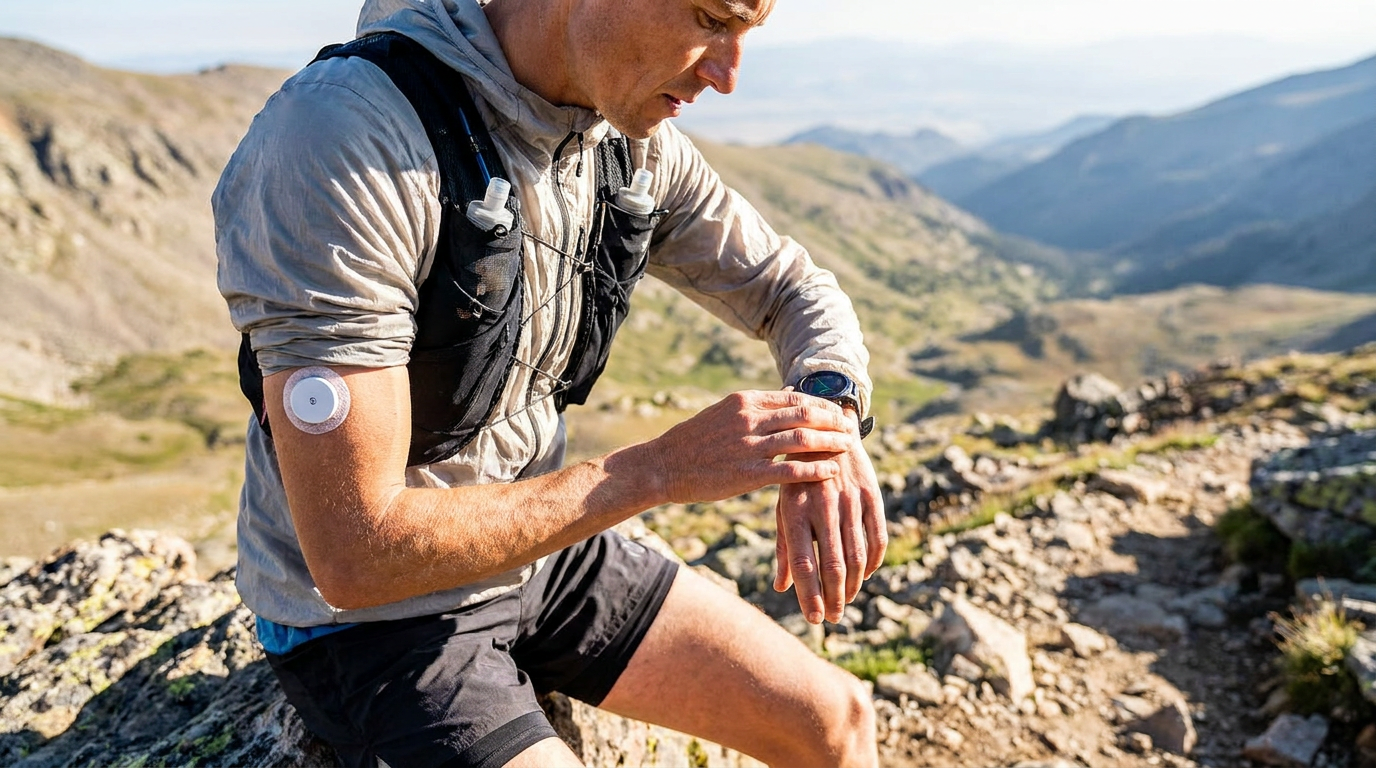
Over the past two years, a piece of medical technology once reserved strictly for diabetes management has become the ultimate status symbol on the starting lines of marathons, triathlons, and ultra-endurance events. Continuous glucose monitors (CGMs)—small, coin-sized sensors adhered to the back of the arm—are now marketed aggressively to healthy, non-diabetic athletes. With the FDA's recent clearance of over-the-counter consumer models like the Dexcom Stelo and Abbott Lingo, the barrier to entry has completely vanished. Anyone with a smartphone and a curiosity about their metabolism can now stream their interstitial glucose data 24 hours a day. The promise pitched by sports tech companies is intoxicating: by tracking real-time blood sugar fluctuations, athletes can supposedly dial in their exact carbohydrate needs, avoid the dreaded mid-race "bonk," and optimize their post-workout recovery with pinpoint precision.[2][3]
But as the adoption of these wearables outpaces clinical research, sports scientists and exercise physiologists are raising critical questions about the actual efficacy of CGMs for non-diabetic performance. To understand the growing debate, one must first understand the underlying biology of what a continuous glucose monitor actually measures. The sensor's tiny filament does not sit inside a vein; rather, it measures glucose concentrations in the interstitial fluid—the liquid that surrounds the body's cells. Under resting conditions, such as when an athlete is sleeping or sitting at a desk, interstitial glucose mirrors blood glucose with remarkable accuracy. However, the dynamics change drastically the moment an athlete begins to sweat and push their cardiovascular system to its limits.[3][4]
During high-intensity exercise, a well-documented physiological lag time emerges between what is happening in the bloodstream and what is reflected in the interstitial fluid. Depending on alterations in blood flow, body temperature, and acidity, this delay can range anywhere from 5 to 25 minutes. This lag creates a significant blind spot for athletes attempting to use a CGM as a real-time dashboard during a race. By the time a sensor registers a precipitous drop in glucose during a steep, grueling climb, the athlete's actual blood sugar may have already stabilized—or it may have plummeted even further. Relying on delayed data to make split-second fueling decisions at 160 beats per minute is a strategy that many sports scientists warn is fundamentally flawed.[4]

Furthermore, the primary fuel gauge for endurance performance is not circulating blood glucose, but rather muscle glycogen. Glycogen is the stored form of carbohydrates locked inside the muscle tissue itself, and it is the primary energy source that dictates how long and how hard an athlete can push. CGMs are entirely incapable of measuring these localized glycogen stores. An athlete might have perfectly stable blood glucose readings on their smartwatch while their leg muscles are entirely depleted of glycogen. In this scenario, profound fatigue and muscle failure are inevitable, regardless of the reassuring numbers displayed on the screen. This biological reality severely limits the CGM's utility as a definitive fuel sensor during competition.[1][4]
Despite these physiological limitations, proponents of the technology argue that CGMs offer unparalleled, highly personalized insights into an athlete's metabolic responses to food outside of competition. Generalized sports nutrition advice often falls short because individual metabolisms vary wildly. Two athletes can consume the exact same pre-race meal—for instance, a bowl of oatmeal and a banana—and experience drastically different glycemic responses. For one athlete, that meal might provide a slow, steady release of energy that perfectly sustains a two-hour run. For another, the exact same carbohydrates might trigger a massive glucose spike followed by a rapid, energy-sapping rebound crash just as they are lacing up their shoes.[1][3]
Generalized sports nutrition advice often falls short because individual metabolisms vary wildly.
Identifying these highly personalized responses during a training block allows athletes to meticulously tailor their fueling strategies. By experimenting with different carbohydrate sources, meal timing, and macronutrient combinations, an athlete can use the CGM data to ensure they arrive at the starting line with stable, optimized energy levels. This educational phase—learning how one's body reacts to specific gels, sports drinks, and whole foods—is widely considered the most scientifically valid application of the technology for non-diabetics. It replaces the traditional trial-and-error approach with objective data, giving athletes confidence in their nutritional game plan long before the starting gun fires.[3][6]

Beyond meal timing, there is also emerging evidence that post-exercise glucose measurements can serve as a valuable early warning system for overtraining and under-recovery. When an endurance athlete is consistently pushing their volume without adequate rest, they can enter a state of low energy availability. In these highly stressed states, the body's hormonal profile shifts, often resulting in increased glucose variability and a blunted glycemic response to carbohydrate ingestion. By monitoring these trends over weeks and months, coaches and athletes might be able to detect the subtle, early indices of overtraining before it manifests as a catastrophic injury or a prolonged drop in physical performance.[5]
Yet, the influx of constant, round-the-clock biometric data carries its own set of psychological risks, particularly in a demographic already prone to perfectionism. Sports dietitians and psychologists are increasingly reporting cases of orthorexia by algorithm, where healthy athletes develop severe food anxiety after misinterpreting normal physiological responses. It is entirely normal, and often necessary, for a non-diabetic athlete's glucose to spike to 140 or 150 mg/dL after a carbohydrate-heavy recovery meal or during a high-intensity interval session. When a smartphone app flags this natural, performance-enhancing response in red, it can prompt athletes to unnecessarily restrict carbohydrates—the exact opposite of what endurance performance requires.[4][6]
Ultimately, the consensus among sports scientists is that continuous glucose monitors are a powerful educational tool for metabolic awareness, rather than a real-time speedometer for racing. Athletes who use them strategically for a limited two-to-four-week window to map their responses to specific foods and training loads often extract immense value, without falling into the trap of long-term data dependency. As sensor technology inevitably evolves to track multiple metabolites—such as lactate and hydration—alongside glucose, the wearable landscape will undoubtedly shift again. For now, the most reliable performance metric remains a combination of structured, evidence-based fueling and the athlete's own finely tuned sense of perceived exertion.[5][6]

The regulatory environment surrounding these devices in professional sports further highlights the tension between technological advancement and fair competition. The Union Cycliste Internationale (UCI), the world governing body for sports cycling, proactively banned the use of continuous glucose monitors and other metabolic sensors during sanctioned races in 2021. The rationale was to prevent the sport from devolving into a purely data-driven formula, preserving the tactical and instinctual elements of racing. However, professional cyclists continue to use CGMs extensively during their grueling training camps, utilizing the data to strictly monitor their massive daily caloric intake and ensure they are adequately replacing the thousands of calories burned during mountain stages.[3][5]
Looking to the future, the integration of artificial intelligence with CGM data promises to refine how athletes interpret their metabolic health. Rather than simply displaying a raw glucose curve, next-generation software platforms are beginning to contextualize the data by cross-referencing it with sleep metrics, heart rate variability, and training load. This holistic approach aims to filter out the noise of normal physiological spikes and provide actionable, plain-language recommendations. Until these multi-variable algorithms are perfected, however, the burden remains on the athlete to interpret their glucose data through the lens of established sports science, ensuring that the pursuit of metabolic data enhances their performance rather than hindering their relationship with food.[6]
How we got here
Pre-2024
CGMs are strictly prescription-only medical devices designed exclusively for diabetes management.
2024–2025
The FDA clears the first wave of over-the-counter CGMs, including the Dexcom Stelo and Abbott Lingo, for general wellness use.
2026
CGM integration becomes standard in major endurance sports platforms, prompting sports scientists to publish extensive reviews on their actual efficacy.
Viewpoints in depth
Sports Tech Optimists
Advocates believe real-time glucose data is the key to unlocking personalized fueling and preventing fatigue.
For coaches and athletes focused on marginal gains, the CGM represents the end of the 'guessing game' in sports nutrition. Because individual responses to identical foods vary wildly, proponents argue that a CGM allows an athlete to map exactly which carbohydrates provide them with stable, long-lasting energy and which trigger a crash. By integrating this data with smartwatches and training platforms, they aim to dial in pre-race meals and intra-workout fueling to maintain a 'Goldilocks zone' of energy availability.
Sports Science Skeptics
Researchers caution that the physiological limitations of the sensors make them unreliable as real-time fuel gauges.
Clinical researchers emphasize a fundamental biological disconnect: CGMs measure interstitial glucose, not muscle glycogen. Because glycogen inside the muscle is the actual fuel source dictating endurance performance, an athlete can experience profound fatigue even while their CGM displays perfectly stable glucose levels. Furthermore, the 5-to-25-minute lag time between blood glucose and interstitial fluid during intense exercise means the data on an athlete's wrist is effectively a look into the past, rendering real-time fueling adjustments highly imprecise.
Everyday Endurance Athletes
Recreational competitors seek the educational benefits of the technology but face the risk of data-induced anxiety.
For the everyday runner or cyclist, a CGM often serves as a powerful short-term educational tool. Wearing a sensor for a few weeks can reveal surprising insights about how sleep, stress, and meal timing affect their energy levels. However, sports dietitians warn of a growing trend where healthy athletes misinterpret normal, necessary physiological spikes—such as the glucose surge required to fuel a high-intensity interval session—as 'bad' data. This can lead to counterproductive carbohydrate restriction and unnecessary food anxiety.
What we don't know
- Whether maintaining perfectly stable glucose levels actually improves race-day performance in non-diabetics.
- How soon multi-metabolite sensors capable of tracking lactate alongside glucose will become commercially viable.
Key terms
- Continuous Glucose Monitor (CGM)
- A wearable sensor that tracks glucose levels 24 hours a day by measuring the fluid just beneath the skin.
- Interstitial Fluid
- The fluid surrounding the body's cells, which is where CGMs actually measure glucose, rather than directly in the bloodstream.
- Muscle Glycogen
- The stored form of carbohydrates within muscle tissue, serving as the primary fuel source during high-intensity endurance exercise.
- Bonking
- A colloquial sports term for the sudden, paralyzing fatigue that occurs when an athlete completely depletes their glycogen stores.
- Metabolic Flexibility
- The body's ability to efficiently switch between burning stored fats and circulating carbohydrates depending on the exercise intensity.
Frequently asked
Do CGMs measure blood sugar directly?
No. They measure glucose in the interstitial fluid (the fluid between cells), which closely mirrors blood sugar at rest but lags behind during high-intensity exercise.
Can a CGM tell me when I am about to bonk during a race?
It is unlikely to be a reliable real-time warning. Because of the physiological lag time and the fact that CGMs cannot measure muscle glycogen (your primary fuel), fatigue can set in regardless of what the sensor reads.
Are CGMs legal in professional sports?
The UCI (cycling's governing body) currently bans the use of metabolic sensors, including CGMs, during sanctioned competitions, though they are widely used in training.
Do I need a prescription to get a CGM?
Not anymore. In 2024 and 2025, the FDA cleared several consumer-grade CGMs, such as the Dexcom Stelo and Abbott Lingo, for over-the-counter purchase by non-diabetics.
Sources
Source coverage
6 outlets
3 viewpoints surfaced






[1]Gatorade Sports Science InstituteSports Science Skeptics
Continuous Glucose Monitors in Non-Diabetic Athletes: Current State of Knowledge
Read on Gatorade Sports Science Institute →[2]International Journal of Applied SciencesSports Tech Optimists
The Emerging Role of Continuous Glucose Monitors in Endurance Runners and Prediabetes Prevention
Read on International Journal of Applied Sciences →[3]TrainingPeaksSports Tech Optimists
How Endurance Athletes Can Use Continuous Glucose Monitors
Read on TrainingPeaks →[4]Sports MedicineSports Science Skeptics
Continuous Glucose Monitoring in Endurance Athletes: A Review of Current Evidence
Read on Sports Medicine →[5]National Institutes of HealthSports Science Skeptics
Blood Glucose Regulation in Endurance Athletes and the Role of Continuous Glucose Monitoring
Read on National Institutes of Health →[6]Factlen Editorial TeamEveryday Endurance Athletes
Synthesis by Factlen editorial team
Read on Factlen Editorial Team →

More in sports
See all 13 stories →Olympic Sustainability
How the LA 2028 Olympics Will Run Entirely on Existing Stadiums
0 sources

NBA Finals
New York Knicks Win 2026 NBA Finals, Ending 53-Year Championship Drought
0 sources

NBA Finals
New York Knicks Capture First NBA Championship Since 1973
0 sources

Hockey Strategy
How the PWHL's 'Jailbreak' and 'No Escape' Rules Are Rewriting Hockey Strategy
0 sources

Every angle. Every day.
Get sports stories with full source coverage and perspective breakdowns delivered to your inbox.