
The Comeback of the 'Third Place': How Neighborhood Living Rooms Are Curing Modern Isolation
Driven by digital fatigue and a global loneliness epidemic, communities and architects are intentionally rebuilding 'third places'—from micro-communities to neighborhood living rooms—to make human connection ordinary again.
By Factlen Editorial Team
- Community Organizers
- Emphasize grassroots, non-transactional spaces like repair cafes and micro-communities as the true antidote to social isolation.
- Urban Planners & Architects
- Argue that loneliness is a design flaw, advocating for built environments that engineer serendipity through 'bump spaces' and shared infrastructure.
- Hospitality Industry
- View the craving for connection as an opportunity to transform cafes, hotel lobbies, and bars into community-anchored revenue drivers.
What's not represented
- · Rural Residents
- · Disabled Individuals Facing Accessibility Barriers
Why this matters
As loneliness reaches crisis levels globally, the revival of physical community spaces offers a tangible, accessible cure. Understanding how to find or build these 'third places' empowers readers to improve their mental health, expand their support networks, and reclaim their time from digital isolation.
Key points
- The 'third place'—spaces between home and work—is experiencing a deliberate revival in 2026 as an antidote to digital fatigue.
- Architects are designing 'social infrastructure' with 'bump spaces' to naturally encourage casual interactions among residents.
- Micro-communities, such as repair cafes and run clubs, are replacing grand social outings with recurring, low-pressure proximity.
- Gen Z is leading the shift away from algorithm-driven interactions toward in-real-life, analog community building.
- A tension remains between commercial spaces (like cafes) and the need for free, non-transactional hubs (like parks and libraries).
For years, modern life has increasingly been reduced to a two-location loop: home and work, with the spaces in between filled by screens and convenience culture. While food delivery, streaming, and group chats promised frictionless living, they quietly eroded the default spaces where casual human connection once thrived. By the mid-2020s, the World Health Organization had classified loneliness as a global health risk comparable to smoking 15 cigarettes a day. Yet, in 2026, a powerful counter-current is taking hold. People are stepping away from the atomized, digital-first existence and intentionally rebuilding the physical spaces that foster community.[2]
Sociologists call these spaces 'third places'—a term coined by Ray Oldenburg in 1989 to describe the great, good places outside of home (the first place) and work (the second place). Historically, these were diners, barbershops, public libraries, and local pubs where conversation was the primary activity and regulars set the tone. As remote work fractured daily routines and commercial rents pushed out independent venues, these spontaneous hubs largely vanished. Now, rather than waiting for them to organically reappear, communities and urban planners are actively constructing them from the ground up.[3][7]
The most striking evolution of this trend is the rise of the 'neighborhood living room.' In the Netherlands, self-managed spaces known as buurthuiskamers are transforming former homes and vacant storefronts into low-barrier community anchors. Unlike institutional welfare facilities, these living rooms mimic a domestic scale, offering a neutral space where residents can repair appliances, share meals, or simply exist without the pressure to spend money. Researchers note that these spaces function as experimental social infrastructures, allowing neighbors to build trust and organize mutual support from the bottom up.[1]
This shift is fundamentally changing how architects and developers approach the built environment. The concept of 'social infrastructure,' popularized by sociologist Eric Klinenberg, treats physical places that host interaction as vital lifelines rather than optional amenities. Modern housing has long prioritized privacy over proximity, resulting in apartment towers that optimize for efficiency rather than empathy. Today, forward-thinking design firms are embedding connection into the blueprint, retrofitting existing structures to fight urban isolation and ensure that neighborhoods invite people to stay rather than just pass through.[2]

Evidence-backed architectural strategies are being deployed to engineer serendipity. Designers are replacing isolated mailboxes with communal kiosks, utilizing transparent ground-floor glass to connect indoor activities with public street life, and creating flexible common rooms. Crucially, architects are intentionally designing 'bump spaces'—narrow hallways, shared entryways, or stair landings that force brief, casual encounters between residents. These small design choices recognize that the physical environment dictates the frequency of our social interactions, turning barren corridors into thriving micro-communities. By prioritizing these subtle architectural interventions, developers are proving that loneliness can be mitigated through thoughtful, human-centric spatial planning.[2]
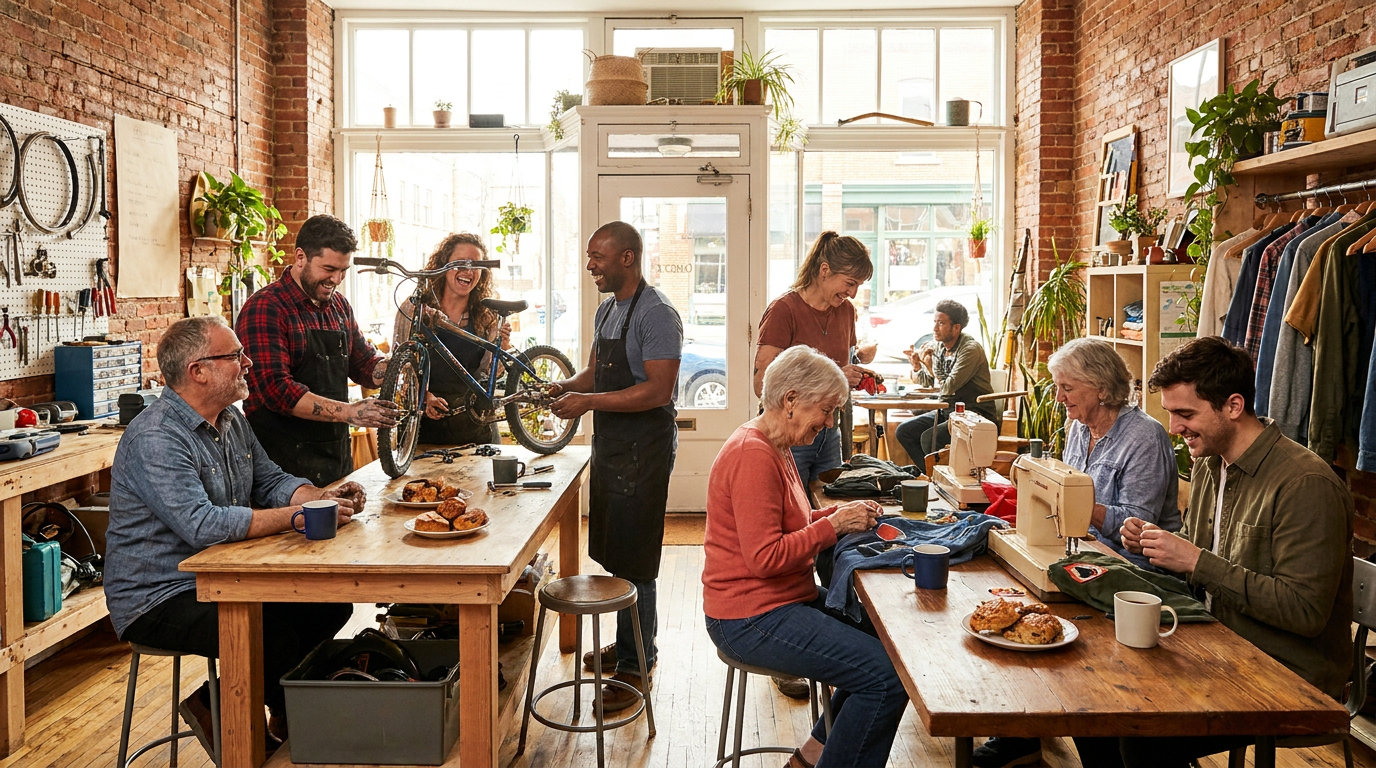
The hunger for these spaces is driven by a need for 'social nutrition'—small, repeatable moments of frictionless interaction that fit seamlessly into modern schedules. Making friends as an adult is notoriously difficult not because of a lack of social skills, but because of the absence of recurring, low-pressure proximity. To counter this, 2026 has seen an explosion of 'micro-communities.' Instead of planning grand, high-stakes social outings, people are joining repair cafes, errand clubs, and local maker spaces that meet weekly or biweekly to share simple, everyday tasks.[4]
The hunger for these spaces is driven by a need for 'social nutrition'—small, repeatable moments of frictionless interaction that fit seamlessly into modern schedules.
These micro-communities succeed because they are built around regularity and shared activity, which naturally lowers the barrier to conversation. At a community repair night, for instance, fixing a bicycle or mending a jacket provides a built-in focus, allowing natural pauses for dialogue without the intensity of a formal networking event. By keeping groups small—typically 6 to 20 regulars—these gatherings offer enough variety for new connections while maintaining the familiarity required to build trust over time, proving that consistency is far more valuable than intensity.[4]
Gen Z is notably leading this 'great reconnection.' Having come of age during pandemic lockdowns and an era of hyper-curated digital identities, younger demographics are increasingly trading endless content streams for genuine, in-real-life community. The novelty of the online world has worn thin, prompting a deliberate pivot toward run clubs, listening bars, and analog hobby groups. For this generation, showing up to a physical space week after week is a conscious reclamation of time and attention from algorithms, signaling a profound cultural shift toward tangible human presence.[5]

The value of these spaces extends far beyond mere socialization; they provide a critical framework for civic and emotional wellbeing. Researchers argue that effective third places support communities through four distinct mechanisms: stimulation, support, protection, and care. They offer the cognitive stimulation of encountering diverse viewpoints and the emotional support of being recognized by regulars. Crucially, they also provide the literal protection of serving as warming centers or mutual aid hubs during crises, proving that these spaces are essential safety nets rather than just pleasant amenities.[3]
This dynamic is visible in legacy third places around the world, though many face existential threats. In South Korea, traditional neighborhood public baths—known as mogyoktang—have long served as vital social infrastructure where locals share hot soups, trade gossip, and experience a quiet, shared sociability. However, as these humble bathhouses close due to redevelopment and rising costs, communities are losing the spaces that facilitate small kindnesses and intergenerational connection, underscoring the urgent need to protect and reinvent these hubs before they vanish entirely.[8]
In the United States, public parks are increasingly taking on the role of the neighborhood living room. In cities like Philadelphia, spaces such as Rittenhouse Square and Clark Park function as shared backyards where office workers, retirees, and chess players share benches without needing an agenda. These parks are not just scenic amenities; they are the social infrastructure that allows a city's residents to feel a sense of belonging and proximity to people they might not otherwise choose to meet, pushing back against the transactional nature of modern urban life.[6]

The commercial sector is also recognizing the immense value of this cultural shift. Hospitality brands are pivoting away from purely transactional models to embrace community programming. Hotel lobbies are being redesigned to feel like public living rooms, and local cafes are hosting open mics and town-hall conversations. In an industry where customer acquisition is expensive, becoming the reliable 'Every Tuesday at 5:30 PM' spot fosters a deep emotional loyalty that transcends traditional marketing, proving that community-building is a highly effective competitive advantage.[6][9]
Yet, a tension remains between commercial and non-commercial third places. While a coffee shop offers a vital public square, the expectation to purchase a premium latte can inadvertently exclude lower-income residents. This is why the rise of cooperative ownership and civic-led spaces—like libraries expanding their roles to host language exchanges and board-game afternoons—is so critical. True social infrastructure must remain accessible to everyone, regardless of their spending power, ensuring that the benefits of community connection are distributed equitably across all demographics.[4][6]
Ultimately, the resurgence of the third place in 2026 is a testament to the enduring human need for physical presence. We are learning that connection is not a project to be optimized, but a place to be inhabited. By showing up consistently to a shared space, doing something small, and allowing relationships to emerge naturally, communities are proving that the most valuable interactions are still the ones that cannot be measured in likes or follows. In a hyper-connected world, the most revolutionary act is simply sharing a room.[4][5]
How we got here
1989
Sociologist Ray Oldenburg coins the term 'third place' in his book The Great Good Place.
2019–2021
The pandemic accelerates the shift to remote work and digital-only socializing, severely eroding physical community hubs.
2023
The World Health Organization officially classifies loneliness as a global public health concern.
2026
A surge in 'micro-communities' and intentional neighborhood living rooms marks a cultural pivot back to in-person connection.
Viewpoints in depth
Urban Planners & Architects
Focus on retrofitting the built environment to engineer serendipity.
This camp argues that modern isolation is largely a design failure. By prioritizing privacy and efficiency, contemporary housing and office towers have eliminated the natural friction of daily life. Architects advocate for 'social infrastructure'—embedding 'bump spaces,' shared mail kiosks, and transparent ground floors into blueprints. They believe that if the physical environment forces people to cross paths comfortably, community will naturally follow.
Community Organizers
Champion grassroots, non-transactional spaces as the purest form of third places.
For community advocates, true third places must be accessible to everyone, regardless of income. They point to the rise of 'micro-communities,' repair cafes, and Dutch 'buurthuiskamers' as models of democratic, self-managed social infrastructure. This perspective warns that relying solely on commercial spaces like cafes or bars inherently excludes marginalized groups, arguing that the future of connection lies in shared, cooperative ownership.
Hospitality Industry
Sees the third place revival as a model for deep customer loyalty.
Hospitality brands recognize that consumers are increasingly fatigued by screens and are willing to spend money on genuine experiences of belonging. By transforming hotel lobbies into public living rooms and prioritizing community programming over quick table turnover, operators aim to become the reliable 'Every Tuesday' spot. They argue that fostering emotional loyalty through community is the most sustainable business model in a post-pandemic economy.
What we don't know
- Whether non-commercial third places can secure the long-term funding needed to survive in increasingly expensive urban centers.
- How the integration of 'bump spaces' in new architectural developments will perform over decades of changing residential demographics.
- If the hospitality industry's pivot toward community programming will remain authentic or eventually feel overly corporatized.
Key terms
- Third Place
- A sociological term for a community hub that sits between home and work, serving as a neutral ground for casual social connection.
- Social Infrastructure
- The physical spaces and organizations—such as libraries, parks, and community centers—that shape how people interact.
- Micro-community
- A small, recurring group built around a specific activity or shared routine, designed to foster low-pressure proximity.
- Bump Space
- Architectural features designed to encourage brief, unplanned encounters between residents, increasing the likelihood of casual social interactions.
- Buurthuiskamer
- A Dutch concept translating to 'neighborhood living room,' serving as a low-barrier, self-managed community space.
Frequently asked
What exactly is a 'third place'?
Coined by sociologist Ray Oldenburg, a third place is a community hub outside of home (the first place) and work (the second place), such as a library, park, or local cafe.
What are 'bump spaces' in architecture?
Bump spaces are design features like narrow hallways, shared mail kiosks, or communal stair landings that naturally encourage brief, unplanned encounters between neighbors.
How do micro-communities combat loneliness?
They provide recurring, low-pressure environments—like a weekly repair cafe or run club—where people can build familiarity and trust over time without the stress of formal socializing.
Why are traditional third places disappearing?
Many spontaneous hubs have been eroded by the rise of remote work, convenience culture (like food delivery), and escalating commercial rents that push out independent venues.
Sources
Source coverage
9 outlets
3 viewpoints surfaced









[1]TU EindhovenUrban Planners & Architects
Prefiguring the Caring City: everyday practices and postcapitalist possibility in neighborhood living rooms
Read on TU Eindhoven →[2]Intellect ArchitectsUrban Planners & Architects
Architecture as Social Infrastructure
Read on Intellect Architects →[3]Color Coded MagazineCommunity Organizers
The Soft Revolution of Third Spaces
Read on Color Coded Magazine →[4]WildheartsCommunity Organizers
Why micro-communities are the lifestyle trend that actually sticks
Read on Wildhearts →[5]Young HollywoodCommunity Organizers
Gen Z is Rebuilding 'Third Places'
Read on Young Hollywood →[6]Philadelphia TodayCommunity Organizers
Parks That Function Like Neighborhood Living Rooms
Read on Philadelphia Today →[7]Factlen Editorial Team
Synthesis by Factlen editorial team
Read on Factlen Editorial Team →[8]CreatripCommunity Organizers
National Bathhouse Tour: Preserving Korea's Disappearing Social Infrastructure
Read on Creatrip →[9]One HausHospitality Industry
The Reinvention of the Third Place in 2026
Read on One Haus →

Every angle. Every day.
Get lifestyle stories with full source coverage and perspective breakdowns delivered to your inbox.