
The Co-Housing Boom: Can Intentional Communities Cure the Loneliness Epidemic?
As global isolation rates soar, a once-niche architectural movement combining private homes with shared communal spaces is experiencing unprecedented mainstream growth.
By Factlen Editorial Team
- Housing Equity Campaigners
- Advocates focused on democratizing access to shared living models to prevent exclusivity.
- Institutional Developers
- Real estate professionals scaling the model to meet massive demand efficiently.
- Intentional Living Advocates
- Grassroots organizers who believe community must be built through shared effort, not just bought.
What's not represented
- · Local zoning boards and municipal planners who often block high-density shared housing.
- · Former residents who left co-housing due to interpersonal conflicts or lack of privacy.
Why this matters
With 30% of households in some Western nations now living alone, traditional real estate is failing to meet human social needs. The mainstreaming of co-housing offers a scalable, architectural solution to a public health crisis, fundamentally rethinking how neighborhoods are built.
Key points
- Co-housing combines fully private homes with extensive shared facilities to combat social isolation.
- The sector is experiencing an unprecedented boom, with Denmark building 8,200 units since 2020.
- The model is shifting from grassroots, resident-led projects to professionally developed real estate.
- Affordability remains a challenge, prompting partnerships with Community Land Trusts to subsidize units.
- Architectural designs focus on 'graduated privacy' to make daily neighborly interaction effortless.
The modern paradox of the digital age is that society has never been more connected, yet structurally, we have never been more isolated. In the United Kingdom alone, recent data reveals that 30% of households are now single-occupancy, with millions living entirely alone. As the loneliness epidemic is increasingly treated as a severe public health crisis, a quiet architectural rebellion is gaining unprecedented momentum.[1][7]
It is called "co-housing," and it is rapidly moving from the fringes of 1960s counterculture into the mainstream residential real estate market. Unlike historical communes where finances and living spaces were entirely pooled, modern co-housing operates on a delicate balance of independence and integration.[3][5]
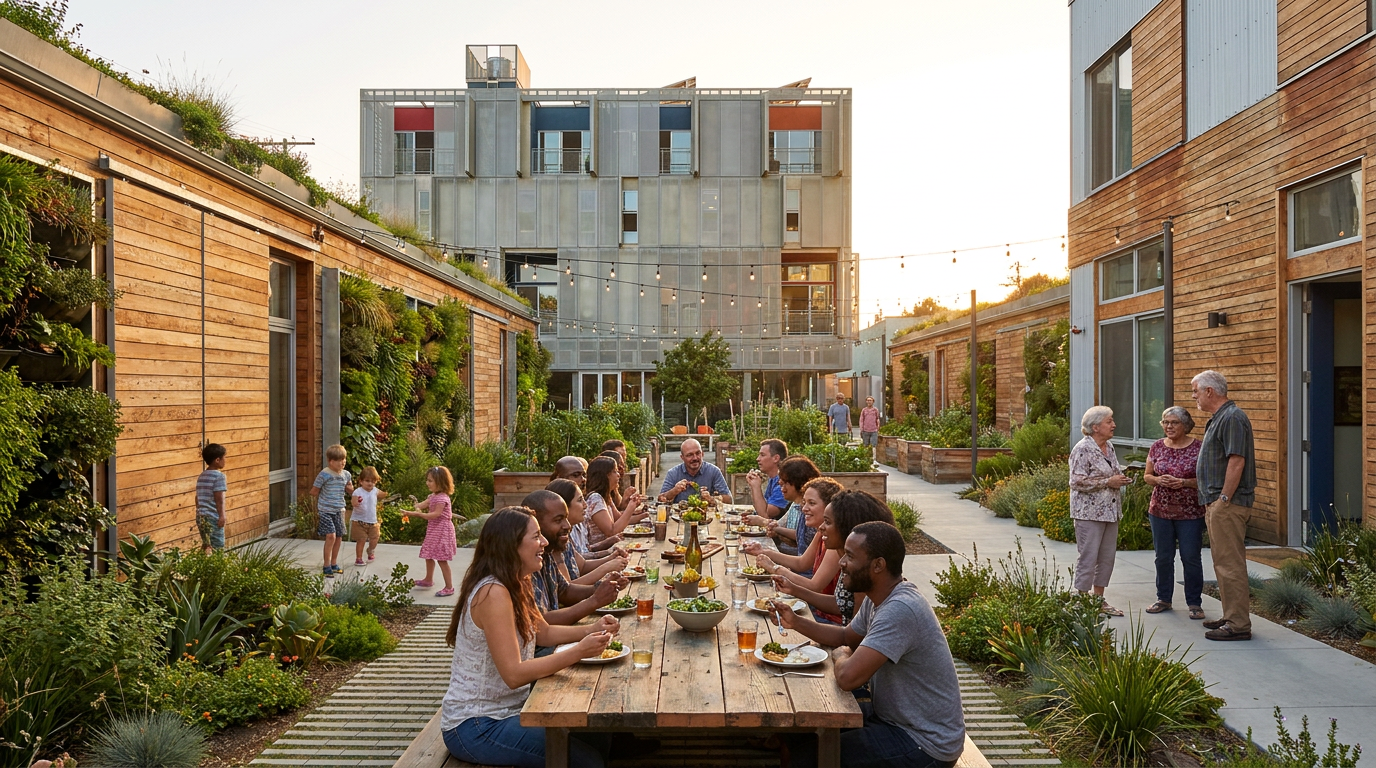
The model relies on an architectural principle known as "graduated privacy." Residents own or rent their own fully equipped, self-sufficient private homes. However, these homes are clustered tightly around extensive shared facilities—typically anchored by a "common house" featuring a large dining room, commercial-grade kitchen, workshops, gardens, and childcare areas.[5][6]
The goal is to engineer "everyday sociability" directly into the built environment. Instead of driving into an attached garage and disappearing behind a privacy fence, residents walk along pedestrian-only paths from the perimeter parking lot to their front doors, naturally crossing paths with neighbors. It is a physical layout designed to make isolation difficult and connection effortless.[4][6][7]
The numbers demonstrate a massive surge in demand. In Denmark, where the concept originated, the sector is experiencing an unprecedented boom. Between 2020 and 2025, nearly 8,200 new co-housing units were built, meaning that 45% of all such homes nationwide were constructed in just the last six years.[3]

The UK is witnessing a similar groundswell. There are now over 120 co-housing developments either completed or actively underway, with national waiting lists swelling past 2,000 names. Retirees, in particular, are flocking to the model as a vibrant alternative to traditional assisted living, trading isolation for informal mutual support and daily human contact.[1]
The United States market, while smaller with roughly 160 established communities, is also pivoting. The Foundation for Intentional Community notes a sharp rise in inquiries from young families seeking a "village" to help raise children in an era of exorbitant childcare costs and distant extended families.[2][5][7]
The United States market, while smaller with roughly 160 established communities, is also pivoting.
Despite the utopian appeal, the model faces a significant structural critique: the affordability trap. Because these projects require extensive land, custom architectural design, and lengthy consensus-based planning, buying into a grassroots co-housing community is often more expensive than purchasing a standard condominium.[2]

This financial barrier has led to accusations of a "middle-class bias." Critics argue that intentional communities, while socially enriching, risk becoming exclusive enclaves for the affluent, inadvertently leaving behind the lower-income demographics who are often the most vulnerable to the health impacts of urban isolation.[2][4]
To combat this exclusivity, a new wave of developers is partnering with Community Land Trusts (CLTs). By having a nonprofit hold the land and removing its cost from the purchase price of the home, communities can offer permanently income-restricted units. In several recent US developments, up to two-thirds of homes have been reserved for buyers earning below the area median income.[2]
Another major shift transforming the landscape is how these communities are actually built. Historically, 90% of co-housing was "bottom-up"—initiated by future residents who spent years, sometimes decades, wrangling architects, securing financing, and fighting zoning boards.[3]
Today, the market is increasingly "top-down." In Denmark, over 92% of new co-housing homes built since 2020 have been driven by private developers and social housing organizations. Institutional investors are beginning to view co-housing not as a fringe experiment, but as a highly durable residential asset class with guaranteed demand.[3]

This developer-led era solves the agonizing bottleneck of grassroots financing and construction, allowing projects to be completed in months rather than decades. Crucially, it also opens the door for renters to access intentional communities, rather than restricting the lifestyle to buyers with significant upfront capital.[3][7]
However, purists within the movement worry that "turnkey" co-housing dilutes the very intentionality that makes the model work. When residents do not go through the crucible of designing the community together, there are open questions about whether they will still forge the deep, resilient bonds necessary to share chores, resolve disputes, and care for one another long-term.[4][7]

The consensus among social researchers remains cautiously optimistic. Studies by the London School of Economics suggest that even without the intense mutual commitment of grassroots projects, the physical architecture of shared spaces naturally fosters higher levels of trust, belonging, and connection than traditional housing layouts.[4]
Ultimately, the co-housing debate forces a fundamental reevaluation of what a home is supposed to do. For decades, residential real estate has been valued almost exclusively by square footage, privacy, and property lines.[1][7]
The mainstream rise of intentional communities suggests a shifting cultural metric. Increasingly, homes are being judged not just by the shelter they provide, but by whether they can help people live less alone. As the loneliness epidemic deepens, the architecture of connection may become the most valuable amenity of all.[1][7]
How we got here
1960s
The modern co-housing concept originates in Denmark under the name 'bofællesskaber' (living communities).
1988
The concept is formally introduced to the United States by architects Kathryn McCamant and Charles Durrett.
2020
The global pandemic triggers a massive surge in demand for intentional communities as lockdowns exacerbate the loneliness epidemic.
2023
Denmark sets a new national record with over 2,000 co-housing homes completed in a single year.
2026
Institutional investors and private developers dominate the new co-housing market, shifting the model from grassroots to mainstream.
Viewpoints in depth
Intentional Living Advocates
Grassroots organizers who believe community must be built, not bought.
For decades, the foundation of intentional communities has been the shared struggle of creating them. Advocates argue that the years spent designing the site, arguing over values, and securing financing act as a necessary crucible. This process filters out those uncommitted to the lifestyle and forges the deep trust required to share resources and govern by consensus. They warn that 'turnkey' developer models, where residents simply sign a lease and move in, risk creating glorified apartment complexes that lack true social resilience when interpersonal conflicts inevitably arise.
Housing Equity Campaigners
Advocates focused on democratizing access to shared living models.
Social researchers and affordable housing advocates point out a glaring flaw in the co-housing movement: it is overwhelmingly white, middle-class, and expensive. Because custom eco-architecture and extensive shared facilities cost money, buying into a community often requires significant capital. This camp argues that unless co-housing aggressively partners with Community Land Trusts (CLTs) and social housing organizations to subsidize units, it will remain a boutique amenity for the affluent rather than a structural cure for the widespread loneliness epidemic.
Institutional Developers
Real estate professionals scaling the model to meet massive demand.
Developers argue that the traditional 'bottom-up' model is hopelessly inefficient. Expecting groups of amateur citizens to act as real estate developers, navigate zoning laws, and secure multi-million dollar commercial loans results in a massive failure rate for proposed communities. By taking over the financing and construction, institutional developers argue they are democratizing the model—delivering high-quality shared living spaces in months rather than decades, and opening the door to renters who could never afford to buy into a grassroots project.
What we don't know
- Whether turnkey, developer-led communities will maintain the same deep social bonds as grassroots projects over the long term.
- How effectively the model can scale in dense urban environments where land costs prohibit sprawling shared facilities.
Key terms
- Co-housing
- A residential community model combining private homes with extensive shared facilities to encourage daily social interaction.
- Graduated Privacy
- An architectural concept where spaces transition smoothly from strictly private zones to semi-private porches and fully public common areas.
- Community Land Trust (CLT)
- A nonprofit corporation that holds land on behalf of a community, separating the cost of land from the housing to ensure long-term affordability.
- Common House
- The central shared building in a co-housing community, typically featuring a large dining room, kitchen, guest rooms, and recreational spaces.
Frequently asked
What is the difference between a commune and co-housing?
Communes typically pool income and resources entirely. Co-housing features private finances and fully self-sufficient private homes that are clustered around shared amenities.
Do I have to share a bathroom or kitchen in co-housing?
No. Modern co-housing units are fully equipped private homes. The shared kitchen and dining hall in the common house are used for optional community meals and gatherings.
Is co-housing cheaper than traditional housing?
Usually not upfront. The custom design and extensive shared facilities often make the purchase price comparable or higher, though shared resources can lower long-term living costs.
How are decisions made in these communities?
Most communities use consensus or sociocracy, requiring residents to actively participate in governance, dispute resolution, and property management.
Sources
Source coverage
7 outlets
3 viewpoints surfaced







[1]Real Estate InsiderInstitutional Developers
Cohousing Demand Rises Amid Loneliness Crisis
Read on Real Estate Insider →[2]ShelterforceHousing Equity Campaigners
Can Cohousing Also Be Affordable Housing?
Read on Shelterforce →[3]Gorrissen FederspielInstitutional Developers
Denmark is in the middle of an unprecedented co-housing boom
Read on Gorrissen Federspiel →[4]Housing LINHousing Equity Campaigners
Living Closer: The Role of Co-Housing in Tackling Loneliness
Read on Housing LIN →[5]Foundation for Intentional CommunityIntentional Living Advocates
What is an Intentional Community?
Read on Foundation for Intentional Community →[6]Econology InstituteIntentional Living Advocates
Foundations of Intentional Community: Community-Centered Design Principles
Read on Econology Institute →[7]Factlen Editorial Team
Synthesis by Factlen editorial team
Read on Factlen Editorial Team →

Every angle. Every day.
Get community stories with full source coverage and perspective breakdowns delivered to your inbox.