
The Analog Renaissance: Why Gen Z is Rebuilding the 'Third Place'
Driven by digital fatigue, a new generation is reviving physical community hubs—from listening bars to run clubs—redefining how society connects offline.
By Factlen Editorial Team
- Civic Advocates & Sociologists
- Viewing third places as essential infrastructure for democracy, pluralism, and community resilience.
- Digital Natives
- Seeking tactile, offline experiences as an antidote to screen fatigue and digital atomization.
- Retail Strategists
- Adapting commercial real estate to monetize the demand for in-person experiences and increased dwell time.
What's not represented
- · Rural Communities
- · Low-Income Urban Residents
- · Elderly Populations
Why this matters
As loneliness and screen time reach historic highs, the resurgence of physical gathering spaces offers a tangible blueprint for rebuilding local communities and improving public mental health. Understanding this shift is crucial for anyone looking to foster deeper connections in an increasingly digital world.
Key points
- Sociologist Ray Oldenburg coined the term 'third place' in 1989 to describe essential community hubs outside of home and work.
- Driven by digital fatigue, Gen Z is leading a movement away from online-only socialization toward physical gathering spaces.
- New third places often center around shared, low-stakes activities like run clubs, listening bars, and board game cafes.
- Retail real estate is adapting to this trend, transforming traditional transactional malls into experiential destinations.
- Public institutions like libraries remain vital, offering free, accessible spaces that bridge generational divides.
In 2026, the most digitally connected generation in human history is leading a quiet rebellion against the screen. Tired of atomized, online-only lives, young adults are increasingly logging off and seeking out physical spaces to gather. This movement is not a rejection of technology, but a conscious pivot toward environments that offer tangible, uncurated human connection.[5]
This cultural shift is driving the resurgence of what sociologists call the "third place." Coined by American urban sociologist Ray Oldenburg in his 1989 book The Great Good Place, the term describes the informal public gathering spots that exist outside of the home—which serves as the first place—and the workplace or school, which acts as the second.[1]
Oldenburg defined these spaces—such as cafes, barbershops, libraries, and local parks—as essential anchors of community life. They are characterized by their accessibility, low cost, and leveling nature, where social status is temporarily suspended and conversation is the primary activity. In these environments, people become regulars, forming the weak ties that sustain neighborhood resilience.[1][2]

For much of the 2010s and early 2020s, the physical third place was steadily replaced by digital alternatives. Group chats, Discord servers, and sprawling social media platforms became the default arenas for socialization, offering a frictionless semblance of connection without the need to leave the house. The pandemic era further accelerated this migration, cementing the internet as the modern town square.[5]
However, the limitations of this digital atomization have become starkly apparent. While online networks excel at information distribution, they often lack the spontaneity, tactile richness, and emotional depth of in-person interaction. The pressure to constantly curate a personal brand online has left many feeling exhausted, sparking a deep-seated craving for authentic, unfiltered contact.[5][7]
The resulting course correction has sparked what analysts are calling an "Analog Renaissance." Recent industry data indicates that 74% of Generation Z now actively value real-world experiences over digital ones, driving a massive surge in attendance at physical community hubs. This demographic is proving that the novelty of the online world has worn thin.[6]
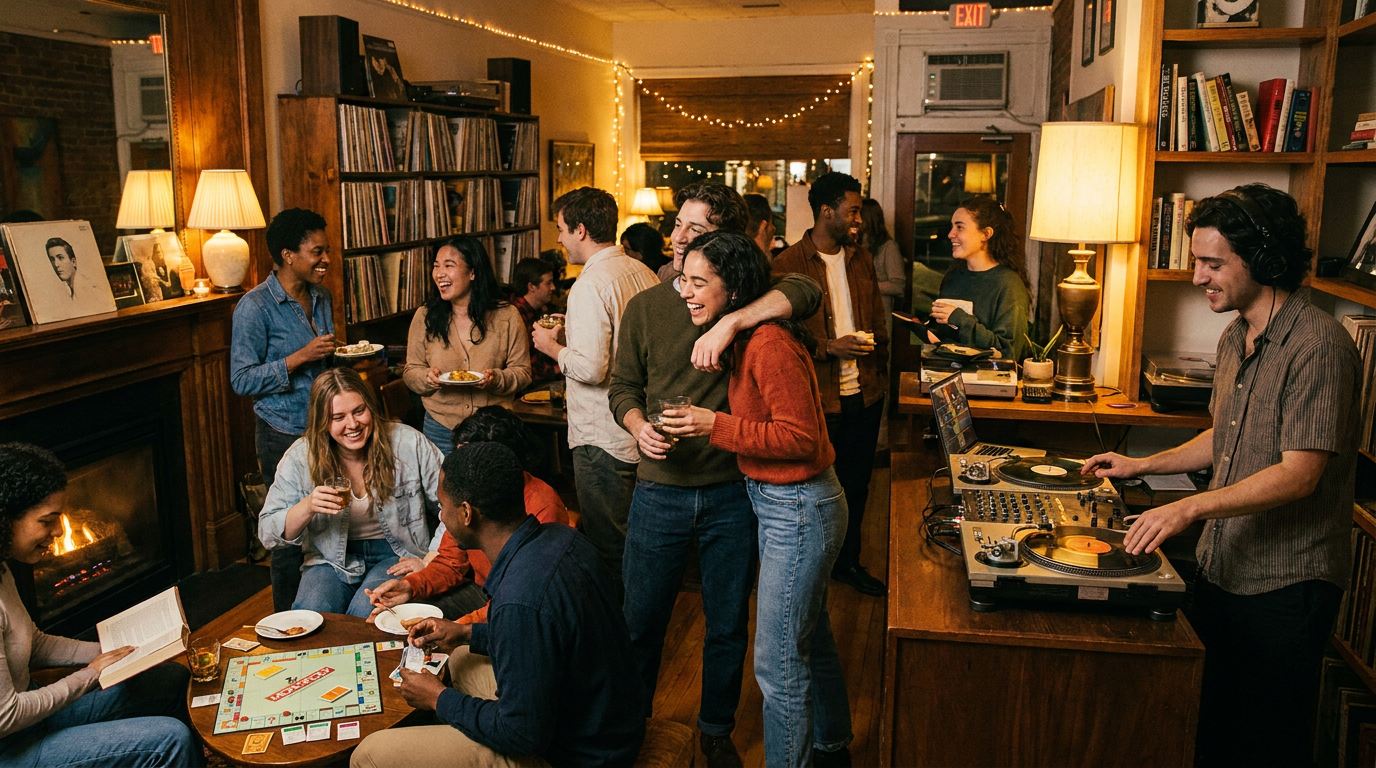
The modern iterations of these spaces look different from the smoky diners of the 20th century. Today’s third places are often built around shared, low-stakes activities. Listening bars, for instance, have emerged as venues dedicated not to networking or loud partying, but to the communal, high-fidelity experience of appreciating an album from start to finish.[5]
Similarly, run clubs and outdoor fitness groups have transformed solitary exercise into major social events. These gatherings provide a structured environment for repeated, low-pressure proximity, allowing strangers to gradually transition into acquaintances and friends without the awkwardness of formal networking.[5][7]

Interestingly, this analog shift embraces a "phygital" model, where digital tools are used to facilitate physical gatherings rather than replace them. Influencers and online creators are increasingly opening brick-and-mortar cafes and hosting pop-up events to give their digital communities a tangible footprint, turning online clout into offline coffee spaces.[6]
Interestingly, this analog shift embraces a "phygital" model, where digital tools are used to facilitate physical gatherings rather than replace them.
This cultural pivot is also reshaping retail real estate. Traditional shopping malls, once threatened by the dominance of e-commerce, are being reimagined as experiential town squares. Research shows that over 80% of young consumers who visit malls today do so primarily to socialize rather than to shop, treating the corridors as backdrops for human connection.[7]
To accommodate this shift, property developers are pivoting away from purely transactional retail toward spaces that encourage "dwell time." Board game cafes, indoor recreation centers, and expansive food halls designed for lingering are replacing traditional apparel anchors, proving that the relational is outperforming the transactional.[7]
Beyond commercial venues, public institutions are experiencing a renewed appreciation. Libraries, in particular, are being recognized as the ultimate surviving third places. They remain free, accessible to all demographics, and open for long hours, quietly filling the cracks of modern civic life where commercial spaces fall short.[2]

At university campuses and in city centers, libraries host clubs, pop-up services, and collaborative study sessions. They provide a vital refuge where people can gather without the expectation of spending money, proving that the demand for neutral, non-commercial gathering spaces remains incredibly robust.[2]
The revival of third places also carries profound civic implications. Observers note that these informal gathering spots serve as crucibles of pluralism, where people learn to interact with neighbors they might not otherwise encounter. They transform anonymous residents into recognizable faces, building the foundation of a healthy democracy.[3]
In an era of intense political polarization and curated media diets, third places provide a low-stakes training ground for citizenship. They force individuals to navigate minor disagreements, share physical space, and recognize the shared humanity of those outside their immediate demographic and ideological bubbles.[3]
Academic research further highlights the generation-bridging potential of these spaces. Physical third places counter the trend of age-segregated living by fostering environments where different generations can engage in mutual discovery and shared rituals, reducing the intergenerational divide through casual, embodied interactions.[4]
The resurgence of tactile hobbies—such as pottery, knitting, and film photography—complements this trend perfectly. These "analog" pursuits offer a tangible sense of craftsmanship and originality that cannot be replicated by artificial intelligence or digital media, giving people a physical anchor in an increasingly virtual world.[7]

Despite this momentum, the modern third place faces significant economic headwinds. In cities with soaring commercial rents, maintaining low-cost, accessible spaces that do not pressure patrons to constantly spend money is a difficult balancing act. Independent businesses often struggle to survive while prioritizing community over throughput.[3][7]
To survive, many contemporary hubs are adopting hybrid models, combining retail, food service, and event hosting to subsidize the cost of providing communal space. This ensures the doors stay open, even if it slightly alters the purely non-commercial vision Oldenburg originally outlined.[6]
How we got here
1989
Sociologist Ray Oldenburg publishes 'The Great Good Place', coining the term 'third place'.
2010s
The rise of smartphones and social media shifts much of casual socialization into digital spaces.
2020–2022
Pandemic lockdowns accelerate digital atomization, highlighting the emotional limits of online-only connection.
2024–2025
A noticeable cultural shift begins as Gen Z popularizes 'analog hobbies' and physical meetups.
2026
The 'Third Place Revival' becomes a dominant lifestyle and retail trend, reshaping urban spaces and commercial real estate.
Viewpoints in depth
Civic Advocates & Sociologists
Viewing third places as essential infrastructure for democracy and community resilience.
For urban planners and sociologists, the decline of the third place is a public health and democratic crisis. They argue that without neutral, low-cost spaces where citizens of different backgrounds can mingle, society naturally fractures into echo chambers. This camp emphasizes that true third places must remain highly accessible and level the playing field, warning that if community hubs become too heavily commercialized or expensive, they fail to serve their core civic function of fostering pluralism and casual neighborhood bonds.
Retail Strategists
Adapting commercial real estate to monetize the demand for in-person experiences.
Faced with the dominance of e-commerce, retail developers view the third place revival as an economic lifeline. This perspective focuses on transforming transactional spaces—like traditional shopping malls—into experiential destinations. By incorporating board game cafes, boutique fitness studios, and expansive food halls, strategists aim to increase 'dwell time.' Their primary challenge is balancing the sociological need for free, lingering socialization with the economic realities of high commercial rents and the necessity of generating revenue.
Digital Natives
Seeking tactile, offline experiences as an antidote to screen fatigue and digital atomization.
For the generation that grew up entirely online, the internet has lost its novelty as a primary social square. This camp views the return to physical spaces and 'analog hobbies' not as nostalgia, but as a necessary boundary against the exhaustion of constant connectivity. They advocate for intentional, low-stakes offline gatherings—like run clubs or listening bars—where the pressure to curate a personal brand is removed, allowing for authentic, unscripted human connection.
What we don't know
- Whether commercialized 'phygital' spaces can truly replicate the civic and leveling benefits of traditional, low-cost third places.
- How the economic realities of high urban rents will impact the long-term sustainability of independent community hubs.
Key terms
- Third Place
- An informal, public social environment distinct from the home and the workplace, essential for community building.
- Digital Atomization
- The process by which individuals become increasingly isolated from physical communities due to a reliance on digital communication.
- Phygital
- A hybrid concept that blends physical experiences with digital elements, such as using an app to organize an in-person run club.
- Dwell Time
- A retail metric measuring the amount of time a consumer spends lingering in a commercial space, which experiential hubs seek to maximize.
- Analog Renaissance
- The resurgence of interest in non-digital, tactile hobbies and physical media as a reaction against constant screen exposure.
Frequently asked
What exactly is a third place?
Coined by sociologist Ray Oldenburg, a third place is an informal public gathering spot outside of the home (first place) and work or school (second place). Examples include cafes, libraries, parks, and barbershops.
Why did physical third places decline?
A combination of suburban sprawl, the rise of digital social networks, and the economic pressures of high commercial rents led to a decrease in accessible, low-cost community hubs over the past few decades.
What is the 'Analog Renaissance'?
It is a cultural trend, largely driven by Gen Z, that embraces tactile, offline activities—such as film photography, knitting, and vinyl records—as an antidote to screen fatigue and digital overload.
Do online communities count as third places?
While platforms like Discord and group chats serve a similar social function, sociologists argue they often lack the spontaneity, diversity, and depth of in-person interactions found in physical third places.
Sources
Source coverage
7 outlets
3 viewpoints surfaced







[1]GrokipediaCivic Advocates & Sociologists
Ray Oldenburg - Impact on Sociology and Urban Planning
Read on Grokipedia →[2]Boston UniversityCivic Advocates & Sociologists
Why Is Everybody Talking About “Third Places” Right Now?
Read on Boston University →[3]Washington MonthlyCivic Advocates & Sociologists
The Shrinking Space Between Home and Work
Read on Washington Monthly →[4]Emerald PublishingCivic Advocates & Sociologists
Generation-bridging experiences in third places
Read on Emerald Publishing →[5]Young HollywoodDigital Natives
The Third Place Takes Over: Gen Z's Revival
Read on Young Hollywood →[6]Coffee IntelligenceRetail Strategists
The new face of the third place
Read on Coffee Intelligence →[7]Factlen Editorial TeamDigital Natives
Synthesis by Factlen editorial team
Read on Factlen Editorial Team →
More in lifestyle
See all 56 stories →Workplace Culture
The Global Rise of the 'Right to Disconnect': How New Laws Are Redrawing the Boundaries of Work
7 sources

Child Development
The 'Serve and Return' Mechanism: How Simple Interactions Shape Infant Brain Architecture
7 sources
Biotech Skincare
The Rise of Biotech Beauty: How Lab-Grown Ingredients Are Reshaping Skincare
8 sources

Skincare Science
The Science of Skin Barrier Repair: How Ceramides and Microbiome Care Replaced Harsh Exfoliants
8 sources
Every angle. Every day.
Get lifestyle stories with full source coverage and perspective breakdowns delivered to your inbox.