
The 90,000-Unit Boom: How Empty Offices Are Finally Becoming Apartments
Driven by record office vacancies and a severe housing shortage, the conversion of commercial towers into residential apartments has surged to an all-time high in 2026.
By Factlen Editorial Team
- Urban Planners & Policymakers
- Focuses on the civic necessity of saving downtowns, expanding housing stock, and updating outdated zoning codes.
- Commercial Developers
- Focuses on the financial mechanics, speed-to-market advantages, and repositioning of distressed assets.
- Architects & Designers
- Focuses on the structural puzzles and creative programming required to make deep-floor-plate conversions livable.
- Factlen Analysis
- Synthesizes the macro trend and its long-term impact on sustainable urban design.
What's not represented
- · Existing Commercial Tenants
- · Affordable Housing Advocates
Why this matters
Empty downtowns drain city tax revenues and hurt local businesses, while a nationwide housing shortage keeps rents artificially high. Converting obsolete offices into apartments solves both crises simultaneously, reshaping the future of how and where we live.
Key points
- The national pipeline of office-to-apartment conversions reached a record 90,300 units in early 2026.
- Office buildings now account for 47% of all adaptive reuse projects nationwide.
- Architects are solving the 'deep floor plate' problem by placing amenities like gyms in windowless interior cores.
- New York City leads the trend with over 16,000 units, aided by zoning reforms and tax abatements.
- Los Angeles recently passed a citywide ordinance eliminating parking minimums for conversion projects.
- Adaptive reuse saves 50 to 75 percent of the embodied carbon emissions compared to new construction.
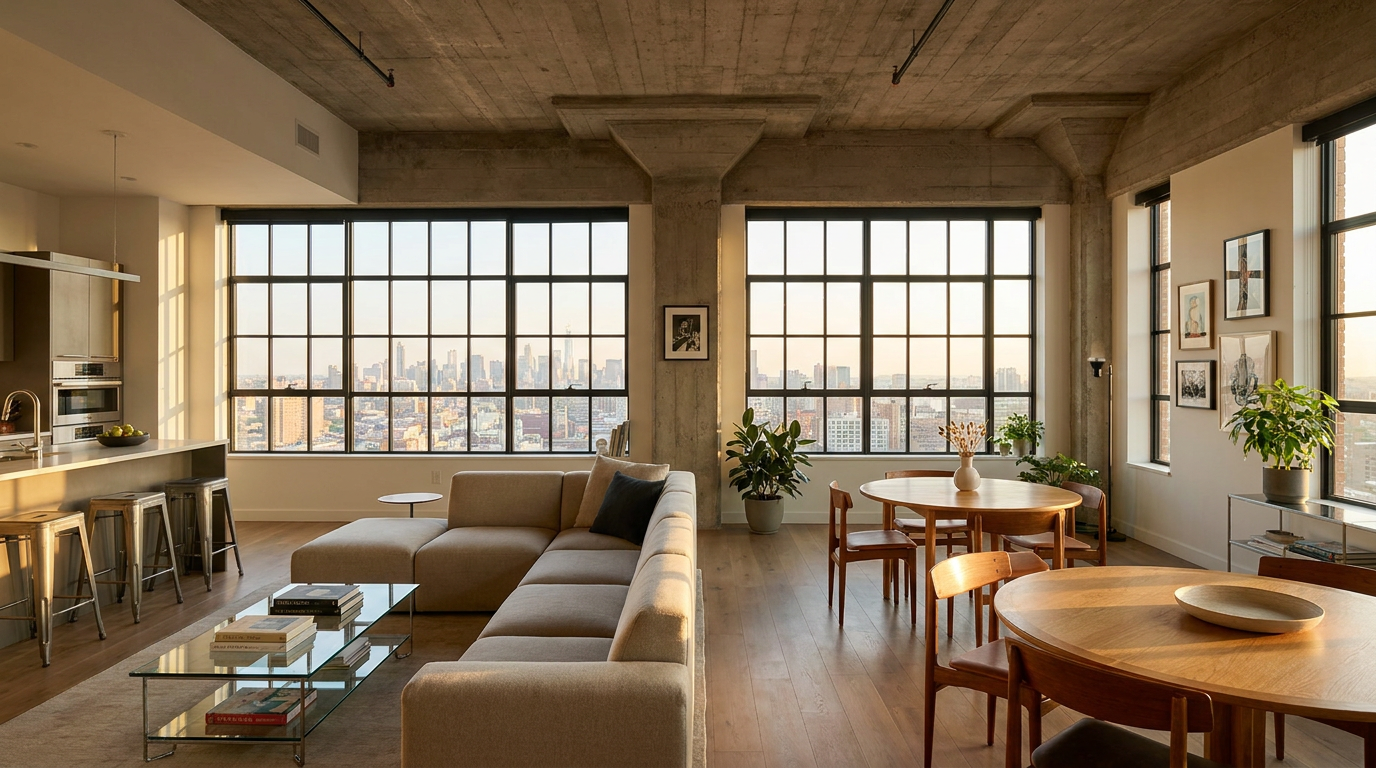
For decades, the American downtown was defined by a simple, predictable rhythm: millions of workers commuted in at nine, and the concrete canyons emptied out at five. The pandemic shattered that equilibrium permanently, leaving cities grappling with a dual crisis: a massive glut of empty office towers and a crippling shortage of affordable housing. But in 2026, those two distinct problems are increasingly being smashed together to form a single, elegant solution. Adaptive reuse—specifically the conversion of obsolete commercial offices into residential apartments—has evolved from a niche architectural experiment into a mainstream real estate strategy.[7]
The scale of the transformation is unprecedented. According to early 2026 data, the national pipeline of office-to-apartment conversions has surged to 90,300 units. That represents a 28 percent year-over-year increase and is nearly four times the volume seen just four years ago. Office buildings now account for 47 percent of all adaptive reuse projects nationwide, easily outpacing hotels and industrial properties as the primary target for redevelopment.[1][2]

This boom is born of sheer economic necessity. The national office vacancy rate continues to hover near 20 percent, with physical occupancy in many older buildings stuck at roughly half of pre-pandemic levels. At the same time, the United States faces a severe housing deficit, with millions of new apartments needed over the next decade to meet demand. With older Class B and C office buildings bleeding tenants to newer, amenity-rich towers, property owners are facing a stark choice: default on their loans, demolish the structures, or adapt.[2][4]
Office-to-residential conversions are no longer viewed as just a workaround for distressed buildings; they have become a strategic tool for adding housing in supply-constrained markets. The financial math, which for years heavily favored ground-up construction, has finally tilted. As commercial property valuations reset and new construction costs remain elevated, repurposing an existing shell offers a critical speed-to-market advantage, allowing developers to bypass lengthy land-clearing and foundational work.[4][5]
However, turning a 1980s cubicle farm into a thriving residential community is a complex architectural puzzle. The feasibility of a conversion depends entirely on the building's physical bones. The most significant hurdle is the floor plate—the total square footage and depth of a single floor. Modern office buildings are often massive, block-sized squares designed to pack in as many interior desks as possible under artificial fluorescent lights.[3][5]
Residential building codes, by contrast, strictly require that every bedroom have a window for natural light and emergency egress. If an office building is too deep, converting it leaves a massive, dark interior core that cannot legally or practically be used for apartments. Consequently, the most successful conversion candidates are often older, pre-1990s buildings with narrower profiles, U-shapes, or interior courtyards that allow sunlight to penetrate the entire floor plan.[3][5]
To solve the deep-floor-plate dilemma in larger towers, architects are deploying highly creative programming. Instead of leaving the windowless center of the building empty, design firms are stacking amenities vertically through the dark cores. At projects like Franklin Tower in Philadelphia, the perimeter of the building is dedicated to sunlit apartments, while the deep interior houses fitness centers, spin rooms, indoor basketball courts, and movie theaters—spaces that actually benefit from controlled, artificial lighting.[3]

To solve the deep-floor-plate dilemma in larger towers, architects are deploying highly creative programming.
Plumbing and HVAC infrastructure present another massive engineering challenge. A typical office floor might have two centralized communal bathrooms serving a hundred workers. Converting that same floor into a dozen apartments requires coring through thick concrete slabs to install individual plumbing lines, kitchens, and localized climate control for every single unit. These structural retrofits push conversion costs anywhere from $100 to $500 per square foot.[4]
Because of these steep capital requirements, the private sector cannot drive the conversion wave alone. The surge in 2026 is heavily underwritten by aggressive new public policy. Cities are realizing that empty downtowns mean plummeting commercial property tax revenues and dying street-level retail. To save their urban cores, municipal governments are tearing up decades-old zoning rulebooks.[7]
New York City is the undisputed epicenter of the trend, boasting a pipeline of over 16,000 conversion units—roughly 9.5 million square feet of space entering redevelopment in 2026 alone. This momentum was unlocked by the city's 'City of Yes' zoning reforms, which expanded the pool of eligible buildings, paired with a state-level tax abatement program that offers up to a 35-year exemption for projects that secure their change-of-use permits by a strict deadline.[1][3]
On the West Coast, Los Angeles recently enacted its sweeping Citywide Adaptive Reuse Ordinance. The new framework radically expands eligibility, allowing buildings as young as 15 years old to be converted. Crucially, it eliminates minimum unit size requirements, waives new parking mandates, and allows developers to retain existing floor area and building heights even if they exceed current zoning limits. By removing these bureaucratic friction points, Los Angeles has made the financial underwriting of conversions vastly more predictable.[6]

Washington, D.C., and Chicago are following suit with their own aggressive incentive packages. D.C.'s Housing in Downtown program offers a 20-year tax abatement aimed at bringing 15,000 new residents to the city center by 2028. Chicago is deploying tax-increment financing to subsidize major conversions in its Loop district, aiming to transform a monolithic corporate center into a 24/7 neighborhood.[2]
Beyond the immediate economic and housing benefits, adaptive reuse is emerging as a cornerstone of sustainable development. The greenest building is the one that is already built. Renovating an existing structure can save between 50 and 75 percent of the embodied carbon emissions compared to demolishing it and building from scratch. As major cities enforce stricter carbon emission fines on noncompliant buildings, conversions offer a pathway to future-proof assets while hitting aggressive climate goals.[7]
The trend is also breaking out of its coastal, big-city confines. While New York and D.C. lead the raw numbers, cities like Denver, Philadelphia, and St. Louis have more than doubled their conversion pipelines over the past year. The strategy is proving equally viable in mid-sized markets where suburban sprawl has reached its limits and downtown revitalization is a civic priority.[1]
Ultimately, the great office-to-residential conversion boom of 2026 represents a profound recalibration of the American city. It is a shift away from the segregated zoning of the 20th century—where people worked in one district and slept in another—toward integrated, mixed-use neighborhoods. By turning the monuments of the remote-work era into the housing of the future, cities are proving that their greatest asset isn't the buildings themselves, but their capacity to adapt.[7]
How we got here
2020–2022
The pandemic triggers a massive shift to remote work, emptying downtown office towers.
2023
Office vacancy rates climb steadily as companies downsize their footprints and favor newer Class A buildings.
2024–2025
Major cities like New York and Washington D.C. introduce aggressive tax abatements and zoning reforms to encourage conversions.
Early 2026
The national office-to-apartment pipeline hits a record 90,300 units, representing 47% of all adaptive reuse projects.
Viewpoints in depth
Urban Planners & Policymakers
Focuses on the civic necessity of saving downtowns and expanding housing.
For city governments, the conversion trend is a lifeline. Empty office buildings lead to a collapse in commercial property tax revenues, which fund vital city services, and create 'dead zones' that hurt street-level retail. By rewriting zoning codes—such as eliminating parking minimums and offering tax abatements—policymakers are actively subsidizing these conversions to transform 9-to-5 business districts into 24/7 mixed-use neighborhoods.
Commercial Developers
Focuses on the financial mechanics and speed-to-market advantages.
Developers view adaptive reuse as a calculated financial play in a high-interest-rate environment. While the structural retrofits are expensive, repurposing an existing shell bypasses the years of entitlement, zoning approvals, and foundational work required for ground-up construction. With office valuations plummeting, acquiring distressed Class B buildings and converting them to residential units offers a viable path to stabilize income streams.
Architects & Designers
Focuses on the structural puzzles and creative programming required to make conversions livable.
The architectural community sees conversions as a supreme design challenge. The primary obstacle is the deep floor plate of modern offices, which leaves windowless interior cores. Designers are solving this by 'stacking' amenities—placing gyms, theaters, and coworking spaces in the dark center of the building, while reserving the perimeter for sunlit apartments. It requires a fundamental rethinking of how a building's volume is utilized.
What we don't know
- Whether the high cost of conversions will result primarily in luxury apartments, leaving affordable housing shortages unaddressed.
- How mid-sized cities without massive tax incentive budgets will fund their own downtown revitalization efforts.
Key terms
- Adaptive Reuse
- The process of repurposing an existing building for a use other than what it was originally designed for, such as turning an office into apartments.
- Floor Plate
- The total leasable square footage and physical layout of a single floor in a commercial building.
- Class B and C Offices
- Older, less modern office buildings that lack the premium amenities and prime locations of top-tier 'Class A' properties.
- Embodied Carbon
- The total greenhouse gas emissions generated by the manufacturing, transportation, and installation of building materials during construction.
Frequently asked
Why can't all empty office buildings be turned into apartments?
Many modern office buildings have massive, deep floor plates. Because residential codes require bedrooms to have windows, converting these deep buildings leaves a large, dark interior core that cannot be used for apartments.
How much does it cost to convert an office to residential?
Retrofitting an office building typically costs between $100 and $500 per square foot, largely due to the need to drill through concrete to install individual plumbing, kitchens, and HVAC systems for each unit.
Which cities are leading the conversion trend?
New York City leads the nation by a wide margin with over 16,000 units in the pipeline, followed by Washington, D.C., and Chicago. Los Angeles is also rapidly expanding its pipeline following new zoning reforms.
Sources
Source coverage
7 outlets
4 viewpoints surfaced







[1]CRE DailyCommercial Developers
Office conversions hit 90K units in 2026, led by New York
Read on CRE Daily →[2]Smart Cities DiveUrban Planners & Policymakers
Office-to-housing conversions grew 28% last year
Read on Smart Cities Dive →[3]GenslerArchitects & Designers
Trends to Watch: What Other Cities Can Learn From New York City's Conversion Boom
Read on Gensler →[4]J.P. MorganCommercial Developers
What to know about office-to-residential conversion
Read on J.P. Morgan →[5]NAIOPCommercial Developers
Office-to-Apartment Conversions Accelerate as Adaptive Reuse Reshapes the Rental Pipeline
Read on NAIOP →[6]Greenberg GluskerUrban Planners & Policymakers
Los Angeles Adopts Citywide Adaptive Reuse Ordinance
Read on Greenberg Glusker →[7]Factlen Editorial TeamFactlen Analysis
Synthesis by Factlen editorial team
Read on Factlen Editorial Team →
Every angle. Every day.
Get real estate stories with full source coverage and perspective breakdowns delivered to your inbox.