
The 3,500-Year-Old Chemistry Secret Reshaping Modern Fine Dining
An ancient Mesoamerican technique for treating corn with alkaline solutions is experiencing a global culinary revival, celebrated for its profound nutritional benefits and complex flavors.
By Lan Xu

In short
- Nixtamalization is a 3,500-year-old Mesoamerican technique of soaking dried corn in an alkaline solution.
- The process dissolves the corn's tough outer hull and allows the starches to form a cohesive dough called masa.
- Chemically, the alkaline soak releases bound Vitamin B3 (niacin), preventing the malnutrition disease pellagra.
The humble corn tortilla found at a bustling Mexico City street stall is the product of over 3,500 years of continuous culinary practice. But behind the simple dough lies one of the most significant food science breakthroughs in human history: a process known as nixtamalization.
Developed by Mesoamerican civilizations long before the advent of modern chemistry, this ingenious technique transforms hard, indigestible dried maize into a nutritional powerhouse. Without it, the global culinary landscape would be devoid of tamales, tostadas, and tortilla chips. Today, this ancient indigenous science is being recognized not just as a cultural artifact, but as a sophisticated chemical process that fundamentally alters the cellular structure of grains.[1][3]
In recent years, nixtamalization has experienced a massive global renaissance. From Michelin-starred tasting menus in Houston to sustainable food security initiatives in East Africa, chefs and agricultural scientists are looking backward to move food forward.
The revival is driven by a dual recognition: the process unlocks unparalleled depths of flavor and aroma, while simultaneously offering profound nutritional benefits that industrial milling simply cannot replicate. As modern gastronomy shifts its focus toward heritage ingredients and sustainable practices, the ancient art of treating corn has moved from rural home kitchens to the center stage of international fine dining.[2]
The mechanics of the process are elegantly simple, yet chemically profound. The word itself originates from the Nahuatl language, combining "nextli," meaning ashes, and "tamalli," meaning unformed or cooked corn dough. The technique involves boiling dried corn kernels in a highly alkaline solution, then allowing them to steep for several hours before washing and hulling. Traditionally, this alkaline bath was created by mixing water with wood ash from cooking fires, or by using slaked lime—calcium hydroxide—scraped from limestone riverbeds.[1]
When the dried maize enters this high-pH environment, a cascade of chemical reactions begins. The alkaline solution attacks the hemicellulose, the tough, glue-like carbohydrate that binds the maize cell walls together. As the hemicellulose dissolves, the stiff outer hull of the kernel loosens and slips off easily. Simultaneously, the heat and alkalinity begin to alter the internal structure of the kernel, partially gelatinizing the starches and changing the composition of the endosperm.[2]
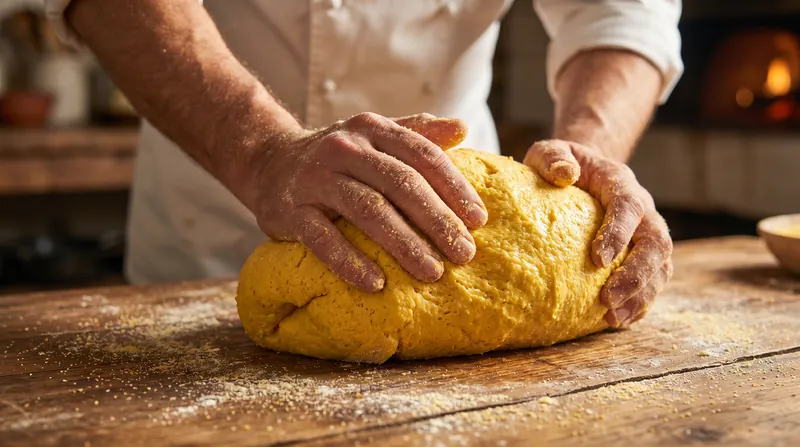
This structural transformation is what makes the creation of masa—the foundational dough of Mesoamerican cuisine—possible. If you simply grind raw, untreated dried corn and mix it with water, the resulting meal will not bind; it remains a crumbly, unworkable paste. Nixtamalization alters the corn's proteins and starches, allowing them to cross-link and form a cohesive, pliable dough that can be pressed flat into tortillas or whipped into fluffy tamales without falling apart.[1]
But the true miracle of nixtamalization is microscopic, occurring at the level of essential human nutrition. Raw corn is naturally rich in niacin, also known as Vitamin B3, which is crucial for human metabolism and cellular repair. However, in untreated corn, this niacin is chemically bound to hemicellulose in a complex called niacytin, rendering it completely unavailable for human absorption. The alkaline soak severs these chemical bonds, releasing the niacin and making it highly bioavailable to the human digestive system.[1][2]
The nutritional enhancements do not stop at vitamins. Because the corn is steeped in a calcium-rich solution, the kernels absorb significant amounts of the mineral. Scientific analyses have shown that tortillas made from traditionally nixtamalized maize can contain up to eighteen times more calcium than the raw kernels from which they originated. For ancient Mesoamerican populations that did not rely on dairy products, this process provided a vital, life-sustaining source of dietary calcium.[3]
Furthermore, the technique acts as an ancient, highly effective food safety mechanism. Stored grains are highly susceptible to fungal infections, particularly those that produce aflatoxins—dangerous mycotoxins that can cause severe liver damage and cancer. The harsh alkaline environment of the nixtamalization process destroys these fungal toxins, reducing aflatoxin levels in the grain by up to 97 percent. Today, agricultural organizations are utilizing this exact property to improve food safety standards in developing nations.[1][2]
The profound importance of this indigenous science becomes starkly clear when examining the historical tragedies that occurred when it was ignored. When Spanish colonizers arrived in the Americas, they quickly recognized the agricultural value of maize and exported the high-yielding crop across the globe. However, they only took the seeds; they completely ignored the indigenous knowledge of nixtamalization, dismissing the alkaline soaking process as an unnecessary, primitive quirk.[1][3]
As untreated corn became a staple dietary crop in Europe, Africa, and eventually the American South, a devastating medical crisis followed. Populations that relied heavily on raw cornmeal began suffering from pellagra, a horrific disease caused by severe niacin deficiency, characterized by dermatitis, dementia, diarrhea, and eventually death. For centuries, European doctors were baffled by the epidemic, entirely unaware that the Mesoamerican cultures who had cultivated the crop had solved the nutritional puzzle thousands of years earlier.[1]
In the mid-to-late twentieth century, the rise of industrialized food production threatened to sideline traditional nixtamalization even in its native regions. The invention of dehydrated, mass-produced masa flour offered unprecedented convenience, allowing cooks to simply add water to a powder. However, this industrial efficiency came at a steep cost. Factory-produced flours often rushed or altered the alkaline steeping process, sacrificing the complex, earthy flavors, the structural integrity of the dough, and the deep cultural connection to the ingredient.[4]
Today, a fierce culinary counter-movement is reclaiming the traditional process. A new generation of chefs is rejecting industrialized flours in favor of in-house nixtamalization, treating the process with the same reverence a French chef might apply to a mother sauce. At restaurants like Houston's Michelin-starred Tatemó, the entire culinary philosophy is built around sourcing diverse, heirloom varieties of Mexican corn and nixtamalizing them daily to showcase their distinct regional terroirs, vibrant colors, and nuanced flavor profiles.[4]
The scientific principles of the technique are also expanding far beyond the borders of maize. Avant-garde chefs and food scientists are actively experimenting with nixtamalizing other grains, legumes, and even vegetables. By applying alkaline solutions to ingredients like sorghum, beans, and winter squash, culinary innovators are unlocking entirely new textures, firming up plant cell walls to survive long cooking times, and discovering novel flavor compounds that were previously hidden.[2][4]
Ultimately, the story of nixtamalization is a powerful testament to the sophistication of indigenous science. It serves as a reminder that technological advancement is not always born in modern, sterile laboratories. Sometimes, the most profound innovations in human health and gastronomy are found in the ancient wisdom of the past, waiting patiently in a simmering pot of wood ash and water to be rediscovered by a world that finally understands its value.[4]
Terms to know
- Nixtamalization
- The Mesoamerican process of soaking and cooking dried grain, usually corn, in an alkaline solution to improve its nutritional value, flavor, and workability.
- Masa
- The pliable dough formed by grinding nixtamalized corn, used as the foundation for tortillas, tamales, and other traditional dishes.
- Pellagra
- A severe disease caused by a deficiency of niacin (Vitamin B3), historically common in populations that relied on untreated corn as a staple food.
- Calcium hydroxide
- Also known as slaked lime or 'cal,' this highly alkaline inorganic compound is commonly used to create the soaking solution for nixtamalization.
- Hemicellulose
- A complex carbohydrate that acts as a glue in plant cell walls; it is dissolved by the alkaline solution during nixtamalization, allowing the corn hull to be removed.
Questions readers ask
Can you make tortillas without nixtamalized corn?
No. If you grind raw, untreated dried corn and mix it with water, the starches will not bind together, resulting in a crumbly paste rather than a pliable dough.
What is the alkaline solution made of?
Traditionally, the solution is made by mixing water with either wood ash from cooking fires or slaked lime (calcium hydroxide).
Why did Europeans get sick from eating corn?
Spanish colonizers exported corn globally but left behind the indigenous nixtamalization process. Without the alkaline soak, the corn's niacin remained biologically unavailable, leading to widespread epidemics of pellagra.
Does nixtamalization work on other grains?
Yes. Modern chefs and food scientists are successfully applying the technique to sorghum, beans, and even vegetables to alter their textures and nutritional profiles.
Different angles
Indigenous Culinary Historians
View nixtamalization as a sacred, 3,500-year-old cultural inheritance that must be preserved against industrial homogenization.
For culinary historians and indigenous advocates, nixtamalization is far more than a cooking technique; it is a profound piece of ancestral technology. They emphasize that the process was likely discovered through careful observation and experimentation, representing a highly sophisticated understanding of chemistry long before the scientific method was formalized. This perspective argues that the modern reliance on industrialized, mass-produced masa flour erases this cultural heritage, stripping away the localized nuances of different wood ashes, regional limestones, and the vast biodiversity of heritage maize.
Nutritional Scientists
Focus on the chemical transformations that prevent malnutrition, increase calcium, and eliminate harmful fungal toxins.
From a biochemical standpoint, researchers view nixtamalization as one of the most effective food processing interventions in human history. They point to the precise chemical cleavage of the niacytin complex, which liberates life-saving Vitamin B3, as a masterclass in nutritional engineering. Furthermore, modern agricultural scientists are increasingly focused on the technique's ability to destroy aflatoxins. In regions where grain storage infrastructure is poor and fungal contamination is rampant, scientists advocate for the expansion of alkaline soaking as a low-cost, highly effective public health tool.
Modern Gastronomy Chefs
Champion the technique for its superior flavor, aroma, and structural properties, using it to elevate heritage ingredients in fine dining.
For the vanguard of modern cuisine, the revival of nixtamalization is driven primarily by the pursuit of ultimate flavor and texture. Chefs argue that industrial masa flours yield a flat, monolithic taste profile, whereas fresh, in-house nixtamalization preserves the volatile aromatic compounds of the corn. By controlling the exact pH, steeping time, and temperature, chefs can manipulate the elasticity of the masa to suit specific dishes. This camp is also pushing the boundaries of the technique, applying alkaline soaks to non-traditional ingredients to discover entirely new culinary applications.
- Indigenous Culinary Historians
- View nixtamalization as a sacred, 3,500-year-old cultural inheritance that must be preserved against industrial homogenization.
- Nutritional Scientists
- Focus on the chemical transformations that prevent malnutrition, increase calcium, and eliminate harmful fungal toxins.
- Modern Gastronomy Chefs
- Champion the technique for its superior flavor, aroma, and structural properties, using it to elevate heritage ingredients in fine dining.
Perspectives this story doesn't cover
- Industrial masa flour manufacturers
- Commercial corn farmers
Sources
Source coverage
4 outlets
3 viewpoints surfaced




- [1]WikipediaIndigenous Culinary Historians
Nixtamalization: History, Process, and Health Impact
Read on Wikipedia → - [2]ECHO CommunityNutritional Scientists
Nixtamalization: Science, Nutrition, and Global Application
Read on ECHO Community → - [3]Science Museum of VirginiaIndigenous Culinary Historians
Ah-Maize-ing Nixtamalization: Food Science and History
Read on Science Museum of Virginia → - [4]Factlen Editorial TeamModern Gastronomy Chefs
Synthesis by Factlen editorial team
Read on Factlen Editorial Team →
More in Food & Drink
See all →Fonio Grain
How Fonio, an Ancient West African Grain, is Becoming a Global Climate-Resilient Staple
4 sources
Culinary Science
The Science of Koji: How a Domesticated Mold is Rewiring Global Cuisine
6 sources
Global Agriculture
How Global Food Networks Are Absorbing the 2026 Cereal Output Drop
4 sources
Culinary Science
The Ancient Chemistry That Makes Corn Digestible, Nutritious, and Delicious
4 sources
Comments
Every angle. Every day.
Get Food & Drink stories with full source coverage and perspective breakdowns, free every day.