
The 2026 World Cup's Biggest Engineering Feat Is the Grass Beneath the Players' Feet
To meet FIFA's strict natural-grass mandate, scientists spent five years engineering hybrid turf systems capable of surviving inside domed stadiums and across 16 distinct climates.
By Factlen Editorial Team
- Turfgrass Agronomists
- Scientists focused on the technical achievement of engineering a uniform, durable playing surface across diverse climates.
- Player Safety Advocates
- Medical professionals and players who argue natural grass is essential for injury prevention.
- Environmental Analysts
- Critics weighing the ecological footprint of the massive turfgrass operation.
What's not represented
- · Stadium Operations Managers
- · Local Water Authorities
Why this matters
The massive logistical effort to replace artificial turf with engineered natural grass highlights a growing consensus in sports science regarding player safety, while pushing the boundaries of indoor agriculture and agronomy.
The 2026 FIFA World Cup is officially underway across North America, but the most complex engineering achievement of the tournament is not the architecture of the stadiums—it is the grass. FIFA strictly mandates that all 104 matches must be played on natural grass to ensure consistent ball roll and player safety. However, this requirement clashed directly with North American sports infrastructure, where eight of the 16 host venues utilize artificial turf, and five are fully enclosed domes that receive no natural sunlight.[1][2]
The central claim driving this massive logistical effort is that natural grass is fundamentally safer for athletes than artificial surfaces. Biomechanical evidence strongly supports this mandate. When a player plants their foot to execute a sharp cut, natural grass provides a crucial degree of "give," allowing the cleat to release from the soil under extreme rotational force.[1][3]
To quantify this safety claim, researchers at the University of Tennessee developed the "Flex" machine—a 3D-printed mechanical foot and ankle fitted with a soccer cleat. By simulating the exact shear forces generated by professional athletes, the data demonstrated that natural turf significantly reduces the stress transferred to knee and ankle ligaments, lowering the risk of non-contact injuries.[2][6]
Meeting FIFA's exacting standards for surface hardness, vertical ball rebound, and traction required unprecedented agronomic research. A five-year scientific consortium led by Michigan State University and the University of Tennessee was formed to engineer a playing surface that would perform identically whether a match was held in the humid heat of Miami, the high altitude of Mexico City, or inside a dark dome in Vancouver.[5][6]
The agronomic evidence dictated a highly specific recipe. At research farms, scientists evaluated over 51,000 distinct plots of grass, utilizing cleat-imitating machines to pummel the turf and identify the strains with the highest durability, drought tolerance, and recovery speed.[4]

The resulting playing surface is not purely natural. It is a highly engineered hybrid system comprising approximately 95 percent living grass reinforced with 5 percent synthetic plastic fibers. Evidence from previous European tournaments shows that this synthetic reinforcement acts much like rebar in concrete, preventing the grass from tearing under the immense shear force generated by top-tier soccer players.[2][3]
Selecting the right grass species presented a geographic puzzle. Agronomists had to map specific grass blends to 16 distinct microclimates. For outdoor stadiums in warmer regions, researchers selected Bermudagrass, which is well-documented for its heat tolerance and rapid recovery.[2][5]
Selecting the right grass species presented a geographic puzzle.
However, the data demanded a counter-intuitive approach for hot-weather cities with domed stadiums, such as Houston, Dallas, and Atlanta. Because these enclosed stadiums are climate-controlled to roughly 72 degrees Fahrenheit, warm-season grasses would fail to thrive. Instead, scientists deployed a cool-season blend of 84 percent Kentucky bluegrass and 16 percent perennial ryegrass.[3][5]

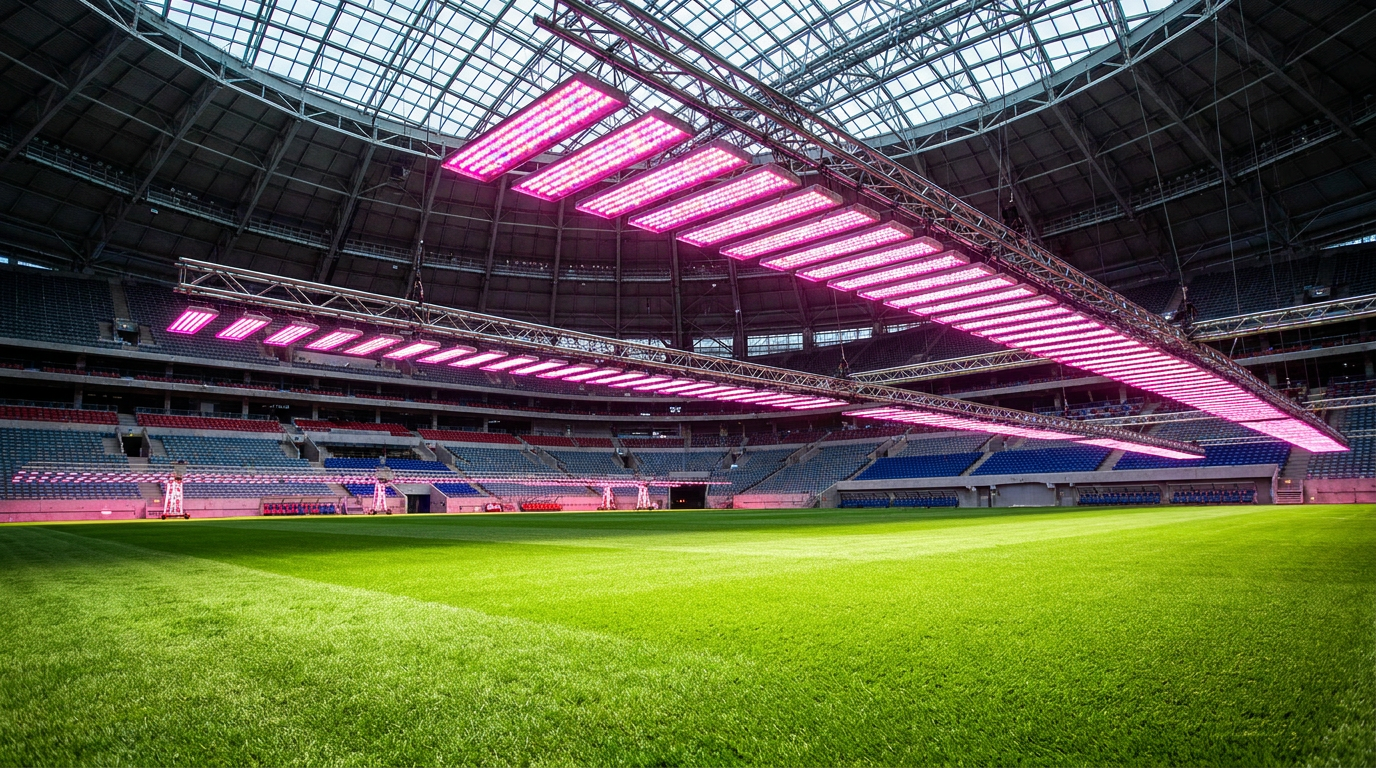
To keep this cool-season grass alive indoors for weeks, engineers installed massive arrays of pink LED grow lights. The specific wavelength of the pink light is optimized to stimulate photosynthesis without generating excess heat that would dry out the soil.[3][5]
The engineering extends deep underground. Core samples of the World Cup pitches reveal a complex subterranean architecture designed for rapid drainage and aeration. Beneath the sod lies a 12-inch layer of engineered sand, followed by six inches of gravel.[4][5]
At the base of this profile, active vacuum and ventilation systems—often utilizing modular plastic reservoirs known as Permavoid systems—pull excess moisture away from the roots and pump oxygen directly into the soil. This ensures the pitch will not become waterlogged even during severe rainstorms.[5]

The logistical evidence highlights a massive, tightly controlled supply chain. The grass was cultivated for months on specialized sod farms, grown directly onto plastic fiber carpets that allow the root systems to intertwine tightly and remain intact during transport.[2][7]
Once mature, the sod was rolled into massive 3,500-pound cylinders, loaded into fleets of refrigerated trucks, and shipped across the continent. This allowed for rapid, seamless installation over the existing concrete or artificial turf floors of the host stadiums.[2][3]
Where the evidence becomes contested is the environmental impact of the operation. Proponents argue that natural grass acts as a carbon sink, filtering water and providing a significantly cooler ambient playing temperature than the heat-trapping rubber infill of artificial turf.[7]

However, environmental analysts point to the staggering resource footprint required to sustain the illusion of a natural meadow indoors. The massive energy draw of running LED grow lights around the clock, the intense irrigation requirements, and the emissions generated by refrigerated transport complicate the tournament's sustainability claims.[3][7]
How we got here
2018
FIFA begins consulting with university agronomists to solve the challenge of North America's artificial turf stadiums.
2020
Michigan State University and the University of Tennessee launch a formal five-year research consortium to engineer the perfect pitch.
2022
Researchers construct a shade facility to simulate the exact lighting conditions of domed stadiums.
Early 2026
Sod farms across North America begin cultivating the final grass blends on plastic fiber carpets.
June 2026
The engineered sod is rolled up, shipped in refrigerated trucks, and installed in 16 stadiums ahead of the opening matches.
Viewpoints in depth
Turfgrass Agronomists
Scientists focused on the technical achievement of engineering a uniform, durable playing surface across diverse climates.
For the researchers at Michigan State and the University of Tennessee, the 2026 World Cup represents the largest agronomic experiment in sports history. Their primary claim is that through rigorous data collection—testing over 51,000 plots for drought tolerance, heat resistance, and shear strength—they have eliminated the variables that typically plague natural grass. By controlling the subterranean environment with vacuum ventilation and utilizing hybrid synthetic fibers, they argue they have achieved a level of consistency previously thought impossible across 16 distinct microclimates.
Player Safety Advocates
Medical professionals and players who argue natural grass is essential for injury prevention.
This camp relies heavily on biomechanical evidence showing that artificial turf lacks the necessary 'give' when a player plants their foot to change direction. Data from testing devices like the Flex machine demonstrates that natural grass allows the cleat to release from the soil under extreme rotational force, significantly reducing the risk of catastrophic knee and ankle ligament tears. For these advocates, the massive logistical expense of installing temporary grass is a non-negotiable requirement for protecting the world's most valuable athletes.
Environmental Analysts
Critics weighing the ecological footprint of the massive turfgrass operation.
While acknowledging that natural grass acts as a carbon sink and reduces the 'heat island' effect of artificial turf, environmental researchers point to the staggering resource consumption required to sustain these pitches. The evidence they highlight includes the massive energy draw of running pink LED grow lights indoors for weeks, the intense irrigation requirements, and the emissions generated by shipping 3,500-pound rolls of sod in refrigerated trucks. Furthermore, they raise concerns about the 5 percent synthetic plastic fibers woven into the hybrid grass, which introduce microplastics into the soil ecosystem.
What we don't know
- Whether the temporary hybrid pitches will hold up perfectly through the later knockout rounds of the tournament after enduring heavy wear.
- The exact total carbon and water footprint of cultivating, transporting, and illuminating the grass across all 16 venues.
Key terms
- Hybrid pitch
- A playing surface that combines natural living grass with synthetic fibers to increase durability and prevent tearing.
- Cool-season grass
- Grass species, such as Kentucky bluegrass and perennial ryegrass, that thrive in moderate temperatures and are used in the World Cup's climate-controlled indoor stadiums.
- Permavoid system
- A modular plastic layer installed beneath the soil that acts as an underground reservoir to circulate water and air through the pitch.
- Sod
- Sections of grass and the part of the soil beneath it held together by roots, grown on specialized farms and transported in rolls to be installed elsewhere.
Frequently asked
Why doesn't FIFA just use artificial turf?
FIFA mandates natural grass because biomechanical evidence shows it reduces joint stress and non-contact injuries, while providing more consistent ball roll and bounce.
How do they keep grass alive inside dark, domed stadiums?
Agronomists use cool-season grass blends maintained at 72 degrees Fahrenheit, sustained by massive arrays of pink LED grow lights and underground ventilation systems.
Is the World Cup grass 100% natural?
No. The pitches use a hybrid system consisting of approximately 95 percent natural living grass reinforced with 5 percent synthetic plastic fibers to prevent the surface from tearing.
What happens to the grass after the tournament?
The temporary natural grass pitches will be removed from the stadiums that typically use artificial turf, though some of the specialized sod may be repurposed for local parks or training facilities.
Sources
Source coverage
7 outlets
3 viewpoints surfaced







[1]The New York TimesPlayer Safety Advocates
The Scientific Quest for Perfect World Cup Pitch
Read on The New York Times →[2]ForbesTurfgrass Agronomists
Engineering the Perfect Pitch for the 2026 World Cup
Read on Forbes →[3]Scientific AmericanEnvironmental Analysts
The Surprising Science Behind the 2026 World Cup Grass
Read on Scientific American →[4]CBS NewsPlayer Safety Advocates
Most World Cup stadiums have Rutgers turfgrass, tested for toughness at a research farm in New Jersey
Read on CBS News →[5]Michigan State UniversityTurfgrass Agronomists
Spartan research brings turfgrass to soccer's biggest stage
Read on Michigan State University →[6]University of TennesseeTurfgrass Agronomists
Bringing UT's turfgrass expertise to FIFA World Cup 26
Read on University of Tennessee →[7]Oregon Public BroadcastingEnvironmental Analysts
Oregon grass seed takes the pitch at the 2026 FIFA World Cup
Read on Oregon Public Broadcasting →


Every angle. Every day.
Get science stories with full source coverage and perspective breakdowns delivered to your inbox.