
The 2026 Solid-State Battery Breakthrough: How EVs Are Finally Leaving Lithium-Ion Behind
After years of delays, automakers are putting solid-state electric vehicle batteries on the road in 2026, promising 600-mile ranges, 15-minute charge times, and zero fire risk.
By Factlen Editorial Team
- Semi-Solid Pragmatists
- Believe that 2026's breakthroughs are mostly semi-solid hybrids, which serve as the realistic bridge while true all-solid tech matures.
- Solid-State Optimists
- Argue that the manufacturing hurdles are solved and mass adoption of solid-state tech will happen rapidly before 2030.
- Manufacturing Realists
- Focus on the immense capital cost of rebuilding battery factories, arguing true solid-state won't scale until the 2030s.
What's not represented
- · Lithium mining communities
- · Independent auto mechanics
- · First responders and firefighters
Why this matters
Solid-state batteries solve the three biggest hurdles to mass electric vehicle adoption: range anxiety, slow charging times, and the risk of battery fires. As this technology moves from the lab to the road, it promises to make EVs lighter, safer, and capable of driving further than traditional gas-powered cars.
Key points
- Stellantis and Factorial Energy are testing solid-state batteries in a Dodge Charger Daytona on North American roads.
- Chinese automakers like Dongfeng are targeting mass production of solid-state EVs in the second half of 2026.
- Solid-state technology replaces flammable liquid electrolytes, raising the thermal runaway threshold from 90°C to 247°C.
- The new cells can push energy density past 350 Wh/kg, enabling ranges of over 600 miles on a single charge.
- Many 2026 batteries are actually 'semi-solid' hybrids, which are cheaper to manufacture on existing lithium-ion assembly lines.
- True zero-liquid all-solid-state batteries are not expected to reach high-volume commercialization until the early 2030s.
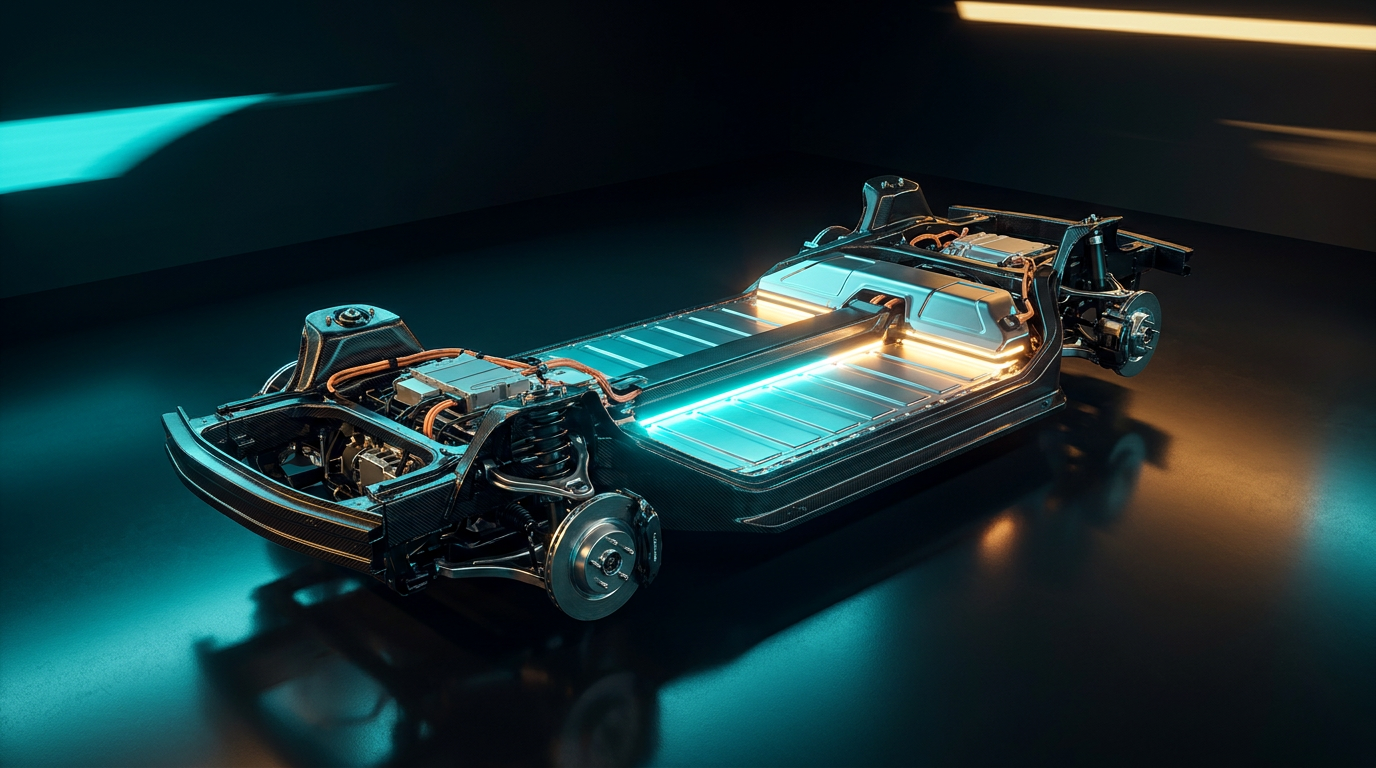
For the better part of a decade, solid-state batteries have been the electric vehicle industry's holy grail—a technology perpetually "five years away." But in 2026, the timeline has abruptly collapsed. After years of laboratory breakthroughs, advanced solid-state and semi-solid battery cells are finally being integrated into real-world test vehicles and early production models. This shift promises to fundamentally rewrite the constraints of EV ownership, targeting driving ranges of over 600 miles, charging times under 20 minutes, and the near-total elimination of battery fire risks.[1][4]
The most visible milestone arrived this summer in North America, where Stellantis and Massachusetts-based Factorial Energy began on-road testing of solid-state cells in a Dodge Charger Daytona development vehicle. The tests utilize Factorial's FEST (Factorial Electrolyte System Technology) cells, which previously demonstrated an energy density of 375 watt-hours per kilogram (Wh/kg) and the ability to charge from 15 to 90 percent in just 18 minutes. Moving these cells from controlled lab environments to the punishing realities of a performance vehicle required advanced engineering, but it marks the first time this chemistry has powered an EV on North American roads.[1]
While Western automakers are testing prototypes, Chinese manufacturers are aggressively pushing toward mass production. Dongfeng Motor recently announced that its solid-state batteries are scheduled for vehicle integration in the second half of 2026. Boasting an energy density of 350 Wh/kg, Dongfeng claims its new battery pack is 30 percent lighter than traditional lithium-ion counterparts while enabling a driving range exceeding 1,000 kilometers (621 miles). In extreme cold-weather testing in Mohe, China, the prototype retained over 74 percent of its charge at temperatures as low as -30°C (-22°F).[2][3]

To understand why this matters, one must look at the architecture of the batteries currently powering the world's EVs. Traditional lithium-ion batteries rely on a liquid electrolyte—a lithium salt dissolved in an organic solvent—to shuttle ions back and forth between the cathode and the anode. While effective, this liquid is inherently flammable. Under severe stress, such as a high-speed collision, overcharging, or extreme heat, the liquid can ignite, triggering a dangerous chain reaction known as thermal runaway.[4]
Solid-state batteries eliminate this vulnerability by replacing the liquid electrolyte with a solid material, typically made of ceramics, polymers, or sulfides. Because these solid materials are non-flammable, the safety margins of the battery increase dramatically. Comparative testing shows that thermal events in solid-state systems do not begin until temperatures reach approximately 247°C (476°F), compared to just 90°C (194°F) for conventional lithium-ion cells. In extreme compression tests, modern solid-state cells have remained operational even after being deformed by 50 percent without igniting.[2][4][5]

Solid-state batteries eliminate this vulnerability by replacing the liquid electrolyte with a solid material, typically made of ceramics, polymers, or sulfides.
Beyond safety, the solid electrolyte unlocks a massive leap in energy density. Because the solid separator is highly stable, battery engineers can replace the standard graphite anode with pure lithium metal. This substitution allows the battery to store significantly more energy in the same physical footprint. Today's best liquid lithium-ion batteries top out around 250 to 300 Wh/kg. The solid-state cells entering the market in 2026 are pushing past 350 Wh/kg, with theoretical limits stretching toward 500 Wh/kg.[4][5]
For consumers, this energy density translates directly into freedom. Automakers can choose to keep the battery pack the same size and double the vehicle's driving range, effectively eliminating range anxiety. Alternatively, they can halve the size and weight of the battery while maintaining a standard 300-mile range, resulting in lighter, more efficient, and better-handling vehicles. Furthermore, because solid-state batteries require fewer raw materials to produce the same amount of energy, European studies suggest they could reduce an EV's carbon footprint by up to 24 percent compared to lithium-ion production.[3][4]
Despite the breathless headlines, battery experts caution that the "solid-state" label in 2026 requires a degree of nuance. Many of the batteries hitting the market this year are technically "semi-solid" or solid-liquid hybrids. A semi-solid battery retains a small amount of liquid electrolyte—roughly 5 to 15 percent of its total weight—mixed with a solid framework to ensure ions move rapidly enough for automotive applications. True all-solid-state batteries, which use zero percent liquid, are still largely confined to pilot testing and are not expected to reach high-volume commercialization until the early 2030s.[5][6]

The distinction between semi-solid and all-solid is driven entirely by manufacturing economics. Upgrading an existing liquid lithium-ion gigafactory to produce semi-solid batteries requires an equipment investment of just 10 to 15 percent of the original line cost. This allows manufacturers to leverage billions of dollars in legacy infrastructure. In contrast, true all-solid-state batteries are incompatible with current assembly lines and require entirely new factories built from scratch, costing up to 50 times more per gigawatt-hour to establish.[5]

This economic reality explains the cautious timeline of industry giants. While startups and some automakers push aggressive 2026 targets, others note that suppressing lithium dendrites—microscopic metallic whiskers that can cause short circuits—remains a core bottleneck for true zero-liquid cells. Mercedes-Benz, which recently drove a modified EQS sedan over 745 miles on a single charge using Factorial's cells, views the technology as a gamechanger that will initially debut in premium, low-volume vehicles.[1][3][4]
This top-down approach mirrors the early days of lithium-ion adoption, where high-end models absorb the initial research and development costs before economies of scale bring the technology to the mass market. As 2026 unfolds, the electric vehicle industry is straddling two eras. The liquid lithium-ion battery, which made the modern EV possible, is approaching its performance ceiling. Meanwhile, the solid-state future is finally arriving—first as semi-solid hybrids that seamlessly integrate into existing factories, and soon as true all-solid cells that will redefine automotive engineering.[1][5][6]
For drivers, the exact chemistry matters less than the result. The transition happening today means that the next generation of electric vehicles will charge like smartphones, drive further than gas cars, and operate with unprecedented safety. The solid-state era is no longer a laboratory promise; it is rolling onto the pavement.
How we got here
2022
Solid-state batteries remain largely confined to laboratory testing and small-scale prototypes.
2024
Startups like Factorial and QuantumScape achieve major energy density milestones in A-sample cells.
Mid-2026
Stellantis and Factorial begin on-road testing of solid-state cells in North America.
Late 2026
Chinese automakers like Dongfeng target the first mass-production integration of solid-state batteries.
2027-2030
Industry consensus targets the scaling of semi-solid hybrids and the gradual introduction of true all-solid-state vehicles.
Viewpoints in depth
Aggressive Adopters
Automakers and startups pushing for immediate 2026/2027 commercialization.
Companies like Dongfeng and Factorial Energy believe the technology is ready for the road today. They argue that the massive leaps in energy density and safety justify the initial production costs, and that getting vehicles on the road now will accelerate the learning curve for mass manufacturing.
Pragmatic Scalers
Battery manufacturers focusing on semi-solid hybrids as a bridge technology.
This camp argues that true all-solid-state batteries are still years away from economic viability. Instead, they advocate for semi-solid batteries, which offer 80 percent of the benefits but can be manufactured on existing lithium-ion assembly lines for a fraction of the capital cost.
Manufacturing Realists
Industry analysts warning about the immense capital required to rebuild the supply chain.
These experts point out that the global auto industry has just spent billions building liquid lithium-ion gigafactories. They argue that true solid-state adoption will be delayed until the 2030s simply because automakers need to recoup their existing investments before tearing down factories to build incompatible solid-state lines.
What we don't know
- How quickly the cost of solid-state batteries will reach parity with traditional lithium-ion cells.
- Whether true zero-liquid all-solid-state batteries can overcome the lithium dendrite problem at a mass-manufacturing scale.
- How the existing global supply chain for liquid electrolytes will adapt to the shift toward solid ceramics and sulfides.
Key terms
- Solid-State Battery
- A battery that uses solid electrodes and a solid electrolyte, eliminating the liquid components found in traditional lithium-ion cells.
- Energy Density
- The amount of energy stored in a given system per unit of mass, typically measured in Wh/kg for batteries.
- Electrolyte
- The medium that allows ions to move between the cathode and anode during charging and discharging.
- Thermal Runaway
- A dangerous chain reaction within a battery cell where rising temperatures cause further heating, potentially leading to a fire.
- Lithium Dendrites
- Microscopic, needle-like metallic structures that can grow inside a battery, potentially piercing the separator and causing a short circuit.
Frequently asked
Can I buy a solid-state EV today?
No, but test vehicles are on the road in 2026, with premium models expected to launch in 2027.
What is the difference between semi-solid and all-solid-state?
Semi-solid retains 5 to 15 percent liquid electrolyte to help ions move, while all-solid uses 0 percent liquid.
Why are solid-state batteries safer?
They replace flammable liquid electrolytes with stable solid materials, drastically reducing fire risk and raising the thermal runaway temperature.
Will solid-state batteries make EVs cheaper?
Eventually, yes. While initial production costs are high, they require fewer raw materials per kilowatt-hour, which should lower long-term prices.
Sources
Source coverage
6 outlets
3 viewpoints surfaced






[1]ElectrekSolid-State Optimists
Factorial, Stellantis test solid-state EV batteries in real life
Read on Electrek →[2]CarNewsChinaSolid-State Optimists
Dongfeng's solid-state batteries scheduled for mass production
Read on CarNewsChina →[3]CarsGuideSolid-State Optimists
Game-changing solid-state batteries are back on the agenda
Read on CarsGuide →[4]To7MotorSemi-Solid Pragmatists
Solid-state batteries are no longer simply lab experiments
Read on To7Motor →[5]Bonnen BatteriesSemi-Solid Pragmatists
What is the real difference between semi-solid and all-solid-state batteries?
Read on Bonnen Batteries →[6]Battery Technology OnlineManufacturing Realists
Solid-State Batteries in 2026: Promise vs. Reality
Read on Battery Technology Online →
Every angle. Every day.
Get technology stories with full source coverage and perspective breakdowns delivered to your inbox.