
The 2026 Revival of 'Third Places' Is Rebuilding Community Infrastructure
Driven by digital fatigue, communities are actively reviving physical gathering spaces and offline micro-communities to combat isolation and improve public health.
By Factlen Editorial Team
- Public Health Advocates
- Viewing social infrastructure as a critical component of preventative medicine.
- Urban Planners & Policymakers
- Focusing on how the built environment and zoning laws dictate social behavior.
- Gen Z Community Builders
- Rejecting digital-only socialization in favor of intentional, offline gatherings.
What's not represented
- · Rural community organizers
- · Small business owners operating commercial third places
Why this matters
The spaces where we spend our time directly dictate our health and happiness. Rebuilding local third places offers a tangible, proven solution to the modern loneliness epidemic, empowering individuals to find real-world connection outside of their screens.
Key points
- Sociologists identify 'third places' as neutral, accessible spaces outside of home and work where communities gather.
- A 2026 revival is underway as digital fatigue drives young adults to form offline 'micro-communities'.
- Research links strong social connections formed in these spaces to a 50% increase in survival likelihood.
- Access to third places remains unequal, with rural and low-income areas facing significant shortages.
- Urban planners are increasingly treating public spaces like libraries and parks as essential civic infrastructure.
Making friends as an adult is notoriously difficult, but sociologists argue the problem is rarely a lack of social skills—it is a fundamental lack of physical infrastructure. For decades, modern life has quietly eroded the default spaces where casual, low-stakes connection happens. The routine neighborhood interactions and semi-regular gatherings that build trust over time have been replaced by a highly privatized, screen-centric existence. This structural shift has left millions feeling isolated, not because they do not want community, but because the physical environments required to foster it have slowly disappeared from the modern landscape.[1][9]
In the wake of the COVID-19 pandemic, the United States faced an unprecedented crisis of isolation, prompting public health officials to label loneliness a severe epidemic. Without casual hangout spots, disconnection surged across all demographics. However, by 2026, a powerful counter-movement has taken root. Across the globe, communities are actively reclaiming and reinventing "third places"—the essential social environments that exist entirely outside the realms of home and work. This revival is shifting the focus from merely finding friends to actively building the physical and social infrastructure where friendships can naturally occur.[1][5][8]
The concept of the "third place" was originally coined by urban sociologist Ray Oldenburg in his influential 1989 book, The Great Good Place. In Oldenburg's framework, the home serves as the "first place," providing rest and family life, while the workplace or school acts as the "second place," characterized by duty and structured productivity. The third place, therefore, is the neutral ground. It is a space where people gather informally, free from the agendas and obligations that dictate the rest of their daily lives, simply to enjoy companionship and community.[3][4]

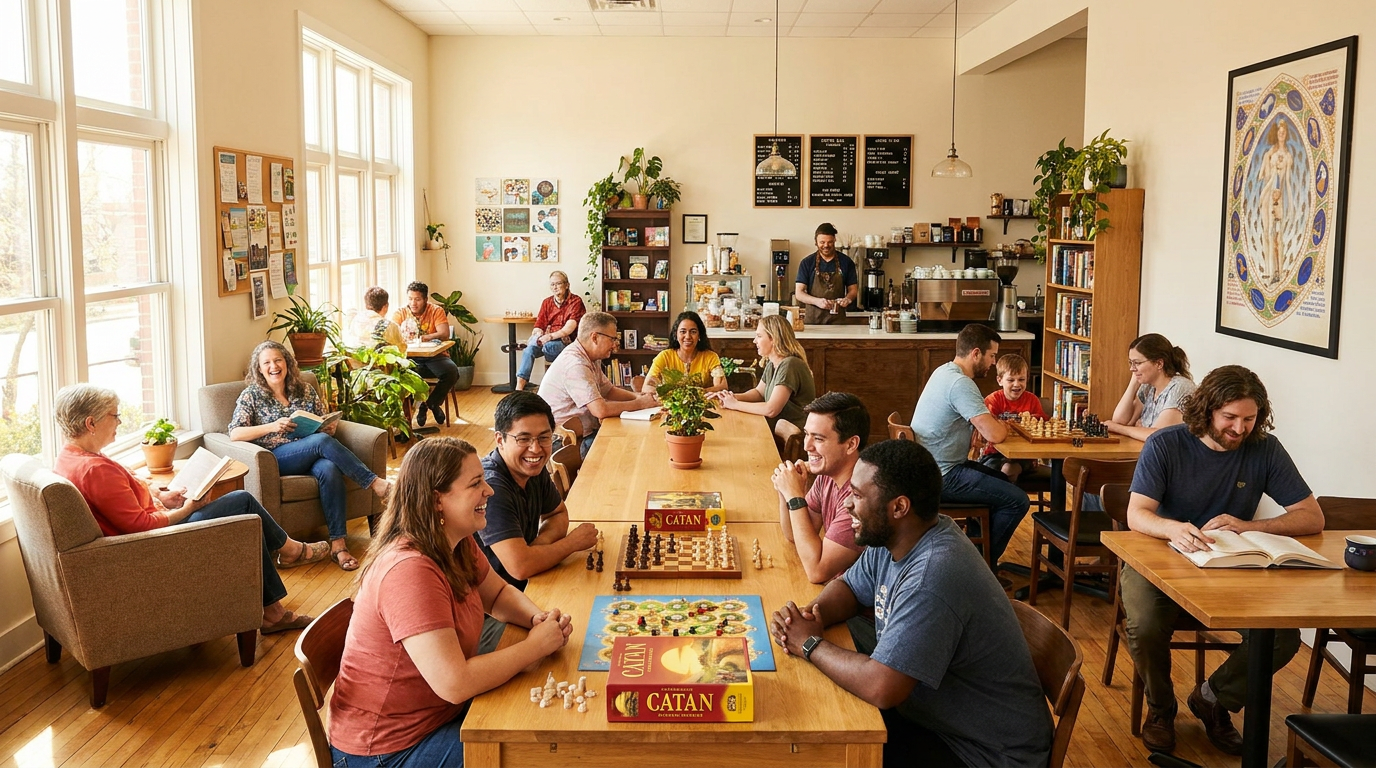
True third places share a specific set of characteristics that make them effective engines for social cohesion. They are highly accessible, relatively inexpensive, and deliberately foster informal interaction among strangers. Whether it is a cozy neighborhood coffee shop, a sunlit corner of a public library, a bustling barbershop, or a community garden, these spaces act as society's living room. In a functional third place, social classes and professional backgrounds are leveled out, allowing individuals to engage with one another as equals, with casual conversation serving as the primary activity.[2][3][4]
The necessity of this modern revival stems from a steep and measurable historical decline. In mid-20th-century America, third places thrived in the form of bowling alleys, diners, and civic halls. However, decades of suburban sprawl, car-centric urban planning, and the rise of big-box retail hollowed out these human-scale spaces. The data reflects this loss starkly: between 2014 and 2019 alone, the average time Americans spent socializing with friends dropped by 37 percent. Lockdowns during the pandemic only accelerated this trend, forcing the closure of many independent venues that never reopened.[6][9]

For Generation Z and younger millennials, the digital world was initially positioned as the ultimate replacement for these physical hubs. Social media platforms and group chats promised frictionless connection without the need for physical proximity. Instead, the reality proved hollow. The dopamine hits of endless algorithmic scrolling and virtual interactions became a poor substitute for the oxytocin generated by real-world, face-to-face connection. Young adults found themselves hyper-connected yet profoundly isolated, leading to a widespread cultural fatigue with screen-based socialization.[5][9]
This widespread digital fatigue has become the primary catalyst for the 2026 revival, driven largely by young adults seeking intentional, offline experiences. Rather than attempting to find one large, generalized friend group—a daunting task in adulthood—people are increasingly turning to "micro-communities." These are small, recurring groups built around specific, low-stakes activities that require participants to put their devices away and engage directly with the people in front of them. By shifting the focus from digital broadcasting to physical presence, these groups are rebuilding local social fabrics from the ground up.[1][5]
This widespread digital fatigue has become the primary catalyst for the 2026 revival, driven largely by young adults seeking intentional, offline experiences.
These modern micro-communities take many creative forms, ranging from weekend "errand clubs" and micro-volunteering squads to offline reading hours and curated supper clubs. By meeting consistently—often weekly or biweekly—these groups inherently lower the barrier to entry. Consistency creates familiarity, allowing trust to build organically over time without the pressure of forced networking. Participants do not need to be highly extroverted; they simply need to show up regularly to a shared space where conversation can flow naturally during the pauses in the activity.[1][5]

The benefits of this revitalized social infrastructure extend far beyond mere entertainment or weekend plans; they are a critical matter of public health. A robust and growing body of medical research links strong social connections to dramatically improved mental and physical well-being. Third places provide the venue for "weak ties"—the casual acquaintances, like a friendly barista or a familiar face at the dog park—that psychologists note are surprisingly vital for emotional regulation and a sustained sense of belonging.[4][7][8]
The physiological impact of these spaces is profound. One widely cited meta-analysis found that individuals with strong social relationships have a roughly 50 percent increased likelihood of survival over time compared to those with weaker ties. Furthermore, the casual banter and social support shared in third places have been shown to actively lower anxiety, alleviate depression, and build community resilience. In many ways, community leaders and social workers now view the preservation of these spaces as a form of preventative healthcare.[1][4][7]

Despite these clear benefits, access to high-quality third places remains starkly unequal across the country. Data from urban researchers reveals that third places are not distributed evenly; they are in significantly shorter supply in rural areas and in neighborhoods with higher poverty rates. In cities like New York, high-poverty neighborhoods have historically had 21 percent less access to public parks than wealthier districts. This lack of infrastructure means that the communities most vulnerable to the negative health impacts of isolation are often the ones with the fewest places to gather.[6][8]
To combat this inequity, forward-thinking urban planners and local governments are beginning to treat third places as essential civic infrastructure, requiring the same level of investment as roads, bridges, or utilities. In New York City, a pioneering partnership between the public housing authority and the parks department is actively braiding funding sources to build and maintain green spaces in historically underserved neighborhoods. By integrating social infrastructure into official city master plans, municipalities are attempting to engineer serendipity and connection back into the built environment.[2][6]
A central tension in the current revival is the heavy reliance on commercial spaces to fill the void. While independent cafes, bookstores, and fitness centers serve as excellent third places, they inherently require a financial transaction. The expectation to purchase a five-dollar coffee or pay a monthly membership fee can inadvertently exclude lower-income residents from participating in the community. As the cost of living remains a concern, the privatization of gathering spaces threatens to make social connection a luxury rather than a public good.[3][6][9]
This economic reality makes fully public, free spaces like municipal libraries more critical than ever before. Modern libraries have evolved far beyond their traditional role as quiet book repositories. Today, institutions like Boston University's Mugar Memorial Library and local public branches across the country host study sessions, community clubs, art galleries, and pop-up social services. They serve as the ultimate inclusive third place—open to everyone regardless of background or budget, providing a safe, climate-controlled environment where the only requirement for entry is being a member of the public.[3][9]
The resurgence of third places in 2026 represents a profound and optimistic shift in how society values human connection. After years of retreating into private, digital silos, people are recognizing that true community requires a physical footprint. By investing time, policy, and resources into these shared spaces, neighborhoods are proving that the antidote to modern isolation is not found on a screen, but in the physical, shared presence of one another. As micro-communities flourish and urban planners prioritize social infrastructure, the revival of the third place stands as a testament to the enduring human need to simply belong somewhere together.[4][6][9]
How we got here
1989
Sociologist Ray Oldenburg coins the term 'third place' in his book The Great Good Place.
2014–2019
The time Americans spend socializing in person drops by nearly 40 percent.
2020–2022
The COVID-19 pandemic forces the closure of physical gathering spaces, accelerating the loneliness epidemic.
2023
The U.S. Surgeon General issues an advisory declaring loneliness and isolation a public health crisis.
2026
A grassroots revival of 'micro-communities' and offline clubs drives a resurgence in local third places.
Viewpoints in depth
Public Health Advocates
Viewing social infrastructure as a critical component of preventative medicine.
For medical professionals and public health researchers, the decline of third places is treated as a biological threat. They point to data showing that chronic loneliness triggers stress hormones that degrade cardiovascular health and immune response. From this perspective, funding community centers and public parks is not merely a civic amenity, but a necessary healthcare intervention designed to extend lifespans and reduce the burden on medical systems.
Urban Planners & Policymakers
Focusing on how the built environment and zoning laws dictate social behavior.
City planners argue that isolation is a design flaw, not a personal failure. They emphasize that decades of car-centric zoning, suburban sprawl, and the privatization of public land have engineered serendipity out of daily life. This camp advocates for aggressive policy changes—such as rewriting zoning codes to allow mixed-use neighborhoods, subsidizing public transit, and increasing municipal budgets for libraries and parks—to physically rebuild the infrastructure of connection.
Gen Z Community Builders
Rejecting digital-only socialization in favor of intentional, offline gatherings.
Younger generations are actively rebelling against the premise that social media can fulfill the human need for community. Experiencing severe digital fatigue, this camp is pioneering the micro-community movement. They argue that true belonging requires physical proximity and shared, low-stakes activities. By organizing offline reading hours, supper clubs, and volunteer squads, they are proving that the desire for authentic, face-to-face interaction remains strong, even among digital natives.
What we don't know
- Whether local governments can secure the long-term funding required to maintain free, public third places like libraries and parks.
- How the heavy reliance on commercial spaces, like cafes, will impact social access for lower-income residents over time.
- If the current surge in offline micro-communities will sustain its momentum or eventually succumb to the convenience of digital alternatives.
Key terms
- Third place
- A social environment distinct from the home and workplace that fosters casual, informal community connection.
- Social capital
- The networks of relationships, trust, and cooperation among people who live and work in a particular society.
- Micro-community
- A small, recurring group of individuals who gather consistently around a specific, low-stakes activity.
- Built environment
- The human-made surroundings that provide the setting for human activity, from buildings to parks and neighborhoods.
- Weak ties
- Casual acquaintances or strangers one interacts with regularly, which research shows are vital for emotional well-being.
Frequently asked
What is an example of a third place?
Classic examples include public libraries, coffee shops, barbershops, community gardens, and local parks where people can gather informally.
Why are third places important for health?
They provide essential social interaction that reduces isolation, lowers anxiety, and has been linked to a 50% increase in long-term survival likelihood.
How do micro-communities differ from traditional friend groups?
Micro-communities are built around specific, recurring activities with a low barrier to entry, rather than relying on deep, pre-existing personal histories.
Are third places always free to access?
Some, like public libraries and parks, are free. However, many commercial third places, like cafes, require a purchase, which can create barriers for lower-income individuals.
Sources
Source coverage
9 outlets
3 viewpoints surfaced







[1]Wild HeartsGen Z Community Builders
The 2026 'Third Place' Revival: 13 Micro-Communities That Make Adult Life More Social
Read on Wild Hearts →[2]Brookings InstitutionUrban Planners & Policymakers
Third places as community builders
Read on Brookings Institution →[3]Boston UniversityGen Z Community Builders
What Is a Third Place? And Why Do We Need Them?
Read on Boston University →[4]University of MissouriUrban Planners & Policymakers
The Power of Third Places
Read on University of Missouri →[5]Seen & UnseenGen Z Community Builders
The return of the Third Place
Read on Seen & Unseen →[6]Urban InstituteUrban Planners & Policymakers
Public Third Places Are Essential for Thriving Cities
Read on Urban Institute →[7]Emerald InsightPublic Health Advocates
The critical role of third places as social infrastructure
Read on Emerald Insight →[8]Foundation for a Healthy ColoradoPublic Health Advocates
The Healing Power of Third Places
Read on Foundation for a Healthy Colorado →[9]Factlen Editorial Team
Synthesis by Factlen editorial team
Read on Factlen Editorial Team →
Every angle. Every day.
Get lifestyle stories with full source coverage and perspective breakdowns delivered to your inbox.