
The 2026 Guide to Hands-Free Driving: Decoding Level 2+ and Level 3 Automation
As automakers roll out advanced hands-free driving systems, the difference between 'eyes-on' and 'eyes-off' technology has become the most critical—and confusing—decision for new car buyers.
By Ivan Smirnov

Share this story
In short
- Level 2 systems require the driver to keep their eyes on the road and retain all legal liability.
- Level 3 systems allow the driver to look away, with the automaker assuming liability under specific conditions.
- Driver Monitoring Systems (DMS) are becoming stricter to prevent 'automation complacency.'
The modern car dealership pitch has shifted from horsepower to processing power. In 2026, nearly every premium vehicle and a growing number of mass-market cars offer some form of "hands-free" driving. Yet, behind the glossy marketing terms—Super Cruise, BlueCruise, Autopilot, Drive Pilot—lies a complex web of capabilities, legal liabilities, and subscription fees. For car buyers, understanding exactly what a vehicle can and cannot do on the highway is no longer just a matter of convenience; it is a critical safety and financial decision.[4][5]
To decode the showroom jargon, buyers must first understand the Society of Automotive Engineers (SAE) automation scale, which governs how the industry categorizes self-driving tech. The scale runs from Level 0 (no automation) to Level 5 (full automation anywhere, anytime). In 2026, the consumer market is entirely focused on the chasm between Level 2 and Level 3. This single step represents the most significant legal and technological leap in automotive history.[1]
The vast majority of hands-free systems available today are classified as Level 2, often colloquially called "Level 2+." These systems can simultaneously control steering, acceleration, and braking on mapped highways. You can take your hands off the wheel, but you cannot take your mind off the road. The human driver remains legally responsible for the vehicle at all times and must be ready to intervene instantly if the system encounters a construction zone, erratic driver, or faded lane markings.[1]
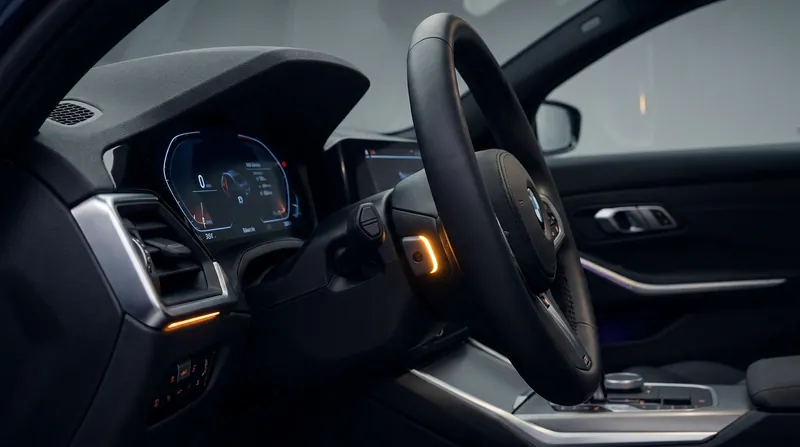
Because the human is the ultimate backup in a Level 2 system, automakers rely heavily on Driver Monitoring Systems (DMS). Infrared cameras mounted on the steering column or dashboard track the driver's eye gaze and head position. If you look down at your phone or close your eyes, the system will issue escalating visual and audible warnings. If ignored, the car will eventually disengage the system, turn on the hazard lights, and bring the vehicle to a slow, controlled stop.[2][3]
The Insurance Institute for Highway Safety (IIHS) has made these monitoring systems a primary focus in 2026. Early iterations of Level 2 systems were easily tricked, leading to a phenomenon known as "automation complacency," where drivers tuned out and crashed. Now, rigorous IIHS testing demands that a vehicle not only tracks the driver's eyes but also requires shared control during lane changes and issues rapid alerts the moment attention wanders.[2]
Under the hood, Level 2+ systems rely on a combination of high-resolution cameras and radar. Cameras read lane lines, speed limit signs, and traffic lights, while radar bounces radio waves off surrounding objects to determine their speed and distance. This "sensor fusion" allows the car's computer to build a 3D model of its environment. However, cameras can be blinded by direct sunlight or heavy rain, and radar struggles with stationary objects at high speeds, which is why the human must remain vigilant.[5]
The true frontier for 2026 car buyers is Level 3, or "conditional automation." Unlike Level 2, a Level 3 system allows the driver to take their hands off the wheel and their eyes off the road. You can legally watch a movie, read a book, or text on your phone. Crucially, when a Level 3 system is engaged, the automaker—not the human driver—assumes legal liability for the vehicle's actions.[1]
Because the automaker is taking on immense legal risk, Level 3 systems operate under strictly defined conditions, known as an Operational Design Domain (ODD). Currently, systems like Mercedes-Benz's Drive Pilot only activate in dense, stop-and-go highway traffic at speeds under 40 mph (64 km/h). The weather must be clear, the route must be pre-mapped, and there can be no construction zones.
If traffic clears and speeds increase, or if it begins to rain, the Level 3 system will issue a "takeover request." The driver is given a generous buffer—usually around 10 seconds—to put their phone down, grab the wheel, and resume control. If the driver fails to respond, perhaps due to a medical emergency, the car will safely pull itself over and call emergency services.[3]
To achieve the redundancy required for Level 3 liability, automakers must equip vehicles with LiDAR (Light Detection and Ranging). LiDAR spins invisible laser beams to create a hyper-accurate, millimeter-level 3D map of the world, regardless of lighting conditions. While LiDAR was once prohibitively expensive, the cost has plummeted by 2026, allowing it to be integrated seamlessly into the rooflines and grilles of premium consumer vehicles.[5]
Beyond the hardware, buyers must navigate the new financial reality of software-defined vehicles. Hands-free driving is rarely a one-time purchase. Most automakers now include the necessary cameras and radar as standard equipment but lock the actual functionality behind a paywall. Buyers typically receive a three-year trial, after which they must pay a monthly or annual subscription fee to keep the system active and receiving over-the-air map updates.[4]
Consumer advocates argue this model obscures the true cost of ownership. A system that costs $2,000 upfront might require an additional $800 per year in subscription fees. However, automakers counter that these fees fund the continuous mapping of new highways and the cloud infrastructure required to process billions of miles of fleet data, ultimately making the systems safer over time.[5]
For buyers in the United States, the availability of Level 3 systems is further complicated by a patchwork of state laws. While Level 2 systems are legal nationwide, Level 3 requires specific state-by-state approval. In 2026, a driver might be able to legally watch a movie in a traffic jam in California or Nevada, but the system will automatically downgrade to Level 2 the moment they cross the border into a state that hasn't updated its autonomous vehicle regulations.[3][4]
When shopping for a new car in 2026, buyers must ask three specific questions: Does the system require me to watch the road? What happens if the weather turns bad? And how much will this cost me three years from now? For most commuters, a robust Level 2+ system offers immense fatigue relief on long road trips. But for those enduring grueling daily traffic jams, the legal and mental freedom of a Level 3 system represents the ultimate automotive luxury.[4][5]
Key terms
- Level 2 Automation
- A system that can steer, accelerate, and brake simultaneously, but requires the human driver to constantly monitor the road and retain legal liability.
- Level 3 Automation
- Conditional automation where the car handles all driving tasks in specific situations (like a traffic jam), allowing the driver to look away, with the automaker assuming liability.
- Driver Monitoring System (DMS)
- Infrared cameras inside the cabin that track the driver's eye movement and head position to ensure they are paying attention to the road.
- LiDAR
- A sensor that uses spinning laser beams to create a highly accurate, 3D map of the vehicle's surroundings, crucial for the redundancy needed in Level 3 systems.
- Operational Design Domain (ODD)
- The specific operating conditions—such as speed limits, weather, and road types—under which an automated driving system is designed to function safely.
Reader questions
Can I sleep in the driver's seat with a Level 3 system?
No. Even with Level 3 automation, you must remain awake and in the driver's seat. The system may issue a takeover request at any time, and you typically have about 10 seconds to resume control.
Who pays for the accident if a Level 3 system crashes?
If a Level 3 system is actively engaged and operating within its approved conditions (like a traffic jam under 40 mph), the automaker assumes legal liability for the vehicle's actions.
Do I have to pay a monthly fee for hands-free driving?
In most cases, yes. While the hardware is often built into the car, automakers typically charge a monthly or annual subscription fee (after an initial trial period) to keep the software and maps updated.
Why do these systems turn off in heavy rain?
Level 2 systems rely heavily on cameras to see lane lines. Heavy rain, snow, or direct glare can blind these cameras, forcing the system to hand control back to the human driver.
Where opinion splits
Safety Regulators & Insurers
Focuses on preventing automation complacency by mandating strict driver monitoring and clear limitations on where systems can operate.
Organizations like the IIHS and NHTSA view the transition between Level 2 and Level 3 as a zone of extreme risk. Their primary concern is 'automation complacency'—the proven psychological tendency for humans to tune out when a machine is doing most of the work. Regulators argue that until a car can handle every edge case, the human must be forced to pay attention. This is why the IIHS has introduced rigorous new ratings that penalize vehicles with easily defeated driver monitoring cameras, pushing the industry to adopt systems that issue rapid, unavoidable alerts the moment a driver's eyes leave the road.
Automakers
Views advanced automation as a premium luxury feature, incrementally taking on legal liability to offer drivers true hands-off, eyes-off time.
For legacy automakers, advanced driver assistance is the new horsepower—a key differentiator in the premium market. Companies like Mercedes-Benz are willing to cross the liability rubicon into Level 3 because it offers a tangible luxury: the gift of time. By accepting legal responsibility during traffic jams, they allow executives and commuters to legally answer emails or watch a show. Automakers argue that their redundant sensor suites, which combine cameras, radar, and LiDAR, are statistically safer than a distracted human driver, justifying the slow, geofenced rollout of these 'eyes-off' features.
Consumer Advocates
Demands transparent marketing so buyers understand the difference between assistance and autonomy, while pushing back against hidden subscription fees.
Consumer protection groups argue that the auto industry has fundamentally failed at communicating what these systems actually do. Advocates point out that terms like 'Autopilot' or 'Full Self-Driving' mislead buyers into treating Level 2 systems like Level 4 autonomy, leading to preventable accidents. Furthermore, consumer groups are highly critical of the shift toward software-as-a-service models in the automotive sector. They argue that locking safety and convenience features behind perpetual $800-a-year paywalls obscures the true cost of ownership and penalizes second-hand buyers who may be locked out of the vehicle's hardware capabilities.
- Safety Regulators & Insurers
- Focuses on preventing automation complacency by mandating strict driver monitoring and clear limitations on where systems can operate.
- Automakers
- Views advanced automation as a premium luxury feature, incrementally taking on legal liability to offer drivers true hands-off, eyes-off time.
- Consumer Advocates
- Demands transparent marketing so buyers understand the difference between assistance and autonomy, while pushing back against hidden subscription fees.
Perspectives this story doesn't cover
- Used Car Buyers
- Independent Mechanics
Sources
Source coverage
5 outlets
3 viewpoints surfaced





- [1]SAE InternationalAutomakers
Taxonomy and Definitions for Terms Related to Driving Automation Systems
Read on SAE International → - [2]Insurance Institute for Highway SafetySafety Regulators & Insurers
Safeguards for partial driving automation
Read on Insurance Institute for Highway Safety → - [3]National Highway Traffic Safety AdministrationSafety Regulators & Insurers
Automated Vehicles for Safety
Read on National Highway Traffic Safety Administration → - [4]Factlen Editorial TeamConsumer Advocates
Synthesis by Factlen editorial team
Read on Factlen Editorial Team → - [5]The VergeConsumer Advocates
Tesla claims driver ‘manually overrode self-driving’ in deadly Texas crash
Read on The Verge →
More in Shopping & Reviews
See all →Auto Trade Rules
The USMCA Countdown: How the Proposed 50% 'American Content' Rule Will Reshape Car Prices
4 sources
Auto Retail
The 3-Day Return Right: How California's New CARS Act Reshapes Used Car Shopping and Bans Dealer Junk Fees
3 sources
Auto Safety
The 2026 Safety Shift: How NHTSA's New 5-Star Rating Will Force Pedestrian Protection Into Every Car
4 sources
Impaired Driving Tech
The 'Kill Switch' Mandate: How New US Impaired Driving Tech Will Reshape Car Shopping and Privacy Concerns
2 sources
Comments
Every angle. Every day.
Get Shopping & Reviews stories with full source coverage and perspective breakdowns, free every day.