
The 2026 Guide to Electric Motorcycles: Solid-State Batteries and Fast Charging Change the Math
With the arrival of solid-state batteries, 10-minute fast charging, and accessible urban models from major manufacturers, electric motorcycles have matured into practical alternatives for everyday riders.
By Factlen Editorial Team
- Practical Commuters
- Riders focused on total cost of ownership, low maintenance, and accessible entry prices for daily urban transportation.
- Performance Enthusiasts
- Riders drawn to electric motorcycles for their instant torque, clutchless acceleration, and cutting-edge technological integration.
- Long-Distance Tourers
- Riders who prioritize battery energy density, highway range, and the expansion of reliable fast-charging infrastructure.
What's not represented
- · Traditional gas-powered motorcycle purists
- · Independent motorcycle mechanics facing a shift in repair needs
Why this matters
For years, electric motorcycles demanded steep compromises in range, charging time, and purchase price. The 2026 model year effectively eliminates those hurdles, offering buyers a genuine alternative to gas-powered bikes that costs significantly less to maintain and run.
Key points
- Solid-state batteries have entered production, offering 400 Wh/kg energy density and up to 370 miles of range.
- Integration of the NACS standard allows premium electric motorcycles to fast-charge in under 10 minutes.
- Legacy brands like Honda and Can-Am have released accessible, urban-focused electric motorcycles starting around $11,000.
- Electric motorcycles offer a roughly 40% lower total cost of ownership over five years due to minimal maintenance.
- Electric dirt bikes now out-power their gas equivalents, utilizing instant torque and adjustable mapping for off-road dominance.
For the better part of a decade, buying an electric motorcycle required a healthy dose of compromise. Early adopters accepted limited range, agonizingly slow charging times, and premium price tags in exchange for the thrill of silent, instant torque. But in 2026, the electric two-wheeler market has crossed a critical threshold. Driven by breakthroughs in battery chemistry and the entry of legacy manufacturers, electric motorcycles have evolved from niche novelties into highly practical machines.[4][5]
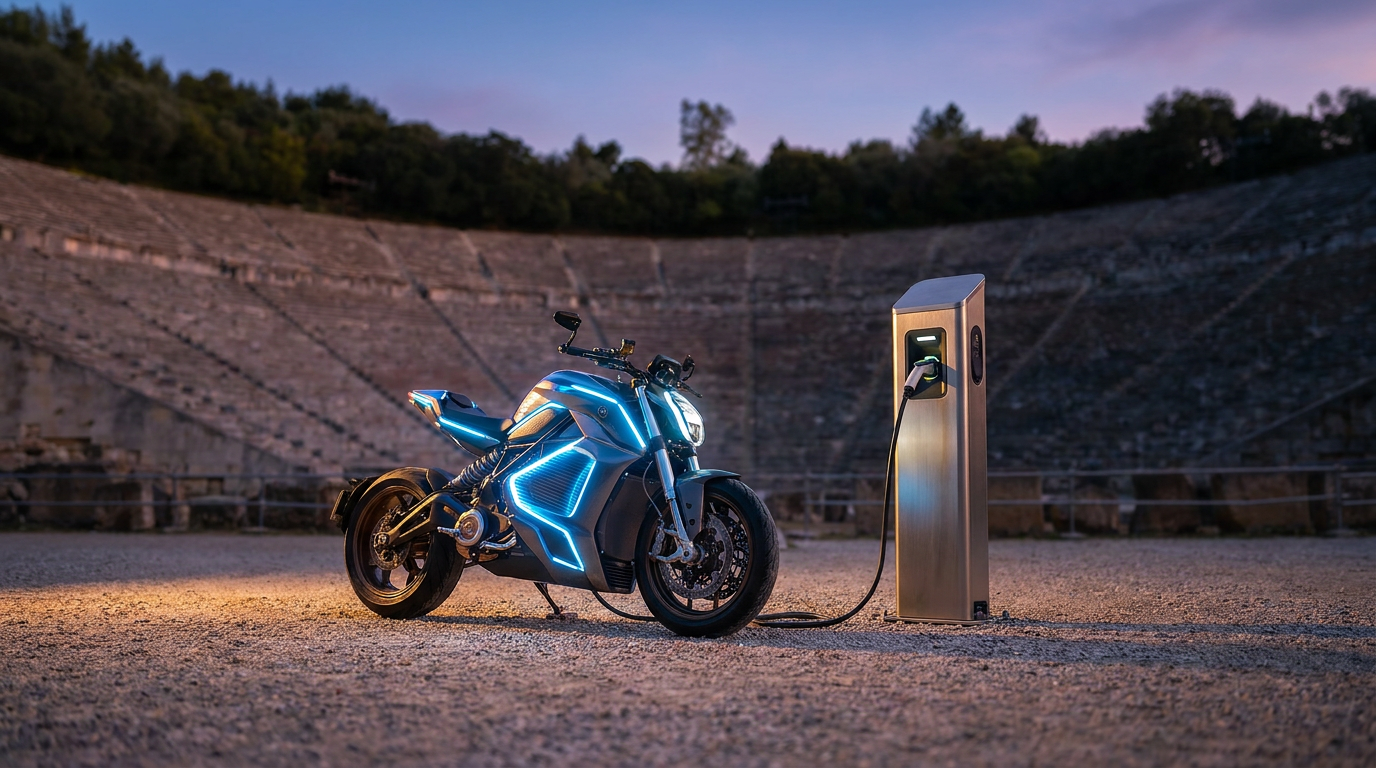
The most significant technological leap of the year is the commercial arrival of solid-state batteries. At the 2026 Consumer Electronics Show, Verge Motorcycles and its technology partner Donut Lab unveiled the first production motorcycle equipped with an all-solid-state power unit. By replacing the liquid or gel electrolytes found in traditional lithium-ion cells with a solid material, engineers have drastically increased the battery's energy density while simultaneously improving thermal safety.[1][6]
The numbers attached to this breakthrough fundamentally alter the touring equation. The new battery architecture achieves an energy density of 400 Wh/kg—a roughly 74% improvement over previous generations. When fitted to the Verge TS Pro and TS Ultra models, this allows for a staggering maximum range of up to 370 miles on a single charge. For the first time, an electric motorcycle can comfortably match, and in some cases exceed, the highway range of a traditional gas-powered touring bike.[1][6]

Range, however, is only half the battle; the speed at which a rider can replenish that battery is equally vital. The 2026 Verge models integrate the North American Charging Standard (NACS) and support 200 kW DC fast charging. In real-world terms, this allows riders to add approximately 186 miles of range in just ten minutes. This rapid turnaround transforms long-distance electric riding from an exercise in logistical patience into a seamless, stop-and-go experience akin to filling a gas tank.[1][6]
While solid-state technology represents the bleeding edge, the established touring market remains fiercely competitive. Italy's Energica Experia continues to hold its ground as the premier electric sport-tourer. Utilizing a massive 22.5 kWh battery pack, the Experia delivers a proven 261 miles of urban range and roughly 130 miles of mixed highway riding. Equipped with CCS Combo 2 fast charging, it can recover 80% of its battery in 40 minutes, proving that liquid-cooled lithium-ion platforms still offer robust, reliable long-distance capability.[4]
Beyond the high-priced halo bikes, 2026 is defined by the democratization of electric performance. Legacy manufacturers have finally entered the fray with aggressively priced, urban-focused models. BRP's Can-Am Pulse has emerged as a value leader, arriving in dealerships with a base price of $10,999. Designed as a nimble middleweight commuter, the Pulse utilizes a 35-kW Rotax E-Power drivetrain and an 8.9 kWh battery to deliver 100 miles of city range.[2][4]
Beyond the high-priced halo bikes, 2026 is defined by the democratization of electric performance.
The Can-Am Pulse prioritizes approachability over staggering top speeds. Weighing in at just 390 pounds, its frame doubles as the battery housing, centralizing the mass and making it exceptionally easy to handle in dense traffic. While it lacks DC fast charging, its onboard 6.6-kW Level 2 charger can replenish the battery from 20% to 80% in just 50 minutes, making it an ideal solution for riders who can charge at home or the office.[2]

Honda has also made its long-awaited move into the full-size electric segment with the WN7. Winning an iF Gold Design Award for its futuristic, frameless aesthetic, the WN7 is a naked streetbike that produces 100Nm of torque—comparable to a 1,000cc combustion engine. While its real-world range hovers around a modest 60 miles, Honda has equipped the WN7 with a CCS2 quick-charging port, allowing urban riders to top up rapidly at automotive charging stations.[3][4]
The WN7's engineering highlights the unique packaging advantages of electric drivetrains. By using the heavy battery pack as a stressed member of the chassis, Honda kept the bike incredibly narrow—just 826mm wide at the mirrors. This slim profile, combined with the flawless, clutchless power delivery that electric motors provide, makes the WN7 a formidable tool for slicing through urban gridlock.[3]
Off the pavement, electric motorcycles are not just competing with gas bikes; they are actively displacing them. The Stark VARG continues to disrupt the motocross world, standing as the most powerful production dirt bike available in 2026. Without the need to manage a clutch or keep an engine in its powerband, riders can utilize the VARG's adjustable power mapping to find perfect traction on loose surfaces, proving that electric propulsion is a distinct advantage in the dirt.[4][5]
For fleet operators and daily commuters, the financial argument for electric motorcycles has never been stronger. Total Cost of Ownership (TCO) analyses in 2026 indicate that running an electric motorcycle is roughly 40% cheaper than maintaining a traditional internal combustion engine bike over a five-year period. The savings compound rapidly when factoring in the elimination of oil changes, valve clearances, spark plugs, and clutch replacements.[7]

Furthermore, the widespread adoption of regenerative braking significantly extends the life of traditional brake pads. Many modern electric bikes, including the Can-Am Pulse and Honda WN7, utilize enclosed belt drives or chaincases, further reducing the messy, frequent maintenance associated with exposed motorcycle chains. For a rider using their bike for daily transportation, this translates to hundreds of hours and thousands of dollars saved.[2][3][7]
The electric motorcycle market of 2026 offers a machine for nearly every use case. Whether a rider is seeking the 370-mile touring capability of a solid-state superbike, the silent agility of an urban commuter, or the explosive torque of an electric dirt bike, the options are diverse and highly capable. The era of waiting for the technology to mature is over; the electric two-wheeled future has officially arrived on the showroom floor.[1][4][5]
How we got here
Early 2020s
Electric motorcycles are largely confined to premium halo models or short-range urban scooters.
2024
Major automotive and motorcycle manufacturers commit to adopting the NACS charging standard.
Late 2025
Honda reveals the production-ready WN7, signaling a major legacy brand's entry into full-size electric streetbikes.
January 2026
Verge Motorcycles and Donut Lab unveil the world's first production solid-state motorcycle battery at CES.
Spring 2026
Can-Am begins deliveries of the Pulse and Origin, bringing sub-$12,000 electric options to the mainstream market.
Viewpoints in depth
The Practical Commuter's View
Electric motorcycles are finally making financial sense for daily riders.
For riders who use their motorcycles primarily to commute, the 2026 market is a revelation. The initial purchase price of bikes like the Can-Am Pulse has dropped to match traditional middleweight gas bikes, but the real victory is in the running costs. Without the need for regular oil changes, valve clearance checks, or frequent brake pad replacements, the total cost of ownership plummets. Commuters also highlight the ease of use—clutchless direct-drive systems and silent operation turn stop-and-go city traffic from a chore into a seamless, low-stress experience.
The Performance Enthusiast's View
Electric drivetrains offer a level of instant torque and control that combustion engines cannot match.
Performance riders are increasingly drawn to the raw physics of electric propulsion. An electric motor delivers 100% of its torque from zero RPM, resulting in acceleration that feels violently immediate compared to the spool-up time of a gas engine. In the off-road sector, bikes like the Stark VARG have proven that this instant power delivery, combined with the ability to digitally adjust traction and power mapping on the fly, provides a distinct competitive advantage on the track. For these riders, the lack of an exhaust note is a small trade-off for superior handling and speed.
The Long-Distance Tourer's View
Solid-state batteries and fast charging are finally making electric touring viable.
Touring riders have historically been the most skeptical of electric motorcycles, and for good reason: highway speeds drain batteries quickly, and waiting hours at a Level 2 charger ruins a road trip. However, the introduction of solid-state batteries boasting 370 miles of range and 10-minute NACS fast-charging has fundamentally changed their outlook. While rural charging infrastructure remains a concern in remote areas, the ability to ride for three hours and recharge during a quick coffee break means electric touring is no longer restricted to carefully planned, charger-to-charger anxiety runs.
What we don't know
- How solid-state batteries will hold up to the extreme vibrations and thermal cycles of real-world motorcycling over a 10-year lifespan.
- Whether public fast-charging infrastructure will expand quickly enough in rural areas to fully support electric adventure touring.
- How the used market will value first-generation electric motorcycles as battery technology continues to advance rapidly.
Key terms
- Solid-State Battery
- A next-generation battery technology that uses solid electrodes and a solid electrolyte, offering higher energy density and faster charging than traditional liquid-based lithium-ion batteries.
- NACS (North American Charging Standard)
- The fast-charging connector standard originally developed by Tesla, now widely adopted across the EV industry to provide high-speed charging access.
- Energy Density (Wh/kg)
- A measurement of how much energy a battery contains in proportion to its weight; higher density means a lighter battery can provide more range.
- Regenerative Braking
- A system where the electric motor reverses its function during deceleration, acting as a generator to capture kinetic energy and feed it back into the battery.
- Stressed Member
- A design technique where a component (like the heavy battery pack) is used as an active structural part of the motorcycle's frame, reducing overall weight and bulk.
Frequently asked
What is a solid-state motorcycle battery?
A solid-state battery replaces the liquid or gel electrolyte found in traditional lithium-ion batteries with a solid material. This makes the battery safer, lighter, and capable of holding significantly more energy (up to 400 Wh/kg), which drastically increases the motorcycle's range.
How long does it take to charge an electric motorcycle?
It depends on the charger and the bike. Premium 2026 models with NACS or CCS fast-charging can add up to 186 miles of range in just 10 to 15 minutes. Standard commuter bikes using Level 2 chargers typically take about 50 minutes to reach an 80% charge.
Are electric motorcycles cheaper to maintain?
Yes. Electric motorcycles eliminate the need for engine oil changes, spark plugs, valve adjustments, and clutch replacements. Combined with regenerative braking that saves brake pads, the total cost of ownership is roughly 40% lower over five years.
Do electric motorcycles have gears or a clutch?
The vast majority of modern electric motorcycles use a single-speed direct drive, meaning there is no clutch lever and no gear shifting required. You simply twist the throttle to accelerate.
Sources
Source coverage
7 outlets
3 viewpoints surfaced







[1]TechRadarLong-Distance Tourers
Verge Motorcycles unveils world's first solid-state battery electric motorcycle with 370-mile range
Read on TechRadar →[2]Rider MagazinePractical Commuters
2026 Can-Am Pulse Review: The Electric Commuter Comes of Age
Read on Rider Magazine →[3]VisordownPerformance Enthusiasts
2026 Honda WN7 review: Honda's first full-size production electric motorcycle
Read on Visordown →[4]MotorWattLong-Distance Tourers
2026 buyer's guide to electric motorcycles and dirt bikes
Read on MotorWatt →[5]BikeBoundPerformance Enthusiasts
Best 2026 Electric Motorcycles: The Category Comes of Age
Read on BikeBound →[6]Supercar BlondieLong-Distance Tourers
The first-ever solid-state battery-powered motorcycle has been unveiled at CES
Read on Supercar Blondie →[7]BENLGPractical Commuters
Total Cost of Ownership (TCO) Analysis for Electric Motorcycles
Read on BENLG →

More in shopping
See all 5 stories →


Every angle. Every day.
Get shopping stories with full source coverage and perspective breakdowns delivered to your inbox.