
Tennessee's Lottery-Funded College Scholarship System Faces $113 Million Funding Gap by 2030
Declining lottery revenues and rising student demand have created a structural deficit in Tennessee's higher education funding. A new law redirecting sports betting revenue to K-12 schools means future scholarship shortfalls could drain local infrastructure budgets.


- Higher Education Advocates
- Focus on maintaining full funding for HOPE and TN Promise to ensure college access and workforce readiness.
- K-12 Infrastructure Proponents
- Argue that sports betting revenue should remain dedicated to local public school construction rather than bailing out the lottery fund.
- State Fiscal Managers
- Emphasize balancing the budget and adjusting program parameters to prevent a hard deficit.
How we got here
2003
Tennessee General Assembly authorizes the creation of the HOPE scholarship, funded by the newly established state lottery.
2014
The state launches Tennessee Promise, utilizing a $1.3 billion endowment and lottery surpluses to offer free community college.
2020
Tennessee legalizes online sports betting, directing 80% of the privilege tax to the Lottery Education Account as a backup funding source.
2022 to 2025
Net lottery proceeds decline by 21.9%, while student demand for scholarships increases by over 25%.
July 2026
The Tennessee Education Freedom Scholarship Act takes effect, redirecting sports betting revenue from scholarships to K-12 school construction.
August 2026
ThinkTennessee releases a report projecting a $113 million funding gap for the state's scholarship programs by 2030.
Why it matters
Tennessee's lottery-funded scholarships are the primary vehicle for college affordability in the state. If the projected $113 million deficit is not resolved, future students could face reduced award amounts, or local K-12 schools could lose critical construction funding to cover the gap.
For hundreds of thousands of Tennessee families, the state's lottery-funded scholarships are the definitive answer to the rising cost of higher education. But the very mechanism that built this system is no longer keeping pace with the students who rely on it. A structural tension has emerged between the surging demand for college aid and the declining revenue from lottery ticket sales. A new report from the nonpartisan think tank ThinkTennessee projects a $113 million funding gap for the state's scholarship programs by 2030, forcing lawmakers to navigate a complex web of sports betting revenue, K-12 construction funds, and higher education access to keep the scholarships fully funded.[6]
For current high school seniors and enrolled college students, the immediate takeaway is clear: proceed with applications as normal. The Tennessee Higher Education Commission (THEC) confirms that current fiscal year revenues are trending slightly above projections, meaning immediate award amounts for the HOPE scholarship and Tennessee Promise remain secure. Students must still complete the FAFSA by April 1 and meet community service requirements to maintain eligibility. However, families planning for college in the late 2020s should monitor legislative developments, as the state may be forced to adjust award caps or tighten eligibility if the structural deficit is not resolved.[2][3][7][8]
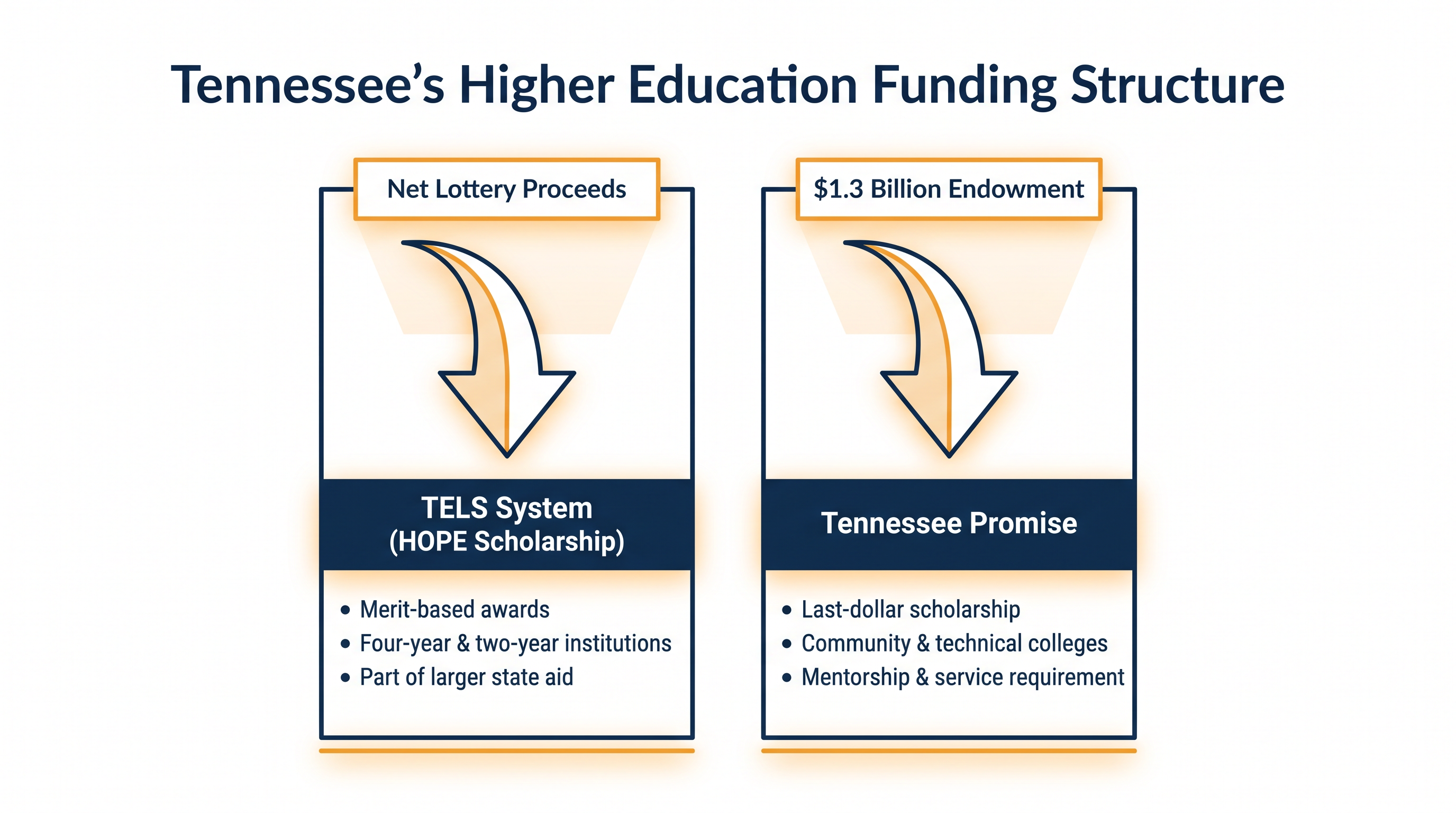
Understanding the shortfall requires looking at how Tennessee finances higher education. The Tennessee Education Lottery Scholarship (TELS) system operates 12 distinct programs, most notably the merit-based HOPE scholarship, which provides up to $6,000 annually for students at four-year institutions. These programs are funded directly by net lottery proceeds—the cash left over after prize payouts and administrative costs. When lottery sales boom, the scholarship fund runs a surplus; when sales dip, the fund faces a squeeze.[1][4][6][7]
A parallel track exists for Tennessee Promise, a "last-dollar" program that covers remaining tuition at community and technical colleges after other aid is applied. Unlike the HOPE scholarship, Tennessee Promise is primarily anchored by a $1.3 billion state endowment. However, it historically relied on surplus funds from the TELS system to cover excess costs. Between 2022 and 2025, the lottery transferred up to $151 million annually to the Promise program. Today, those transfers are capped at $10 million, placing tighter constraints on the program's expansion.[1][6][8]
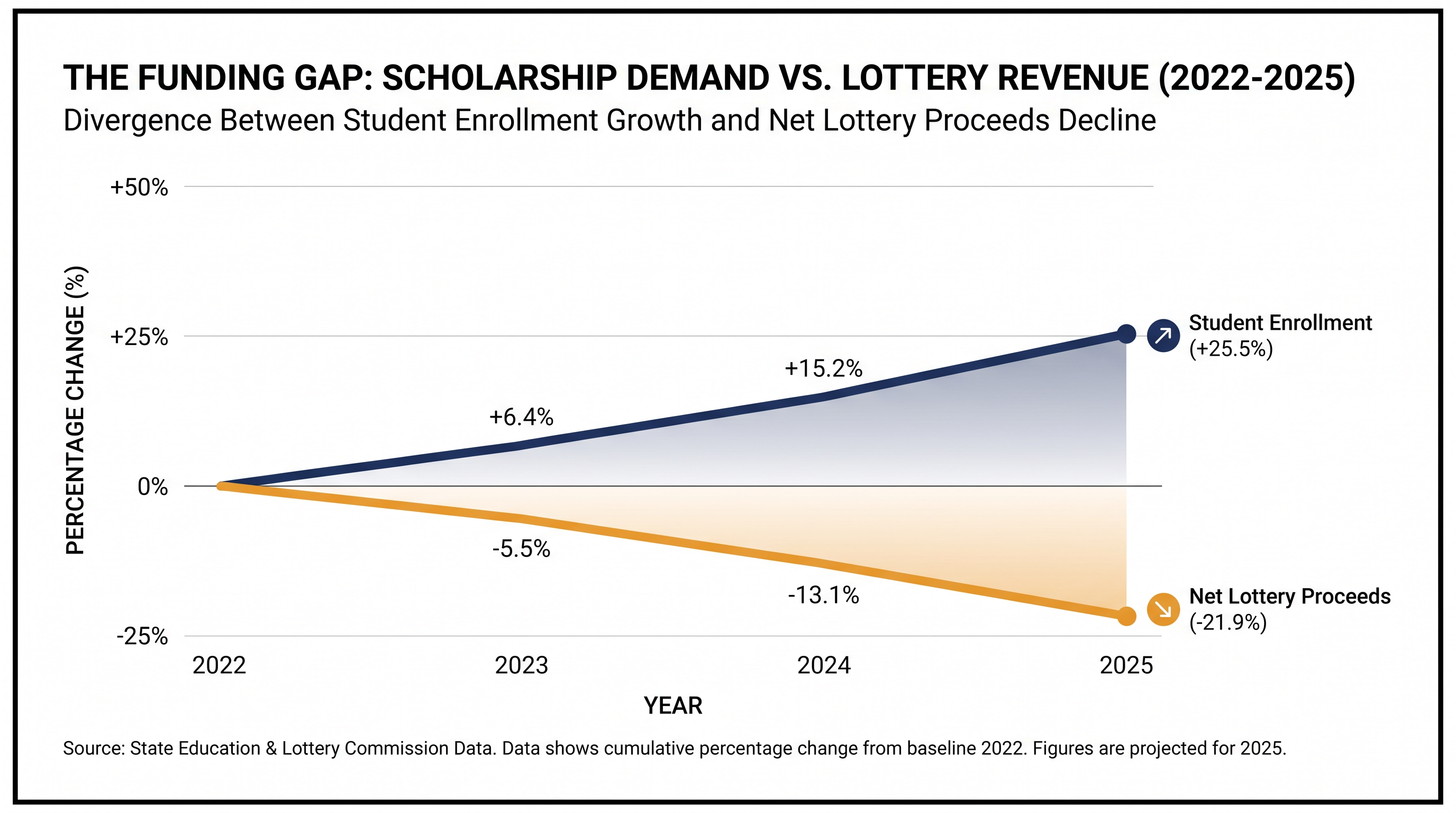
The math driving the projected deficit is straightforward: costs are rising while the primary revenue stream is shrinking. Between fiscal years 2022 and 2025, net lottery proceeds dropped by 21.9%, representing a real-terms loss of more than $113 million. Simultaneously, the programs became more popular. Student enrollment in the scholarship programs surged by 25.5%, and direct spending climbed 23.4%. In 2025, the combined programs spent $505 million to support nearly 170,000 students, marking the first time that lottery proceeds fell short of scholarship spending.[1][6][7]
The deficit was previously masked by a secondary revenue stream: sports wagering. When Tennessee launched online-only sports betting in 2020, the state directed 80% of the privilege tax to the Lottery Education Account, effectively creating a backstop for the scholarships. This sports betting revenue successfully covered the initial shortfalls in fiscal year 2025. However, a major legislative overhaul has now removed that safety net, fundamentally altering the state's education funding formula.[1][5][6]
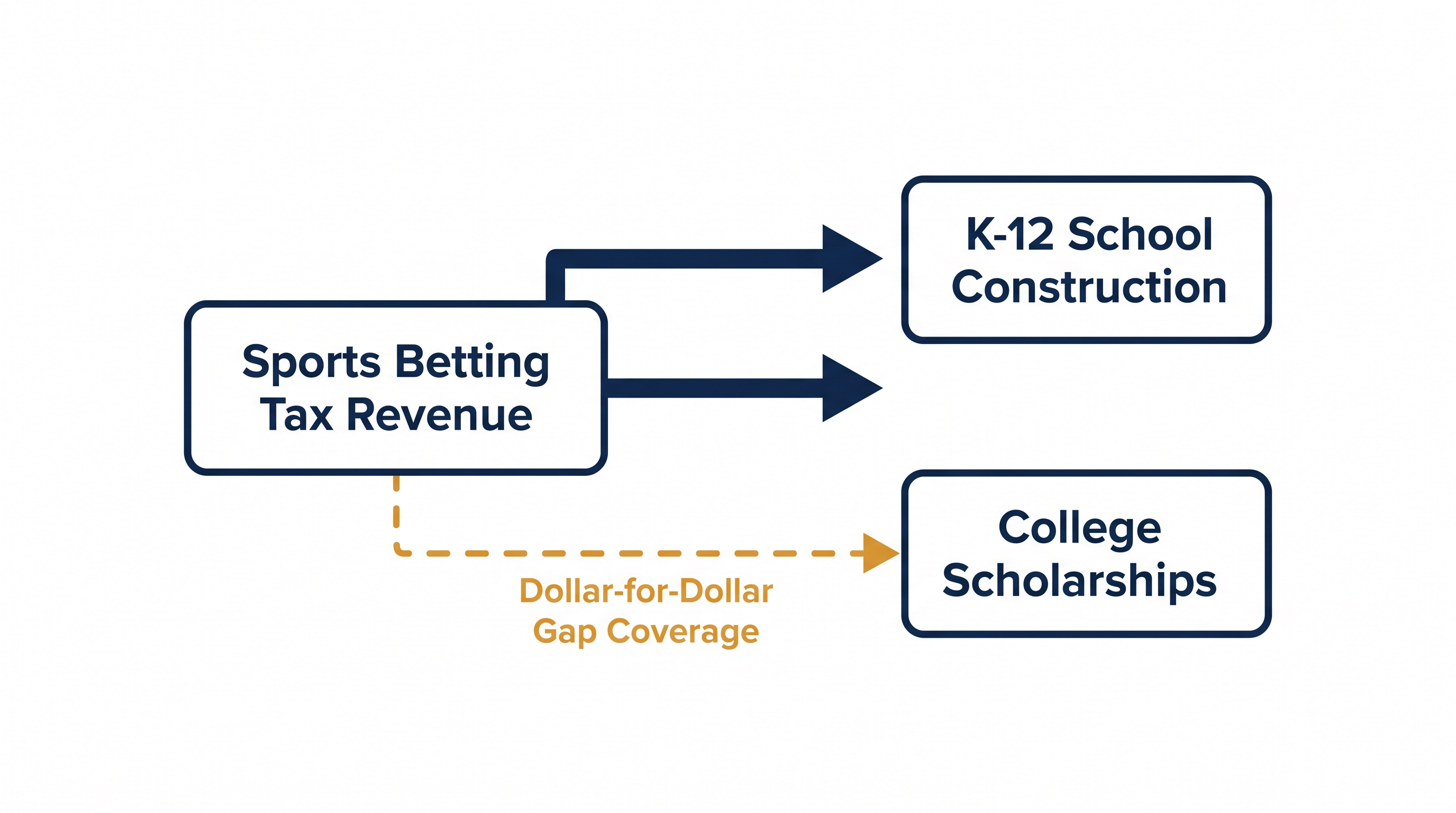
Under the 2026 Tennessee Education Freedom Scholarship Act—a sweeping law that expanded private school vouchers—lawmakers struck a deal to redirect the sports wagering tax revenue. Instead of backstopping college scholarships, those funds are now legally mandated for K-12 public school building construction and maintenance. This shift was designed to secure political support for the voucher program by guaranteeing infrastructure funds for local school districts, but it left the higher education portfolio exposed to the lottery's declining yields.[1][5][6]
Instead of backstopping college scholarships, those funds are now legally mandated for K-12 public school building construction and maintenance.
The new law creates a direct financial conflict between local public schools and college tuition aid. The legislation includes a "dollar-for-dollar" provision: if lottery revenues are insufficient to meet the state's scholarship obligations in future years, money will be pulled directly from the K-12 construction and maintenance fund to cover the gap. As scholarship costs continue to outpace lottery sales, this mechanism threatens to systematically drain money away from local school infrastructure to keep college students enrolled.[1][6]
State officials are actively exploring mitigation strategies to avoid triggering the dollar-for-dollar drain on K-12 funds. During a recent briefing, THEC Executive Director Dr. Steven Gentile emphasized that the $114 million projected deficit for the upcoming fiscal year is not set in stone. Lawmakers could potentially authorize new revenue streams, adjust the sports betting allocation, or leverage federal programs. For example, the newly introduced federal Workforce Pell grant, a needs-based initiative, is expected to offset the costs of some short-term technical programs, slightly reducing the burden on state funds.[1][3]
Tennessee's predicament highlights a broader vulnerability in lottery-funded education models. Nine states currently rely on lottery revenues to finance postsecondary aid. While these systems successfully shield taxpayers from direct tuition subsidies, they tether educational access to the volatile performance of gambling revenues. As consumer spending habits shift and alternative gaming options proliferate, states are finding that lottery sales cannot indefinitely scale to match the rising costs of university tuition and growing student populations.[4][6][7]
For now, the TELS portfolio and Tennessee Promise continue to operate without immediate cuts to student awards. The state's robust endowment for the Promise program provides a partial buffer, and current-year lottery revenues are slightly outperforming the direst projections. However, the structural imbalance remains. Without legislative intervention before the end of the decade, Tennessee will be forced to choose between reducing the value of its flagship college scholarships or sacrificing the infrastructure budgets of its local public schools.[1][3][5][8]
The stakes are high because the TELS system has been undeniably effective at expanding access to higher education. Since its inception in 2003, the HOPE scholarship has transformed the college landscape in Tennessee, incentivizing high-achieving students to remain in-state for their degrees. The subsequent launch of Tennessee Promise in 2014 further cemented the state's reputation as a national leader in per-capita postsecondary financial aid, empowering over 150,000 students to pursue associate degrees and technical certificates without the burden of tuition debt.[7][8]
To understand who is most at risk, families must look at the specific eligibility requirements. The HOPE scholarship is available to any Tennessee resident who graduates high school with a minimum 3.0 GPA or a composite ACT score of at least 21. Because it is merit-based rather than need-based, a reduction in the award amount would impact students across all income brackets. If the state is forced to reduce the $6,000 annual maximum for four-year institutions, middle-income families who do not qualify for federal Pell Grants would face the steepest sudden increase in out-of-pocket costs.[1][7]

The impact on community colleges and Tennessee Colleges of Applied Technology (TCATs) would be equally profound. These institutions rely heavily on the enrollment pipeline generated by Tennessee Promise. While the Promise endowment is insulated from the immediate lottery shortfall, the program's status as a "last-dollar" scholarship means it pays the remainder of a student's tuition only after TELS awards are applied. If TELS awards shrink, the Promise program will have to cover a larger share of each student's tuition, accelerating the depletion of its own reserves.[6][8]
Ultimately, the $113 million funding gap represents a critical juncture for Tennessee's education policy. The state has built one of the most generous and accessible higher education funding systems in the country, but its financial architecture is showing its age. As the 2030 horizon approaches, families, educators, and lawmakers will have to confront the mathematical reality that a growing scholarship program cannot be sustained by a shrinking lottery fund.[5][6]
What to know
- Tennessee's TELS system, which funds the HOPE scholarship, is projected to face a $113 million funding gap by 2030 due to declining lottery revenues.
- Between 2022 and 2025, net lottery proceeds dropped by 21.9%, while student enrollment in the scholarship programs surged by 25.5%.
- The 2026 Education Freedom Scholarship Act redirected sports betting revenue—previously a backup for scholarships—to K-12 school construction.
- If lottery funds fall short, state law requires pulling money dollar-for-dollar from the K-12 construction fund to cover the college scholarship deficit.
Where opinion splits
Higher Education Advocates
Focus on maintaining full funding for HOPE and TN Promise to ensure college access and workforce readiness.
Organizations like ThinkTennessee and state higher education officials emphasize that the state's economic future depends on a highly educated workforce. They argue that the TELS system and Tennessee Promise have been instrumental in closing equity gaps and incentivizing students to pursue postsecondary credentials. From this perspective, allowing the scholarship fund to operate at a deficit—or reducing award amounts—would reverse decades of progress. Advocates urge lawmakers to find dedicated, recurring revenue streams to replace the lost sports betting funds, ensuring that the burden of the shortfall does not fall on students in the form of higher out-of-pocket tuition costs.
K-12 Infrastructure Proponents
Argue that sports betting revenue should remain dedicated to local public school construction rather than bailing out the lottery fund.
Public school advocates and local district officials view the 2026 legislative shift as a necessary victory for K-12 infrastructure. Many rural and underserved school districts in Tennessee face massive backlogs in building maintenance and construction. Proponents of the current law argue that sports wagering taxes are a vital resource for ensuring safe, modern learning environments for children. They express deep concern over the 'dollar-for-dollar' provision, warning that pulling money from K-12 construction to cover college scholarship deficits unfairly pits the needs of young children against those of young adults, effectively penalizing local schools for the lottery's underperformance.
State Fiscal Managers
Emphasize balancing the budget and adjusting program parameters to prevent a hard deficit.
Fiscal conservatives and state budget analysts focus on the structural math of the entitlement programs. They point out that it is fiscally irresponsible to operate a scholarship system where expenditure growth consistently outpaces revenue generation. From this viewpoint, the solution is not necessarily to find new taxes to feed the system, but to adjust the parameters of the scholarships themselves. Proposals from this camp include tightening eligibility requirements, raising the minimum GPA or ACT score for the HOPE scholarship, or capping the total number of awards to ensure the program remains solvent without draining K-12 infrastructure funds or requiring general fund bailouts.
Key terms
- Tennessee Education Lottery Scholarship (TELS)
- The umbrella system of 12 state financial aid programs, including the HOPE scholarship, funded by net lottery proceeds.
- Last-Dollar Scholarship
- Financial aid that covers the remaining tuition and mandatory fees after all other gift aid, such as Pell Grants, has been applied.
- Net Lottery Proceeds
- The remaining revenue from state lottery sales after prize payouts and administrative operating costs are deducted.
- Tennessee Promise
- A state program providing two years of tuition-free attendance at community or technical colleges for high school graduates.
- Fiscal Externality
- The secondary financial impact of a policy, such as the state pulling K-12 construction funds to cover a higher education deficit.
Unanswered questions
- It remains unclear if the Tennessee General Assembly will introduce new revenue streams to backstop the TELS system before the deficit peaks in 2030.
- The exact impact of the new federal Workforce Pell grant on reducing the state's short-term technical program costs is not yet quantified.
- It is unknown whether lawmakers will choose to tighten HOPE scholarship eligibility requirements rather than pulling funds from K-12 infrastructure.
Reader questions
Will my HOPE scholarship be reduced this year?
No, current fiscal year revenues are trending slightly above projections. The projected shortfalls target future fiscal years up to 2030, though lawmakers are exploring solutions now.
How does the TN Promise program differ from HOPE?
TN Promise is a last-dollar scholarship funded primarily by a $1.3 billion endowment, covering remaining tuition at community colleges. In contrast, HOPE is a merit-based award funded directly by annual lottery revenues.
Why did sports betting revenue stop funding the scholarships?
The 2026 Tennessee Education Freedom Scholarship Act redirected those funds to K-12 school construction and maintenance to secure support for a statewide voucher program.
What happens if the lottery fund runs out of money?
Under current state law, funds would be pulled dollar-for-dollar from the K-12 construction fund to cover the college scholarship gap.
Sources
Source coverage
8 outlets
3 viewpoints surfaced








[1]WBIRK-12 Infrastructure Proponents
Lottery sales could create scholarship funding gap, study shows
Read on WBIR →[2]AxiosHigher Education Advocates
Shrinking lottery revenue pinches HOPE scholarship
Read on Axios →[3]Tennessee FireflyState Fiscal Managers
HOPE Scholarships Could Be Reduced Amid $114 Million Deficit
Read on Tennessee Firefly →[4]Tennessee Conservative NewsState Fiscal Managers
Tennessee college scholarship $113 million funding gap
Read on Tennessee Conservative News →[5]TNEdReportK-12 Infrastructure Proponents
Gambling on the Future: The Lottery Scholarship Faces Revenue Decline
Read on TNEdReport →[6]ThinkTennesseeHigher Education Advocates
The State of Higher Education in Tennessee: Scholarship Funding
Read on ThinkTennessee →[7]Tennessee State GovernmentState Fiscal Managers
HOPE Scholarship Program Review
Read on Tennessee State Government →[8]CollegeForTNHigher Education Advocates
Tennessee Promise Overview
Read on CollegeForTN →
Comments

Every angle. Every day.
Get education stories with full source coverage and perspective breakdowns delivered to your inbox.