
Supreme Court Warns of 'Anarchy' as White House Defies Landmark Ruling
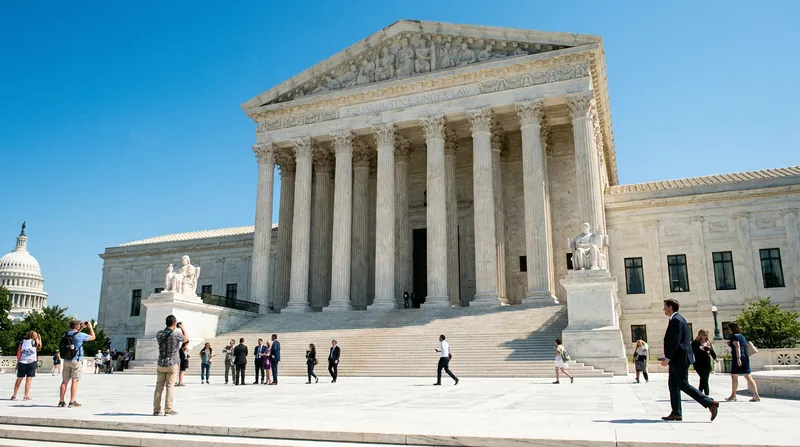
In an unprecedented constitutional crisis, the administration announced it will not comply with a recent Supreme Court decision, prompting a rare public rebuke from the Chief Justice warning of a breakdown in the rule of law.
By Anaya Sharma

Share this story
The United States has entered uncharted legal territory after the White House announced it will formally instruct federal agencies to ignore a landmark Supreme Court ruling, prompting a severe and immediate rebuke from the judicial branch. In a televised statement, the administration declared that it views the Court's recent 6-3 decision—which struck down a controversial executive order—as an illegitimate infringement on executive authority.
The directive orders federal departments to continue enforcing the nullified policy, effectively daring the judiciary to enforce its own mandate. This direct defiance of the nation's highest court marks a rupture in the constitutional order not seen in over a century.[1][2]
Within hours of the administration's announcement, Chief Justice John Roberts took the extraordinary step of issuing a public statement attached to a procedural order, warning that the executive branch's actions invite "anarchy" and threaten the foundational rule of law.
Roberts wrote that the American system of government relies on the mutual respect of its co-equal branches, and that ignoring a definitive constitutional interpretation by the Supreme Court dismantles the framework that protects civil liberties and property rights. Legal scholars across the political spectrum expressed shock, noting that while presidents have often criticized rulings, outright refusal to comply shatters a core democratic norm.[2]
The standoff stems from the Court's ruling last week that invalidated the administration's sweeping executive actions, finding that the executive branch had exceeded its constitutional authority.
By instructing federal agents to disregard the injunction and proceed with the policy, the White House has placed thousands of federal employees in legal jeopardy, forcing them to choose between obeying their commander-in-chief or complying with a federal court order. The Department of Justice has reportedly been thrown into turmoil, with several high-ranking career officials threatening immediate resignation rather than executing orders they view as illegal.[1]
Defenders of the administration's move argue that the Supreme Court has engaged in unchecked "judicial overreach" and that the President possesses independent authority to interpret the Constitution.
Allies in conservative media and some aligned lawmakers have invoked the legacy of Andrew Jackson—who famously ignored the Court's ruling in Worcester v. Georgia in 1832—asserting that the judiciary has no army and cannot compel the executive to act against the national interest. They frame the defiance as a necessary corrective to an unelected judicial body that they claim has usurped the policymaking role of the elected branches.
The political fallout has been immediate and explosive. Congressional Democrats have already begun drafting articles of impeachment, characterizing the defiance as a clear-cut violation of the President's oath of office and a high crime against the state. Meanwhile, the Republican party appears deeply fractured; while populist loyalists have cheered the move as a bold stand against the establishment, institutionalist GOP lawmakers have expressed deep unease, warning that abandoning the Supreme Court's ultimate authority over constitutional questions could lead to systemic collapse.
The unprecedented clash has sent shockwaves through global financial markets, which rely heavily on the stability and predictability of the U.S. legal system. The Dow Jones Industrial Average plummeted over 600 points following the announcement, and bond yields fluctuated wildly as investors priced in the risk of a full-blown constitutional crisis.
Business leaders and the U.S. Chamber of Commerce issued urgent statements pleading for a resolution, noting that if the government can ignore the Supreme Court on executive power, it could theoretically ignore rulings on contracts, property rights, and corporate law.[3]
Legal experts are now debating the mechanical realities of how this standoff might unfold. Because the Supreme Court relies on the executive branch—specifically the U.S. Marshals Service and the Department of Justice—to enforce its rulings, the judiciary has few tools to compel compliance if the President orders those same agencies to stand down. Some constitutional scholars suggest that lower federal court judges could begin holding cabinet secretaries in contempt of court, potentially ordering their arrest, though it remains entirely unclear who would execute such warrants.[2]
The crisis also raises profound questions about the military's role, though Pentagon officials have aggressively pushed back against any suggestion that the armed forces would intervene in a domestic legal dispute. The Uniform Code of Military Justice requires service members to obey "lawful orders," creating a paradox when the Commander-in-Chief and the Supreme Court fundamentally disagree on what the law is. While the current standoff centers on civilian agencies, the theoretical implications for the chain of command have alarmed national security experts.[2]
Internationally, the spectacle of the United States government openly defying its own highest court has drawn intense scrutiny from allies and adversaries alike. European diplomats have privately expressed concern that the breakdown of American institutional norms will embolden authoritarian leaders globally, who frequently use executive power to sideline independent judiciaries. Adversarial nations have already begun amplifying the crisis through state media, framing the U.S. as a failing democracy unable to govern itself or maintain internal stability.[1][3]
As the nation braces for the coming days, all eyes are on Congress to see if a bipartisan coalition will emerge to check the executive branch, or if partisan polarization will paralyze the legislative response. The immediate fate of the individuals affected by the reinstated executive order hangs in the balance, but the long-term casualty may be the American public's faith in the constitutional system itself. Without a resolution that restores the Court's authority, the United States faces a fundamental reordering of how its government functions.[2]
Key points
- The White House announced it will instruct federal agencies to ignore a recent 6-3 Supreme Court ruling.
- Chief Justice John Roberts issued a rare public statement warning the defiance invites 'anarchy'.
- Federal employees are now caught between obeying the President and complying with a federal court order.
- Congressional Democrats have begun drafting articles of impeachment in response.
Unanswered questions
- Will rank-and-file federal law enforcement agents follow the orders of the President or the injunctions of the Court?
- Will Congress muster the bipartisan votes necessary to intervene or pursue impeachment?
- How will lower federal courts respond if individuals sue over the continued enforcement of the nullified policy?
How we got here
Last Week
The Supreme Court issues a 6-3 ruling striking down a major administration executive order.
Yesterday Morning
The White House announces it views the ruling as illegitimate and will not comply.
Yesterday Afternoon
Chief Justice John Roberts releases a statement warning of 'anarchy' and the collapse of the rule of law.
Today
Financial markets open sharply lower as Congress debates potential impeachment proceedings.
- Institutionalists
- Argue that defying the Supreme Court destroys the rule of law and the fundamental checks and balances of the Republic.
- Executive Supremacy Advocates
- Believe the President has independent authority to interpret the Constitution and must check an overreaching judiciary.
- Market Observers
- Focus on the systemic risk to the U.S. economy, warning that legal instability threatens contracts and investment.
Perspectives this story doesn't cover
- Rank-and-file federal workers forced to choose whose orders to follow
- Lower court judges who must now navigate the enforcement vacuum
Sources
Source coverage
3 outlets
3 viewpoints surfaced



- [1]ReutersMarket Observers
White House defies Supreme Court ruling, drawing 'anarchy' warning from Chief Justice
Read on Reuters → - [2]The New York TimesInstitutionalists
A Constitutional Crisis: Supreme Court Warns of 'Anarchy' as President Defies Ruling
Read on The New York Times → - [3]The Wall Street JournalMarket Observers
Markets Tremble as Executive Defiance of Supreme Court Sparks Legal Crisis
Read on The Wall Street Journal →

More in News & Politics
See all →Data Privacy
New Mexico Judge Orders Meta to Pay $25 Billion Over Cambridge Analytica Privacy Violations
6 sources

Prison Healthcare
Supreme Court Rejects Trump Administration Bid to Restrict Transgender Inmate Medical Care
5 sources
Immigration Crackdown
State Department Cancels Over 300,000 Visas in Broad Trump Administration Immigration Crackdown
5 sources

Border Security
Trump Administration Asks Supreme Court to Lift Halt on Big Bend Border Wall
6 sources
Comments
Every angle. Every day.
Get News & Politics stories with full source coverage and perspective breakdowns, free every day.