
Sudan's U-17 Women's Soccer Team Makes Historic Return to International Stage Amid Civil War
Despite the ongoing civil war, Sudan's teenage girls have revived the country's women's soccer program, taking the field in Morocco and Tanzania to represent hope for the future.
By Factlen Editorial Team
- Sudanese Players & Coaches
- Focus on the joy of playing, representing their country, and building a foundation for the future.
- Women's Rights Advocates
- View the team's return as a positive step but emphasize the need for genuine, long-term investment and federation reform.
- Regional Soccer Officials
- Celebrate the inclusion of debutant teams as a milestone for East and Central African women's football development.
What's not represented
- · Families of the players
- · Sudanese citizens in conflict zones
Why this matters
The team's participation marks a defiant step forward for women's sports in a nation where it has long been controversial, offering a symbol of resilience and normalcy amid devastating conflict.
Key points
- Sudan's U-17 women's national team played their first international matches since the civil war erupted in 2023.
- The hastily assembled squad of schoolgirls competed in Olympic qualifiers in Morocco and the CECAFA Championship in Tanzania.
- Despite conceding 30 goals to Comoros, the team celebrated two historic goals against Somalia.
- Women's rights advocates urge the government to provide genuine funding for the sport rather than using the team for public relations.
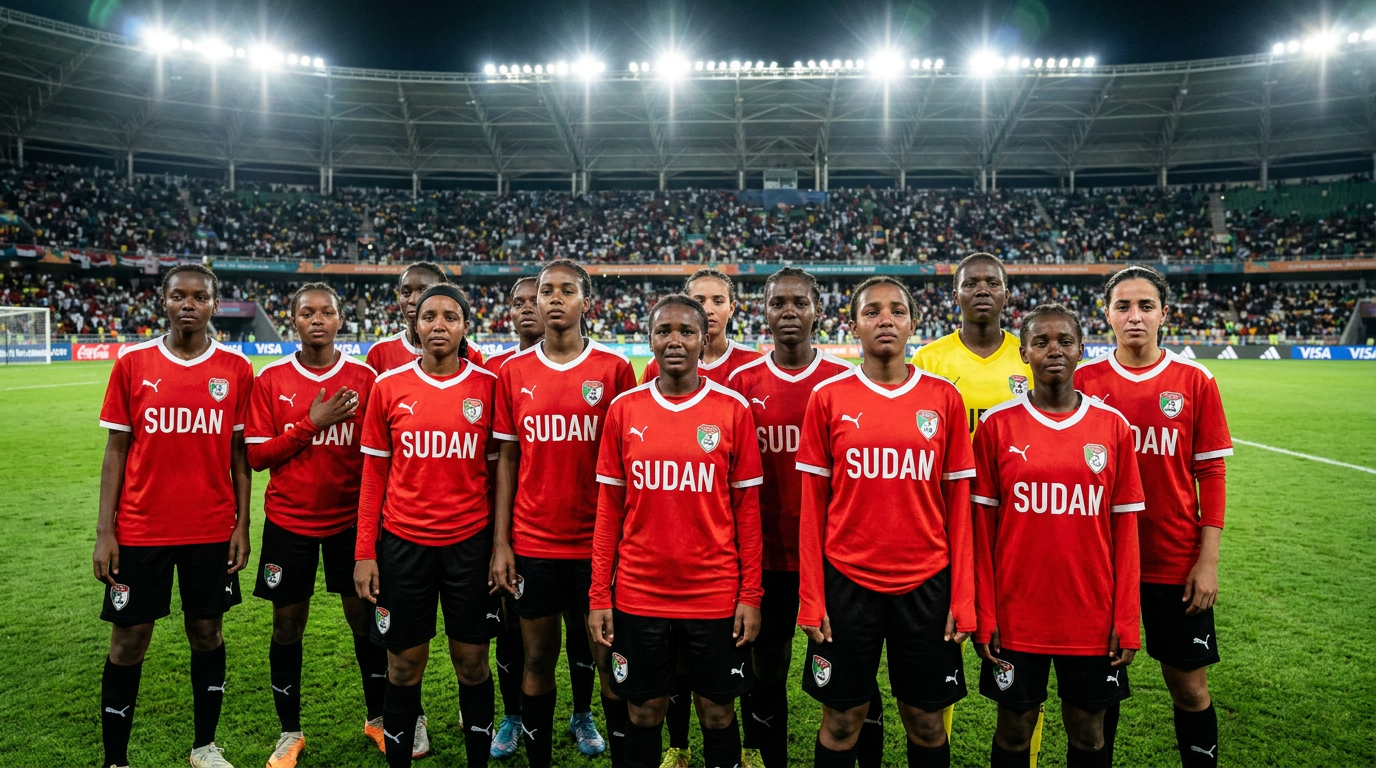
In the shadow of a devastating civil war that has fractured their homeland, a group of teenage girls in bright red jerseys stepped onto the pitch at Larbi Zaouli Stadium in Casablanca, Morocco, this June. They were there to play a soccer match, but their presence represented something much larger: Sudan’s first appearance in international women’s soccer since conflict engulfed the nation in 2023. For a country where women’s participation in sports has historically faced steep societal barriers and conservative pushback, the mere act of fielding a team was a monumental victory. The young athletes, many of whom had never played in an organized league or worn professional cleats, took on the challenge of representing their nation on a global stage, defying the odds, the critics, and the ongoing turmoil back home.[1][2][4][5]
The squad, officially designated as Sudan's under-17 women's national team, was hastily assembled to ensure the country did not forfeit its place in the African qualifiers for the 2028 Los Angeles Olympics. Unable to gather a senior women's squad due to the widespread displacement and logistical nightmares caused by the war, the Sudanese Football Association turned to a younger generation to keep the program alive. Many of the players are ordinary schoolgirls who had never set foot in a major stadium before this month. Some had fled the violence in their hometowns, traveling long distances across dangerous terrain and separating from their families just to attend the national training camp that began only weeks prior to the tournament.[1][2][3]
The sheer inexperience of the squad was immediately evident on the scoreboard. In their Olympic qualifying matches against Comoros in Morocco, the Sudanese team suffered heavy defeats, conceding 30 goals across two games, including a brutal 17-0 loss in their opener. Comoros fielded a much older, fitter, and more experienced roster, with several players already competing in established European leagues. Yet, when the final whistle blew, the tears shed by the Sudanese players in front of a small but vocal group of cheering fans were not just tears of defeat. They were a complex mix of physical exhaustion, overwhelming emotion, and profound pride in what they had accomplished simply by showing up and refusing to quit.[1][2][3]

"My goal is to lift up soccer in my country," said 17-year-old team captain Nura Mohamed, reflecting on the historic moment with remarkable maturity. "It's a beautiful, unique feeling because, at the end of the day, I just love playing." Head coach Burhan Tia, a veteran of Sudanese soccer who oversees the women's national teams, acknowledged the massive gap in skill and preparation but emphasized that the objective was survival and revival, not immediate triumph. "We cannot yet compete at the highest level," Tia noted, pointing out the lack of grassroots infrastructure. But he praised the girls' immense courage for taking on the challenge under such immense pressure and with so little preparation time.[1][3][4]
"My goal is to lift up soccer in my country," said 17-year-old team captain Nura Mohamed, reflecting on the historic moment with remarkable maturity.
The team's historic month didn't end in Morocco. They also traveled to Dar es Salaam, Tanzania, to compete in the 2026 CECAFA U-17 Women's Championship, marking their debut in the regional East and Central African tournament. Facing strong, established sides like Kenya, Tanzania, and Somalia, the Sudanese squad again struggled defensively, finishing last in their group after a series of tough matches. However, the tournament provided a massive breakthrough moment for the program: Sudan celebrated two historic goals scored by Fatin Fadol and Naswa Abbas during an 8-2 defeat to Somalia. Those two strikes proved that the team could find the back of the net on an international stage, sparking wild celebrations on the touchline.[6][7]
For regional soccer officials, the participation of debutant teams like Sudan and Somalia in the CECAFA tournament is a critical step forward for women's football development across the continent. The tournament organizers highlighted the courage of the Sudanese girls, noting that their presence on the pitch, despite the barriers of war and conservative tradition, symbolizes possibility for millions of other young women. "Everybody now knows Sudan has a U17 Women's national team, and there is a path we are creating into the senior women's team," a CECAFA official remarked, emphasizing that exposure to international play—regardless of the final score—is the only way to build long-term competitiveness and inspire the next generation of players.[6][7]

Back home, the revival of the women's team has sparked complex reactions among citizens and activists. Manal Ali Bushra, head of the women's soccer committee, stated that the federation is working on infrastructure projects, including renovating stadiums in safer parts of the country to support the girls' continued development. However, prominent Sudanese women's rights activists like Hala Al-Karib have cautioned against allowing the military government to use the team to project a progressive image while the country remains in turmoil. Al-Karib stressed that true progress requires deep institutional reform and sustained financial investment in women's sports, rather than just symbolic international appearances designed for good public relations.[1][4][5]
Despite the political complexities and the steep learning curve on the pitch, the young women of Sudan's U-17 team have laid a new foundation for the future of the sport in their country. As the global soccer community's attention often gravitates toward massive men's tournaments and established European leagues, these teenage pioneers have quietly carved out their own space in the sport's history. For Captain Nura Mohamed and her resilient teammates, the summer of 2026 will be remembered not for the goals conceded, but as the defiant moment they brought Sudanese women's soccer back to life against all odds, proving that hope can flourish even in the darkest of times.[1][2][3]
How we got here
2023
Civil war erupts in Sudan, halting all women's soccer programs and domestic leagues.
May 2026
Sudan's Football Association hastily assembles a U-17 girls' squad to avoid forfeiting international qualifiers.
June 8, 2026
The team plays its first match against Comoros in Casablanca, Morocco, marking Sudan's return to international women's soccer.
June 13, 2026
Sudan makes its debut at the CECAFA U-17 Women's Championship in Dar es Salaam, Tanzania.
June 17, 2026
Fatin Fadol and Naswa Abbas score Sudan's first historic goals of the tournament against Somalia.
Viewpoints in depth
Sudanese Players & Coaches
Focus on the joy of playing, representing their country, and building a foundation for the future.
For the players and coaching staff, the primary victory was simply taking the field. Captain Nura Mohamed and Coach Burhan Tia emphasized that despite the heavy defeats, the experience of international competition is invaluable. They view these tournaments as the first building blocks for a future senior women's team, prioritizing resilience, team cohesion, and the pure love of the game over immediate results.
Women's Rights Advocates
View the team's return as a positive step but emphasize the need for genuine, long-term investment and federation reform.
Activists like Hala Al-Karib argue that while the girls' courage is inspiring, the Sudanese Football Association and the military government must not use the team merely as a progressive PR tool. They point out the severe lack of funding, infrastructure, and grassroots support for women's sports in Sudan, demanding systemic reforms to ensure these young athletes are genuinely supported rather than exploited for optics.
Regional Soccer Officials
Celebrate the inclusion of debutant teams as a milestone for East and Central African women's football development.
CECAFA organizers view the participation of teams like Sudan and Somalia as a triumph for regional development. They argue that providing a platform for these debutant nations, regardless of the scorelines, normalizes women's football in conservative regions and encourages neighboring countries to invest in their own youth programs.
What we don't know
- It remains unclear how the Sudanese Football Association will fund the promised infrastructure projects for women's soccer amid the ongoing war.
- We do not know when or if a senior women's national team will be able to safely assemble and compete internationally.
Key terms
- CECAFA
- The Council of East and Central Africa Football Associations, a regional governing body of association football in East and Central Africa.
- U-17
- Under-17, a youth sports age category for players who are under the age of 17.
- Olympic Qualifiers
- A series of preliminary matches that determine which national teams advance to compete in the Olympic Games.
Frequently asked
Why did Sudan send a youth team to the Olympic qualifiers?
Due to the ongoing civil war and displacement, the Sudanese Football Association was unable to assemble a senior women's squad. They entered the U-17 team to avoid forfeiting their place in the qualifiers.
Who did Sudan play against in June 2026?
They played against Comoros in the Olympic qualifiers in Morocco, and faced Kenya, Tanzania, and Somalia in the CECAFA U-17 Championship in Tanzania.
Did the Sudanese team win any matches?
No, the inexperienced team suffered heavy defeats in all their matches, but they successfully scored two historic goals against Somalia.
Sources
Source coverage
7 outlets
3 viewpoints surfaced







[1]AP NewsSudanese Players & Coaches
Far from the World Cup, a girls team tries to revive soccer dreams for war-ravaged Sudan
Read on AP News →[2]ABC NewsSudanese Players & Coaches
Sudan's young women return to international soccer as war and taboos linger
Read on ABC News →[3]Winnipeg Free PressSudanese Players & Coaches
Far from the World Cup, a girls team tries to revive soccer dreams for war-ravaged Sudan
Read on Winnipeg Free Press →[4]The IndependentWomen's Rights Advocates
Sudan women's soccer team makes historic return to international stage
Read on The Independent →[5]The Voice of AfricaWomen's Rights Advocates
Sudan Women's Football Team Returns to International Stage Despite War and Social Barriers
Read on The Voice of Africa →[6]CECAFA OnlineRegional Soccer Officials
Sudan: Courage Against the Odds
Read on CECAFA Online →[7]WikipediaRegional Soccer Officials
Sudan women's national under-17 football team
Read on Wikipedia →

More in sports
See all 5 stories →WTA Tour
Alexandra Eala's Historic Berlin Open Run Signals a Breakthrough for Philippine Tennis
6 sources
WNBA Milestone
WNBA Commemorates Anniversary of Inaugural Game Amidst Record-Breaking 30th Season
6 sources

U.S. Open
Wyndham Clark Takes Six-Shot Lead Into Final Round of U.S. Open as Scottie Scheffler Chases Career Grand Slam
7 sources

Every angle. Every day.
Get sports stories with full source coverage and perspective breakdowns delivered to your inbox.