
WNBA Commemorates Anniversary of Inaugural Game Amidst Record-Breaking 30th Season
Exactly 29 years after the New York Liberty and Los Angeles Sparks tipped off the WNBA's first game, the league is celebrating its foundational pioneers during a season defined by unprecedented viewership and expansion.
By Factlen Editorial Team
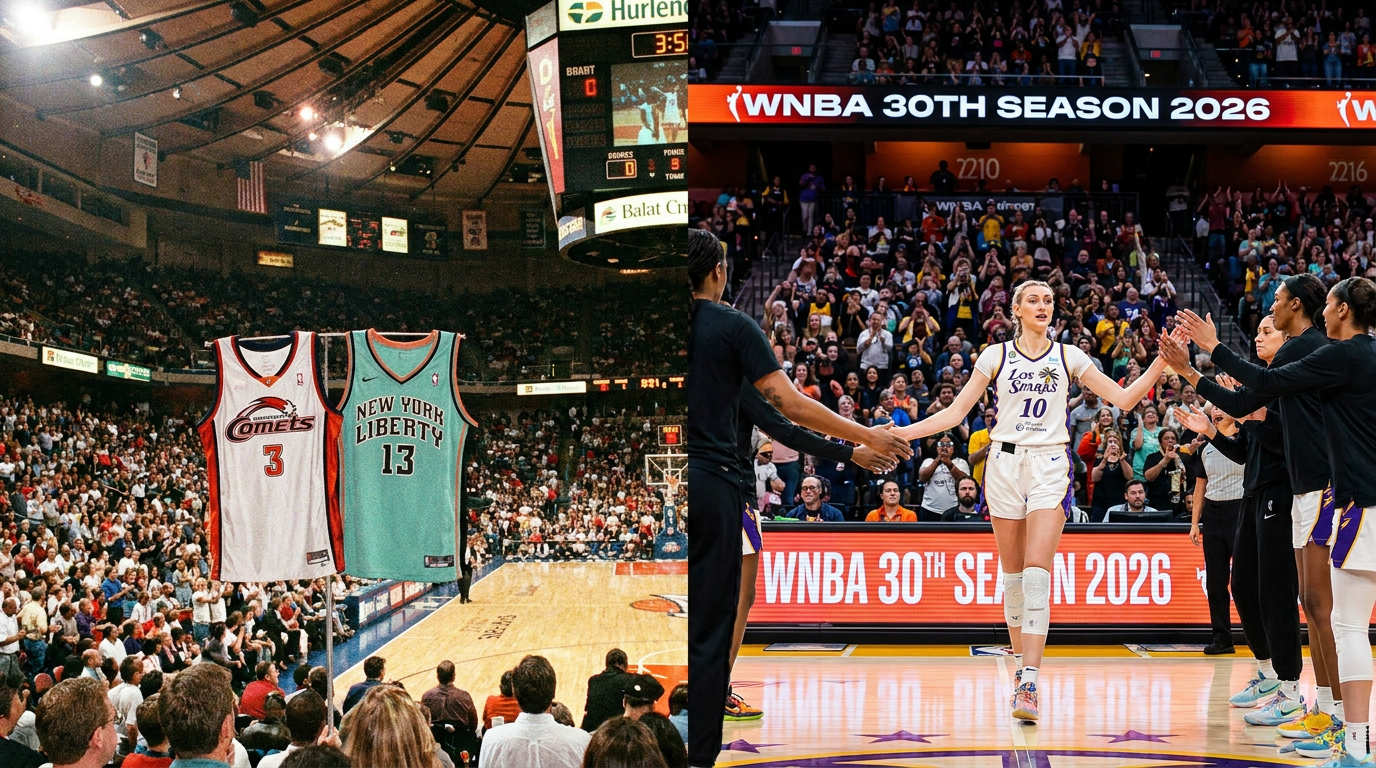
- Current Players
- Focuses on leveraging the current boom to secure long-term financial equity while honoring the past.
- Foundational Pioneers
- Emphasizes the sacrifices made to keep the league alive in its early years and the pride in its current success.
- Sports Business Analysts
- Views the anniversary as a marker of the WNBA's graduation from a subsidized experiment to a tier-one media asset.
What's not represented
- · Early investors and team owners who took financial losses in the 1990s
- · International leagues that competed with the WNBA for talent during the early years
Why this matters
The WNBA's transformation from a heavily subsidized summer experiment into a standalone cultural and financial juggernaut proves the long-term viability of women's professional sports. For fans and athletes, the anniversary highlights a generational shift where players now enter a league with charter flights, multi-million dollar endorsements, and global visibility.
Key points
- The WNBA is celebrating the anniversary of its inaugural June 21, 1997 game between the Liberty and Sparks.
- The league is currently playing its 30th season amidst record-breaking attendance and television viewership.
- Current players and executives are honoring pioneers like Lisa Leslie and Rebecca Lobo for ensuring the league's survival.
- The anniversary highlights the league's transition from an NBA-subsidized experiment to a standalone financial powerhouse.
On June 21, 1997, the New York Liberty and Los Angeles Sparks stepped onto the court at the Great Western Forum in Inglewood, California, launching a professional women's basketball experiment that many sports executives quietly expected to fail. Today, exactly twenty-nine years later, the WNBA is commemorating the anniversary of that inaugural tip-off while playing its thirtieth milestone season—a campaign defined by sold-out arenas, massive television ratings, and unprecedented cultural relevance. The anniversary serves as a powerful measuring stick for the league's explosive growth, contrasting the humble, heavily subsidized beginnings of the late 1990s with the multi-billion dollar sports and entertainment juggernaut the WNBA has become in 2026. Across the country this weekend, franchises are hosting tribute ceremonies, wearing commemorative warm-up gear, and honoring the foundational pioneers who carried the sport through its leanest years.[1][3]
The contrast between the league's birth and its current reality is stark. In 1997, the WNBA was launched as a centralized entity heavily subsidized by the NBA, designed in part to fill summer programming hours. Players made modest salaries, traveled exclusively on commercial flights, and often had to work second jobs or play overseas during the offseason to make ends meet. The original eight teams played in NBA arenas, but often to partially tarped-off upper bowls. Today, the landscape is virtually unrecognizable. The 2026 season features league-wide charter flights, a rapidly expanding footprint with highly anticipated new franchises in San Francisco and Toronto, and a massive influx of corporate sponsorships that have fundamentally altered the financial calculus of women's professional sports.[2][5]
Val Ackerman, the WNBA's first president, noted in a recent retrospective that the initial goal during those early years was simply survival. Executives and players alike were acutely aware that previous attempts at professional women's leagues in the United States had folded quickly. "We were building the airplane while we were flying it," Ackerman remarked, expressing both relief and profound pride that the foundation they poured has supported such a massive modern structure. The pioneers of that era—players who endured grueling travel schedules and minimal media coverage—are now watching the current generation reap the rewards of their endurance.[1][4]
The anniversary arrives at a moment when the league's talent pool and visibility have never been higher. A generational wave of college stars who entered the league over the past three years has supercharged viewership, bringing millions of new fans to the sport and dominating social media discourse. This influx of talent has coincided with a shift in how broadcasters and sponsors view the league. Financial analysts point out that the WNBA is no longer treated as a social good or a diversity initiative for television networks; it is a highly lucrative, tier-one live-rights property capable of anchoring prime-time broadcast schedules.[5][6]

Current superstars have been highly vocal this week about their debt to the 1997 class. Players across the league used pre-game press conferences and social media platforms to acknowledge that their current multi-million dollar endorsement deals, global platforms, and improved working conditions were paid for by the unglamorous work of the league's founders. There is a palpable sense of gratitude among the modern roster, with many players explicitly connecting their ability to fly private and play in sold-out, 18,000-seat arenas to the women who laid the groundwork in half-empty gyms three decades ago.[2][6]
Current superstars have been highly vocal this week about their debt to the 1997 class.
The league's recent media rights negotiations have reflected this dramatic shift in status. Moving away from being bundled as a supplementary add-on to NBA television packages, the WNBA has successfully established itself as a standalone premium property. Media analysts note that the sheer volume of live viewership the league now commands gives it unprecedented leverage in boardroom negotiations. This leverage has allowed executives to demand broadcast terms, prime-time placement, and promotional commitments that would have been unimaginable even a decade ago, let alone during the inaugural 1997 season when games were often relegated to obscure cable channels.[3][5]
Despite the celebratory mood surrounding the anniversary, the milestone has also sparked serious conversations about the work still left to do. The WNBA Players Association is currently laying the groundwork for upcoming collective bargaining negotiations. With the league's revenue exploding, players are seeking a significantly larger percentage of the financial pie, arguing that the current revenue-sharing models are outdated and do not reflect the league's new reality. Furthermore, there is a growing push to establish better pension plans and healthcare benefits for the retired pioneers who built the league but missed out on its current financial windfall.[2][5]
The expansion of the league is another major storyline intertwined with the anniversary. From the original eight teams in 1997, the WNBA is currently navigating a highly competitive expansion process, with ownership groups across North America bidding hundreds of millions of dollars for the right to launch new franchises. The recent additions of the Golden State Valkyries and the upcoming Toronto franchise demonstrate a level of institutional investment that validates the original vision of the league's founders, proving that women's basketball can anchor major markets on its own merits.[4][5]

Grassroots development has also been transformed by the league's thirty-year existence. Young athletes today have never known a world without the WNBA. High school and college players now model their games after female professionals, utilizing training techniques and strategic approaches pioneered in the WNBA. This unbroken pipeline of inspiration has dramatically elevated the skill level of incoming draft classes, creating a faster, more athletic, and highly tactical on-court product that continues to draw in basketball purists and casual fans alike.[2][6]
Looking ahead, league executives are focused on international growth and year-round engagement. While the 1997 season was strictly a summer affair, the modern WNBA is increasingly a twelve-month business, with players participating in high-profile domestic winter leagues, massive brand campaigns, and global tours. The anniversary serves not just as a look backward, but as a launchpad for these future ambitions, signaling to the global sports market that the WNBA is preparing for its next phase of aggressive expansion.[3][4]
For now, however, the immediate focus remains on the weekend's milestone. As the current iterations of the New York Liberty and Los Angeles Sparks prepare for their respective matchups, the echoes of that first jump ball at the Great Western Forum serve as a poignant reminder of the journey. The WNBA has survived skepticism, financial hurdles, and cultural resistance to emerge as a dominant force in the sports landscape, proving that the experiment launched on June 21, 1997, was one of the most important investments in the history of professional sports.[1][3]
How we got here
April 1996
The NBA Board of Governors approves the creation of the WNBA.
June 21, 1997
The New York Liberty and Los Angeles Sparks play the league's inaugural game.
2007
The WNBA signs its first television rights extension with ESPN, guaranteeing rights fees.
2024-2025
A massive influx of generational college talent supercharges league viewership and attendance.
June 2026
The league celebrates the anniversary of its first game during its 30th milestone season.
Viewpoints in depth
The 1997 Pioneers
Focuses on the grueling early days of the league and the pride in its survival.
For the players and executives who launched the WNBA in 1997, the primary emotion surrounding the anniversary is profound relief mixed with pride. Early pioneers often speak about the immense pressure they felt to succeed, knowing that previous women's leagues had folded quickly. They endured commercial flights, modest pay, and a sports media landscape that was often deeply skeptical of their product, all to ensure the league survived long enough to reach the next generation.
The Modern Superstars
Focuses on gratitude for the past and capitalizing on the current financial boom.
Today's WNBA players view the anniversary through a lens of deep gratitude, frequently acknowledging that their charter flights and multi-million dollar platforms were built on the sacrifices of the 1997 class. However, they are also using this moment of high visibility to push for systemic changes. As the league's revenue explodes, current stars are actively organizing ahead of the next collective bargaining agreement, demanding a larger share of the profits and advocating for improved benefits for the retired players who paved the way.
Sports Business Analysts
Views the WNBA's trajectory as a textbook case of successful long-term sports investment.
From a financial perspective, industry analysts view the 30th season as the WNBA's definitive graduation from a subsidized 'diversity initiative' to a tier-one media asset. The league's ability to command massive standalone broadcast rights fees and attract hundreds of millions in expansion bids proves that the initial investment made by the NBA in 1997 has paid off exponentially. Analysts note that the WNBA is now one of the fastest-growing live-rights properties in the global entertainment sector.
What we don't know
- How the upcoming collective bargaining agreement will distribute the league's new wealth to both current players and retired pioneers.
- Whether the league will expand beyond the currently planned 16 teams before the end of the decade.
Key terms
- Charter flights
- Private team flights, a major quality-of-life upgrade recently implemented across the WNBA to replace commercial travel.
- Collective Bargaining Agreement (CBA)
- The contract between the players' union and the league dictating revenue sharing, salaries, and working conditions.
Frequently asked
Who played in the first WNBA game?
The New York Liberty and the Los Angeles Sparks played the inaugural game on June 21, 1997, at the Great Western Forum.
How many teams were in the original WNBA?
The league launched with eight original franchises in 1997, heavily subsidized by the NBA.
Who was the first president of the WNBA?
Val Ackerman served as the first president of the WNBA, guiding the league through its foundational early years.
Sources
Source coverage
6 outlets
3 viewpoints surfaced






[1]ESPNFoundational Pioneers
'It really had all come to life': Leslie, Lobo and the WNBA's inaugural game
Read on ESPN →[2]The AthleticCurrent Players
From the Forum to sold-out arenas: How the WNBA's pioneers view the 2026 boom
Read on The Athletic →[3]CBS SportsSports Business Analysts
WNBA celebrates June 21 tip-off anniversary with league-wide tributes
Read on CBS Sports →[4]Yahoo SportsFoundational Pioneers
Val Ackerman reflects on the WNBA's survival and current golden era
Read on Yahoo Sports →[5]Sports IllustratedSports Business Analysts
The financial evolution of the WNBA: 1997 to the 2026 media deal
Read on Sports Illustrated →[6]Women's Hoops NetworkCurrent Players
Generational shift: How the modern stars built on the '97 foundation
Read on Women's Hoops Network →


Every angle. Every day.
Get sports stories with full source coverage and perspective breakdowns delivered to your inbox.