
Steam Deck OLED vs. Asus ROG Ally X: The Definitive 2026 Handheld Comparison
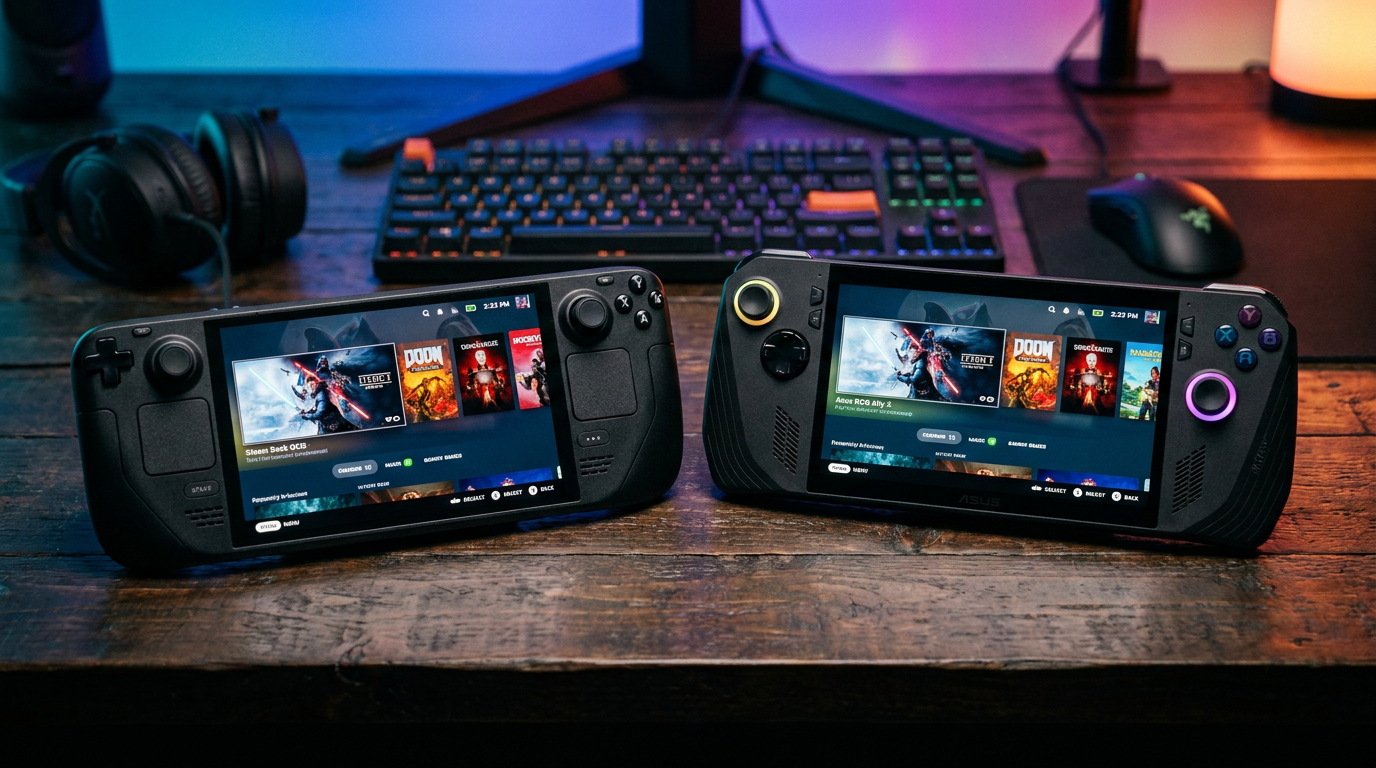
Valve’s Steam Deck OLED and Asus’s ROG Ally X represent the pinnacle of portable PC gaming, but they force players to choose between seamless console-like efficiency and raw Windows-based power.
By Factlen Editorial Team
- Console-First Gamers
- Value ease of use, the seamless SteamOS interface, and OLED screen contrast.
- Performance Enthusiasts
- Prioritize raw frame rates, 120Hz refresh rates, and the flexibility of Windows 11.
- Value Analysts
- Focus on the price-to-performance ratio and the significant cost difference between the devices.
What's not represented
- · Game Developers optimizing for handhelds
- · Cloud gaming advocates
Why this matters
Choosing the right handheld gaming PC is a significant $500 to $800 investment. Understanding the stark trade-offs between Valve's seamless console-like experience and Asus's raw Windows-based power ensures players buy the device that actually fits their gaming habits.
Key points
- The Steam Deck OLED excels in battery efficiency, screen contrast, and console-like ease of use.
- The Asus ROG Ally X offers superior raw performance, a 1080p 120Hz screen, and native Windows 11 support.
- Valve's handheld starts at a much more accessible $549, while Asus demands a premium $799.
- SteamOS blocks some anti-cheat multiplayer games, whereas the Ally X can run any PC launcher.
The handheld PC gaming market has matured from a niche experiment into a definitive two-horse race. As of mid-2026, players looking to take their PC libraries on the go are faced with a stark choice between two distinct philosophies: Valve’s highly optimized Steam Deck OLED and Asus’s brute-force ROG Ally X. While both devices represent the pinnacle of portable gaming technology, they cater to fundamentally different types of players.[1][4]
At the heart of this rivalry is a debate over operating systems. Valve relies on SteamOS, a custom Linux-based interface designed specifically for handheld use, while Asus utilizes a full desktop installation of Windows 11. This foundational difference dictates everything from how games are launched to how the devices manage battery life and sleep modes.[5][6]
**The Case For the Steam Deck OLED:** Valve’s handheld is built around a stunning 7.4-inch HDR OLED display that offers perfect black levels and vivid colors. Coupled with the lightweight SteamOS, it provides a frictionless, console-like experience where suspending and resuming games works instantly, mirroring the ease of a Nintendo Switch.[2][6]

**The Evidence:** Reviewers consistently highlight the Steam Deck's efficiency. Capped at a 15-watt thermal design power (TDP), the device can stretch its 50Wh battery up to 12 hours on lightweight indie titles. Furthermore, its OLED panel reaches a peak brightness of 1,000 nits in HDR, significantly outperforming the Ally X's 400-nit IPS screen in contrast and color depth.[5][7]
**The Case Against the Steam Deck OLED:** The device lacks the raw horsepower required to run the latest AAA blockbusters at high frame rates. Additionally, its Linux-based operating system cannot natively run games that rely on kernel-level anti-cheat software, locking players out of popular multiplayer titles like Fortnite, Call of Duty, and native Xbox Game Pass installations.[6][7]
**The Case Against the Steam Deck OLED:** The device lacks the raw horsepower required to run the latest AAA blockbusters at high frame rates.
**The Case For the ROG Ally X:** Asus designed this handheld for uncompromised performance and platform freedom. Powered by Windows 11, it natively supports every PC game launcher and anti-cheat system while delivering a sharper 1080p resolution and a buttery-smooth 120Hz refresh rate equipped with Variable Refresh Rate (VRR) technology.[1][3]
**The Evidence:** The Ally X is equipped with the formidable AMD Ryzen Z1 Extreme processor and 24GB of RAM, allowing it to push past 60 frames per second in demanding games like Cyberpunk 2077 where the Steam Deck struggles. To support this power, Asus included a massive 80Wh battery, which yields nearly three hours of heavy gameplay—the best in its class for AAA titles.[5][7]

**The Case Against the ROG Ally X:** The reliance on Windows 11 is a double-edged sword. The desktop operating system is notoriously clunky to navigate on a 7-inch touchscreen, and users frequently battle forced updates, background resource drains, and an unreliable sleep mode that pales in comparison to SteamOS. It is also heavier and significantly more expensive.[6][7]
**Price and Value:** The financial barrier to entry heavily favors Valve. The Steam Deck OLED starts at $549 for the 512GB model, making it a high-value entry point for portable PC gaming. In contrast, the Asus ROG Ally X comes in a single premium configuration priced at $799, pushing it into the territory of budget gaming laptops.[4][5]

**Fits well when:** The Steam Deck OLED is the definitive choice for players who want a seamless, console-like experience, primarily play their existing Steam library, and value battery efficiency and screen contrast over raw frame rates. It is the superior pick for travel, indie games, and casual couch gaming.[2][6]
How we got here
Feb 2022
Valve releases the original LCD Steam Deck, proving the viability of the modern handheld PC gaming market.
Jun 2023
Asus launches the first ROG Ally, introducing Windows 11 and the powerful Z1 Extreme chip to the handheld space.
Nov 2023
Valve launches the Steam Deck OLED, featuring a superior HDR screen, a larger battery, and improved thermals.
Jul 2024
Asus releases the ROG Ally X, doubling the battery capacity and fixing the ergonomic issues of its predecessor.
Viewpoints in depth
Console Purists
Gamers who prioritize a frictionless, pick-up-and-play experience over raw computing power.
This camp argues that a handheld device should feel like a console, not a miniaturized desktop. They heavily favor the Steam Deck OLED because SteamOS allows for instant sleep and wake functionality, seamless game updates, and a unified interface. For these users, the perfect black levels of the OLED screen and the ability to play indie games for 8+ hours on a single charge far outweigh the inability to play the newest AAA titles at maximum settings.
Power Maximizers
Enthusiasts who want desktop-level flexibility and the highest possible frame rates on the go.
Power maximizers view handhelds as portable PCs first and foremost. They advocate for the ROG Ally X because its Windows 11 foundation removes all software barriers, allowing native installations of Xbox Game Pass, Epic Games, and titles with strict anti-cheat software. This group is willing to tolerate the clunkiness of a desktop OS on a 7-inch touchscreen in exchange for the Z1 Extreme processor's ability to push modern games past 60 frames per second on a 1080p, 120Hz display.
What we don't know
- Whether Valve plans to release a true 'Steam Deck 2' with upgraded processing power in the near future.
- How Microsoft's rumored native Xbox handheld might disrupt the Windows portable market.
Key terms
- TDP (Thermal Design Power)
- The maximum amount of heat generated by a computer chip that the cooling system is designed to dissipate, often used as a proxy for how much battery power the device consumes.
- VRR (Variable Refresh Rate)
- A display technology that synchronizes the screen's refresh rate with the game's frame rate to prevent screen tearing and visual stuttering.
- SteamOS
- A custom, Linux-based operating system developed by Valve specifically for the Steam Deck, designed to mimic a traditional console interface.
Frequently asked
Can I play Xbox Game Pass on the Steam Deck OLED?
Not natively. Because the Steam Deck runs on Linux-based SteamOS, you must either stream Game Pass titles via the cloud or go through a complex process to install Windows. The ROG Ally X runs Game Pass natively.
Which handheld has better battery life?
It depends on the workload. The ROG Ally X has a massive 80Wh battery that lasts longer during heavy AAA gaming. However, the Steam Deck OLED is more power-efficient and lasts significantly longer when playing lightweight indie games.
Do both devices support external monitors and docks?
Yes. Both handhelds feature USB-C ports that support display output and docking stations. The ROG Ally X notably includes two USB-C ports, allowing for simultaneous charging and data transfer without a dock.
Sources
Source coverage
7 outlets
3 viewpoints surfaced







[1]Tom's HardwarePerformance Enthusiasts
Best Handheld Gaming PCs 2026: Windows and Steam Decks tested
Read on Tom's Hardware →[2]Rock Paper ShotgunConsole-First Gamers
The best handheld PCs in 2026
Read on Rock Paper Shotgun →[3]PCMagPerformance Enthusiasts
Steam Deck and Beyond: The Best Handheld Gaming PCs for 2026
Read on PCMag →[4]ZDNETValue Analysts
The best handheld game consoles of 2026: Expert tested and reviewed
Read on ZDNET →[5]Trusted ReviewsConsole-First Gamers
ROG Ally X vs Steam Deck OLED: Which handheld console is best?
Read on Trusted Reviews →[6]Pocket-lintConsole-First Gamers
The ROG Ally X is great, but the Steam Deck OLED easily beats it in 4 key ways
Read on Pocket-lint →[7]Chris Asante MediaValue Analysts
The ULTIMATE Gaming Handheld Comparison – Steam Deck OLED vs ROG Ally X
Read on Chris Asante Media →
Every angle. Every day.
Get gaming esports stories with full source coverage and perspective breakdowns delivered to your inbox.