
Steam Deck OLED vs. ASUS ROG Ally X: The 2026 Premium Handheld PC Showdown
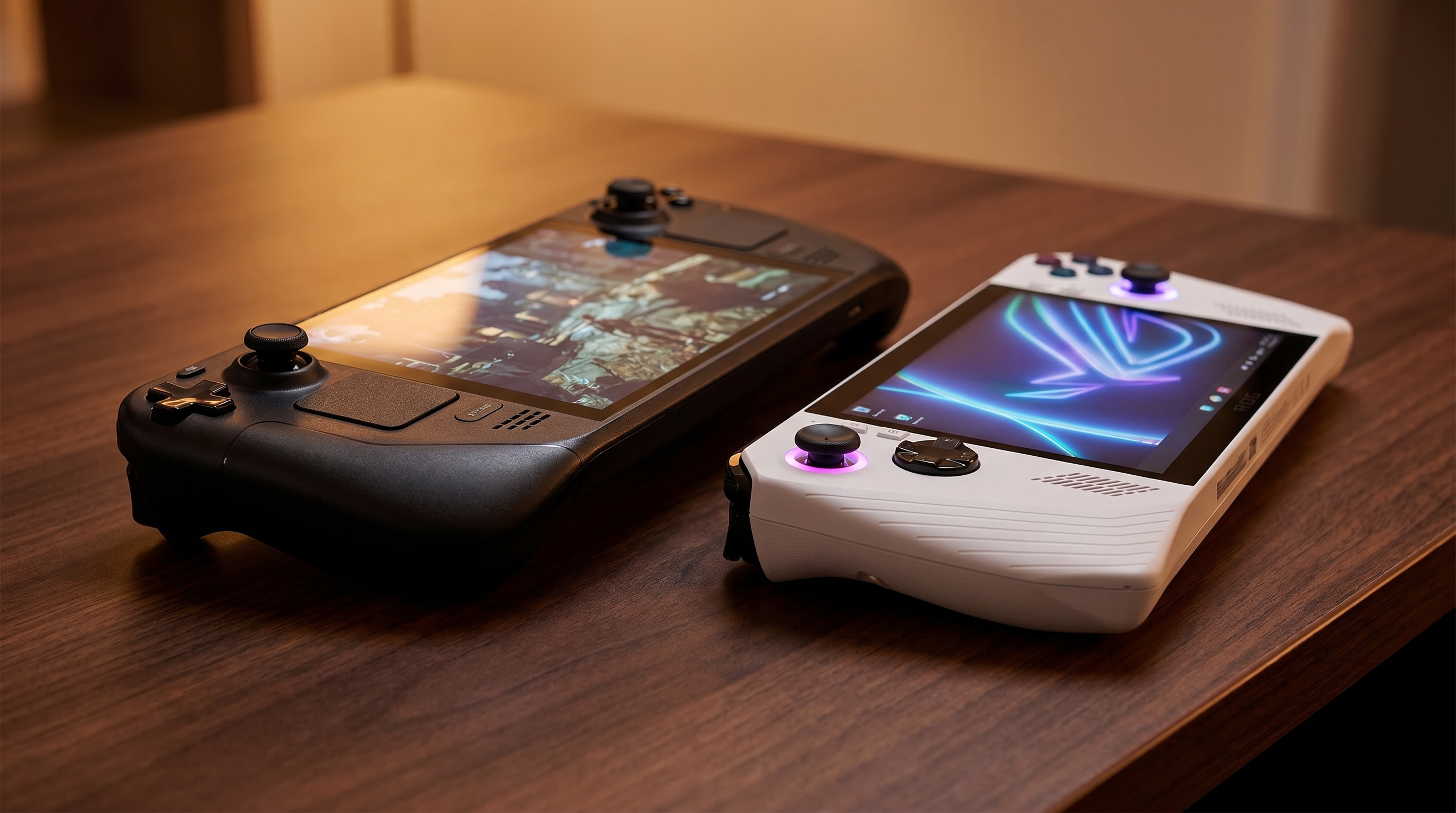
Valve’s highly optimized Steam Deck OLED and ASUS’s powerhouse ROG Ally X represent two fundamentally different approaches to portable PC gaming in 2026. This side-by-side analysis breaks down the trade-offs between console-like simplicity and raw Windows performance.
By Factlen Editorial Team
- Console Simplicity Advocates
- Gamers who want a frictionless, plug-and-play experience without desktop operating system headaches.
- Windows Power Users
- Enthusiasts who demand maximum performance and total freedom to install any game or launcher.
- Value-Conscious Gamers
- Buyers focused on maximizing the price-to-performance ratio in an increasingly expensive market.
What's not represented
- · Game Developers optimizing for fixed hardware
- · Cloud Gaming Advocates
Why this matters
Choosing the right handheld PC dictates whether you'll enjoy seamless gaming on the go or spend your commute troubleshooting software. At price points approaching $1,000, understanding the specific trade-offs between raw power and battery efficiency is essential to avoid buyer's remorse.
Key points
- The handheld PC market in 2026 is dominated by the efficiency-focused Steam Deck OLED and the performance-driven ASUS ROG Ally X.
- Valve's Steam Deck OLED excels in battery life, ease of use, and value, starting at $549 for a console-like experience.
- The $999 ROG Ally X offers raw Windows 11 power, a massive 80Wh battery, and a 120Hz display for maximum performance.
- SteamOS provides a frictionless, plug-and-play interface but struggles with non-Steam storefronts and aggressive anti-cheat software.
- Windows 11 on the Ally X guarantees total game compatibility but requires more technical tinkering and background maintenance.
- Choosing between the two depends entirely on whether a player prioritizes seamless simplicity or uncompromised graphical fidelity.
The handheld PC gaming market has officially matured from a niche hardware novelty into a legitimate, mainstream alternative to desktop gaming. As players increasingly seek ways to untether themselves from their desks after long workdays, the industry has responded with a wave of highly capable portable machines. In 2026, the premium tier of this market is dominated by two distinct titans: Valve’s refined Steam Deck OLED and ASUS’s brute-force ROG Ally X. While both devices promise to put your entire PC gaming library into the palm of your hands, they represent fundamentally different philosophies about what a portable computer should be. Valve has doubled down on a curated, highly optimized console experience, whereas ASUS and Microsoft have partnered to cram the raw, unbridled power of a full Windows desktop into a seven-inch form factor. Choosing between them is no longer just a matter of comparing spec sheets; it requires a careful analysis of how, where, and what you actually play.[1][2][5]
The case for the Steam Deck OLED rests entirely on its unmatched efficiency, ease of use, and a stunning visual presentation. Valve’s device is built around a custom Linux-based operating system called SteamOS, which strips away the bloat of a traditional desktop to deliver a frictionless, plug-and-play environment. At $549 for the premium model, it remains the undisputed king of value in a hardware landscape where competitors frequently push past the $1,000 threshold. The OLED panel provides perfect black levels and punchy high-dynamic-range colors, making atmospheric single-player adventures look incredible despite the screen’s modest 1280 by 800 resolution. For players who simply want to wake their device from sleep and instantly resume a game without ever seeing a driver update notification, the Steam Deck offers a level of polish that feels remarkably close to a dedicated home console.[2][3][6]
The arguments against the Steam Deck OLED center on its hard performance ceiling and its walled-garden software approach. Because it relies on a highly efficient but older custom AMD APU, it lacks the raw horsepower required to max out the graphical settings on the most demanding modern releases. Furthermore, the Linux-based SteamOS introduces compatibility hurdles. Players whose libraries are locked inside non-Steam ecosystems, or who rely heavily on native Xbox Game Pass, will find themselves forced to rely on cloud streaming or cumbersome third-party workarounds. Additionally, several popular multiplayer shooters utilize aggressive anti-cheat software that simply refuses to run on Linux, locking Steam Deck users out of those specific competitive communities entirely.[2][5]

Evidence from extensive hardware testing consistently highlights the Steam Deck’s dominance in low-wattage efficiency. Reviewers note that Valve’s APU is masterfully tuned to extract maximum performance at minimal power draws, sometimes running indie titles on as little as seven or eight watts. This efficiency, paired with the 50-watt-hour battery, allows the device to stretch between six and eight hours of continuous playtime in lighter 2D games. Even in heavier titles, the system runs quietly, with fan noise remaining unobtrusive and the chassis staying comfortably cool to the touch. The integrated trackpads also provide a distinct advantage, offering precise, mouse-style control for strategy games and complex user interfaces that traditional joysticks struggle to navigate.[3][5]
The case for the ASUS ROG Ally X is built on raw, uncompromising performance and total ecosystem freedom. Priced at $999, it is the ambitious powerhouse of the 2026 handheld world. ASUS equipped the device with the formidable Ryzen AI Z2 Extreme processor, 24 gigabytes of high-speed LPDDR5X RAM, and a massive 80-watt-hour battery that directly addresses the primary longevity complaints of first-generation Windows handhelds. Because it runs a full installation of Windows 11, there are no compatibility layers or restricted launchers; if a game or application runs on a desktop PC, it will run natively on the Ally X. This makes it the ultimate portable machine for power users who want to seamlessly bounce between Steam, Epic Games, Xbox Game Pass, and heavily modded titles without encountering artificial software barriers.[1][4][6]
The case for the ASUS ROG Ally X is built on raw, uncompromising performance and total ecosystem freedom.
The arguments against the ROG Ally X focus on its premium price tag and the inherent friction of using a desktop operating system on a small touch screen. While ASUS has introduced a new full-screen Xbox Experience interface to mask the clunkiness of Windows 11, users will inevitably find themselves wrestling with tiny close buttons, background system updates, and occasional driver conflicts. It is a device that demands a bit more patience and technical tinkering than its Valve counterpart. Furthermore, while the massive battery provides excellent longevity, it makes the Ally X noticeably heavier. Pushing the device to its 30-watt maximum performance mode will still chew through that 80-watt-hour reserve in roughly two hours, generating more heat and fan noise in the process.[1][5]

Evidence for the ROG Ally X’s performance advantage is stark when looking at benchmark data for demanding software. In heavy workloads, the Z2 Extreme chip can deliver a 50 to 60 percent performance uplift over the Steam Deck, allowing it to maintain playable frame rates in titles that Valve’s machine struggles to run. The Ally X also features a sharper 7-inch IPS panel running at a native 1920 by 1080 resolution with a 120-hertz refresh rate. Crucially, this display supports Variable Refresh Rate (VRR) technology. Testing shows that even when frame rates fluctuate wildly during intense action sequences, the VRR screen prevents screen tearing and stuttering, ensuring that the visual experience remains remarkably smooth and responsive for competitive play.[5][6]
When evaluating ergonomics and long-term comfort, the two devices take divergent paths. The Steam Deck is physically larger and chunkier, but its contoured grips and excellent weight distribution make it incredibly comfortable for marathon gaming sessions. The joystick layout feels natural, and the overall build quality exudes a friendly, approachable vibe. The ROG Ally X, by contrast, adopts a more traditional Xbox-style asymmetrical layout. While it is heavier than the original Ally, the internal components have been balanced meticulously to prevent wrist fatigue. ASUS has also refined the trigger feel, improved the haptic feedback, and included programmable back buttons that give competitive players a distinct mechanical advantage in fast-paced shooters.[2][5]
Ultimately, the decision comes down to matching the hardware to your specific lifestyle and gaming habits. The ROG Ally X fits well when players demand maximum graphical fidelity, rely heavily on subscription services like Xbox Game Pass, or want a single, powerful device that can dock into a monitor and function as a full Windows workstation. It is the definitive choice for enthusiasts who do not mind occasional software tinkering in exchange for the highest possible frame rates and total ecosystem flexibility. If you view a handheld as a miniaturized extension of a high-end desktop rig, the Ally X delivers an unparalleled premium experience.[1][6]

Conversely, the ROG Ally X does not fit when budget is the primary concern, or when a player values seamless, console-like simplicity above all else. If the thought of navigating Windows desktop menus with a joystick, troubleshooting occasional driver conflicts, or managing background operating system updates sounds exhausting, the Ally X will likely cause more frustration than joy. It operates much like a high-performance race car that requires regular tuning and maintenance, which can significantly detract from the simple pleasure of picking up a device for a quick, frictionless twenty-minute gaming session during a daily commute.[2][5]
The Steam Deck OLED fits well when players prioritize exceptional battery life, effortless usability, and a gorgeous, high-contrast screen for indie games or older cinematic titles. It is the ultimate companion for frequent travelers who need a reliable machine that can survive a cross-country flight without constantly hunting for a power outlet. For gamers who already own a massive Steam library and simply want a device that works perfectly the moment it is turned on, Valve’s handheld offers a level of refined, console-like magic that no Windows-based competitor has managed to fully replicate in 2026.[3][6]

However, the Steam Deck OLED does not fit when a player’s library is heavily invested in non-Steam storefronts, when they exclusively play the most demanding next-generation releases, or when they require a high-refresh-rate 1080p display for competitive multiplayer titles. If you need to play games with strict anti-cheat software or want the absolute highest performance available in a portable form factor, the Steam Deck’s hardware limitations will eventually feel restrictive. In the 2026 handheld war, there is no single universal winner—only the perfect portable tool tailored to your specific gaming reality and daily habits.[2][5]
How we got here
Early 2022
Valve launches the original Steam Deck, proving the viability of a premium handheld PC gaming market.
Mid 2023
ASUS releases the first ROG Ally, introducing high-performance Windows 11 gaming to the portable space.
Late 2023
Valve releases the Steam Deck OLED, significantly improving battery life, screen quality, and thermal efficiency.
Mid 2026
ASUS launches the ROG Ally X, featuring the Z2 Extreme chip and a massive 80Wh battery to address previous longevity concerns.
Viewpoints in depth
Console Simplicity Advocates
Gamers who want a frictionless, plug-and-play experience without desktop operating system headaches.
This camp argues that a handheld device should feel like a dedicated console, not a miniaturized desktop PC. They point to the Steam Deck's custom Linux-based SteamOS as the gold standard for portable gaming, praising its ability to suspend and resume gameplay instantly without crashing. For these users, the occasional inability to play a game with aggressive anti-cheat software is a worthwhile trade-off for an interface that never forces them to use a joystick as a makeshift mouse to close a background Windows update.
Windows Power Users
Enthusiasts who demand maximum performance and total freedom to install any game or launcher.
Power users view handhelds as extensions of their high-end desktop rigs. They champion the ROG Ally X because its Windows 11 foundation means zero compatibility barriers—if a game exists on PC, it runs on the Ally X. This camp values the ability to install Xbox Game Pass natively, apply complex community mods, and push the Z2 Extreme processor to its 30-watt limit for maximum frame rates. They accept the clunkiness of a desktop OS on a small screen as the necessary cost of total digital freedom.
Value-Conscious Gamers
Buyers focused on maximizing the price-to-performance ratio in an increasingly expensive market.
As flagship handhelds push toward the $1,000 mark, this perspective emphasizes the importance of accessible entry points. They highlight the Steam Deck OLED's $549 price tag as the sweet spot for portable gaming, arguing that the diminishing returns of higher-end hardware do not justify doubling the cost. For this group, the ability to play thousands of indie titles and older AAA games flawlessly at a reasonable price is far more important than chasing 120-hertz frame rates in the latest demanding releases.
What we don't know
- How upcoming software updates from Microsoft might further optimize the Windows 11 handheld experience.
- Whether Valve plans to release a true next-generation Steam Deck with a more powerful APU in the near future.
- How long the current pricing disparity will last as RAM and NAND shortages continue to affect manufacturing costs.
Key terms
- APU (Accelerated Processing Unit)
- A single chip that combines both the central processor (CPU) and the graphics processor (GPU), essential for compact handheld devices.
- VRR (Variable Refresh Rate)
- A display technology that syncs the screen's refresh rate with the game's frame rate, eliminating visual stuttering and screen tearing.
- TDP (Thermal Design Power)
- The maximum amount of heat a chip is expected to generate, which dictates how much battery power the device consumes during heavy gaming.
- SteamOS
- Valve's custom, Linux-based operating system designed specifically to provide a console-like interface for PC games.
Frequently asked
Can the ROG Ally X play Steam games?
Yes. Because the ROG Ally X runs a full version of Windows 11, you can install the standard Steam desktop application and play your entire library just as you would on a regular PC.
Does the Steam Deck OLED support Xbox Game Pass?
Not natively. While you can stream Game Pass titles via the cloud, installing them directly requires complex workarounds or installing Windows on the device, which degrades the seamless SteamOS experience.
Which device has better battery life?
The Steam Deck OLED is more efficient for indie and 2D games, lasting up to 8 hours. However, for demanding AAA games, the ROG Ally X's massive 80Wh battery allows it to run longer under heavy loads.
Can these handhelds replace a gaming laptop?
Yes, for many users. Both devices can be connected to external monitors, keyboards, and mice. The ROG Ally X, in particular, functions exceptionally well as a docked Windows desktop replacement.
Sources
Source coverage
6 outlets
3 viewpoints surfaced






[1]Tom's HardwareWindows Power Users
Best Handheld Gaming PCs 2026: Windows and Steam Decks tested
Read on Tom's Hardware →[2]PC GamerConsole Simplicity Advocates
The best handheld gaming PCs in 2026
Read on PC Gamer →[3]Rock Paper ShotgunConsole Simplicity Advocates
Best handheld PCs: Steam Deck OLED, ROG Ally X, and more
Read on Rock Paper Shotgun →[4]TechRadarWindows Power Users
Handheld gaming in 2026 just got better: Computex reveals
Read on TechRadar →[5]Windows ForumValue-Conscious Gamers
The 2026 handheld war: Steam Deck OLED vs ROG Ally X
Read on Windows Forum →[6]Handheld Gaming HubValue-Conscious Gamers
Top Handheld Gaming PC Recommendations for 2026
Read on Handheld Gaming Hub →

More in shopping
See all 5 stories →


Every angle. Every day.
Get shopping stories with full source coverage and perspective breakdowns delivered to your inbox.