
SpaceX Valuation Eclipses $2 Trillion Following Historic Stock Market Debut
SpaceX shares continued to surge Monday after a record-breaking $75 billion IPO that transformed the aerospace giant into a publicly traded AI conglomerate and made Elon Musk the world's first trillionaire.
By Factlen Editorial Team
- Retail & Institutional Bulls
- Investors who view SpaceX as three monopolies in one—launch provider, global ISP, and orbital AI infrastructure—justifying its massive valuation.
- Market Skeptics & Index Watchers
- Analysts concerned about the company's multi-billion-dollar cash burn and the volatility its early index inclusion will cause for passive funds.
- Space & Tech Visionaries
- Advocates who view the IPO not as a financial exit, but as a necessary funding mechanism for Mars colonization and pushing the boundaries of human capability.
What's not represented
- · Competitors in the aerospace sector facing a heavily capitalized rival
- · Astronomers concerned about the rapid expansion of the Starlink constellation
Why this matters
The successful listing of SpaceX not only redefines the scale of public market valuations but also opens the door for everyday investors to fund—and potentially profit from—the next era of space exploration and orbital artificial intelligence.
Key points
- SpaceX shares surged 6% in premarket trading Monday, following a historic Friday debut that pushed its valuation to $2.1 trillion.
- The company raised $75 billion by offering 555.6 million shares at a fixed price of $135, bypassing traditional Wall Street price discovery.
- The massive valuation officially made founder and CEO Elon Musk the world's first paper trillionaire.
- SpaceX's recent acquisition of xAI positions the company to build 'orbital AI infrastructure,' driving intense investor demand despite a $4.28 billion Q1 net loss.
- Nasdaq altered its rules to allow SpaceX to join the Nasdaq-100 index just 15 days after its IPO, forcing passive funds to rapidly buy shares.
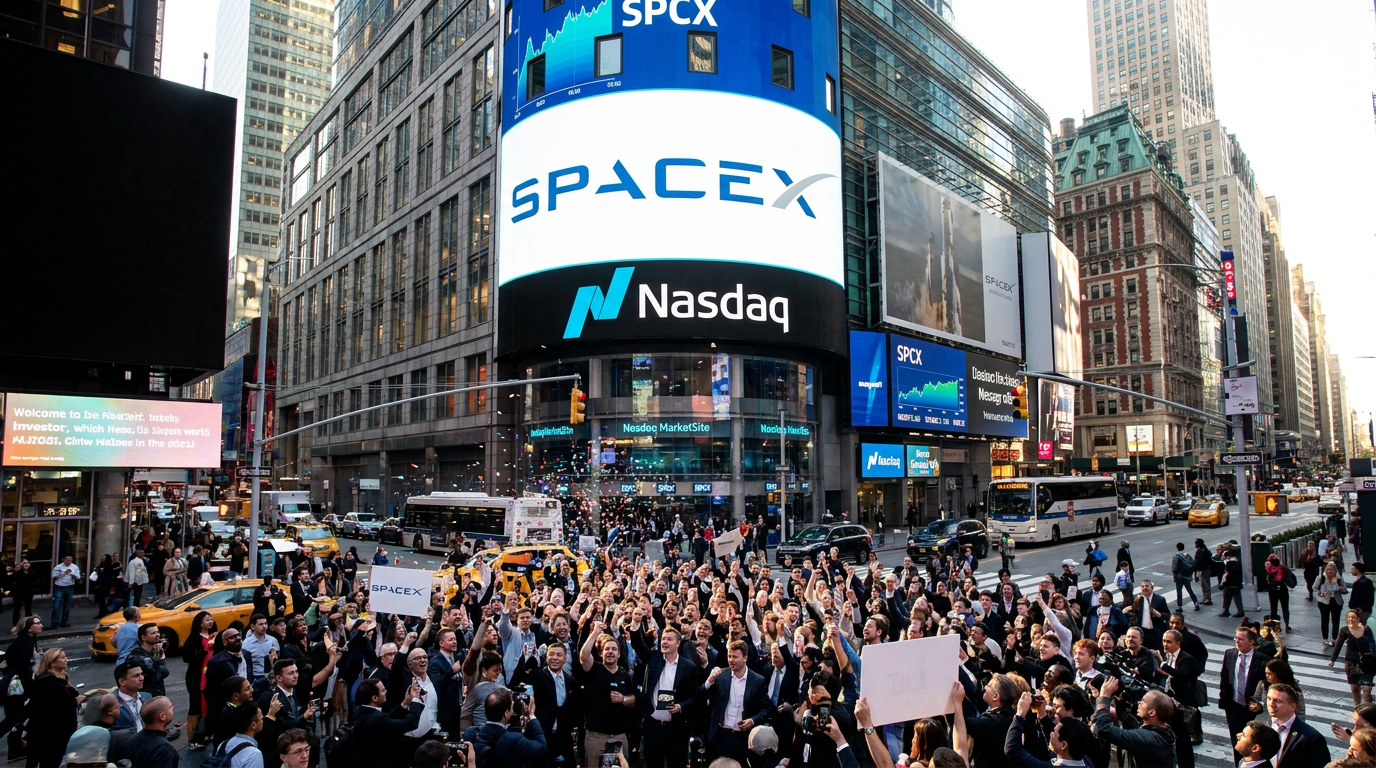
The momentum from the largest stock market debut in history shows no signs of slowing down. As Wall Street opened for a new week of trading on Monday morning, shares of SpaceX surged an additional 6% in premarket activity. The early gains extend a historic rally that began on Friday, when the aerospace and artificial intelligence conglomerate finally transitioned to public markets after nearly two and a half decades as a private enterprise. For investors who had spent years clamoring for a piece of Elon Musk’s crown jewel, the weekend provided little time to digest the sheer scale of the offering before the opening bell rang once again.[1]
SpaceX officially debuted on the Nasdaq exchange on Friday under the ticker symbol SPCX, shattering every existing record for an initial public offering. While the company had set a fixed pre-open price of $135 per share, intense demand drove the opening trade to $150 by midday. Throughout the afternoon, the stock continued to climb, reaching an intraday high of $176 before settling at $160 by market close. That 19% first-day pop pushed SpaceX’s total market capitalization to a staggering $2.1 trillion, instantly cementing its position as the sixth most valuable publicly traded company in the United States.[2][7]
The mechanics of the IPO were as unconventional as the company itself. Bypassing the traditional Wall Street price-discovery process—where underwriters announce a price range and narrow it based on institutional bookbuilding—SpaceX simply handed the market a fixed price of $135 and moved forward. The offering successfully raised $75 billion by floating 555.6 million shares. Despite the lack of a traditional roadshow pricing debate, the deal was massively oversubscribed, with investor demand reportedly exceeding $250 billion in the days leading up to the listing.[3][5]

The sheer gravity of the $2.1 trillion valuation triggered a historic milestone for the company’s founder and chief executive. With his massive retained equity stake in SpaceX, combined with his holdings in Tesla, Elon Musk officially became the world’s first individual to reach a net worth exceeding one trillion dollars on paper. Following the offering, Musk retains absolute control over the company’s direction, holding 82.4% of the voting power through a specialized class of super-voting shares, ensuring that public market pressures cannot easily derail his long-term strategic vision.[2][3]
Wall Street’s willingness to assign a two-trillion-dollar valuation to a company historically focused on rocketry is largely tied to a massive strategic pivot executed earlier this year. In February 2026, SpaceX formally acquired xAI, Musk’s artificial intelligence startup, which was independently valued at roughly $125 billion at the time. The merger transformed SpaceX from a pure-play aerospace manufacturer into a hybrid infrastructure giant. The company’s S-1 prospectus outlined an ambitious roadmap to build "orbital AI infrastructure," effectively leveraging its Starlink satellite network and heavy-lift launch capabilities to deploy data centers in low-Earth orbit, free from terrestrial power constraints.[3]
In February 2026, SpaceX formally acquired xAI, Musk’s artificial intelligence startup, which was independently valued at roughly $125 billion at the time.
However, the financial realities beneath the astronomical valuation reveal a company burning through capital at an unprecedented rate to fund its dual ambitions. While SpaceX generated a robust $18.7 billion in total revenue for the full year of 2025—driven predominantly by its Starlink broadband division—the company remains deeply unprofitable on a GAAP basis. In the first quarter of 2026 alone, SpaceX posted a staggering $4.28 billion net loss. This deficit is largely attributed to massive capital expenditures required for AI infrastructure buildouts and the ongoing depreciation of the rapidly expanding Starlink constellation.[5]

To fund this cash burn, SpaceX structured its IPO to tap directly into the retail investor enthusiasm that has long surrounded Musk’s ventures. In a highly unusual move for a mega-cap offering, the company earmarked a full 30% of the public float specifically for retail investors—roughly three times the standard allocation for an IPO of this magnitude. Goldman Sachs, which served as the lead left underwriter among a syndicate of 21 banks, facilitated a dedicated virtual event for thousands of retail participants just days before the pricing, ensuring that individual traders could participate alongside institutional giants.[4][5]
The sheer size of the newly public entity has also forced structural changes within the broader financial ecosystem. Recognizing the massive gravitational pull SpaceX would exert on passive investment vehicles, the company successfully lobbied for early inclusion in major market indices. In March, Nasdaq altered its internal rules specifically to accommodate the listing, allowing SpaceX and other mega-cap debuts to be added to the prestigious Nasdaq-100 index just 15 trading days after their IPO, bypassing the traditional waiting period that can last up to a year.[3][6]
This accelerated inclusion timeline has triggered a frenzy among index fund managers and institutional traders. Because trillions of dollars are passively pegged to the Nasdaq-100, funds are now forced to rapidly accumulate SPCX shares to accurately track the index's performance. Market analysts warn that this forced buying pressure, combined with the relatively small percentage of the company actually floating on the open market, could lead to outsized volatility in the coming weeks as passive capital collides with retail enthusiasm and limited supply.[6]
Despite the financial engineering and Wall Street fanfare, the company’s core operational cadence remained uninterrupted during the historic listing. On Friday morning, just hours before executives rang the opening bell to the tune of Elton John’s "Rocket Man" in New York, SpaceX successfully launched a Falcon 9 rocket from the Cape Canaveral Space Force Station in Florida. The mission deployed another 29 Starlink satellites into low-Earth orbit, a tangible reminder to investors of the physical infrastructure underpinning the company’s soaring valuation.[2]

Addressing employees at the company’s headquarters in El Segundo, California, Musk reiterated that the $75 billion capital injection is not an endgame, but a stepping stone toward the company’s founding objective. He emphasized that the ultimate purpose of the public offering is to secure the immense funding required to make humanity a multiplanetary species and to establish a self-sustaining city on Mars. The integration of artificial intelligence and orbital data centers, while highly lucrative, is viewed internally as the economic engine necessary to finance the colonization of the solar system.[2][3]
As the first full week of trading gets underway, the global financial landscape is adjusting to a new heavyweight champion. The successful debut of SpaceX has not only redefined the ceiling for public market valuations but has also provided a massive liquidity event that could spur a broader revival in the IPO market. For now, investors are betting that the combination of monopolistic launch capabilities, a global satellite internet constellation, and the frontier of orbital artificial intelligence will be enough to sustain the most ambitious corporate valuation in history.[1][7]
How we got here
Dec 2025
Elon Musk confirms intentions to take SpaceX public in mid-2026, reversing his previous stance on keeping the company private.
Feb 2026
SpaceX officially acquires Musk's artificial intelligence startup, xAI, merging aerospace and AI infrastructure.
May 20, 2026
SpaceX publicly files its S-1 prospectus with the SEC, revealing its financials and plans for orbital data centers.
Jun 3, 2026
SpaceX bypasses standard bookbuilding, setting a fixed IPO price of $135 per share.
Jun 12, 2026
SpaceX debuts on the Nasdaq, closing at $160 per share and reaching a historic $2.1 trillion valuation.
Viewpoints in depth
Retail & Institutional Bulls
Investors who view SpaceX as three monopolies in one—launch provider, global ISP, and orbital AI infrastructure—justifying its massive valuation.
Bullish investors argue that traditional valuation metrics fail to capture the scope of SpaceX's business model. By successfully integrating xAI, the company has positioned itself not just as a logistics provider for space, but as the foundational infrastructure for the next generation of artificial intelligence. Proponents point out that SpaceX effectively operates as a monopoly in commercial heavy-lift launch services and global satellite internet via Starlink. They believe that deploying data centers in low-Earth orbit will unlock entirely new revenue streams, making the $2.1 trillion valuation a reasonable premium for a company with no true peers in the public markets.
Market Skeptics & Index Watchers
Analysts concerned about the company's multi-billion-dollar cash burn and the volatility its early index inclusion will cause for passive funds.
Skeptics warn that SpaceX is priced for absolute perfection, leaving little room for execution errors. They point to the company's staggering $4.28 billion net loss in the first quarter of 2026 as evidence that the capital expenditure required to maintain Starlink and build orbital AI infrastructure is unsustainable without continuous cash injections. Furthermore, market structure analysts are deeply concerned about the mechanics of the IPO. By bypassing traditional price discovery and forcing early inclusion into the Nasdaq-100, they argue SpaceX has created a scenario where passive index funds are forced to buy shares at inflated prices, potentially setting up retail investors for a painful correction once the initial hype subsides and lockup periods expire.
Space & Tech Visionaries
Advocates who view the IPO not as a financial exit, but as a necessary funding mechanism for Mars colonization and pushing the boundaries of human capability.
For long-term tech visionaries and space exploration advocates, the financial mechanics of the IPO are secondary to the mission it enables. This camp views the $75 billion capital raise as the critical war chest required to fund the Starship program and ultimately establish a self-sustaining human presence on Mars. They argue that the integration of xAI and the push for orbital data centers are simply highly lucrative stepping stones designed to generate the immense capital required for multiplanetary colonization. From this perspective, the public offering is a triumph of human ambition, proving that the market is willing to fund generational, science-fiction-scale engineering projects.
What we don't know
- How quickly SpaceX can achieve profitability given its massive capital expenditures for AI infrastructure and Starlink expansion.
- The exact timeline and technical feasibility of deploying large-scale data centers in low-Earth orbit.
- How the stock will perform once the initial retail enthusiasm subsides and the post-IPO lockup period expires for insiders.
Key terms
- Initial Public Offering (IPO)
- The process of offering shares of a private corporation to the public in a new stock issuance, allowing the company to raise capital from public investors.
- Market Capitalization
- The total value of a company's outstanding shares of stock, calculated by multiplying the current stock price by the total number of shares.
- Float
- The regular shares a company has issued to the public that are available for investors to trade on the open market.
- Nasdaq-100
- A stock market index made up of 100 of the largest non-financial companies listed on the Nasdaq stock exchange.
Frequently asked
What is SpaceX's stock ticker symbol?
SpaceX trades on the Nasdaq stock exchange under the ticker symbol SPCX.
How much is SpaceX worth after the IPO?
At the close of its first trading day on Friday, SpaceX reached a market capitalization of approximately $2.1 trillion.
Did SpaceX acquire xAI?
Yes, in February 2026, SpaceX acquired Elon Musk's artificial intelligence startup xAI, positioning the combined entity as an aerospace and AI conglomerate.
Why did SpaceX lose money in Q1 2026?
The company reported a $4.28 billion net loss in the first quarter of 2026, primarily driven by massive capital expenditures for AI infrastructure and Starlink satellite depreciation.
Sources
Source coverage
7 outlets
3 viewpoints surfaced







[1]CNBCRetail & Institutional Bulls
SpaceX gains 6% in premarket after record debut
Read on CNBC →[2]The GuardianRetail & Institutional Bulls
SpaceX makes largest ever stock market debut, making Elon Musk world's first trillionaire
Read on The Guardian →[3]WikipediaSpace & Tech Visionaries
Initial public offering of SpaceX
Read on Wikipedia →[4]Capital.comSpace & Tech Visionaries
SpaceX IPO targets June 2026 after SEC filing
Read on Capital.com →[5]BitMEXMarket Skeptics & Index Watchers
SpaceX IPO Guide: S-1 Breakdown, Valuation & Trading Strategy
Read on BitMEX →[6]FinvizMarket Skeptics & Index Watchers
SpaceX Is Coming Early to Your Index. How Worried Should You Be?
Read on Finviz →[7]Yahoo FinanceRetail & Institutional Bulls
SpaceX IPO Soars in Historic Debut, Opens at $150 Per Share
Read on Yahoo Finance →
More in business
See all 5 stories →AI Infrastructure
SpaceX Raises Record $85.7 Billion in Historic IPO to Fund Orbital AI Infrastructure
7 sources
AI Economics
The Compute-First Era: How AI is Rewriting the Rules of Venture Capital
6 sources
Fed Watch
Federal Reserve Holds Rates Steady as New Chair Kevin Warsh Signals Hawkish Pivot
8 sources

Every angle. Every day.
Get business stories with full source coverage and perspective breakdowns delivered to your inbox.