
SpaceX Surpasses Amazon to Become World's Fifth Most Valuable Company Days After Historic IPO
Elon Musk's aerospace and AI conglomerate reached a $2.7 trillion valuation, leapfrogging Amazon following the largest initial public offering in history.
By Factlen Editorial Team
- Bullish Market Participants
- Investors focused on the company's monopoly in space and rapid growth in AI.
- Valuation Skeptics
- Financial analysts warning of a massive disconnect between price and underlying revenue.
- Tech Strategy Analysts
- Industry observers focused on the structural shift of combining space and AI.
What's not represented
- · Competitors in the aerospace and AI sectors reacting to the massive influx of capital.
- · Regulators monitoring the unprecedented consolidation of space infrastructure, social media, and AI.
Why this matters
The unprecedented scale of SpaceX's public debut reshapes the hierarchy of global tech giants and signals massive investor appetite for private space and AI ventures. It also establishes a new template for mega-cap conglomerates, blending hardware, satellite infrastructure, and artificial intelligence under one ticker.
Key points
- SpaceX's market capitalization reached $2.7 trillion, surpassing Amazon as the world's fifth most valuable public company.
- The stock has rallied nearly 50% since its historic $85.7 billion initial public offering on June 12.
- The newly public conglomerate includes space exploration, Starlink, the social platform X, and the AI venture xAI.
- SpaceX announced a $60 billion all-stock acquisition of the AI coding startup Cursor.
- The massive valuation surge has made CEO Elon Musk the world's first trillionaire.
- Analysts warn the rally is partly driven by artificial scarcity, with only 4.9% of shares available to trade.
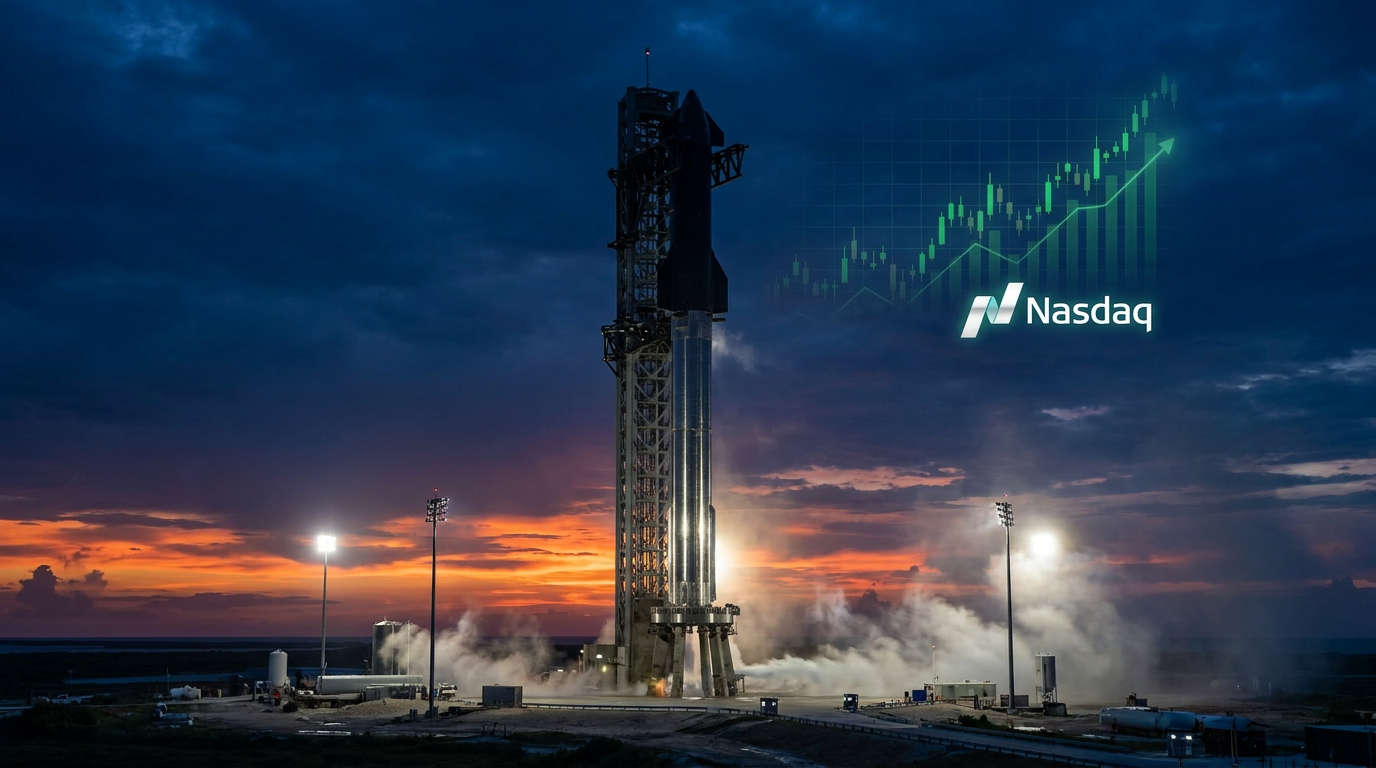
Just days after executing the largest initial public offering in history, SpaceX has fundamentally reordered the upper echelon of the global stock market. Shares of Elon Musk’s aerospace and artificial intelligence conglomerate surged in early trading this week, pushing the company's market capitalization past $2.7 trillion and officially leapfrogging Amazon to become the fifth most valuable public company in the world.[2][3][5]
The milestone caps a historic debut for the stock, which trades under the ticker SPCX. After pricing its IPO at $135 per share on June 12, the stock rallied nearly 50% over its first three trading sessions, briefly eclipsing Microsoft's $2.92 trillion valuation in intraday trading before settling comfortably ahead of Amazon's $2.65 trillion market cap.[4][5][7]

The sheer scale of the offering has shattered Wall Street records. Initial demand was so overwhelming that underwriters fully exercised their "greenshoe" option, increasing the total capital raised from $75 billion to $85.7 billion. The resulting valuation surge has also propelled Musk's personal fortune to an estimated $1.1 trillion, making him the world's first trillionaire.[1][4][7]
Investors flocking to the stock are buying into a sprawling technological empire rather than a pure-play rocket manufacturer. The newly public entity encompasses SpaceX's core orbital launch business, the highly profitable Starlink satellite internet constellation, the social media platform X, and Musk's artificial intelligence venture, xAI.[1][2]
Underscoring its aggressive expansion into the AI sector, SpaceX announced a massive $60 billion all-stock acquisition of Anysphere, the startup behind the popular AI coding assistant Cursor, on the same day it surpassed Amazon. Analysts view the acquisition as a direct challenge to Microsoft and Anthropic, integrating advanced code-generation capabilities into xAI's existing Grok models.[1][4][6]

Analysts view the acquisition as a direct challenge to Microsoft and Anthropic, integrating advanced code-generation capabilities into xAI's existing Grok models.
Market strategists note that the stock's explosive upward momentum is being heavily amplified by artificial scarcity. Only about 4.9% of SpaceX's total outstanding shares were made available to the public in the IPO. This limited float, combined with massive retail investor demand and a frenzy of newly listed options trading, has created a supply squeeze that is driving prices sharply higher.[4][6]
Despite the enthusiasm, some financial analysts are urging caution, pointing to a stark disconnect between the company's multi-trillion-dollar valuation and its current balance sheet. SpaceX reported $18.7 billion in revenue and a net loss of $4.9 billion in 2025. At its current market cap, the stock is trading at roughly 128 times its 2025 sales—a staggering multiple compared to the broader S&P 500 average of 3.7.[1][8]

Bulls, however, argue that traditional valuation metrics fail to capture the company's near-monopoly on orbital payloads and the recurring revenue potential of Starlink, which is projected to bring in $11.4 billion this year alone. Musk has publicly stated that he expects the conglomerate to generate $1 trillion in annual revenue by 2031.[1][8]
Looking ahead, the stock is expected to face continued upward pressure from institutional buyers. SpaceX is slated for fast-track inclusion into major indices, including the Nasdaq 100, FTSE Russell, and MSCI, by the end of June. This will force passive index funds and exchange-traded funds to purchase massive blocks of shares, regardless of the underlying valuation.[4]
As the dust settles on Wall Street's biggest event of the decade, the focus now shifts to execution. With a valuation that prices in years of flawless growth and a newly acquired $60 billion AI division to integrate, SpaceX must now prove it can scale its revenues to match the historic expectations set by its public debut.[6][8]
How we got here
May 20, 2026
The SEC publicly disclosed SpaceX's S-1 filing, detailing plans for the massive IPO.
June 11, 2026
SpaceX finalized its IPO price at $135 per share, cementing it as the largest public offering in history.
June 12, 2026
Shares debuted on the Nasdaq under the ticker SPCX, jumping nearly 20% on the first day of trading.
June 15, 2026
Underwriters fully exercised their greenshoe option, bringing total IPO proceeds to $85.7 billion.
June 16, 2026
SpaceX announced the $60 billion acquisition of Cursor as its market cap officially surpassed Amazon's.
Viewpoints in depth
Bullish Market Participants
Investors focused on the company's monopoly in space and rapid growth in AI.
Proponents of the $2.7 trillion valuation argue that traditional metrics like price-to-earnings ratios are irrelevant for a company building foundational infrastructure for the next century. They point to Starlink's rapidly growing, high-margin subscription revenue and SpaceX's near-total dominance of the global launch market. Furthermore, the integration of xAI and the $60 billion acquisition of Cursor position the company to capture massive value in the artificial intelligence boom, justifying the premium price.
Valuation Skeptics
Financial analysts warning of a massive disconnect between price and underlying revenue.
More cautious voices on Wall Street highlight that SpaceX is trading at over 120 times its 2025 sales, a multiple that dwarfs even the most aggressive tech valuations. They argue the current price is artificially inflated by a 'supply squeeze'—with less than 5% of shares available to trade—and a speculative retail frenzy fueled by options trading. If the company's ambitious revenue targets slip, these analysts warn, the stock could face a severe correction.
Tech Strategy Analysts
Industry observers focused on the structural shift of combining space and AI.
For tech strategists, the most significant aspect of the IPO is the formal combination of Musk's disparate ventures into a single mega-conglomerate. By housing rockets, satellite internet, social media data, and frontier AI models under one roof, SpaceX is attempting to build a vertically integrated tech monopoly unlike anything seen before. The immediate $60 billion purchase of Cursor signals that the company intends to use its massive new public currency to aggressively consolidate the AI sector.
What we don't know
- Whether SpaceX can scale its revenue quickly enough to justify its massive price-to-sales multiple.
- How the integration of the $60 billion Cursor acquisition will impact xAI's competitive standing against Microsoft and Anthropic.
- How the stock will behave once the initial retail frenzy subsides and early investor lock-up periods eventually expire.
Key terms
- Market Capitalization
- The total value of a publicly traded company's outstanding shares of stock, calculated by multiplying the current share price by the total number of shares.
- Initial Public Offering (IPO)
- The process of offering shares of a private corporation to the public in a new stock issuance, allowing the company to raise capital from public investors.
- Greenshoe Option
- A provision in an underwriting agreement that allows the underwriters to sell more shares than originally planned if demand is exceptionally high.
- Price-to-Sales (P/S) Ratio
- A valuation metric that compares a company's stock price to its revenues, often used for fast-growing companies that are not yet consistently profitable.
- Share Float
- The number of shares of a corporation that are actually available for trading by the public, excluding closely held shares owned by insiders.
Frequently asked
What is SpaceX's new stock ticker?
SpaceX trades on the Nasdaq exchange under the ticker symbol SPCX.
What businesses are included in the public company?
The public entity includes the core space exploration business, the Starlink satellite network, the social media platform X, and the artificial intelligence venture xAI.
Why did the stock price jump so quickly?
The surge is driven by massive retail demand, the introduction of options trading, and a very limited supply of shares, with only about 4.9% of the company's stock available to trade.
Is SpaceX a profitable company?
As a whole, SpaceX is not yet profitable, posting a $4.9 billion net loss in 2025. However, its Starlink satellite internet division is highly cash-flow positive.
Sources
Source coverage
8 outlets
3 viewpoints surfaced








[1]The GuardianTech Strategy Analysts
SpaceX overtakes Amazon as world's fifth most valuable company
Read on The Guardian →[2]AxiosTech Strategy Analysts
SpaceX soars above Amazon in market cap
Read on Axios →[3]ForbesBullish Market Participants
SpaceX Passes Amazon As Fifth-Largest Company—Surges Another 10%
Read on Forbes →[4]BNN BloombergValuation Skeptics
SpaceX roared past Amazon's market valuation on Tuesday
Read on BNN Bloomberg →[5]Business InsiderBullish Market Participants
SpaceX leapfrogs Amazon and hits a $2.7 trillion valuation in 3 days of trading
Read on Business Insider →[6]The Japan TimesValuation Skeptics
SpaceX overtakes Amazon in value as post-IPO rally reaches 49%
Read on The Japan Times →[7]Investing.comBullish Market Participants
SpaceX extended its post-IPO rally on Tuesday, surging past Amazon's market valuation
Read on Investing.com →[8]The Motley FoolValuation Skeptics
SpaceX Is Now Bigger Than Amazon and Closing in on Microsoft. Here's How to Think About the Valuation.
Read on The Motley Fool →
More in business
See all 5 stories →AI Infrastructure
SpaceX Raises Record $85.7 Billion in Historic IPO to Fund Orbital AI Infrastructure
7 sources
AI Economics
The Compute-First Era: How AI is Rewriting the Rules of Venture Capital
6 sources
Fed Watch
Federal Reserve Holds Rates Steady as New Chair Kevin Warsh Signals Hawkish Pivot
8 sources

Every angle. Every day.
Get business stories with full source coverage and perspective breakdowns delivered to your inbox.