
SpaceX Shatters Records With $75 Billion IPO, Minting Thousands of Employee Millionaires
Elon Musk's aerospace giant surged 19% in its public market debut, reaching a $2.1 trillion valuation and unlocking unprecedented wealth for blue-collar workers and early investors.
By Factlen Editorial Team
- Retail & Institutional Bulls
- View SpaceX as a generational growth engine spanning aerospace, AI, and telecommunications.
- Value Skeptics
- Warn that the company's massive cash burn and unproven technologies do not justify a multi-trillion-dollar valuation.
- Local Communities & Workers
- Celebrate the unprecedented wealth transfer to blue-collar workers while bracing for severe housing affordability crises in Texas.
What's not represented
- · Longtime South Texas residents facing housing displacement
- · Traditional aerospace competitors losing market share
Why this matters
SpaceX's record-shattering public debut not only mints thousands of new millionaires and crowns the world's first trillionaire, but it violently reopens the IPO market, setting the stage for everyday investors to buy into the next generation of space and AI infrastructure.
Key points
- SpaceX raised a record $75 billion in its initial public offering, surpassing Saudi Aramco's previous high mark.
- Shares surged 19% on their first day of trading, giving the aerospace company a $2.1 trillion market valuation.
- The massive liquidity event minted an estimated 4,000 new millionaires, including non-technical staff like welders and cooks.
- The surge in employee wealth is expected to heavily impact the Texas real estate market, particularly in Austin and San Antonio.
- The capital raise will fund capital-intensive projects like the Starship rocket, Starlink broadband, and orbiting AI data centers.
- Skeptics warn the company is overvalued, pointing to an $8.7 billion loss over the past 15 months.
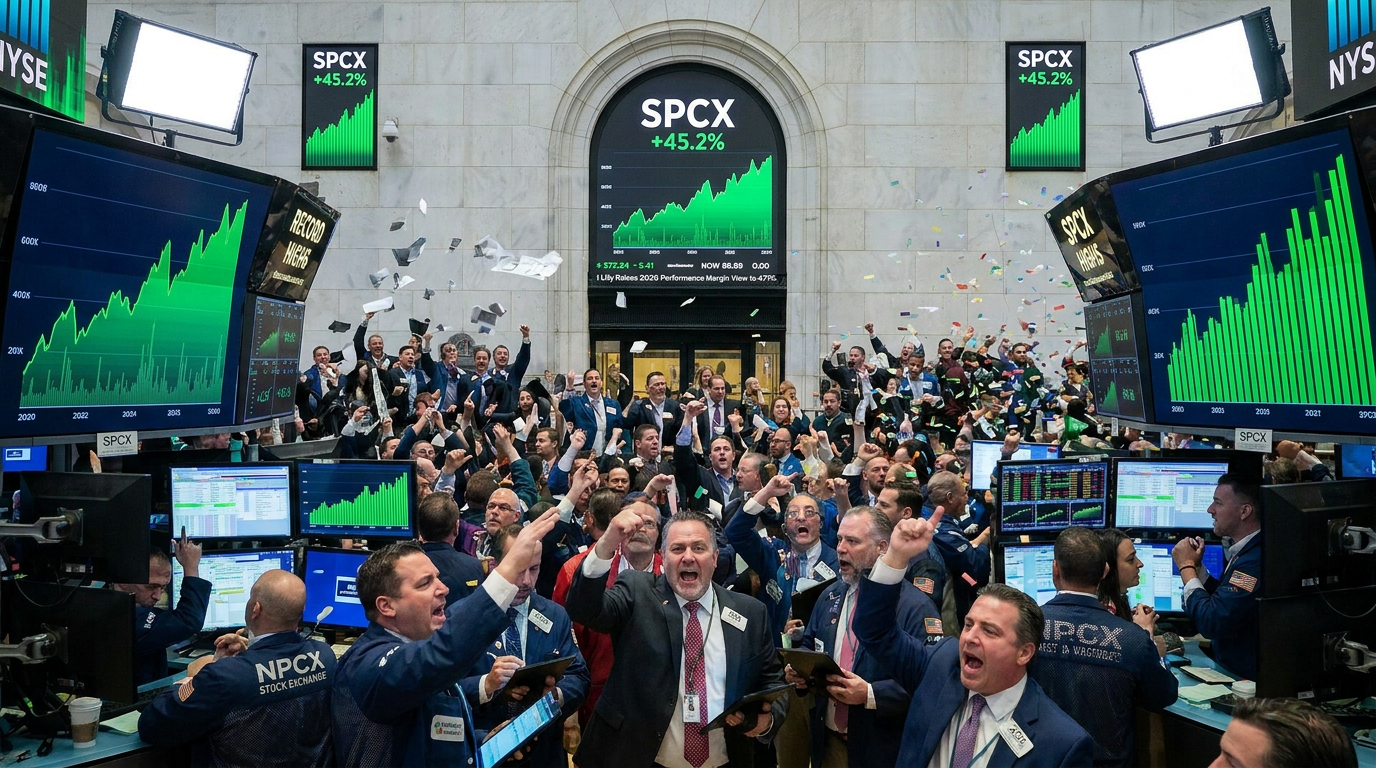
The financial world shifted on its axis Friday as SpaceX executed the largest initial public offering in history, raising a staggering $75 billion and violently blowing open the IPO window for the broader technology sector. Trading under the ticker symbol SPCX on the Nasdaq, the aerospace giant priced its shares at $135 before intense retail and institutional demand drove the stock up 19% in its highly anticipated debut. By the time the closing bell rang, shares settled at $160.95, cementing a $2.1 trillion market valuation and instantly making SpaceX the seventh-most valuable public company on Earth.[1][7]
The sheer scale of the offering shattered previous records, easily eclipsing the $29.4 billion raised by Saudi Arabia's state-owned oil giant, Saudi Aramco, in 2019. Wall Street had spent weeks stress-testing trading infrastructure to handle the anticipated volume, desperate to avoid the technical glitches that marred Facebook's debut over a decade ago. The preparation paid off. After a two-hour auction process, the stock opened cleanly at $150, backed by a reported $100 billion in retail orders and massive institutional block buys, including a $5 billion order from BlackRock.[1][5][7]
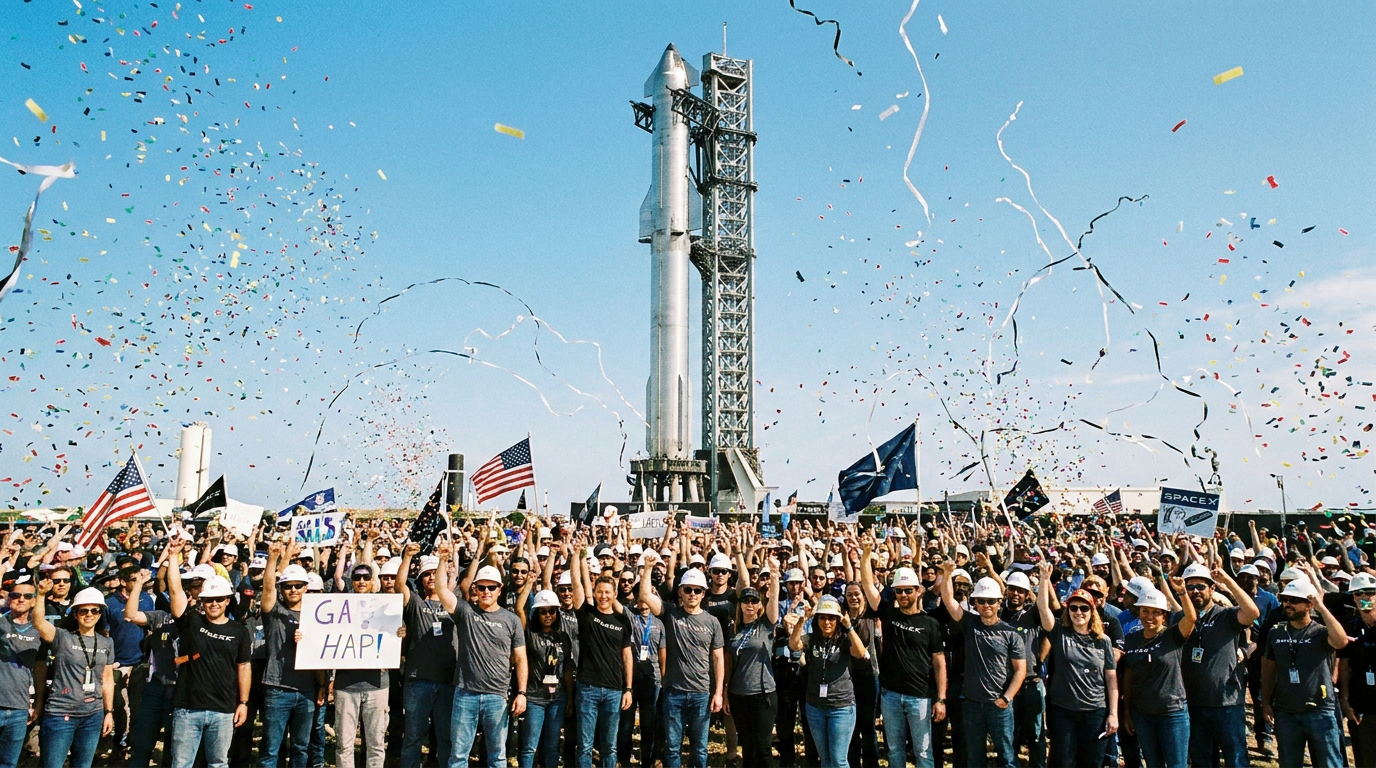
For CEO Elon Musk, the blockbuster debut pushed his personal fortune past a historic threshold, making him the world's first trillionaire. Despite the public listing, Musk maintains an iron grip on the company's future. Through a special class of B shares, he retains 82% voting control, ensuring that public market pressures will not override his long-term, capital-intensive ambitions. Addressing a cheering crowd of employees at the company's Starbase headquarters in Texas, Musk reiterated that the ultimate goal of the capital raise is not just corporate growth, but establishing a human colony on Mars and deploying solar-powered data centers in space.[1][3][4]

While Musk's milestone captured the headlines, the most profound impact of the IPO is playing out among the company's rank-and-file workforce. SpaceX has long utilized a compensation philosophy that favors equity over cash, extending stock options far beyond the engineering and executive suites. As a result, Friday's listing minted an estimated 4,000 new millionaires. This unprecedented wealth transfer includes non-technical staff—such as welders, cooks, and cafeteria workers—who held onto their early equity grants, transforming the financial trajectories of thousands of blue-collar families.[4][6]
While Musk's milestone captured the headlines, the most profound impact of the IPO is playing out among the company's rank-and-file workforce.
The ripple effects of this sudden liquidity are already threatening to upend the Texas real estate market. Real estate brokerages estimate that the combined post-tax windfall of SpaceX employees is large enough to hypothetically purchase 40% of all homes in San Antonio, or every single residential property in the border city of McAllen. While employees are subject to a staggered lockup period preventing immediate stock sales, many are already leveraging their newly valuable portfolios. Real estate agents in Austin report a surge of SpaceX personnel seeking to borrow against their locked-up shares to make all-cash offers on luxury homes in the $1.5 million range.[6]
The windfall extends to Wall Street, where the syndicate of banks that underwrote the mammoth offering is celebrating a historic payday. Led by Goldman Sachs, Morgan Stanley, and JPMorgan Chase, a consortium of 23 financial institutions guided the listing. Even with the compressed fee structures typical of mega-deals, the 1.5% to 2% cut on a $75 billion raise translates to a fee pool exceeding $1.1 billion. For the investment banking sector, which endured a prolonged drought of tech listings over the past two years, the SpaceX deal represents a massive injection of revenue and a signal that the capital markets are fully open for business.[5]

Yet, the $75 billion war chest is not merely a victory lap; it is a necessity for SpaceX's staggering operational costs. The company pitched investors on a $28 trillion total addressable market, framing itself not just as a rocket manufacturer, but as the foundational infrastructure for the next century. The funds are earmarked for three highly capital-intensive pillars: the ongoing development of the Starship launch vehicle, the expansion of the Starlink global broadband network, and the construction of massive orbiting data centers to power xAI, Musk's artificial intelligence venture.[1][7]
Not everyone on Wall Street is convinced the math adds up. Value investors and research firms have raised red flags about the company's underlying financials and the speculative nature of its valuation. Morningstar analysts issued a pre-IPO note valuing SpaceX at just $780 billion—less than half of its Friday closing price. Skeptics point to the company's S-1 filing, which revealed an $8.7 billion loss between the start of 2025 and March 2026 on $18.7 billion in revenue. They argue that retail investors are paying a massive premium for unproven technologies, noting that SpaceX's profitability is currently lightyears behind mega-cap peers like Apple and Nvidia.[1][4]

Despite the warnings, the market's appetite for generational tech infrastructure appears insatiable. Analysts note that betting against SpaceX has historically been a losing proposition, as the company has consistently achieved milestones once deemed impossible by traditional aerospace contractors. The successful debut has also set a bullish precedent for the rest of the tech sector. With artificial intelligence leaders Anthropic and OpenAI reportedly preparing for their own trillion-dollar public offerings later this year, the SpaceX IPO has effectively fired the starting gun on a new era of mega-cap public listings.[1][3][4]
How we got here
2002
Elon Musk founds Space Exploration Technologies Corp. in a warehouse in El Segundo, California.
April 2026
SpaceX files confidential paperwork with the SEC to prepare for a public market debut.
May 20, 2026
The company's S-1 filing is made public, revealing plans for the largest stock offering in history.
June 11, 2026
SpaceX officially prices its shares at $135, raising $75 billion from institutional and retail investors.
June 12, 2026
Shares begin trading on the Nasdaq under the ticker SPCX, surging 19% to close at $160.95.
Viewpoints in depth
The Bull Case
A bet on a multi-planetary, AI-driven future.
Investors driving SpaceX's valuation past $2 trillion are not valuing it as a traditional aerospace contractor. They view it as a monopolistic infrastructure play for the next century. By bundling the Starship launch vehicle, the Starlink global broadband network, and the massive data centers required for xAI, bulls argue SpaceX is positioned to capture a significant slice of a $28 trillion total addressable market. For these investors, Elon Musk's track record of disrupting entrenched industries justifies the premium, treating the stock as a combined bet on space exploration, artificial intelligence, and global telecommunications.
The Value Skeptics
Concerns over cash burn and dot-com era exuberance.
Financial purists and research firms like Morningstar argue the math simply does not support a $2.1 trillion market capitalization. They point to the company's staggering $8.7 billion loss over the last 15 months and note that SpaceX's $18.7 billion in annual revenue is a fraction of what highly profitable tech giants like Apple or Nvidia generate. Skeptics warn that retail investors are paying a massive premium for unproven technologies—such as shielding orbiting AI data centers from radiation—and liken the current fervor to the dot-com bubble, suggesting the stock is priced for flawless execution in highly experimental fields.
The Texas Ripple Effect
A blue-collar windfall colliding with a housing crunch.
For the communities surrounding SpaceX's Texas operations, the IPO is a double-edged sword. On one hand, the company's policy of granting equity to non-technical staff has triggered a historic wealth transfer, turning thousands of welders, cooks, and technicians into millionaires overnight. On the other hand, this sudden influx of liquid capital is poised to supercharge local housing markets. Real estate analysts warn that as newly wealthy employees borrow against their shares to make all-cash offers, longtime residents in cities like Brownsville and San Antonio could face unprecedented affordability pressures and displacement.
What we don't know
- How the massive influx of employee wealth will permanently alter housing affordability in South Texas communities.
- Whether SpaceX can achieve profitability in the near term given the massive capital requirements of its Starship and xAI initiatives.
- How the stock will perform once the staggered lockup periods expire and insiders begin selling larger blocks of shares.
Key terms
- Initial Public Offering (IPO)
- The process where a private company offers its shares to the public for the first time, allowing anyone to buy a stake in the business.
- Total Addressable Market (TAM)
- The total revenue a company could theoretically make if it captured 100% of the market for its products and services.
- Lockup Period
- A set window of time after an IPO during which company insiders and early employees are legally restricted from selling their shares.
- Market Capitalization
- The total dollar value of a company's outstanding shares of stock, calculated by multiplying the current share price by the total number of shares.
Frequently asked
How much money did SpaceX raise in its IPO?
SpaceX raised a record-breaking $75 billion by selling shares at $135 each, surpassing Saudi Aramco's 2019 offering as the largest IPO in history.
Did everyday employees actually get rich?
Yes. Because SpaceX historically compensated non-technical staff—including welders, cooks, and cafeteria workers—with stock options, the IPO minted an estimated 4,000 new millionaires.
Why do some analysts think the stock is overvalued?
Firms like Morningstar point out that SpaceX lost $8.7 billion over the last 15 months and relies on unproven technologies, arguing its true value is closer to $780 billion.
What is SpaceX planning to do with the $75 billion?
The capital will fund highly expensive, long-term projects, including the Starship rocket program, the Starlink satellite internet network, and massive orbiting data centers for its artificial intelligence ventures.
Sources
Source coverage
7 outlets
3 viewpoints surfaced







[1]CBS NewsRetail & Institutional Bulls
SpaceX stock soars 19% on first day of trading following record-breaking $75 billion IPO
Read on CBS News →[2]AxiosRetail & Institutional Bulls
SpaceX raises $75 billion in its IPO
Read on Axios →[3]The GuardianLocal Communities & Workers
Elon Musk becomes world's first trillionaire as SpaceX ends trading day with valuation of $2.1tn
Read on The Guardian →[4]Los Angeles TimesValue Skeptics
SpaceX shares rise 19% in stock market debut after historic IPO
Read on Los Angeles Times →[5]Business InsiderRetail & Institutional Bulls
Goldman Sachs to Lead Banks in Record-Breaking SpaceX IPO
Read on Business Insider →[6]MarketWatchLocal Communities & Workers
SpaceX employees now have enough wealth on paper to buy every home in this Texas city
Read on MarketWatch →[7]ForbesRetail & Institutional Bulls
SpaceX Opens At $150—Surging 20% After Largest IPO Ever
Read on Forbes →
More in finance
See all 7 stories →Parametric Insurance
How Parametric Insurance is Rewiring Climate Resilience with Instant Payouts
7 sources
Retirement Strategy
The Late-Career Roth 401(k) Switch: What the Evidence Actually Shows
7 sources

Cross-Border Payments
Stablecoins Quietly Overhaul Global Remittances, Slashing Cross-Border Fees Under 1%
7 sources
Roth Strategies
The Evidence for Switching to a Roth 401(k) in Your 50s
6 sources

Every angle. Every day.
Get finance stories with full source coverage and perspective breakdowns delivered to your inbox.