
SpaceX Seeks $40 Billion in Debt Financing to Purchase Nvidia AI Chips
Elon Musk’s aerospace company is reportedly negotiating a massive debt package led by Apollo Global Management to fund its expanding artificial intelligence infrastructure. The proposed deal highlights the escalating capital requirements for securing advanced computing power.

SpaceX has initiated discussions to raise $40 billion in debt financing to acquire advanced artificial intelligence processors from Nvidia. The aerospace manufacturer is negotiating a package that includes approximately $10 billion in bank loans and $30 billion in investment-grade debt, with private equity firm Apollo Global Management expected to lead the transaction.[1][2][3]
The proposed financing, which targets a 2027 close, represents one of the largest debt efforts ever mounted specifically for AI infrastructure. Bond giant Pimco is also participating in the early-stage talks among a small consortium of lenders. The sheer scale of the borrowing underscores the escalating capital requirements for companies racing to secure computing power.[1][2]
SpaceX currently holds a BBB credit rating, placing it on the second-lowest rung of the investment-grade ladder. That classification allows institutional investors, such as pension funds and insurance companies, to purchase the company’s debt. The aerospace firm previously tested this market in June, issuing $25 billion in high-grade bonds shortly after its initial public offering.[1][2]
The new capital is earmarked exclusively for hardware expansion. Elon Musk has aggressively scaled the computing footprint across his corporate ecosystem, integrating operations between SpaceX and his artificial intelligence venture, xAI. The companies have become some of the largest buyers of Nvidia’s specialized processors, driving a massive surge in capital expenditure.[1][3]
Scaling the Colossus Infrastructure
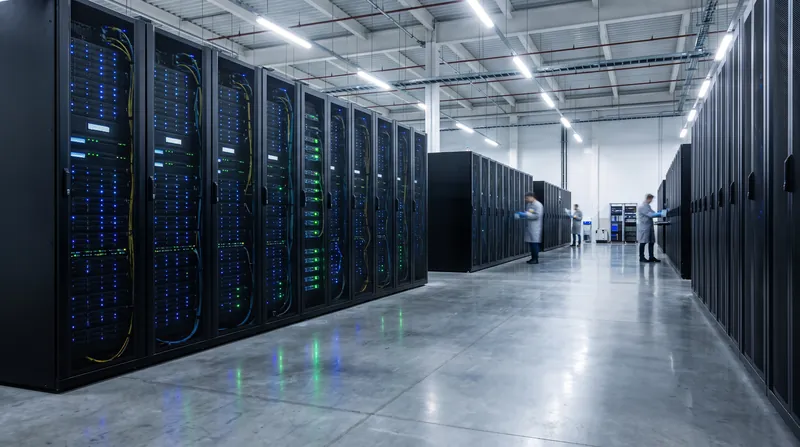
The hardware acquisition aligns with a rapid buildout of the Colossus data center network. During an August earnings call, Musk stated that the company would rely exclusively on Nvidia hardware to power its intensive artificial intelligence training workloads.[2]
"We've decided to build exclusively on Nvidia because we think the Vera Rubin architecture is the best architecture," Musk said during the briefing. "We think it's the best AI computer, and we greatly value our close co-operation and partnership."[2]
The current Colossus 2 facility is already slated to more than double its Nvidia chip count by December. To support that growth, SpaceX spent $15.8 billion on computing infrastructure in the second quarter alone. The $40 billion debt package would provide the necessary runway to continue that expansion without depleting the company's cash reserves.[1][3]
Nvidia and SpaceX have deepened their financial ties alongside their hardware partnership. The chipmaker holds a stake in the aerospace company recently valued at roughly $21 billion. Meanwhile, Apollo Global Management has previously financed two separate $3.5 billion deals for xAI’s computing clusters earlier this year, establishing a track record for these massive hardware loans.[1]
SpaceX does not consume all of its computing power internally. The company leases excess capacity to third parties, generating immediate returns on its hardware investments. Since the spring, SpaceX has rented the entirety of its Colossus 1 data center to AI developer Anthropic, a business line that is expected to grow as new facilities come online.[1]
The Debt Market for Compute
The transaction tests the appetite of corporate debt markets for massive AI infrastructure projects. Tech developers are increasingly turning to external financing to cover the soaring costs of land, power generation, and specialized silicon. Morgan Stanley recently estimated that AI infrastructure will require $1.5 trillion in external financing by 2028.[1]
Lenders are evaluating the returns on these unprecedented hardware investments. Every percentage point of annual interest on a $40 billion debt load equates to $400 million in servicing costs. Investors must weigh the potential leasing revenue and expanded AI capabilities against the burden of carrying such a massive financial obligation.[1][2]
The Apollo-led financing mirrors a broader trend of private capital mobilizing to fund the AI boom. In August, Nvidia partnered with several major asset managers, including Apollo, Blackstone, and BlackRock. That consortium created financing platforms intended to unlock over $500 billion for AI infrastructure projects globally.[1]
Other major tech conglomerates are pursuing similar debt structures. Broadcom recently finalized a $60 billion financing package for Anthropic to secure its own AI chips. The shift indicates that the sheer cost of frontier model training has pushed the industry beyond what traditional venture capital or internal cash flows can comfortably support.[1]
Market Reaction and Next Steps
Following the initial reports of the $40 billion package, SpaceX shares experienced slight volatility in extended trading, dropping just over one percent. Investors reacted cautiously to the prospect of a heavily leveraged balance sheet, even as they acknowledged the necessity of securing top-tier computing hardware to maintain a competitive edge.[1][3]
The fundraising discussions remain in an early stage and could still conclude without a finalized deal. Representatives for SpaceX, Apollo, Pimco, and Nvidia have all declined to comment publicly on the negotiations. If completed, the transaction would set a new benchmark for corporate borrowing in the artificial intelligence sector.[1][2]
The ultimate structure of the debt will dictate how quickly SpaceX can deploy the capital. With a target close date in 2027, the company is securing its place in the hardware queue well in advance. The move ensures that its data centers will be equipped with the next generation of Nvidia silicon as soon as it rolls off the production line.[1][2]
As the 2027 closing window approaches, the broader technology sector will be watching the bond market's reception. A successful $40 billion placement would prove that institutional lenders are willing to underwrite the physical foundation of artificial intelligence. A failure or a significant restructuring would signal that the infrastructure boom has finally found its credit limit.[1][3]
Key points
- SpaceX is negotiating a $40 billion debt package to purchase Nvidia artificial intelligence processors.
- The proposed financing includes $10 billion in bank loans and $30 billion in investment-grade debt.
- Apollo Global Management is expected to lead the deal, with a targeted closing date in 2027.
- The massive borrowing highlights the escalating capital requirements for companies building frontier AI infrastructure.
What we don’t know
- The exact interest rates and maturity schedules attached to the proposed $40 billion debt package.
- Whether the full $40 billion will be drawn down immediately or structured as a credit facility over several years.
- How much of the new computing capacity will be leased to third parties versus consumed internally by SpaceX and xAI.
How we got here
June 2026
SpaceX goes public in a record $86 billion initial public offering and subsequently issues $25 billion in high-grade bonds.
August 2026
Elon Musk announces that SpaceX will build its AI infrastructure exclusively on Nvidia's upcoming Vera Rubin architecture.
October 2026
Reports emerge that SpaceX is negotiating a $40 billion debt package led by Apollo to fund further chip acquisitions.
2027
The targeted closing window for the massive debt transaction, securing hardware deliveries for the coming years.
- Tech Expansionists
- Prioritize securing maximum computing power to lead AI development.
- Institutional Capital
- View AI infrastructure as a stable, high-yield debt investment.
- Market Skeptics
- Warn against the systemic risks of massive corporate borrowing.
Perspectives this story doesn't cover
- Retail Investors
- Hardware Competitors
Sources
Source coverage
3 outlets
3 viewpoints surfaced



- [1]Financial TimesInstitutional Capital
SpaceX looks to raise $40bn to buy Nvidia chips
Read on Financial Times → - [2]The Straits TimesMarket Skeptics
SpaceX seeks US$40 billion to buy Nvidia chips
Read on The Straits Times → - [3]The Next WebTech Expansionists
SpaceX reportedly in talks to borrow $40B to buy Nvidia AI chips
Read on The Next Web →
More in Artificial Intelligence
See all →AI Silicon
Alibaba Unveils Zhenwu V900 AI Chip for 2027 Mass Production
8 sources
Compute Precision
The Memory and Stability Trade-Offs Between FP32, FP16, BF16, and FP8 in AI Compute
5 sources
AI Infrastructure
The $10.3 Trillion AI Buildout Is Shifting Financial Risk Off Big Tech Balance Sheets
5 sources
AI Infrastructure
AWS and NVIDIA Announce Deployment of 2 Million Next-Gen GPUs in Massive Cloud Expansion
6 sources
Comments
Every angle. Every day.
Get Artificial Intelligence stories with full source coverage and perspective breakdowns, free every day.