
Nvidia and SK Group Announce $500 Billion Partnership to Build South Korean AI Infrastructure
Nvidia and South Korea's SK Group have unveiled a landmark $500 billion, decade-long partnership to construct sovereign AI data centers and advanced memory fabrication facilities. The deal cements South Korea's position as a central hub for global artificial intelligence hardware and secures critical supply chains for next-generation compute.
By Sofia Matos

Share this story
In a move that reshapes the global semiconductor and artificial intelligence landscape, US chipmaker Nvidia and South Korea's SK Group have announced a sweeping $500 billion infrastructure partnership. Unveiled during a joint summit in Seoul, the decade-long initiative aims to transform South Korea into the premier hub for AI compute in the Asia-Pacific region. The agreement represents the largest single capital commitment to physical AI infrastructure in history, dwarfing previous cloud provider investments and signaling a new era of nation-state level compute scaling.[1][2]
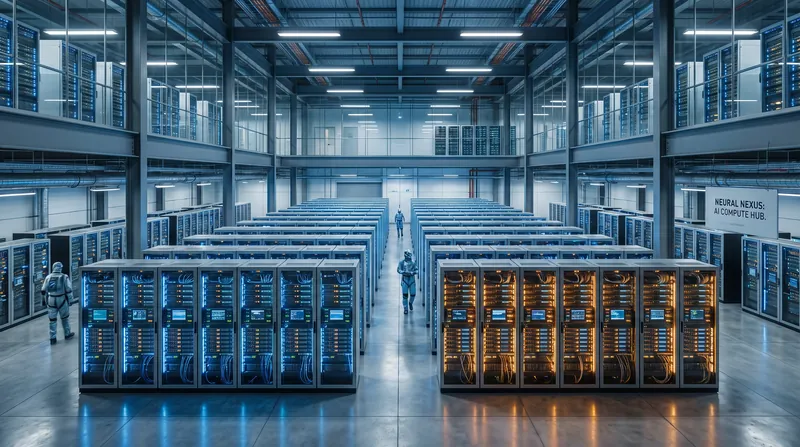
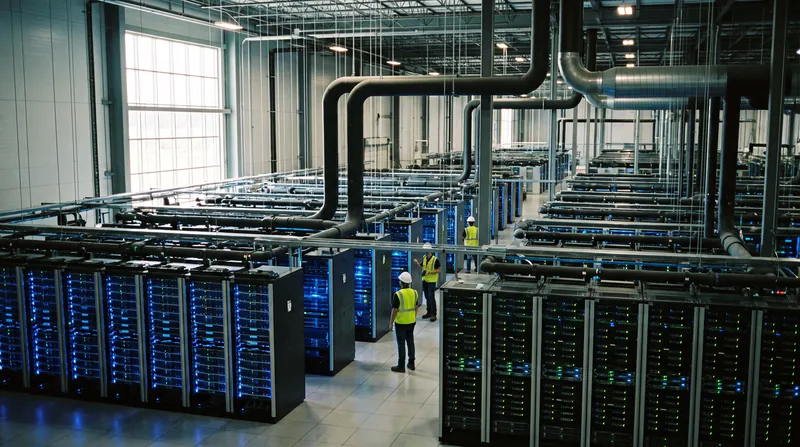
The massive capital injection, scheduled to roll out between 2026 and 2035, will fund the construction of twelve hyper-scale AI data centers across South Korea, alongside state-of-the-art research and development campuses. A significant portion of the $500 billion will be directed toward SK Hynix, SK Group's semiconductor arm, to rapidly scale the fabrication of next-generation High Bandwidth Memory (HBM) chips. These specialized memory components are the critical bottleneck in modern AI processing, and the deal effectively guarantees Nvidia priority access to SK Hynix's output for years to come.[2][3]
For Nvidia, the partnership is a strategic masterstroke in supply chain security. As AI models grow exponentially in size, the demand for HBM4 and the upcoming HBM5 architectures has vastly outstripped global manufacturing capacity. By deeply integrating its GPU roadmap with SK Hynix's memory fabrication schedule, Nvidia secures the vital components needed for its upcoming Rubin Ultra architecture and beyond, effectively insulating itself from broader market shortages that have plagued competitors.[4]
SK Group will leverage Nvidia's full-stack technology to power the new data centers, deploying hundreds of thousands of next-generation GPUs connected via Nvidia's proprietary networking infrastructure. The facilities will also utilize the Nvidia AI Enterprise software layer, creating a seamless, optimized environment for training frontier AI models. This hardware-software synergy is expected to deliver unprecedented efficiency, lowering the cost of compute for enterprises and researchers utilizing the South Korean mega-cluster.[1]
The initiative is heavily anchored in the concept of "Sovereign AI"—the push for nations to build and control their own artificial intelligence capabilities rather than relying exclusively on American cloud giants like AWS, Microsoft Azure, or Google Cloud. By constructing domestic hyper-scale infrastructure, South Korea ensures that its public sector, financial institutions, and domestic tech companies can train and deploy advanced models while keeping sensitive data within national borders.[3]
The South Korean government has thrown its full weight behind the mega-cluster, viewing it as an existential economic imperative. President Yoon Suk Yeol's administration has pledged extensive regulatory support, including fast-tracked permitting, substantial corporate tax incentives, and direct subsidies for infrastructure development. Officials have framed the Nvidia-SK alliance as the cornerstone of South Korea's strategy to maintain its technological edge in an increasingly competitive global economy.
Powering twelve hyper-scale data centers presents a monumental energy challenge, requiring gigawatts of continuous, reliable electricity. To address this, the partnership includes a parallel initiative with the South Korean government to upgrade the national power grid. Plans are already underway to integrate advanced Small Modular Reactors (SMRs) and expand renewable energy capacity specifically dedicated to the AI mega-cluster, ensuring the infrastructure meets stringent global sustainability targets.[4]
The competitive implications of the deal are profound. By locking SK Hynix into a deeply symbiotic relationship with Nvidia, the partnership creates a formidable moat that rival chipmakers like AMD and Intel will struggle to cross. Furthermore, it places immense pressure on Samsung Electronics, South Korea's other memory giant, which has been racing to close the HBM technology gap with SK Hynix. Industry analysts suggest the deal effectively crowns SK Hynix as the undisputed king of AI memory for the foreseeable future.
Domestically, the economic impact for South Korea is projected to be transformative. The construction and operation of the data centers, combined with the expansion of semiconductor fabrication, is expected to create over 150,000 high-tech jobs over the next decade. Beyond direct employment, the influx of compute power is anticipated to spawn a vibrant ecosystem of AI startups and research institutions, drawing top-tier global talent to Seoul and surrounding tech hubs.[3]
Ultimately, the $500 billion commitment serves as a resounding rebuttal to skeptics who argued the AI capital expenditure cycle was nearing its peak. By laying down a half-trillion-dollar roadmap stretching to 2035, Nvidia and SK Group are signaling that the physical build-out of the AI era is only just beginning. Groundbreaking for the first three data centers is scheduled for late 2026, with the initial phase of the sovereign AI network expected to come online by 2028.[1][2]
Viewpoints in depth
South Korean Government & Industry
Views the mega-cluster as a vital step in securing national competitiveness in the AI era.
For South Korean policymakers and domestic tech leaders, the $500 billion investment is about far more than corporate profits; it is a matter of national security and economic survival. By hosting the physical infrastructure required to train frontier models, South Korea ensures it will not be relegated to a mere consumer of American AI products. The government's willingness to overhaul power grids and offer sweeping tax incentives underscores a unified national strategy to transition from a traditional manufacturing powerhouse into a sovereign AI superpower.
Global Tech Analysts
Sees the deal as a massive vote of confidence in sustained AI scaling, though notes execution risks.
Financial and technology analysts view the half-trillion-dollar commitment as the definitive end to debates over whether the AI capital expenditure cycle was a short-term bubble. By planning infrastructure build-outs through 2035, Nvidia and SK Group are betting that the demand for compute will only accelerate. However, analysts caution that executing a project of this scale faces significant hurdles, primarily regarding energy procurement. Securing the gigawatts of power necessary for twelve hyper-scale data centers will require flawless execution of South Korea's nuclear and renewable energy expansion plans.
Semiconductor Competitors
Views the tightening Nvidia-SK Hynix bond as a formidable moat that will be difficult to breach.
For competitors in the semiconductor space, the alliance is a daunting development. AMD and Intel, already struggling to match Nvidia's GPU market share, now face an ecosystem where the world's leading AI chipmaker has locked in priority access to the world's most advanced memory fabrication. Similarly, Samsung Electronics—South Korea's other tech titan—finds itself under immense pressure on its home turf. The deep integration between Nvidia's hardware roadmap and SK Hynix's production schedule creates a highly optimized, closed-loop supply chain that rivals will find incredibly expensive and technologically difficult to replicate.
Key points
- Nvidia and SK Group announced a $500 billion, decade-long partnership to build AI infrastructure in South Korea.
- The investment will fund 12 hyper-scale data centers and expand advanced memory chip fabrication.
- The deal secures Nvidia's supply of critical High Bandwidth Memory (HBM) from SK Hynix for its next-generation GPUs.
- South Korea is backing the initiative with tax incentives and power grid upgrades to establish 'Sovereign AI' capabilities.
What we don’t know
- How South Korea will generate the massive, gigawatt-scale electricity required for 12 new hyper-scale data centers without compromising climate goals.
- The exact year-over-year breakdown of capital expenditure through the 2035 target date.
- How competing memory manufacturers like Samsung and Micron will respond to the deepened Nvidia-SK alliance.
How we got here
2023-2024
SK Hynix emerges as the dominant supplier of HBM3 memory for Nvidia's Hopper generation GPUs.
Early 2025
Nvidia and SK Group begin preliminary talks on a localized, sovereign AI infrastructure framework.
July 2026
The $500 billion decade-long partnership is officially unveiled at a joint summit in Seoul.
Late 2026
Groundbreaking is scheduled for the first three hyper-scale data centers in South Korea.
2028
The first phase of the sovereign AI mega-cluster is expected to become fully operational.
- South Korean Policymakers
- Views the partnership as a critical national security and economic imperative to establish South Korea as a sovereign AI superpower.
- Market Analysts
- Focuses on the sheer scale of the capital expenditure and its validation of a sustained, decade-long AI infrastructure boom.
- Tech Industry Observers
- Emphasizes the strategic supply chain advantages, noting how the alliance creates a formidable moat against competing chipmakers.
Perspectives this story doesn't cover
- Environmental groups concerned about the massive energy and water requirements of the new hyper-scale data centers.
- Competing semiconductor firms like Samsung or AMD facing a tighter, exclusive Nvidia-SK ecosystem.
Sources
Source coverage
4 outlets
3 viewpoints surfaced




- [1]ReutersTech Industry Observers
Nvidia, SK Group strike $500 bln AI infrastructure deal in South Korea
Read on Reuters → - [2]BloombergMarket Analysts
SK Group Commits $500 Billion in Decade-Long Nvidia AI Pact
Read on Bloomberg → - [3]Yonhap News AgencySouth Korean Policymakers
SK, Nvidia to build massive AI data centers in Korea under $500 bln vision
Read on Yonhap News Agency → - [4]Financial TimesMarket Analysts
South Korea bids for AI supremacy with half-trillion-dollar Nvidia partnership
Read on Financial Times →

More in Artificial Intelligence
See all →AI Infrastructure
AI Inference Spending to Surpass Training Spending in 2026 as AI Moves to Mass Production
8 sources
AI Infrastructure
US National Security Officials Warn Against Frontier AI Compute Moving Overseas
4 sources
AI Leadership
DeepMind CEO Demis Hassabis Steps Down to Focus on 'Big Picture' AGI Strategy
3 sources

AI Search
Publishers Push Back Against Google's AI-Generated Headlines Over Misinformation and Control
5 sources

Comments
Every angle. Every day.
Get Artificial Intelligence stories with full source coverage and perspective breakdowns, free every day.