
$1 Trillion AI Chip Selloff Follows Wave of Custom Silicon Shipments, Reshaping Compute Market
A massive semiconductor sector rotation signals a healthy maturation of the AI industry as tech giants deploy cost-effective custom silicon, challenging Nvidia's near-monopoly on compute.
By Harper Lane

Share this story
The July 2026 semiconductor selloff erased over $1 trillion in market value in a matter of days, sending shockwaves through the tech industry. Heavyweights like Micron lost $38 billion in a single session, while Intel and Marvell suffered steep double-digit declines. Yet, beneath the red ticker tape, the underlying story is not one of a collapsing artificial intelligence bubble. Instead, it signals a profound and healthy maturation of the AI hardware ecosystem.[3][4]
For the past three years, the AI industry has operated under a de facto monopoly. Nvidia's general-purpose graphics processing units (GPUs) were the undisputed currency of the generative AI boom, allowing the company to command unprecedented pricing power and profit margins hovering between 70% and 80%. But in the summer of 2026, the world's largest technology companies finally began deploying their own custom-built silicon at scale, fundamentally altering the economics of computing.[1][6]
This shift is being driven by the transition from "training" to "inference." Training a massive frontier model requires the raw, flexible power of general-purpose GPUs, a domain where Nvidia remains unchallenged. However, inference—the everyday process of users actually querying those models—demands ruthless cost efficiency. General-purpose GPUs often run inference workloads at a fraction of their total capacity, whereas custom Application-Specific Integrated Circuits (ASICs) can achieve utilization rates above 80%.[1][2]
The financial imperative to build in-house hardware has become impossible for hyperscalers to ignore. Cloud providers like Amazon, Google, and Microsoft are spending tens of billions on infrastructure, and every fraction of a cent saved on inference translates to massive bottom-line growth. By designing their own chips, these companies are seeking "silicon sovereignty"—a strategic decoupling from single-supplier dependency that allows them to control their own destiny and lower costs for developers.[1][6]
The sheer scale of this custom silicon wave is staggering. Alphabet recently announced the general availability of its TPU v7, codenamed "Ironwood," which boasts a massive leap in memory bandwidth specifically engineered to handle the massive caches required for trillion-parameter models. Simultaneously, Amazon has deployed roughly 1.4 million of its Trainium chips across its cloud infrastructure, turning its internal silicon operation into a formidable business with an estimated $20 billion annual run rate, proving that hyperscalers can successfully operate at the scale of traditional semiconductor giants.[1][2][6]
Even the pure-play AI research labs are joining the hardware race to protect their margins. OpenAI recently unveiled "Jalapeño," its first in-house inference chip developed in a strategic partnership with Broadcom, which aims to cut the startup's staggering operating costs by 50%.
Furthermore, OpenAI has partnered with Cerebras, a hardware startup famous for manufacturing massive wafer-scale chips, to develop novel architectures specifically designed to challenge traditional GPU bottlenecks and accelerate the next generation of AI models. This signals that software companies are no longer content to just buy hardware; they want to design it.[2][3]
The data confirms that the market is bifurcating. According to industry analysts at TrendForce, custom ASIC shipments are projected to grow by 44.6% in 2026, outpacing the 16.1% growth expected for commercial GPUs. This marks the first time custom silicon growth has surpassed general-purpose hardware, ushering in a "dual-track" era where Nvidia handles the heavy lifting of training, while custom ASICs manage the high-volume, day-to-day workload of inference.[2]
The immediate catalyst for the July selloff was a sharp drop in the hourly rental prices for flagship AI compute. Live dashboard metrics showed the cost to rent a top-tier Nvidia B200 GPU falling from $6.11 in late May to $4.22 by late June—a 31% decline in just three weeks. While some investors panicked, interpreting this as a collapse in demand, industry insiders view it as a necessary correction. Compute supply is finally catching up to demand, which will ultimately make AI applications cheaper and more ubiquitous.[5]
The market's reaction was highly targeted. Companies heavily exposed to the custom silicon supply chain, such as Marvell, faced downgrades as analysts worried that bespoke hyperscaler chips would carry lower profit margins than off-the-shelf merchant parts. Meanwhile, TSMC, the foundry that actually manufactures these chips, reported record revenue and sold-out packaging capacity, proving that the overall appetite for AI hardware remains insatiable despite the shifting dynamics among chip designers.[4][7]
Nvidia, for its part, is far from defeated. The company's stock remained remarkably resilient during the broader sector selloff, buoyed by a staggering $124 billion in forward supply commitments. Nvidia's executives have aggressively pushed back against the narrative of commoditization, arguing that the rise of "agentic AI"—systems that autonomously reason and execute complex, multi-step tasks—will require the dynamic flexibility that only a fully integrated hardware and software platform can provide.[5]
Nvidia's deepest moat remains CUDA, its proprietary software ecosystem that millions of developers rely on to program GPUs efficiently. While custom ASICs are highly efficient at specific tasks, they are structurally rigid; an application-specific chip is essentially locked into its architecture the moment it is manufactured. Nvidia argues that as AI models rapidly evolve, the ability to update a flexible platform via software will keep general-purpose GPUs indispensable for the foreseeable future.[5]
The push for custom silicon is also taking on a distinct geopolitical dimension as international markets adapt to trade restrictions. In China, technology giants like ByteDance, Alibaba, and Baidu are rapidly accelerating their own ASIC programs to bypass stringent United States export controls on advanced GPUs.
ByteDance alone has reportedly earmarked nearly $30 billion for its annual AI infrastructure budget, with its next-generation custom chip slated for mass production later this year to ensure domestic compute sovereignty. This global diversification ensures that the future of AI hardware will not be dictated by a single nation or a single company.[2]
Ultimately, the $1 trillion selloff is not the end of the AI hardware supercycle, but rather the end of its first, monolithic phase. The transition from a scarcity-driven gold rush to a cost-driven utility phase is exactly what the industry needs to scale. As compute becomes cheaper and more diverse, the barriers to entry for AI startups will plummet, sparking a new wave of innovation built on the foundation of affordable, specialized silicon.[1]
Looking ahead to late 2026 and 2027, the battle for silicon supremacy will likely move to the 2-nanometer process node and advanced networking interconnects. As the hardware landscape fragments into a diverse ecosystem of specialized chips, the ultimate winners will be the end-users and developers. The erosion of a single-vendor monopoly guarantees a future where artificial intelligence is not a luxury resource hoarded by a few, but a ubiquitous, cost-effective utility powering the next decade of digital transformation.
Key points
- A broad semiconductor selloff erased $1 trillion in market value as investors reacted to a surge in custom AI chip shipments.
- Tech giants like Amazon, Google, and Meta are deploying in-house silicon to lower the massive costs of AI inference.
- Custom ASIC shipments are projected to grow by 44.6% in 2026, outpacing general-purpose commercial GPUs.
- Nvidia retains a dominant position in AI training, supported by its entrenched CUDA software ecosystem and $124 billion in commitments.
What we don’t know
- Whether custom ASICs can adapt quickly enough to the rapidly changing architectures of next-generation frontier models.
- How Nvidia's upcoming Rubin platform will alter the cost-benefit analysis of building in-house silicon.
- The long-term impact of geopolitical export controls on the global supply chain for custom AI chips.
How we got here
Late 2025
Google releases the TPU v7 'Ironwood', signaling a major leap in custom silicon capabilities.
May 2026
Hourly rental prices for flagship Nvidia B200 GPUs peak at over $6.00 before beginning a steep decline.
June 2026
OpenAI and Broadcom announce 'Jalapeño', a custom inference chip designed to cut operating costs.
July 2026
A wave of custom silicon shipments triggers a broad sector rotation, erasing $1 trillion in semiconductor market value.
- Hyperscalers & AI Labs
- Cloud giants and AI developers seeking to lower inference costs and achieve hardware independence through custom silicon.
- Incumbent GPU Defenders
- Proponents of general-purpose GPUs who argue that software ecosystems and complex agentic AI workloads will maintain Nvidia's dominance.
- Market Analysts
- Financial observers who view the selloff as a structural sector rotation toward a dual-track market rather than a collapse in AI demand.
Perspectives this story doesn't cover
- Independent AI Developers
- Semiconductor Foundry Workers
Sources
Source coverage
7 outlets
3 viewpoints surfaced







- [1]Financial ContentHyperscalers & AI Labs
The Great Decoupling of 2026: AI Hardware Ecosystem Shifts
- [2]BigGoMarket Analysts
Trillion-Dollar Compute Ledger: Why Nvidia's Biggest Customers Are Defecting to Custom Chips
- [3]Crypto BriefingMarket Analysts
AI chip selloff erases over $1 trillion as custom silicon threatens Nvidia's dominance
- [4]PhemexMarket Analysts
Here is why the AI chip trade is cracking
- [5]TIKRIncumbent GPU Defenders
NVIDIA Stock Is Down 18% in 2026. Is the AI Leader Finally Cheap?
- [6]Windows ForumHyperscalers & AI Labs
Hyperscalers and the fight over AI compute economics
- [7]BarchartMarket Analysts
The AI Chip Sell-Off Looks Scary, But the Real Story May Be Liquidity

More in Artificial Intelligence
See all →AI Hardware
Cerebras Launches WSE-3, the World's Largest AI Chip With 4 Trillion Transistors
3 sources

Agentic EDA
Synopsys Debuts Autonomous AI Chip Design Workflows, Slashing Debug Time by 40%
7 sources
Silicon Fabrication
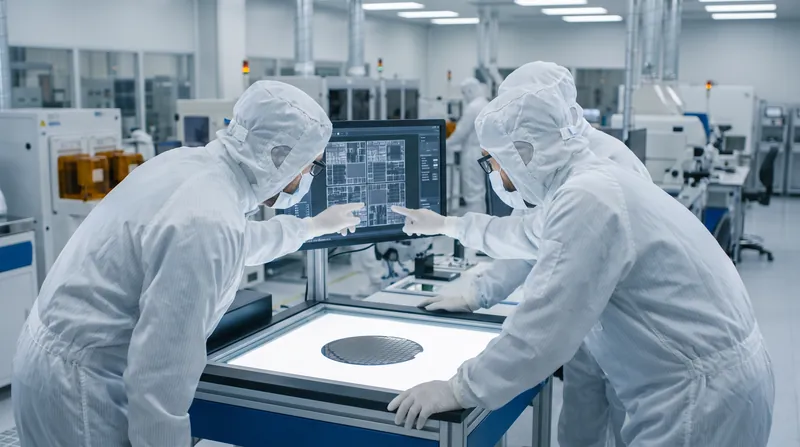
TSMC Enters Volume Production of 2nm Process Node Ahead of Schedule, Accelerating AI Chip Roadmaps
3 sources

AI Infrastructure
Google Cloud and NVIDIA Launch Vera Rubin AI Infrastructure for General Availability
6 sources
Comments
Every angle. Every day.
Get Artificial Intelligence stories with full source coverage and perspective breakdowns, free every day.