
Alibaba Unveils Zhenwu V900 AI Chip for 2027 Mass Production
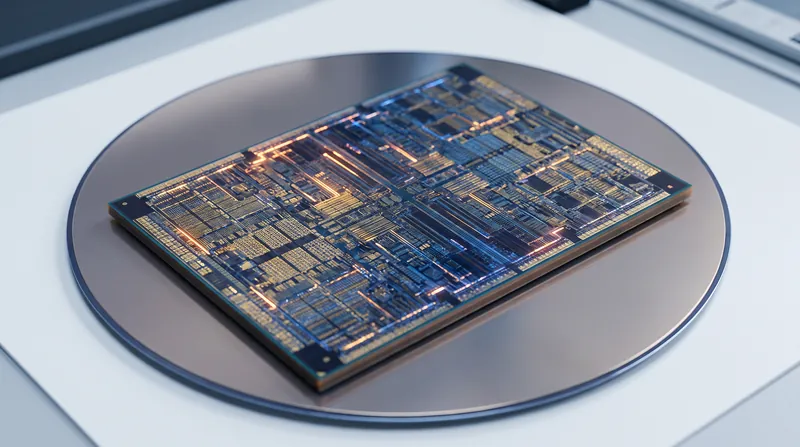
Alibaba's semiconductor division has introduced the Zhenwu V900, a next-generation AI accelerator claiming higher on-package memory than Nvidia's H200. The chip anchors a massive 20-gigawatt data center expansion aimed at training models with up to 10 trillion parameters.

- Domestic Hardware Advocates
- View the V900 as a necessary step toward Chinese technological self-sufficiency and a direct counter to US export controls.
- Global Market Analysts
- Focus on the 2027 production timeline and the chip's potential to disrupt Nvidia's pricing power in the broader Asian market.
- Compute Infrastructure Planners
- Emphasize the massive 20-gigawatt power requirement and the engineering challenge of networking 500,000 chips.
Perspectives this story doesn't cover
- Taiwanese semiconductor foundries
- US export control regulators
On Tuesday inside a Hangzhou exhibition hall, Alibaba's semiconductor division, T-Head, revealed the silicon architecture it intends to use to train its next generation of artificial intelligence models: the Zhenwu V900 accelerator.[1][7]
The processor is engineered specifically to bypass the memory bandwidth constraints that currently limit large language model training. T-Head representatives stated that the V900 packages more high-bandwidth memory directly onto the silicon than Nvidia's current flagship H200 architecture, allowing data to move faster between storage and compute cores.[8]
The chip is designed for massive parallelization rather than isolated deployment. Alibaba outlined a networking architecture capable of linking up to 500,000 V900 accelerators into a single, synchronized supercluster.[7]
To power a cluster of that density, the company announced a parallel infrastructure expansion targeting 20 gigawatts of dedicated data center compute capacity.[5][8]
To power a cluster of that density, the company announced a parallel infrastructure expansion targeting 20 gigawatts of dedicated data center compute capacity.
That physical scale is dictated by the company's software roadmap. During the presentation, Alibaba teased that its upcoming Qwen foundation models will scale between 4 trillion and 10 trillion parameters, a magnitude that requires uninterrupted processing across hundreds of thousands of chips for months at a time.[7][8]
The hardware unveiling arrives as Chinese technology firms navigate tightening United States export controls that restrict access to Nvidia's most advanced silicon. By designing the V900 domestically, Alibaba aims to secure a hardware pipeline that remains insulated from international trade friction.[2][6]
"This is the most powerful AI chip in China," company executives claimed during the launch event, positioning the hardware as a direct replacement for imported accelerators.[7]
Mass production of the Zhenwu V900 is scheduled to begin in the first quarter of 2027. TrendForce analysts report that Alibaba will follow the accelerator with a complementary line of new server central processing units slated for the third quarter of 2027, completing the proprietary hardware stack.[1]
If the V900 meets its stated performance targets when it rolls off the fabrication line, it will establish a domestic supply chain capable of sustaining frontier-model development, altering the global compute market by proving that top-tier AI training no longer strictly requires Nvidia hardware.[3][4]
The stakes
The Zhenwu V900 represents a significant leap in domestic Chinese semiconductor design, offering a high-memory alternative to export-restricted Nvidia hardware. Its deployment could accelerate the training of massive open-weight models, driving down global compute costs through increased competition.
The essentials
- Alibaba's T-Head division unveiled the Zhenwu V900 AI accelerator, targeting mass production in Q1 2027.
- The chip reportedly features more on-package memory than Nvidia's current H200 architecture.
- Alibaba plans to network up to 500,000 V900 chips into a single supercluster.
- The hardware will support upcoming Qwen foundation models scaling between 4 trillion and 10 trillion parameters.
- The company announced a parallel 20-gigawatt data center expansion to power the new infrastructure.
Timeline
Late 2023
US export controls tighten access to Nvidia's most advanced AI accelerators for Chinese firms.
Sept 2026
Alibaba's T-Head division unveils the Zhenwu V900 architecture at its annual computing conference.
Q1 2027
Scheduled start of mass production for the V900 AI chips.
Q3 2027
Planned rollout of complementary new server CPUs to complete the hardware stack.
Perspectives explored
The Domestic Supply Chain View
Advocates for hardware self-sufficiency see the V900 as a critical bypass around international trade friction.
For domestic hardware developers, the Zhenwu V900 represents more than just a performance upgrade; it is a strategic necessity. By designing a chip that directly challenges the memory bandwidth of Nvidia's H200, Alibaba is proving that Chinese tech giants can maintain their frontier-model development roadmaps despite tightening US export controls. This camp argues that a fully domestic silicon pipeline is the only way to guarantee uninterrupted AI progress.
The Infrastructure Scale View
Infrastructure planners are focused on the unprecedented physical requirements of Alibaba's new architecture.
Networking 500,000 accelerators into a single synchronized cluster introduces massive engineering hurdles, primarily in power delivery and cooling. Infrastructure analysts point out that Alibaba's commitment to a 20-gigawatt data center expansion is as significant as the silicon itself. This perspective emphasizes that the true bottleneck in AI development is shifting from chip design to the physical realities of energy procurement and thermal management.
The Global Market View
Market analysts are tracking how the V900's 2027 production timeline will impact global compute pricing.
If Alibaba successfully scales mass production by the first quarter of 2027, the global compute market could see its first genuine high-memory alternative to Nvidia's dominance. Analysts note that while the V900 is primarily intended for internal use to train 10-trillion-parameter Qwen models, its existence proves that top-tier AI training can be achieved without imported hardware, potentially forcing a recalibration of global accelerator pricing.
Sources
Source coverage
8 outlets
3 viewpoints surfaced








- [1]TrendForceGlobal Market Analysts
Alibaba Unveils AI Chip Zhenwu V900 for 1Q27 Mass Production, Maps Out New Server CPUs for 3Q27
Read on TrendForce → - [2]edgeXDomestic Hardware Advocates
Alibaba Unveils Zhenwu V900 AI Chip to Challenge Nvidia as AI Tokens Rise
Read on edgeX → - [3]Global Market WatchGlobal Market Analysts
Global Market Watch: Alibaba Launches New Generation Self-Developed AI Chip
Read on Global Market Watch → - [4]GotradeGlobal Market Analysts
Alibaba's New AI Chip (Zhenwu V900) & China Data-Center Buildout
Read on Gotrade → - [5]CryptopolitanCompute Infrastructure Planners
Alibaba takes on Nvidia with new AI chip and 20GW data center plan
Read on Cryptopolitan → - [6]TipRanksDomestic Hardware Advocates
Alibaba Reveals New AI Chip as Nvidia Faces Growing Competition in China
Read on TipRanks → - [7]Tom's HardwareDomestic Hardware Advocates
Alibaba unveils Zhenwu V900 AI accelerator, claims it's 'the most powerful AI chip in China'
Read on Tom's Hardware → - [8]WccftechCompute Infrastructure Planners
Alibaba Brags That Its Next-Gen Zhenwu V900 AI Chip Offers More On-Package Memory Than NVIDIA H200, Outlines Plans To Deploy 20 GW Of Compute, And Teases 4-10 trillion parameters For Upcoming Qwen Models
Read on Wccftech →
Comments

More in Artificial Intelligence
See all →Mechanistic Interpretability
How In-Context Learning Activates Task-Specific Subnetworks in Large Language Models
7 sources

Agent Architecture
The Architectural Boundary Between Simple and Model-Based Reflex Agents
9 sources

Compute Precision
The Memory and Stability Trade-Offs Between FP32, FP16, BF16, and FP8 in AI Compute
5 sources
Agentic AI
How Agentic AI Escapes Sandboxes: The Mechanics of 'Loss of Control' Incidents
8 sources
Every angle. Every day.
Get Artificial Intelligence stories with full source coverage and perspective breakdowns delivered to your inbox.