
Intel Unveils GPU D-Series AI Inference Accelerator With 480GB Memory in Air-Cooled PCIe Design
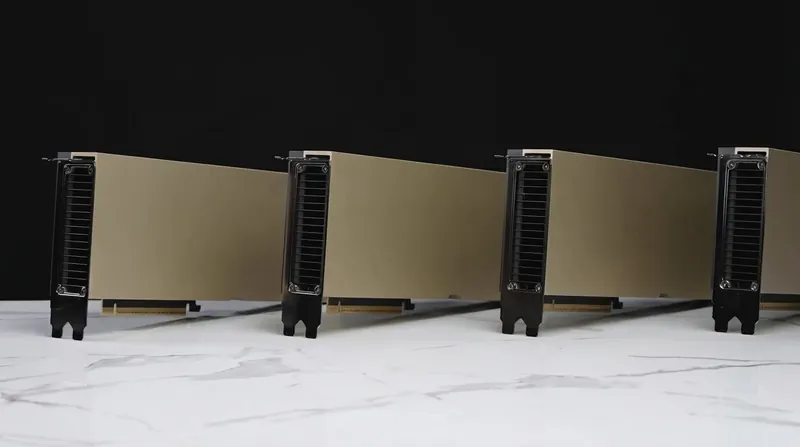
Intel has introduced the GPU D-Series, a new line of enterprise accelerators designed specifically for running large language models. By packing 480 gigabytes of memory onto a standard air-cooled PCIe card, the hardware allows conventional data centers to deploy massive AI systems without upgrading to liquid cooling.
By Harper Lane

The physical limit of artificial intelligence deployment is no longer computational speed, but thermal dissipation and memory capacity inside the server rack. When an enterprise attempts to run a frontier language model, the system must hold hundreds of billions of parameters in active memory simultaneously to function.
If those parameters exceed the memory capacity of a single accelerator, the model must be split across multiple chips, multiplying the hardware cost and power draw. Memory capacity dictates whether a model can run efficiently or if it becomes bottlenecked by constant data transfers between separate nodes.
Intel has targeted this exact deployment bottleneck with the introduction of its GPU D-Series, previously code-named Crescent Island. Announced at the 2026 Open Compute Project Summit, the new D270 accelerator abandons traditional graphics processing entirely to focus exclusively on enterprise AI inference workloads.[2][7]
The defining specification of the D270 is its massive memory payload: up to 480 gigabytes of LPDDR5X memory per card. This represents a significant departure from standard high-bandwidth memory configurations, deliberately trading peak data transfer speeds for sheer volume and capacity.[3][4]
By utilizing LPDDR5X—the same power-efficient memory standard used in high-end laptops—Intel achieved a memory bandwidth of 1.5 terabytes per second. While slower than the HBM3e memory found on Nvidia's flagship chips, the 480-gigabyte capacity allows a single card to hold massive models entirely in local memory.[1][2]
The Air-Cooled Advantage
The most consequential design choice for enterprise adoption is the card's physical format. The GPU D-Series is built as a standard PCI Express (PCIe) add-in card, identical in shape and installation method to a conventional high-end graphics card used in standard workstations.[2][5]
More importantly, the hardware is entirely air-cooled and operates within a strict 350-watt power envelope. The current generation of frontier AI accelerators, such as Nvidia's Blackwell Ultra or AMD's MI455X, draw so much power that they increasingly require direct-to-chip liquid cooling infrastructure to prevent overheating.[2][6]
Liquid cooling demands specialized data center plumbing, reinforced floor loading, and custom server racks that most traditional enterprises do not possess. By capping the power draw and utilizing standard fans, the D270 can be slotted directly into existing corporate server racks without facility upgrades.[2][7]
"Inference is becoming the defining AI workload, and enterprises need infrastructure that delivers the right performance at the right cost," said Anil Nanduri, vice president of AI Products at Intel's Data Center Group, during the product's official unveiling at the summit.[7]
Nanduri noted that the company designed the hardware specifically to integrate into standard enterprise environments. "With Intel GPU D-series, we're focused on making high-capacity inference practical to deploy and economical to scale," he stated, emphasizing the avoidance of custom cooling loops.[7]
Targeting the 300-Billion Parameter Class
The computational core of the D270 delivers 1.3 peak petaflops of FP8 compute performance. This specific level of processing power is calibrated for inference—the act of generating responses from an already-trained model—rather than the highly intensive initial training phase that requires massive supercomputers.[1][2]
The 480-gigabyte memory buffer was not chosen arbitrarily by Intel's engineering team. It is precisely sized to accommodate the current generation of open-weight enterprise models, particularly those operating in the highly capable 70-billion to 300-billion parameter range.[4][7]
Models like Meta's Llama 3 require roughly one byte of memory per parameter when quantized to 8-bit precision. A 300-billion parameter model therefore needs over 300 gigabytes of active memory just to load, before accounting for the context window of the user's prompt and generated output.[4][6]
Previously, running a model of that size required networking four or eight standard 80-gigabyte accelerators together. The D270 allows an enterprise to run these massive models on a single node, drastically reducing the total cost of ownership and the complexity of the underlying software stack.[2][7]
The architecture relies on Intel's Xe3P graphics architecture, but the silicon has been stripped of all display outputs, rasterization engines, and 3D rendering hardware. Every millimeter of the die is dedicated exclusively to the matrix multiplication and tensor operations required by modern neural networks.[3][6]
Open Standards and Market Position
Intel's strategy leans heavily on open industry standards to counter the proprietary ecosystems of its rivals. The D-Series utilizes the Open Compute Project's specifications where applicable, though the primary enterprise push relies on the universal PCIe standard that every major server manufacturer already supports.[2][7]
The hardware also supports the open-source SYCL software stack, allowing developers to write code that can run across different types of accelerators. This open approach prevents enterprises from being locked into a single vendor's proprietary programming language when deploying their internal AI tools.[7]
Market analysts note that Intel is not attempting to beat Nvidia's flagship chips in absolute benchmark performance. Instead, the company is targeting the massive middle market of enterprise customers who need to deploy AI locally for privacy, regulatory compliance, and data security reasons.[5]
"Agentic AI is changing what customers need from their data centers," said Kevork Kechichian, executive vice president of Intel's Data Center Group. "Success will depend not on any single component, but on open, heterogeneous infrastructure that brings together Xeon, purpose-built acceleration and interoperable software."[7]
The ultimate success of the Crescent Island architecture will depend heavily on its final pricing and volume availability. While the specifications offer a clear path for enterprise deployment, the hardware must still compete with aggressive pricing from cloud providers offering inference as a remote service.[1][5]
Key points
- Intel has launched the GPU D-Series, an AI inference accelerator featuring 480 gigabytes of LPDDR5X memory on a standard PCIe card.
- The hardware operates within a 350-watt power envelope and is entirely air-cooled, eliminating the need for specialized liquid-cooling infrastructure.
- The massive memory capacity allows a single card to run 300-billion parameter models that previously required networking multiple accelerators together.
- The silicon abandons traditional graphics processing entirely to focus exclusively on matrix multiplication and tensor operations for AI inference.
What we don’t know
- Intel has not yet announced the official pricing for the GPU D270 or the exact date of retail availability.
- It remains unclear how the LPDDR5X memory bandwidth will perform in real-world, high-concurrency inference workloads compared to HBM3e.
- The exact power efficiency gains over competing AMD and Nvidia PCIe cards will require independent third-party benchmarking.
- Enterprise Infrastructure Advocates
- Prioritizes ease of deployment, power efficiency, and standard form factors that avoid costly data center retrofits.
- Performance Analysts
- Focuses on raw compute, memory bandwidth tradeoffs, and architectural efficiency compared to rival chips.
- Market Strategists
- Views the hardware as a strategic maneuver to capture the massive middle market of local enterprise AI deployment.
Perspectives this story doesn't cover
- Cloud computing providers offering inference-as-a-service
- Nvidia and AMD hardware strategists
Sources
Source coverage
7 outlets
3 viewpoints surfaced







- [1]Tom's HardwarePerformance Analysts
Intel's Crescent Island AI accelerator officially powers new GPU D-Series products — chip delivers 1.3 peak PFLOPS of FP8 compute and 1.5 TB/s of memory bandwidth
Read on Tom's Hardware → - [2]ServeTheHomeEnterprise Infrastructure Advocates
Intel's Crescent Island AI Server GPU Gets a Name and Specs: Meet the Intel GPU D-Series
Read on ServeTheHome → - [3]VideoCardzPerformance Analysts
Intel GPU D270 is Xe3p "Crescent Island" card with 480GB LPDDR5X memory
Read on VideoCardz → - [4]Guru3DPerformance Analysts
Intel GPU D270 Targets 300B-Parameter Models With 480GB of LPDDR5X
Read on Guru3D → - [5]QuartzMarket Strategists
Intel is revealing specs for its new GPU D-series AI inference chip at industry summit
Read on Quartz → - [6]NotebookcheckEnterprise Infrastructure Advocates
Intel's new GPU packs up to 480GB of memory — but skips 3D graphics
Read on Notebookcheck → - [7]Intel NewsroomEnterprise Infrastructure Advocates
Intel Accelerates Open Infrastructure for the Agentic AI Era
Read on Intel Newsroom →
More in Artificial Intelligence
See all →Chiplet Architecture
Optical Reticle Limits Cap AI Dies at 858 Square Millimeters, Forcing Multi-Die Packaging
6 sources
Custom Silicon
Microsoft Unveils Maia 300 AI Chip to Power Cloud Inference Across Multi-Gigawatt Fleet
5 sources

AI Infrastructure
SpaceX Seeks $40 Billion in Debt Financing to Purchase Nvidia AI Chips
3 sources

AI Hardware
Single-Token Autoregressive Decoding Operates at One FLOP per Byte, Trapping Accelerator Tensor Cores Far Below the Roofline Ridge Point
3 sources
Comments
Every angle. Every day.
Get Artificial Intelligence stories with full source coverage and perspective breakdowns, free every day.