
Pope Leo XIV Issues First Papal Encyclical on AI, Co-Presented by Anthropic Co-Founder
In a historic convergence of theology and technology, the Vatican has released 'Magnifica Humanitas,' an encyclical establishing a hopeful, human-centric moral framework for artificial intelligence.

Share this story
In a historic convergence of ancient moral philosophy and frontier technology, Pope Leo XIV promulgated 'Magnifica Humanitas' (Magnificent Humanity) on Thursday, marking the first papal encyclical dedicated entirely to artificial intelligence. The 45,000-word document represents the Catholic Church’s most comprehensive engagement with modern science in decades, offering a deeply optimistic vision of how machine intelligence can elevate the human condition.[1]
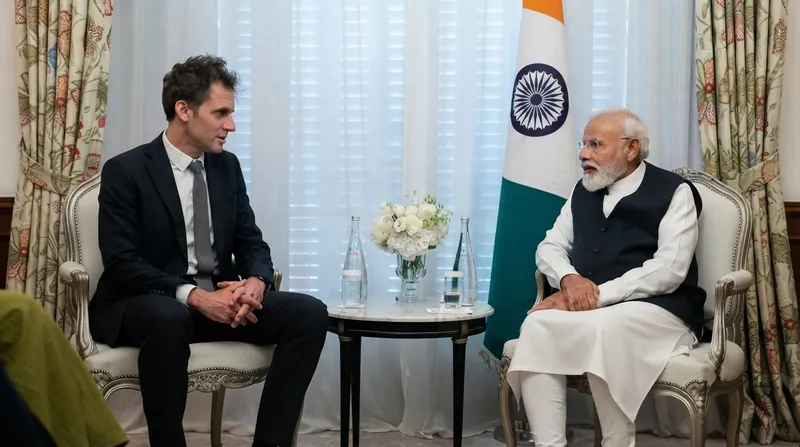
Breaking centuries of Vatican protocol, the Pope did not present the document alone. He was joined in the Holy See’s press office by the co-founder of Anthropic, bridging the geographic and cultural divide between Silicon Valley and Rome. This unprecedented co-presentation signaled a deliberate shift by the Vatican to collaborate directly with the architects of frontier AI, rather than issuing condemnations from afar.[2]
The encyclical explicitly rejects the apocalyptic framing that often dominates AI discourse. Instead, 'Magnifica Humanitas' praises artificial intelligence as a magnificent fruit of human intellect and a participation in divine creation. The text outlines how AI can be harnessed to cure intractable diseases, optimize global agriculture, and alleviate systemic poverty, provided its development remains tethered to an unwavering respect for human dignity.[1]
The theological framework rests on three core pillars: Dignity, Labor, and Truth. The pillar of Dignity insists that humans must never be reduced to mere data points or algorithmic variables. The Labor section argues that AI should be deployed to augment human creativity and eliminate drudgery, rather than stripping workers of their livelihoods and purpose. Finally, the Truth pillar calls for cryptographic and moral safeguards against synthetic deception.[3]
The technology industry’s reception to the encyclical has been overwhelmingly positive. Industry analysts note that the document avoids heavy-handed, prescriptive regulatory demands. Instead, it offers what some developers are calling a moral API—a high-level ethical architecture that AI companies can seamlessly integrate into their own safety and alignment research.[2]
During the press conference, Anthropic's co-founder highlighted the striking parallels between the Vatican’s moral framework and the concept of Constitutional AI. By embedding explicit, human-centric principles into the foundational training of large language models, developers are already attempting to operationalize the exact kind of ethical guardrails that 'Magnifica Humanitas' advocates.
A significant portion of the encyclical is dedicated to the Global South, reflecting the Church's traditional focus on the marginalized. The Pope warns against a looming cognitive divide, urging wealthy nations and tech conglomerates to open-source beneficial AI tools for healthcare and education. The document insists that the dividends of the AI revolution must be distributed globally, empowering developing nations rather than extracting their data.[1][3]
The philosophical depth of the document has drawn praise from academic circles. By weaving the medieval scholasticism of Thomas Aquinas with modern computational theory, the Vatican argues that human reason is inherently creative. The tools we build, the encyclical suggests, are not unnatural intrusions but the logical continuation of human flourishing, provided they are guided by a well-formed conscience.
Looking forward, 'Magnifica Humanitas' calls for a collaborative international treaty on artificial intelligence. However, unlike previous regulatory proposals focused solely on risk mitigation and containment, the Vatican’s proposed treaty is rooted in shared human aspirations. As the United Nations prepares for its global AI summit this September, the encyclical has successfully injected a profound sense of hope and moral clarity into the defining technological transition of the 21st century.[1][3]
Perspectives explored
The Vatican's View
AI is a magnificent tool for human elevation that requires a strong moral compass.
For the Holy See, artificial intelligence is not an inherent threat but a profound expression of human creativity, which they view as a participation in divine creation. The Vatican's primary concern is ensuring that this technology remains a servant to human flourishing rather than a master. They argue that without a foundational respect for human dignity, AI risks reducing individuals to data points and exacerbating global inequalities.
Frontier AI Developers
Ethical frameworks from global institutions validate and guide internal AI safety research.
Leading AI companies have increasingly sought external moral frameworks to guide their alignment research. For developers utilizing methods like Constitutional AI, the Vatican's encyclical provides a robust, globally recognized set of principles—such as the inherent value of human life and the right to truth—that can be directly translated into the training rules for next-generation models. They view the Church not as a regulator, but as a crucial philosophical partner.
Global South Advocates
AI's benefits must be distributed globally to prevent a new era of technological colonialism.
Advocates for developing nations have strongly praised the encyclical's focus on the 'cognitive divide.' They argue that the current trajectory of AI development concentrates wealth and computational power in a few Western tech hubs. By elevating this issue to the level of a papal encyclical, advocates hope to pressure international bodies into mandating technology transfers and open-source models that can directly benefit healthcare and education in the Global South.
Key points
- Pope Leo XIV released 'Magnifica Humanitas,' the first papal encyclical dedicated entirely to artificial intelligence.
- An Anthropic co-founder co-presented the document, marking a historic collaboration between Silicon Valley and the Vatican.
- The text embraces AI as a tool for human flourishing while establishing ethical guardrails.
- Core pillars focus on protecting human dignity, valuing human labor, and preserving truth against synthetic deception.
Open questions
- How non-Western AI developers will integrate an ethical framework heavily rooted in Western philosophical traditions.
- Whether the Vatican's call for an international AI treaty will gain traction among competing geopolitical superpowers.
Timeline
2020
The Vatican introduces the 'Rome Call for AI Ethics,' signed by Microsoft and IBM.
Dec 2023
Pope Francis issues a World Peace Day message focusing on the risks and potential of artificial intelligence.
Early 2026
Pope Leo XIV convenes tech leaders and theologians at the Vatican to draft a comprehensive moral framework.
June 2026
'Magnifica Humanitas' is officially promulgated, co-presented by frontier AI developers.
- Theological Ethicists
- Focus on the encyclical's elevation of human dignity and the moral implications of synthetic intelligence.
- Frontier AI Developers
- View the encyclical as a validating, constructive framework that aligns with existing AI safety research and Constitutional AI.
- Human Rights Advocates
- Emphasize the document's call to prevent a cognitive divide and protect marginalized workers in the Global South.
Perspectives this story doesn't cover
- Secular tech accelerationists who reject religious moral frameworks
- Open-source AI developers who view centralized ethical guidelines as a precursor to regulatory capture
Sources
Source coverage
3 outlets
3 viewpoints surfaced



- [1]ReutersHuman Rights Advocates
In historic first, Pope's encyclical embraces AI as a tool for human flourishing
Read on Reuters → - [2]The Wall Street JournalFrontier AI Developers
Vatican Outlines Pro-Innovation, Pro-Human AI Framework in New Encyclical
Read on The Wall Street Journal → - [3]The GuardianHuman Rights Advocates
Why I’m grateful to the Pope for his encyclical on AI | Francine Prose
Read on The Guardian →

More in Artificial Intelligence
See all →Open-Source AI
Mistral AI Releases One-Trillion-Parameter Open-Weight Model Large 4
4 sources
Model Compression
How Per-Channel Outlier Scaling Protects AI Models From 4-Bit Accuracy Collapse
7 sources
AI Regulation
UK Adopts Lifecycle Regulation to Continuously Monitor AI Medical Devices Across NHS
5 sources

Orbital Computing
Google Launches First Project Suncatcher Satellite to Test In-Orbit AI Computing
5 sources

Comments
Every angle. Every day.
Get Artificial Intelligence stories with full source coverage and perspective breakdowns, free every day.