
SpaceX Reaches $1.8 Trillion Valuation in Historic IPO, Making Elon Musk the First Trillionaire
SpaceX has officially gone public with a record-breaking $75 billion debut, cementing its position as the world's most valuable aerospace company and pushing CEO Elon Musk's net worth past the $1 trillion mark.
By Factlen Editorial Team
- Space Economy Bulls
- View the IPO as the dawn of a multi-trillion dollar orbital economy and validation of reusable rocket technology.
- Financial Skeptics
- Question the sustainability of a $1.8 trillion valuation given the extreme capital intensity and risks of spaceflight.
- Aerospace Incumbents
- Recognize the massive competitive threat posed by a well-capitalized, publicly traded SpaceX.
- Scientific Community
- Focus on how the influx of capital will accelerate Starship development and enable cheaper deep-space research.
What's not represented
- · Environmental advocacy groups concerned about the atmospheric impact of high-cadence rocket launches.
- · Astronomers dealing with light pollution from the expanding Starlink mega-constellation.
Why this matters
The public debut of SpaceX democratizes investment in the space economy and provides the massive capital required for interplanetary infrastructure, while fundamentally resetting the ceiling for entrepreneurial wealth.
Key points
- SpaceX completed the largest IPO in history, raising $75 billion at a $1.8 trillion valuation.
- The massive public debut officially pushed CEO Elon Musk's net worth past the $1 trillion milestone.
- The valuation is heavily supported by Starlink, which generated nearly $30 billion in recurring revenue last year.
- SpaceX currently controls over 80% of the global commercial launch market with its Falcon rocket family.
- The newly raised capital is primarily earmarked for scaling Starship production and funding Mars colonization efforts.
The bell rang on Wall Street this morning, but the reverberations were felt in low Earth orbit. Space Exploration Technologies Corp., universally known as SpaceX, has officially completed its initial public offering, raising a staggering $75 billion in the largest public market debut in financial history.[1]
The debut values the Hawthorne, California-based aerospace manufacturer at $1.8 trillion, instantly making it one of the most valuable companies on the planet and completely reshaping the financial landscape of the commercial space sector.[1][2]
Beyond the corporate milestone, the IPO has triggered a historic wealth threshold: CEO Elon Musk has officially become the world's first individual to amass a net worth exceeding $1 trillion.[2]
Musk’s ascent to the trillion-dollar mark is largely driven by his estimated 42% equity stake in SpaceX, which, when combined with his holdings in Tesla, xAI, and other ventures, pushes his personal balance sheet into entirely uncharted territory.[2][3]
To understand how a rocket company achieved a valuation rivaling established tech giants like Amazon and Alphabet, one must look at the underlying mechanics of the modern space economy and the structural advantages SpaceX has built over two decades.[6]
SpaceX is not a single business; it is effectively three distinct monopolies operating under one roof. The first, and currently the most lucrative, is the Starlink satellite internet constellation.[3][6]

According to the company's Form S-1 filed with the Securities and Exchange Commission, Starlink generated nearly $30 billion in high-margin recurring revenue last year, transforming the company from a hardware manufacturer into a global telecommunications utility.[3]
By providing low-latency broadband to remote regions, maritime vessels, commercial airlines, and enterprise clients, Starlink has created a cash-flow engine that insulates the broader company from the inherent volatility of the launch market.[1][6]
The second pillar of the valuation is the launch business itself. The Falcon 9 and Falcon Heavy rockets have captured over 80% of the global commercial launch market, flying at an unprecedented cadence of more than 150 times a year.[4]
The second pillar of the valuation is the launch business itself.
This near-monopoly on reliable orbital access means that even SpaceX's direct competitors in the satellite industry are frequently forced to pay the company to reach space, creating a formidable economic moat.[4][6]

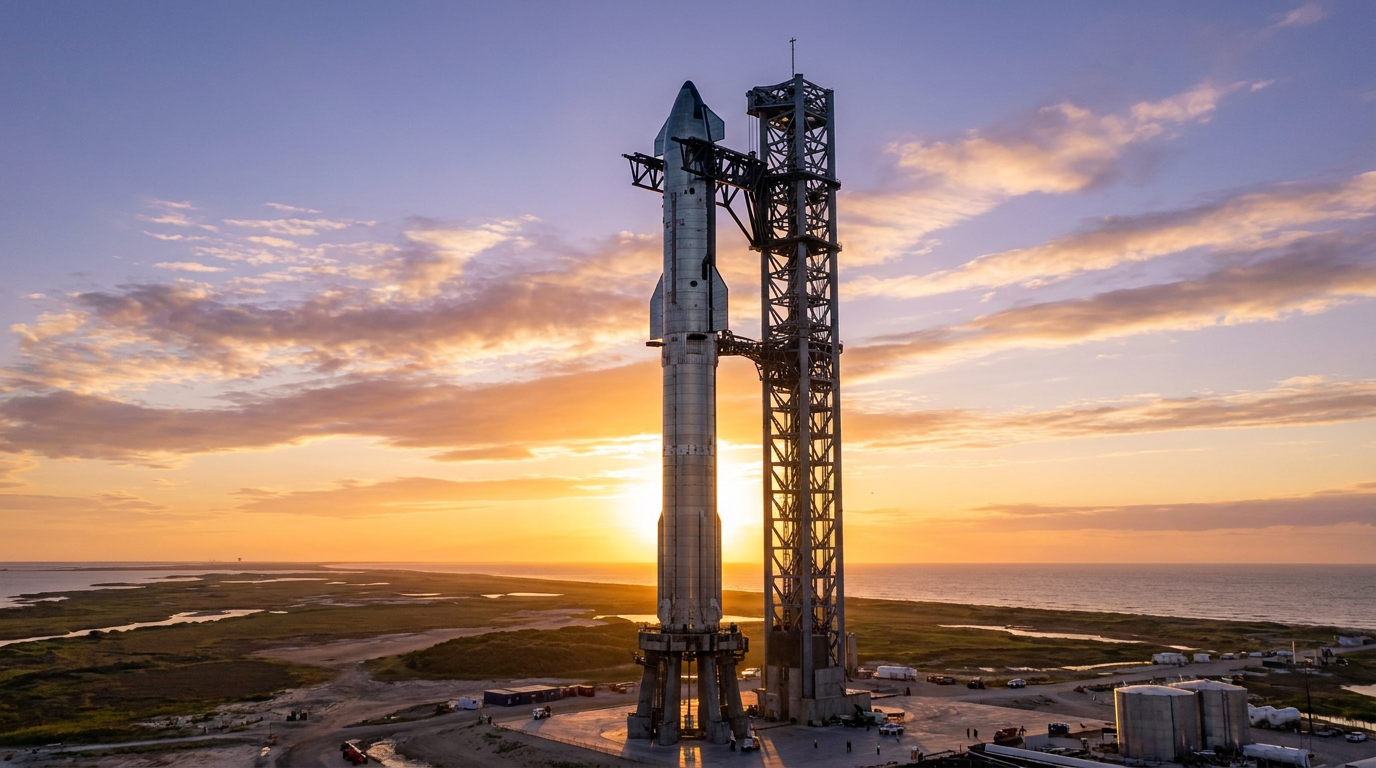
The third, and most speculative, driver of the $1.8 trillion valuation is Starship. The fully reusable, super-heavy lift launch vehicle is designed to carry 100 tons of payload to orbit at a fraction of historical costs.[5]
Aerospace researchers note that if Starship achieves its targeted daily flight cadence, it will reduce the cost of access to space by another order of magnitude, enabling entirely new industries like orbital manufacturing, space-based solar power, and large-scale lunar bases.[5][6]
However, the path forward is not without significant friction. Financial analysts point out that maintaining a $1.8 trillion valuation requires flawless execution on highly experimental deep-space architecture, where a single failure can ground a fleet for months.[2]
Furthermore, the company faces mounting regulatory scrutiny. The Federal Aviation Administration and the Federal Communications Commission are constantly evaluating the environmental impact of Starship launches and the orbital debris risks associated with tens of thousands of Starlink satellites.[3][6]
Despite these uncertainties, the IPO represents a paradigm shift for the aerospace sector. Traditional defense contractors are now forced to compete with a publicly traded juggernaut armed with an immense $75 billion war chest.[6]

For retail and institutional investors, the listing offers the first pure-play opportunity to invest in the foundational infrastructure of the solar system, moving space exploration from the realm of government funding to public equity markets.[1][6]
How we got here
2002
Elon Musk founds Space Exploration Technologies Corp. with the goal of reducing space transportation costs.
2008
Falcon 1 becomes the first privately developed liquid-fueled rocket to reach orbit, saving the company from bankruptcy.
2020
SpaceX successfully launches NASA astronauts to the ISS, restoring human spaceflight capabilities to the United States.
2024
Starship completes its first fully successful orbital test flight and controlled splashdown.
June 2026
SpaceX goes public at a $1.8 trillion valuation, raising $75 billion to fund deep-space infrastructure.
Viewpoints in depth
Space Economy Bulls
Investors and industry analysts who see the IPO as the foundation of a multi-trillion dollar orbital economy.
Proponents of the $1.8 trillion valuation argue that SpaceX should not be priced as a traditional aerospace manufacturer, but rather as the foundational infrastructure layer for the entire solar system. By controlling the cheapest access to orbit and operating the world's largest satellite telecommunications network, bulls argue SpaceX has created an economic moat that is virtually unassailable by legacy competitors or new startups.
Financial Skeptics
Market analysts who caution against the extreme capital requirements and inherent risks of spaceflight.
Skeptics point out that while Starlink provides excellent cash flow, the development of Starship and the pursuit of Mars colonization are unprecedented capital sinks. They warn that a $1.8 trillion valuation leaves no room for error; a single catastrophic failure of a Starship vehicle with human passengers or critical infrastructure could severely damage the stock price and delay the company's roadmap by years.
Scientific Community
Researchers focused on how the influx of capital will accelerate deep-space exploration and research.
For the scientific community, the IPO represents a massive acceleration in capabilities. With $75 billion in fresh capital, SpaceX can scale Starship production to a level that drops the cost per kilogram to orbit to historic lows. Researchers anticipate this will allow universities and space agencies to launch massive space telescopes, interplanetary probes, and orbital laboratories that were previously impossible due to budget and weight constraints.
What we don't know
- How public market pressure for quarterly earnings will impact SpaceX's long-term, high-risk Mars colonization timeline.
- Whether regulatory bodies like the FAA will permit the daily launch cadence required to make Starship's economic model work.
- How legacy aerospace and defense contractors will restructure their businesses to compete with a publicly traded SpaceX.
Key terms
- Form S-1
- The initial registration form required by the SEC for U.S. companies planning to go public, detailing their business model and financials.
- Super-Heavy Lift
- A classification for launch vehicles capable of carrying more than 50 metric tons of payload into low Earth orbit.
- Low Earth Orbit (LEO)
- An Earth-centered orbit with an altitude of 2,000 km or less, where the Starlink satellite constellation operates.
Frequently asked
Why did SpaceX decide to go public now?
The IPO provides liquidity for long-term employees and raises the massive $75 billion capital required to fund the development of Starship and future Mars missions.
Does the IPO include the Starlink satellite business?
Yes, SpaceX went public as a single entity, meaning investors gain exposure to both the launch business and the highly profitable Starlink telecommunications network.
How much of SpaceX does Elon Musk own?
According to SEC filings, Musk retains an estimated 42% equity stake in the company, which is the primary driver pushing his net worth past $1 trillion.
Sources
Source coverage
6 outlets
4 viewpoints surfaced






[1]BloombergSpace Economy Bulls
SpaceX Prices Historic $75 Billion IPO, Reaching $1.8 Trillion Valuation
Read on Bloomberg →[2]CNBCFinancial Skeptics
Elon Musk Crosses $1 Trillion Net Worth Following SpaceX Public Debut
Read on CNBC →[3]U.S. Securities and Exchange Commission
Form S-1 Registration Statement: Space Exploration Technologies Corp.
Read on U.S. Securities and Exchange Commission →[4]Space FoundationSpace Economy Bulls
The Global Space Economy: 2026 Commercial Launch Market Share
Read on Space Foundation →[5]MIT Technology ReviewScientific Community
The Economics of Starship: How Super-Heavy Lift Changes Orbital Math
Read on MIT Technology Review →[6]Factlen Editorial TeamAerospace Incumbents
Synthesis by Factlen editorial team
Read on Factlen Editorial Team →
Every angle. Every day.
Get business stories with full source coverage and perspective breakdowns delivered to your inbox.