
China Unveils $295 Billion National AI Infrastructure Plan to Bypass US Chip Controls
Beijing has launched a massive state-funded initiative to build a nationwide artificial intelligence grid powered entirely by domestic silicon, positioning Huawei at the center of its strategy to overcome US export restrictions.
By Ishani Patel

Share this story
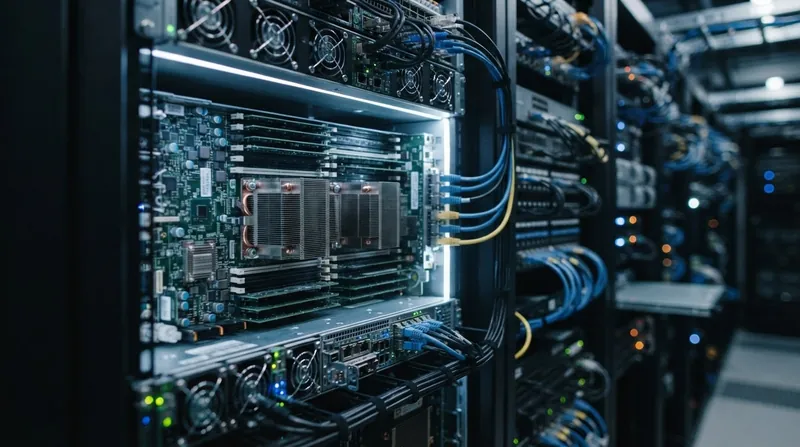
Beijing has officially launched a 2.1 trillion yuan ($295 billion) national initiative to construct a fully domestic artificial intelligence infrastructure, marking the most aggressive response yet to sweeping United States export controls. The "National AI Grid" project aims to physically network dozens of massive data centers across the country, creating a unified computing resource capable of training next-generation frontier models without relying on American silicon.[1]
At the heart of this historic mobilization is Huawei Technologies, which has been tapped as the primary hardware provider for the state-backed compute clusters. The plan heavily subsidizes the deployment of Huawei's Ascend series AI accelerators, explicitly designed to replace the Nvidia H100 and B200 chips that are currently barred from entering the Chinese market under US Commerce Department regulations.[2][3]
The infrastructure rollout builds upon China's existing "East Data, West Compute" strategy, which pipes data from prosperous eastern megacities to energy-rich western provinces like Guizhou and Gansu. By centralizing AI training in regions with abundant renewable energy and lower cooling costs, the government hopes to offset the efficiency gaps between domestic chips and their cutting-edge Western counterparts.
Washington's escalating export controls, which began in earnest in October 2022, were designed to cap China's AI capabilities by cutting off access to advanced semiconductors and the lithography machines needed to make them. However, industry analysts note that these restrictions have inadvertently catalyzed a massive influx of state capital into China's domestic semiconductor ecosystem, forcing a rapid maturation of local alternatives.[1]
The technical hurdles remaining for the National AI Grid are substantial. Manufacturing yields at Semiconductor Manufacturing International Corporation (SMIC), China's leading foundry, remain a closely guarded secret. Experts estimate that producing the 5-nanometer and 7-nanometer chips required for competitive AI training without extreme ultraviolet (EUV) lithography is highly expensive and prone to high defect rates.[2][3]
To compensate for potential hardware bottlenecks, the $295 billion plan places a massive emphasis on advanced packaging and software optimization. Chinese engineers are increasingly utilizing chiplet designs—stitching together multiple less-advanced chips to perform as a single powerful processor—and heavily optimizing Huawei's CANN (Compute Architecture for Neural Networks) software stack to rival Nvidia's ubiquitous CUDA platform.[4]
For the global technology sector, the announcement signals a definitive end to the era of a unified global computing architecture. Multinational corporations operating in China are now preparing to navigate a bifurcated reality, requiring them to develop and maintain separate AI software stacks for Western and Chinese markets to remain compliant with overlapping regulatory regimes.[3][4]
State media outlets have framed the initiative not merely as an economic project, but as a critical pillar of national security and technological sovereignty. The framing emphasizes that true artificial intelligence leadership cannot be built on a foundation vulnerable to foreign sanctions or sudden supply chain disruptions.
The first phase of the National AI Grid is scheduled for completion by late 2027, targeting the activation of three massive sovereign compute clusters capable of training trillion-parameter models. Whether the domestic supply chain can scale to meet these ambitious targets will serve as the ultimate stress test for Washington's containment strategy and Beijing's drive for self-reliance.[1]
Perspectives explored
Technological Sovereignty Advocates
View the massive investment as a necessary and triumphant step toward complete independence from Western technology.
For domestic policymakers and state media, the $295 billion investment is framed as a long-overdue declaration of technological independence. This camp argues that relying on foreign supply chains for foundational AI infrastructure poses an unacceptable national security risk. They point to the rapid maturation of Huawei's hardware and SMIC's manufacturing capabilities as proof that US export controls have ultimately backfired, accelerating China's timeline for self-sufficiency rather than halting its progress.
Western Geopolitical Analysts
See the plan as a direct challenge to US export controls, while questioning the long-term economic viability of manufacturing advanced chips without EUV lithography.
Western analysts acknowledge the sheer scale of Beijing's ambition but remain skeptical about the underlying economics of the National AI Grid. Without access to ASML's extreme ultraviolet (EUV) lithography machines, producing cutting-edge chips requires multi-patterning techniques that are notoriously expensive and yield fewer working chips per wafer. This camp argues that while China can certainly build powerful AI clusters through brute force and massive state subsidies, doing so will be vastly more expensive and less energy-efficient than utilizing the global supply chain.
Global Tech Industry
Focus on the software ecosystem challenges, noting that replacing Nvidia's CUDA platform is as difficult as replacing its hardware.
For software developers and multinational tech firms, the hardware is only half the battle. This perspective emphasizes the immense difficulty of breaking the global monopoly of Nvidia's CUDA software ecosystem, which millions of AI developers rely on daily. While Huawei's CANN platform is improving rapidly, industry observers note that forcing developers to learn and optimize for an entirely new, geographically isolated software stack creates massive friction and permanently bifurcates the global AI development community.
Key points
- China has announced a $295 billion initiative to build a fully domestic AI computing grid.
- The plan relies heavily on Huawei's Ascend AI chips to replace restricted Nvidia hardware.
- Data centers will be networked across the country, utilizing cheaper energy in western provinces.
- The move signals a permanent split in the global AI hardware and software ecosystem.
Open questions
- The exact manufacturing yield rates SMIC is achieving for its advanced AI chips.
- How quickly Chinese software developers will adopt Huawei's CANN ecosystem over Nvidia's industry-standard CUDA.
- Whether the US will respond with further sanctions targeting the software or cloud computing layers of China's AI grid.
Timeline
October 2022
The US Commerce Department implements sweeping export controls on advanced AI chips and semiconductor manufacturing equipment to China.
October 2023
Washington tightens export rules, closing loopholes and blocking the sale of modified Nvidia chips designed specifically for the Chinese market.
June 2026
Beijing officially unveils the $295 billion National AI Grid initiative to bypass US restrictions.
Late 2027
Target completion date for the first phase of fully domestic, trillion-parameter capable AI training clusters.
- Western Geopolitical Analysts
- See the plan as a direct challenge to US export controls, while questioning the long-term economic viability of manufacturing advanced chips without EUV lithography.
- Technological Sovereignty Advocates
- View the massive investment as a necessary and triumphant step toward complete independence from Western technology.
- Tech Industry Observers
- Focus on the software ecosystem challenges, noting that replacing Nvidia's CUDA platform is as difficult as replacing its hardware.
Perspectives this story doesn't cover
- Environmental groups concerned about the massive energy footprint of the new data centers
- Smaller Chinese tech startups that may struggle to secure access to the state-run compute clusters
Sources
Source coverage
4 outlets
3 viewpoints surfaced




- [1]ReutersWestern Geopolitical Analysts
China unveils $295 bln AI infrastructure plan powered by Huawei to counter US curbs
Read on Reuters → - [2]BloombergWestern Geopolitical Analysts
Huawei Takes Center Stage in China's $295 Billion Bid to Break US AI Chip Blockade
Read on Bloomberg → - [3]Financial TimesWestern Geopolitical Analysts
US export controls tested as China commits $295bn to domestic AI ecosystem
Read on Financial Times → - [4]TechCrunchTech Industry Observers
Nvidia wants to cut data center water use, but that’s not the same as fixing AI’s water problem
Read on TechCrunch →
More in Artificial Intelligence
See all →Open-Source AI
Mistral AI Releases One-Trillion-Parameter Open-Weight Model Large 4
4 sources

Model Compression
How Per-Channel Outlier Scaling Protects AI Models From 4-Bit Accuracy Collapse
7 sources
AI Regulation
UK Adopts Lifecycle Regulation to Continuously Monitor AI Medical Devices Across NHS
5 sources

Orbital Computing
Google Launches First Project Suncatcher Satellite to Test In-Orbit AI Computing
5 sources

Comments
Every angle. Every day.
Get Artificial Intelligence stories with full source coverage and perspective breakdowns, free every day.