
SpaceX Raises Record $75 Billion in Historic IPO, Pushing Elon Musk to Trillionaire Status
SpaceX debuted on the Nasdaq in the largest initial public offering in history, achieving a $2.2 trillion valuation and cementing its founder's unprecedented wealth.
By Factlen Editorial Team
- Space Industry & Growth Bulls
- Viewing the IPO as a necessary funding mechanism for humanity's multi-planetary future and AI dominance.
- Market Structure Analysts
- Warning that index rule changes and a tiny public float are creating artificial, forced demand for the stock.
- Governance & Wealth Critics
- Raising alarms over Musk's unchecked corporate control and the societal implications of a trillion-dollar fortune.
What's not represented
- · Retail investors who bought at the intraday peak of $176.52 and are currently holding minor losses.
- · Competitors in the commercial space launch sector reacting to SpaceX's massive new capital war chest.
Why this matters
SpaceX's record-shattering $75 billion IPO fundamentally reshapes the global stock market, injecting a $2.2 trillion heavyweight into major indices and forcing millions of retirement accounts to passively buy the stock. The capital raised will accelerate humanity's push toward Mars and space-based AI infrastructure, while simultaneously cementing Elon Musk's unprecedented financial and corporate power.
Key points
- SpaceX raised a record-breaking $75 billion in its initial public offering, pricing shares at $135.
- The stock surged 19% on its first day of trading, giving the aerospace company a market capitalization of $2.2 trillion.
- The IPO propelled founder Elon Musk's personal net worth past $1.14 trillion, making him the world's first trillionaire.
- Only 4.3% of the company's shares were floated to the public, raising concerns about supply scarcity and forced passive buying.
- Nasdaq fast-tracked the stock for index inclusion, while the S&P 500 will require a 12-month seasoning period and proven profitability.
- Proceeds will fund the development of the Starship rocket, a proposed Mars colony, and space-based AI data centers.
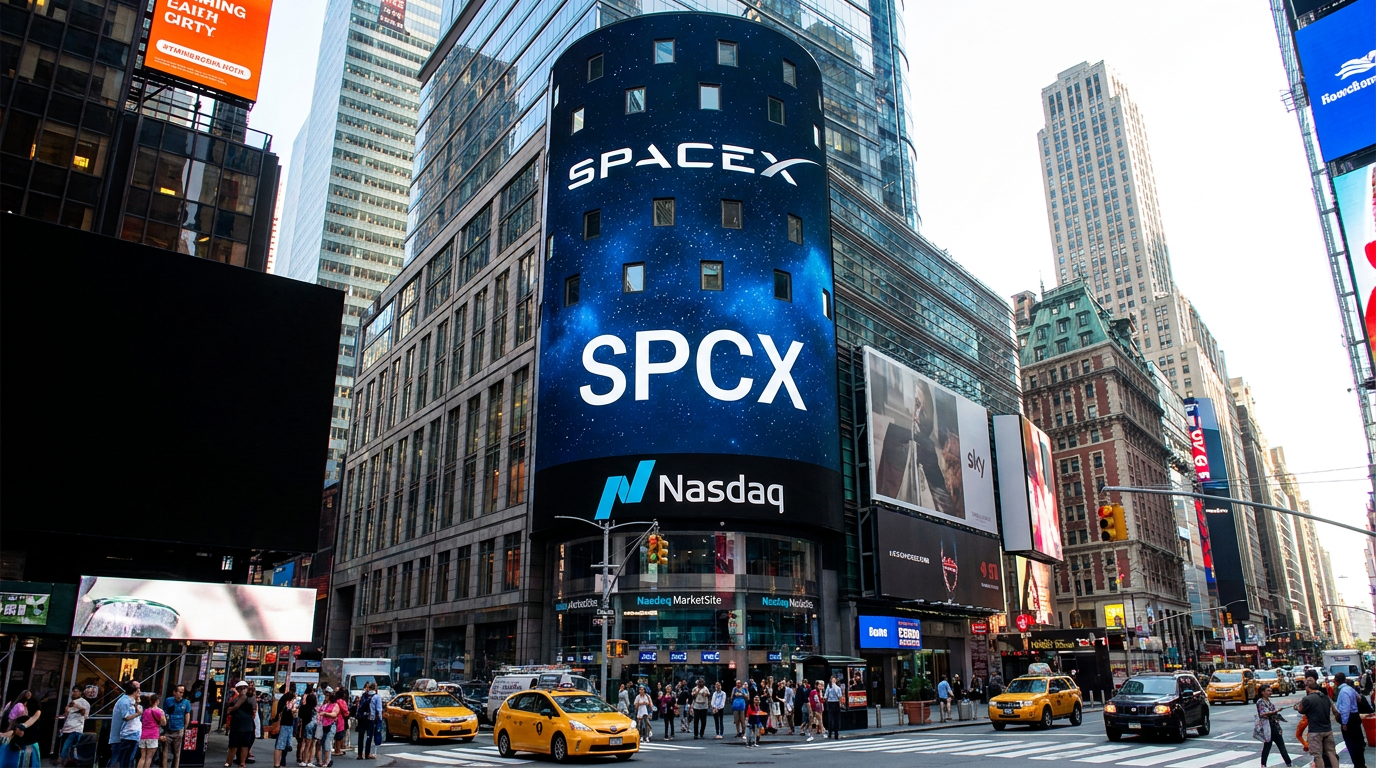
The aerospace company that Elon Musk once predicted had a slim chance of survival has executed the largest initial public offering in the history of global finance. On Friday, Space Exploration Technologies Corp.—trading under the ticker SPCX—debuted on the Nasdaq, raising a staggering $75 billion and instantly transforming the landscape of the public markets.[1][5]
The sheer scale of the offering shattered previous records. SpaceX priced 555.6 million Class A shares at $135 each, easily eclipsing the $29.4 billion raised by Saudi Arabia’s state-owned oil giant, Saudi Aramco, in 2019. When the opening bell rang, demand for the stock overwhelmed the available supply. Shares opened at $150, peaked intraday at $176.52, and ultimately closed at $160.95—a 19% premium over the offering price.[2][5][7][8]
That first-day surge pushed SpaceX’s market capitalization to roughly $2.2 trillion, making it the sixth-most valuable public company in the world on its very first day of trading. The milestone also triggered a historic wealth threshold: the IPO propelled Elon Musk’s personal net worth past $1.14 trillion, making him the first individual in modern history to become a trillionaire on paper.[2][4][6][8]

The $75 billion capital injection is earmarked for a slate of ambitions that border on science fiction. Speaking to cheering employees at the company’s Starbase headquarters in Texas, Musk reiterated that the funds will accelerate the development of the Starship rocket platform, with the ultimate goal of establishing a permanent human colony on Mars capable of supporting one million inhabitants.[5][6]
But rockets are only half of the modern SpaceX story. Following a February 2026 merger with Musk’s artificial intelligence startup, xAI, the company is now pitching itself as a unified infrastructure provider for the AI era. A significant portion of the IPO proceeds will fund the deployment of space-based, solar-powered data centers designed to deliver 100 terawatts of computing power, bypassing the terrestrial energy grid constraints that currently bottleneck AI development.[8][10]
Despite the astronomical valuation, SpaceX’s financial reality is complex. The company generated $18.7 billion in revenue in 2025, driven largely by its near-monopoly on commercial satellite launches and the rapid expansion of its Starlink broadband network. However, the massive capital expenditures required for Starship and the integration of xAI pushed the company deep into the red, resulting in a $4.9 billion net loss last year.[5][10]

That lack of profitability—combined with the mechanics of the offering itself—has sparked intense debate on Wall Street regarding how the stock should be handled by major market indices. In a highly unusual move, SpaceX floated only 4.3% of its total shares to the public.[9][10]
In a highly unusual move, SpaceX floated only 4.3% of its total shares to the public.
Because the public float is so small, market structure analysts warn that the stock’s early price action is being driven more by supply scarcity than by fundamental valuation. This dynamic is being exacerbated by major index providers altering their rules to accommodate the mega-cap listing.[9][10]
Nasdaq recently eliminated its requirement that a company float at least 10% of its shares to be eligible for index inclusion, a rule change widely viewed as a specific carve-out for SpaceX. As a result, SPCX is being fast-tracked into the Nasdaq 100 and FTSE Russell indices within 15 trading days.[9][10]
This accelerated inclusion forces passive index funds and exchange-traded funds (ETFs) tracking those benchmarks to mechanically purchase billions of dollars of SpaceX stock, regardless of the price. Analysts estimate that Nasdaq 100 inclusion alone will trigger approximately $8 billion in forced passive buying within the first month, creating a massive liquidity demand against a tightly constrained supply of shares.[9][10]

Not all index providers are bending their rules. S&P Dow Jones Indices announced it will not waive its eligibility criteria for the S&P 500, meaning SpaceX must complete a 12-month seasoning period and demonstrate four consecutive quarters of GAAP profitability before it can be added to the benchmark. Consequently, funds tracking the S&P 500 will sit on the sidelines for at least a year.[9][10]
The structural mechanics of the IPO have also drawn scrutiny from corporate governance watchdogs. New York City Comptroller Mark Levine publicly criticized the fast-tracking of SpaceX into major indices, pointing to the company’s unprecedented concentration of power.[1]
Through a dual-class share structure, Musk retains 82.4% of the company’s total voting power. Critics argue this leaves public shareholders with virtually no recourse and effectively eliminates independent board oversight, forcing retail and institutional investors to place absolute faith in a single founder.[1][5][6][7]
Beyond Wall Street, the IPO has reignited fierce political debates over wealth inequality. Musk’s new status as a trillionaire—holding a personal fortune that rivals the economic output of entire nations—drew immediate condemnation from progressive lawmakers. Senator Elizabeth Warren released a statement calling the milestone a symbol of a broken economic system, noting that Musk now holds more wealth than anyone in human history.[4][6][8]

Yet, for retail investors and space advocates, the IPO represents a long-awaited opportunity to participate in the commercialization of the cosmos. The offering included an unusually large 20% allocation specifically for retail investors, allowing the public to buy into a company that spent two decades locked behind private equity doors.[3][6][7][10]
As the dust settles on the largest market debut in history, the financial world is left grappling with a new paradigm. SpaceX has proven that a company can wait until it is worth $2 trillion before going public, testing the limits of passive investing, corporate governance, and the sheer scale of modern technological ambition.[8][9]
How we got here
2002
Elon Musk founds Space Exploration Technologies Corp. with the ultimate goal of reducing space transportation costs to enable the colonization of Mars.
2008
SpaceX's Falcon 1 becomes the first privately developed liquid-fueled rocket to reach orbit, saving the company from bankruptcy.
Dec 2019
Saudi Aramco raises $29.4 billion in its IPO, setting a global record that would stand for nearly seven years.
Feb 2026
SpaceX merges with Musk's artificial intelligence startup, xAI, combining space infrastructure with AI compute.
May 2026
Nasdaq alters its index inclusion rules, removing the 10% minimum float requirement to accommodate SpaceX's upcoming listing.
Jun 12, 2026
SpaceX debuts on the Nasdaq, raising $75 billion and pushing Elon Musk's net worth past $1 trillion.
Viewpoints in depth
Space Industry & Growth Bulls
Viewing the IPO as a necessary funding mechanism for humanity's multi-planetary future and AI dominance.
Proponents argue that SpaceX's unprecedented $1.77 trillion initial valuation is entirely justified by its near-monopoly on global launch capacity and the rapid expansion of its Starlink broadband network. For this camp, the $75 billion raised is not just corporate capital, but the required funding to achieve science-fiction-scale goals: establishing a permanent, million-person colony on Mars and deploying space-based, solar-powered data centers capable of delivering 100 terawatts of AI compute. They view the 19% first-day pop as validation that public markets are hungry for ambitious, high-growth tech investments, regardless of near-term profitability.
Market Structure Analysts
Warning that index rule changes and a tiny public float are creating artificial, forced demand for the stock.
Financial mechanics experts are highly critical of how major indices are handling the listing. Because SpaceX only floated 4.3% of its shares, analysts warn that the stock's price discovery is being driven by supply-and-demand imbalances rather than fundamental value. This camp points out that Nasdaq's decision to waive its 10% minimum float rule and fast-track SpaceX into the Nasdaq 100 will force passive index funds to blindly buy billions of dollars of the stock. They praise the S&P 500 committee for holding the line and requiring a 12-month seasoning period and proven GAAP profitability before allowing the mega-cap company into the benchmark.
Governance & Wealth Critics
Raising alarms over Musk's unchecked corporate control and the societal implications of a trillion-dollar fortune.
Corporate governance watchdogs and progressive lawmakers view the IPO as a stark symbol of systemic imbalance. Critics highlight that despite raising $75 billion from the public, Musk retains 82.4% of the voting power through a dual-class share structure, effectively eliminating independent board oversight or shareholder recourse. Furthermore, Musk crossing the $1 trillion net worth threshold has reignited debates over wealth inequality. Lawmakers point out that the company is currently losing billions of dollars annually, yet its public listing has generated a paper fortune for its founder that rivals the gross domestic product of entire nations.
What we don't know
- How the stock will perform once the initial excitement subsides and early insider lock-up periods expire.
- Whether the S&P 500 index committee will eventually face overwhelming pressure to waive its profitability rules to include the $2.2 trillion company.
- If the ambitious timelines for establishing a Mars colony and deploying 100-terawatt space data centers are technologically and financially viable.
Key terms
- Initial Public Offering (IPO)
- The process of offering shares of a private corporation to the public in a new stock issuance, allowing the company to raise capital from public investors.
- Free Float
- The portion of a company's shares that are available for trading by the general public, excluding locked-in shares held by insiders or founders.
- Passive Index Fund
- A mutual fund or ETF designed to automatically track the performance of a specific market benchmark, like the Nasdaq 100, by buying all the stocks in that index.
- Dual-Class Share Structure
- A corporate setup where different classes of stock have different voting rights, often used by founders to retain control of a company even after selling shares to the public.
Frequently asked
Can I buy SpaceX stock in my 401(k)?
Yes, if your retirement plan includes funds that track the Nasdaq 100 or Russell indices, which are fast-tracking SpaceX's inclusion. However, S&P 500 index funds will not hold the stock for at least a year.
Why is SpaceX losing money if it dominates the launch market?
While its core launch and Starlink businesses generate significant revenue ($18.7 billion in 2025), the company is spending heavily on developing the Starship rocket and funding its recently merged xAI division, resulting in a $4.9 billion net loss last year.
How much of the company does Elon Musk still own?
Musk owns roughly 42% of SpaceX's shares, but a dual-class stock structure gives him 82.4% of the company's total voting power.
Sources
Source coverage
10 outlets
3 viewpoints surfaced










[1]BloombergMarket Structure Analysts
What to Know About SpaceX’s Record-Breaking IPO
Read on Bloomberg →[2]ForbesSpace Industry & Growth Bulls
How Elon Musk Just Became The World's First Trillionaire
Read on Forbes →[3]CNBCSpace Industry & Growth Bulls
Jim Cramer says it's not too late to buy SpaceX — under one condition
Read on CNBC →[4]The New York TimesGovernance & Wealth Critics
Musk Is the World’s First Trillionaire. Who Was the First Billionaire?
Read on The New York Times →[5]CBS NewsGovernance & Wealth Critics
SpaceX stock soars 19% on first day of trading following record-breaking $75 billion IPO
Read on CBS News →[6]The Washington PostGovernance & Wealth Critics
Elon Musk becomes world's first trillionaire Friday after a record-breaking initial public offering
Read on The Washington Post →[7]Fox BusinessSpace Industry & Growth Bulls
SpaceX makes historic debut; Musk solidifies status as world's first trillionaire
Read on Fox Business →[8]The GuardianGovernance & Wealth Critics
SpaceX's blockbuster initial public offering (IPO) turned out to be a smooth, successful day
Read on The Guardian →[9]CME GroupMarket Structure Analysts
The SpaceX Mega-IPO: Why Index Choice Matters
Read on CME Group →[10]SpotGammaMarket Structure Analysts
SpaceX IPO Index Inclusion: How Rule Changes for SPY, QQQ, and IWM Force Index Funds to Sell Stocks
Read on SpotGamma →

Every angle. Every day.
Get business stories with full source coverage and perspective breakdowns delivered to your inbox.