
SpaceX Launches Historic $75 Billion IPO: How the Largest Market Debut in History Works
SpaceX has officially gone public in a record-shattering $75 billion initial public offering, drawing over $350 billion in investor demand. The landmark debut not only tests the public market's appetite for deep tech but fundamentally reshapes the commercial space economy.
By Factlen Editorial Team
- Institutional Capital
- Focuses on the recurring revenue of Starlink and the company's monopoly on heavy-lift launch as justification for the massive valuation.
- Retail & Sentiment Investors
- Views the IPO as a historic opportunity to own a tangible stake in the future of human space exploration and multi-planetary ambition.
- Aerospace Sector
- Sees the successful public exit as a rising tide that validates the business models of smaller space startups and injects capital into the supply chain.
- Market Structurists
- Analyzes the mechanical challenges of matching a $350 billion order book and the broader implications for the global IPO pipeline.
What's not represented
- · Early SpaceX employees subject to lock-up periods
- · Competitors facing a newly capitalized giant
Why this matters
This landmark offering proves that capital-intensive 'deep tech' and space infrastructure can achieve massive public market exits, rewriting the playbook for modern entrepreneurship and opening the broader space economy to everyday investors.
Key points
- SpaceX has launched the largest IPO in history, aiming to raise $75 billion.
- Investor demand exceeded $350 billion, driven by both institutional and retail enthusiasm.
- The S-1 filing highlights Starlink's recurring revenue as the primary driver of the company's massive valuation.
- The successful debut proves that capital-intensive 'deep tech' hardware can achieve massive public market exits.
- Trading is delayed on day one as market makers manually match the unprecedented volume of orders.
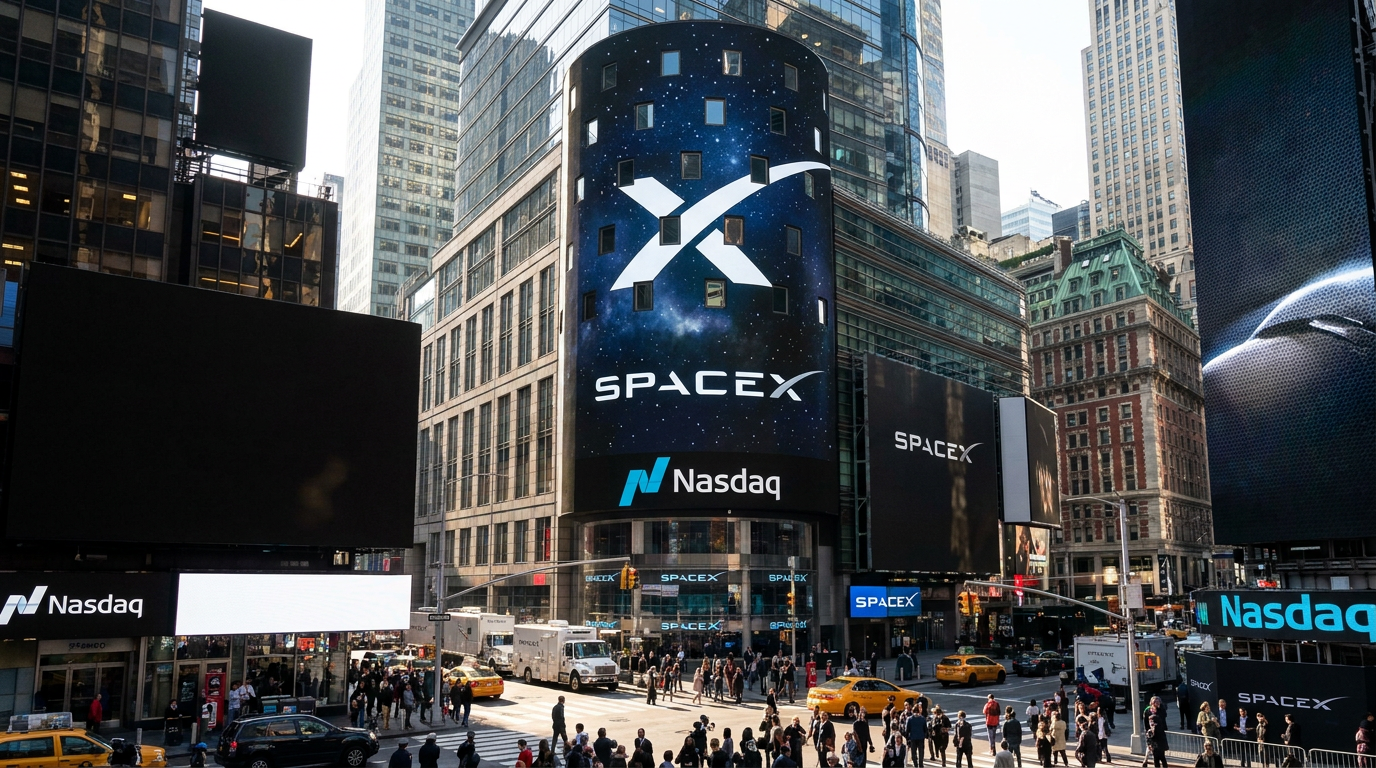
The atmosphere in Times Square on Friday morning was electric, as the Nasdaq MarketSite screens lit up with the iconic X logo, signaling the culmination of the most anticipated financial event of the decade. SpaceX’s initial public offering has officially priced, aiming to raise a staggering $75 billion in capital. This figure shatters previous records held by giants like Alibaba and Saudi Aramco, cementing the aerospace manufacturer's debut as the largest in the history of global capital markets. For years, the company operated behind the closed doors of private venture capital, but today marks its transition into a publicly traded behemoth. The sheer gravity of the offering has captivated both Wall Street veterans and retail traders alike, setting the stage for a trading session that will be analyzed for generations.[1][2]
The demand for a piece of the space economy has been nothing short of unprecedented. According to early indications from the underwriting syndicate, the order book for SpaceX shares swelled to over $350 billion, representing an oversubscription rate that caught even the most bullish analysts off guard. This tidal wave of capital is flowing from sovereign wealth funds, institutional asset managers, and a massive mobilization of retail investors eager to own a stake in humanity's multi-planetary ambitions. The $350 billion figure highlights a profound shift in market sentiment, proving that investors are willing to aggressively back capital-intensive, long-horizon 'deep tech' ventures when the execution track record is flawless.[1][6]
Understanding the mechanics of an IPO of this magnitude requires looking under the hood of the Nasdaq's market structure. Unlike a standard trading day where a stock opens precisely at 9:30 AM Eastern Time, a massive new listing undergoes a complex price discovery process. Market makers and the lead underwriters must manually match the colossal influx of buy and sell orders to establish a fair opening price. This stabilization process is designed to prevent extreme volatility in the opening seconds of trading, meaning eager retail investors often have to wait several hours into the trading day before the first official public trade is executed and the stock is unleashed on the open market.[2][4]

The regulatory foundation for this historic day was laid bare in the company's Form S-1 registration statement filed with the Securities and Exchange Commission. This exhaustive document provided the public with its first unfiltered look at the financial engine powering the world's most active launch provider. The S-1 revealed a dual-pronged business model that effectively functions as two distinct, highly synergistic companies operating under one roof: a heavy-lift transportation service and a rapidly scaling global telecommunications network. By opening its books, the company demonstrated how it transitioned from a cash-burning hardware startup into a diversified enterprise with multiple streams of robust, recurring revenue.[3][6]
At the core of the valuation is the company's undisputed dominance in orbital launch services. The workhorse Falcon 9 rocket has effectively monopolized the commercial launch market, driven by a pioneering reusability model that drastically undercuts competitors on price. By landing and refurbishing first-stage boosters, the company transformed rockets from single-use expendable assets into commercial aircraft-like vehicles. The S-1 filings detail how this reusability loop has expanded profit margins on routine satellite delivery missions, providing the foundational cash flow necessary to fund more ambitious, experimental architectures like the next-generation Starship program.[3][5]
However, launch services alone do not justify a record-breaking public valuation; the true financial catalyst is Starlink. The low-Earth orbit satellite internet constellation has evolved from a theoretical concept into a global telecommunications juggernaut. With millions of active subscribers across the globe, Starlink provides the high-margin, recurring subscription revenue that Wall Street traditionally associates with software-as-a-service companies, rather than aerospace manufacturers. This continuous influx of capital insulates the broader company from the inherent lumpiness of the launch manifest and provides a predictable financial baseline that institutional investors demand.[3][6]

However, launch services alone do not justify a record-breaking public valuation; the true financial catalyst is Starlink.
The success of this IPO fundamentally rewrites the playbook for deep tech entrepreneurship. For the past two decades, venture capital has predominantly favored asset-light software startups, viewing hardware, manufacturing, and aerospace as too capital-intensive and risky for traditional fund lifecycles. By achieving a historic public exit, this offering proves that hardware-centric companies can not only survive the 'valley of death' but can eventually command valuations that dwarf traditional tech unicorns. This paradigm shift is expected to unlock billions in new venture funding for startups tackling hard engineering problems in climate tech, robotics, and advanced manufacturing.[6]
The ripple effects of this liquidity event will be felt across the entire $546 billion global space economy. As the foundational infrastructure provider for low-Earth orbit, the company's capitalization provides a rising tide that lifts an entire ecosystem of suppliers, payload manufacturers, and secondary service providers. Industry analysts note that a publicly traded, highly liquid anchor tenant in the space sector validates the business models of dozens of smaller aerospace startups. Furthermore, the massive influx of capital allows the company to accelerate its procurement, injecting vital revenue into the specialized supply chains that build advanced avionics, propulsion components, and life-support systems.[5][6]
Despite the overwhelming optimism, the S-1 filing transparently outlines the unique, existential risks inherent to the spaceflight industry. Unlike software companies that face bugs or server outages, aerospace companies operate in an unforgiving physical environment where a single anomaly can result in the total loss of a vehicle and its payload. The prospectus explicitly warns prospective shareholders about the financial impact of potential launch failures, the regulatory complexities of securing launch licenses from the Federal Aviation Administration, and the escalating threat of orbital debris to the Starlink constellation.[3][6]

Geopolitics also plays a central role in the company's risk profile and growth narrative. As a primary contractor for the Department of Defense and NASA, the company is deeply intertwined with U.S. national security interests. The S-1 details the delicate balance of operating a global consumer internet service while simultaneously launching highly classified payloads for the intelligence community. This dual identity makes the company a vital strategic asset on the world stage, but it also exposes the stock to shifting geopolitical winds, export control regulations, and international trade disputes.[3][5]
For retail investors, the emotional and historical resonance of the offering cannot be overstated. Beyond the financial metrics, many individuals are buying shares as a tangible stake in the future of human space exploration. The prospect of funding missions to the Moon and eventually Mars has cultivated a brand loyalty that rivals the most dedicated consumer technology fanbases. This sentiment-driven demand is a powerful force, providing the stock with a highly motivated shareholder base that may prove more resilient to short-term market volatility than traditional institutional capital.[2][6]
The sheer size of the $350 billion order book also presents a unique challenge for the underwriters tasked with allocating shares. Balancing the demands of long-term institutional holders—who provide stability—with the massive retail appetite requires delicate financial engineering. If retail demand is left unsatisfied in the initial allocation, it could lead to a massive surge in buying pressure once the stock officially opens for trading, potentially driving the price to unsustainable premiums in the first few hours of the session.[1][4]

As the market awaits the first official print of the stock price, the broader implications for the Nasdaq and the global IPO market are coming into focus. After a prolonged period of sluggish public listings and macroeconomic uncertainty, a successful debut of this magnitude serves as a powerful catalyst for the broader financial ecosystem. Investment bankers and private equity firms are watching closely, hoping that a strong performance will thaw the frozen IPO pipeline and encourage other massive private companies to finally test the public waters.[1][6]
Ultimately, this historic public offering marks the definitive end of the space industry's infancy. The transition from a government-funded endeavor to a commercially viable, publicly traded sector is now complete. As the opening bell rings and billions of dollars change hands, the focus shifts from the spectacle of the IPO to the grueling reality of quarterly earnings reports and shareholder expectations. Yet, for a company that has routinely achieved the impossible in orbit, navigating the pressures of Wall Street may simply be the next frontier.[6]
How we got here
2002
SpaceX is founded with the goal of reducing space transportation costs to enable the colonization of Mars.
2008
Falcon 1 becomes the first privately developed liquid-fueled launch vehicle to reach Earth orbit.
2015
The company successfully lands the first stage of a Falcon 9 rocket, proving orbital-class reusability.
2019
The first operational batch of Starlink satellites is launched, laying the groundwork for the global internet constellation.
June 2026
SpaceX executes a historic $75 billion IPO on the Nasdaq, transitioning to a publicly traded company.
Viewpoints in depth
Institutional Capital
Wall Street focuses on the predictable, recurring revenue generated by the Starlink constellation.
For institutional asset managers and sovereign wealth funds, the appeal of this IPO extends far beyond the romance of space exploration. Their thesis is anchored in the S-1 financials, which reveal Starlink as a high-margin, software-like subscription business operating on top of a hardware monopoly. By controlling the only cost-effective means of heavy-lift launch, the company has created an insurmountable moat that protects its telecommunications revenue, justifying the unprecedented valuation multiples.
Aerospace Sector
Industry insiders view the IPO as a foundational catalyst that will unlock capital for the entire space economy.
Founders and analysts within the broader aerospace ecosystem see this liquidity event as the ultimate validation of the commercial space thesis. For years, venture capitalists hesitated to fund capital-intensive hardware startups due to the lack of clear exit strategies. By proving that a space infrastructure company can achieve a $75 billion public exit, this IPO effectively de-risks the sector, paving the way for a new wave of funding into orbital manufacturing, asteroid mining, and next-generation propulsion startups.
Retail & Sentiment Investors
Everyday traders are driven by brand loyalty and the desire to own a piece of humanity's multi-planetary future.
The retail perspective is heavily influenced by the cultural weight of the company's mission. Unlike traditional tech IPOs evaluated strictly on price-to-earnings ratios, many retail investors view buying shares as a direct contribution to the goal of making humanity multi-planetary. This deep-seated brand loyalty creates a highly motivated shareholder base that is less likely to sell during short-term market downturns, providing the stock with a unique layer of sentiment-driven price support.
What we don't know
- How the stock will perform in its first week of trading once the initial retail frenzy subsides.
- Whether the massive influx of public capital will accelerate the timeline for crewed Starship missions to Mars.
- How the company will balance the transparency required by public markets with its highly classified national security contracts.
Key terms
- Order Book
- The electronic list of buy and sell orders for a specific security, used by underwriters to gauge demand and set the initial trading price.
- Deep Tech
- Startup companies whose business models are based on high-tech innovation in engineering or significant scientific advances, often requiring massive upfront capital.
- Form S-1
- The initial registration form required by the SEC for U.S. companies planning to go public, detailing their business model, financials, and risks.
- Low-Earth Orbit (LEO)
- An Earth-centered orbit with an altitude of 2,000 km or less, where the Starlink satellite constellation operates to provide low-latency internet.
Frequently asked
Why didn't the stock start trading at 9:30 AM?
For massive IPOs, underwriters and market makers need several hours to manually match the colossal influx of buy and sell orders to establish a fair and stable opening price.
What is the total size of the IPO?
The offering aims to raise a record-breaking $75 billion, though total investor demand in the order book exceeded $350 billion.
How does SpaceX make most of its money?
While famous for its reusable Falcon 9 rockets, the company's primary financial engine is now Starlink, which provides high-margin, recurring subscription revenue from satellite internet users worldwide.
What does this mean for other space startups?
Industry analysts view this as a massive validation for the sector, proving to venture capitalists that capital-intensive space hardware companies can achieve highly lucrative public exits.
Sources
Source coverage
6 outlets
4 viewpoints surfaced






[1]BloombergInstitutional Capital
SpaceX’s Record IPO Is Said to Draw Over $350 Billion in Demand
Read on Bloomberg →[2]NYTRetail & Sentiment Investors
When will SpaceX start trading?
Read on NYT →[3]U.S. Securities and Exchange CommissionInstitutional Capital
Form S-1 Registration Statement: Space Exploration Technologies Corp.
Read on U.S. Securities and Exchange Commission →[4]NasdaqMarket Structurists
SpaceX (SPCX) IPO Information and Market Structure
Read on Nasdaq →[5]Space FoundationAerospace Sector
The Global Space Economy: 2026 Q2 Report
Read on Space Foundation →[6]Factlen Editorial TeamMarket Structurists
Synthesis by Factlen editorial team
Read on Factlen Editorial Team →
Every angle. Every day.
Get business stories with full source coverage and perspective breakdowns delivered to your inbox.