
SpaceX Completes Record-Shattering $75 Billion IPO, Pushing Valuation Past $2 Trillion
SpaceX has officially transitioned to a public company in the largest initial public offering in history, raising $75 billion to fund its ambitious space and AI infrastructure projects. The historic debut also propelled CEO Elon Musk's net worth past the $1 trillion mark.
By Factlen Editorial Team
- Retail Investors
- Enthusiastic about direct access to the commercial space economy and the unusually high retail float allocation.
- Institutional Analysts
- Focused on the unprecedented valuation multiple and the massive cash burn driven by AI infrastructure.
- Technology Optimists
- Viewing the capital raise as the necessary financial fuel for humanity's multiplanetary future.
What's not represented
- · Environmental Advocates
- · Competitors in the Aerospace Sector
Why this matters
The sheer scale of SpaceX's public debut reshapes the U.S. equities market, introducing a $2 trillion heavyweight that blends aerospace, telecommunications, and artificial intelligence. As the stock inevitably enters major market indices, millions of everyday investors will gain direct exposure to the commercial space economy and its associated risks.
Key points
- SpaceX raised $75 billion in its IPO, the largest in global financial history.
- Shares priced at $135 and closed at $161 on their first day of trading.
- The company's market capitalization exceeded $2.1 trillion, making Elon Musk the world's first trillionaire.
- Retail investors were allocated an unprecedented 30 percent of the available shares.
- The funds will primarily support Starship development and orbital AI data centers for xAI.
- Despite $18.7 billion in 2025 revenue, the company remains unprofitable due to massive capital expenditures.
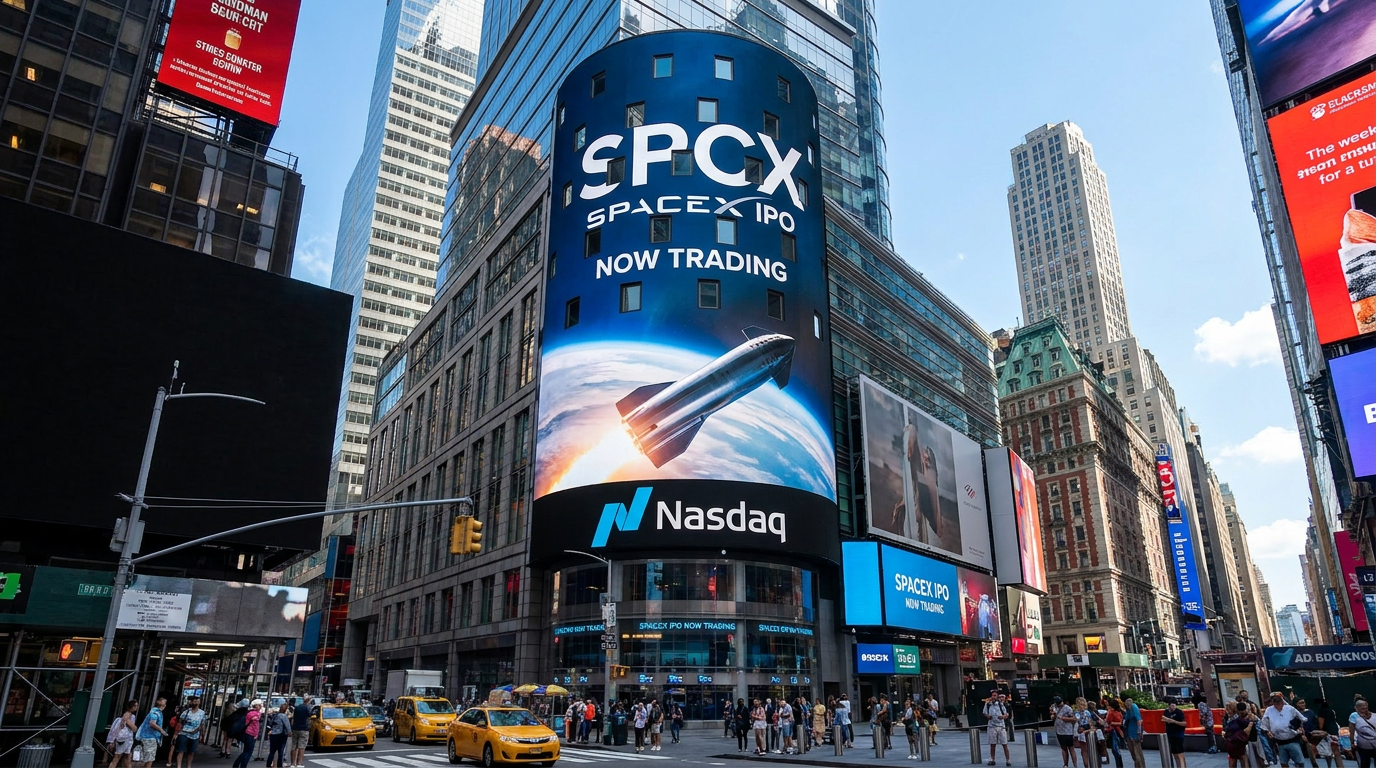
SpaceX officially transitioned to a public company on June 12, 2026, executing the largest initial public offering in the history of global financial markets. The aerospace and artificial intelligence giant raised an unprecedented $75 billion, bypassing traditional Wall Street price-discovery mechanisms to set a fixed entry price of $135 per share. The highly anticipated debut ends nearly two and a half decades of fierce private control, opening the doors of the commercial space economy to public markets.[1][2][7]
Trading commenced on the Nasdaq under the ticker symbol SPCX, with shares opening at $150—well above the fixed offering price. Investor enthusiasm drove the stock steadily upward throughout the day, reaching an intraday high of $176 before settling at a closing price of $161. The 19 percent first-day pop pushed the company's total market capitalization past $2.1 trillion, instantly positioning SpaceX as the sixth most valuable U.S.-listed firm.[1][2][4]
The record-shattering valuation triggered a historic wealth milestone: CEO Elon Musk, who retains a 42 percent equity stake and 82.4 percent of the voting power, officially became the world's first trillionaire. The IPO also generated massive windfalls internally, turning more than 4,400 current and former SpaceX employees into millionaires through their vested stock options, with hundreds securing payouts exceeding $100 million.[1][2][4]

In a significant departure from standard mega-cap offerings, SpaceX allocated an unusually high 30 percent of its float directly to retail investors. Major brokerages adjusted their requirements to accommodate the surge in demand, with platforms like Fidelity lowering IPO participation minimums to just $2,000. This structural decision democratized access to the offering, allowing everyday traders to participate in a wealth-generation event typically reserved for institutional heavyweights.[3][5]
In a significant departure from standard mega-cap offerings, SpaceX allocated an unusually high 30 percent of its float directly to retail investors.
The company's S-1 prospectus revealed the staggering scope of the newly public entity, which now extends far beyond reusable rockets. In February 2026, SpaceX absorbed Musk's artificial intelligence startup, xAI, in an all-stock transaction. The combined company is now pitching itself to investors as a dual-threat infrastructure behemoth, leveraging its Starlink satellite constellation to support vast, space-based data networks.[2][6]
Despite generating $18.7 billion in revenue in 2025—driven largely by the rapid expansion of Starlink, which accounted for 61 percent of total sales—SpaceX remains unprofitable on a Generally Accepted Accounting Principles (GAAP) basis. The company posted a $4.28 billion net loss in the first quarter of 2026 alone. This deficit is heavily tied to the massive capital expenditures required for the Starship rocket program and the aggressive buildout of AI computing infrastructure.[2][4]

The $75 billion war chest secured through the IPO is earmarked specifically for these capital-intensive projects. Beyond funding the ongoing development of the Starship transportation system, which Musk views as essential for Mars colonization, SpaceX plans to construct orbital data centers. These space-based facilities are designed to meet the extreme computing and cooling demands of xAI, representing a sci-fi ambition that requires unprecedented levels of funding.[1][2][4]
The sheer size of the SPCX listing has immediate implications for passive investors and retirement accounts. While the company's current lack of GAAP profitability makes it ineligible for immediate inclusion in the S&P 500, index providers like S&P Global are preparing to fast-track SpaceX into broader total market indices. As these funds rebalance to include the $2 trillion giant, billions of dollars in passive capital will automatically flow into the stock.[1][2]
As the dust settles on the historic offering, broader financial markets have already begun to digest the new heavyweight, with equities moving past the IPO to focus on macroeconomic factors like Federal Reserve policy and geopolitical developments. For SpaceX, the challenge now shifts to execution. The company must balance the relentless cash burn of its AI and interplanetary ambitions with the strict quarterly scrutiny of public shareholders, all while maintaining its near-monopoly in the commercial launch sector.[3][5]
How we got here
December 2025
Elon Musk confirms plans to take SpaceX public, reversing years of insisting the company would remain private.
February 2026
SpaceX absorbs Musk's artificial intelligence company, xAI, in an all-stock merger.
May 20, 2026
SpaceX files its S-1 offering statement, revealing financial details and plans for orbital data centers.
June 3, 2026
The company bypasses traditional bookbuilding, setting a fixed IPO price of $135 per share.
June 12, 2026
SpaceX begins trading on the Nasdaq, raising $75 billion and surpassing a $2 trillion valuation.
Viewpoints in depth
Retail Investors
Enthusiastic about direct access to the commercial space economy.
For years, exposure to SpaceX was restricted to venture capital firms, private equity, and accredited insiders. Retail investors view the IPO—and specifically the unprecedented decision to allocate 30 percent of the float to everyday traders—as a long-overdue democratization of the space economy. Many are willing to overlook the company's current lack of profitability, viewing the stock as a generational buy-and-hold asset tied to the future of satellite internet and interplanetary travel.
Institutional Analysts
Focused on the unprecedented valuation multiple and massive cash burn.
Wall Street analysts acknowledge SpaceX's engineering dominance but remain cautious about the financial math. At a $2.1 trillion valuation, the company is trading at nearly 100 times its 2025 revenue, a multiple with virtually no precedent among mega-cap stocks. Analysts are particularly scrutinizing the integration of xAI, noting that the artificial intelligence division is driving billions in quarterly losses. The primary concern is whether the core launch and Starlink businesses can generate enough cash to subsidize Musk's orbital data center ambitions before investors lose patience.
Technology Optimists
Viewing the capital raise as essential fuel for humanity's multiplanetary future.
Within the aerospace and tech sectors, the $75 billion raise is seen not just as a financial event, but as a species-level milestone. Proponents argue that colonizing Mars and building space-based AI infrastructure are endeavors too massive for private funding alone. By tapping the public markets, they believe SpaceX has secured the necessary runway to absorb the inevitable failures and iterations required to make the Starship program fully operational and realize the vision of making humanity multiplanetary.
What we don't know
- How quickly SpaceX can achieve GAAP profitability to qualify for inclusion in the S&P 500.
- Whether the ambitious plan to build orbital data centers for xAI is technologically and economically viable.
- How the public market's demand for quarterly earnings will impact SpaceX's historically high-risk, iterative engineering culture.
Key terms
- Initial Public Offering (IPO)
- The process by which a private company offers shares of its stock to the public for the first time, allowing it to raise capital from everyday investors.
- Float
- The total number of a company's shares that are publicly owned and available for trading on the open market.
- GAAP Profitability
- A measure of a company's earnings calculated strictly according to Generally Accepted Accounting Principles, which is required for inclusion in major indices like the S&P 500.
- Market Capitalization
- The total value of a publicly traded company's outstanding shares, calculated by multiplying the current share price by the total number of shares.
- Capital Expenditure (Capex)
- Funds used by a company to acquire, upgrade, and maintain physical assets such as property, industrial buildings, or equipment—in SpaceX's case, rockets and data centers.
Frequently asked
Can I buy SpaceX stock now?
Yes, SpaceX is now a publicly traded company. Shares can be purchased through any standard brokerage account under the ticker symbol SPCX.
Why did SpaceX go public?
The company requires massive amounts of capital—estimated at $75 billion from the IPO alone—to fund the development of its Starship rocket and build orbital AI data centers for its xAI subsidiary.
Is SpaceX in the S&P 500?
Not yet. S&P 500 inclusion requires a company to be profitable on a GAAP basis over its most recent four quarters, and SpaceX is currently operating at a net loss due to heavy infrastructure spending.
How much of the company does Elon Musk still own?
Following the IPO, Elon Musk retains a 42 percent equity stake in the company and controls 82.4 percent of the voting power through special Class B shares.
Sources
Source coverage
7 outlets
3 viewpoints surfaced






[1]The GuardianTechnology Optimists
SpaceX makes largest ever stock market debut, making Elon Musk world's first trillionaire
Read on The Guardian →[2]ForbesInstitutional Analysts
SpaceX IPO 2026 Guide: Price Predictions, Dates, and Everything You Need to Know
Read on Forbes →[3]BloombergInstitutional Analysts
Stock Market Moves On From SpaceX With Iran Deal, Fed in Focus
Read on Bloomberg →[4]BitMEX ResearchInstitutional Analysts
SpaceX IPO Guide: S-1 Breakdown, Valuation & Trading Strategy
Read on BitMEX Research →[5]Fidelity InvestmentsRetail Investors
SpaceX IPO explained
Read on Fidelity Investments →[6]WikipediaTechnology Optimists
Initial public offering of SpaceX
Read on Wikipedia →[7]SpaceXTechnology Optimists
Space Exploration Technologies Corp. Announces Pricing of Initial Public Offering
Read on SpaceX →
More in business
See all 5 stories →AI Infrastructure
SpaceX Raises Record $85.7 Billion in Historic IPO to Fund Orbital AI Infrastructure
7 sources
AI Economics
The Compute-First Era: How AI is Rewriting the Rules of Venture Capital
6 sources
Fed Watch
Federal Reserve Holds Rates Steady as New Chair Kevin Warsh Signals Hawkish Pivot
8 sources

Every angle. Every day.
Get business stories with full source coverage and perspective breakdowns delivered to your inbox.