
SpaceX Completes Record $75 Billion IPO, Igniting the Commercial Space Economy
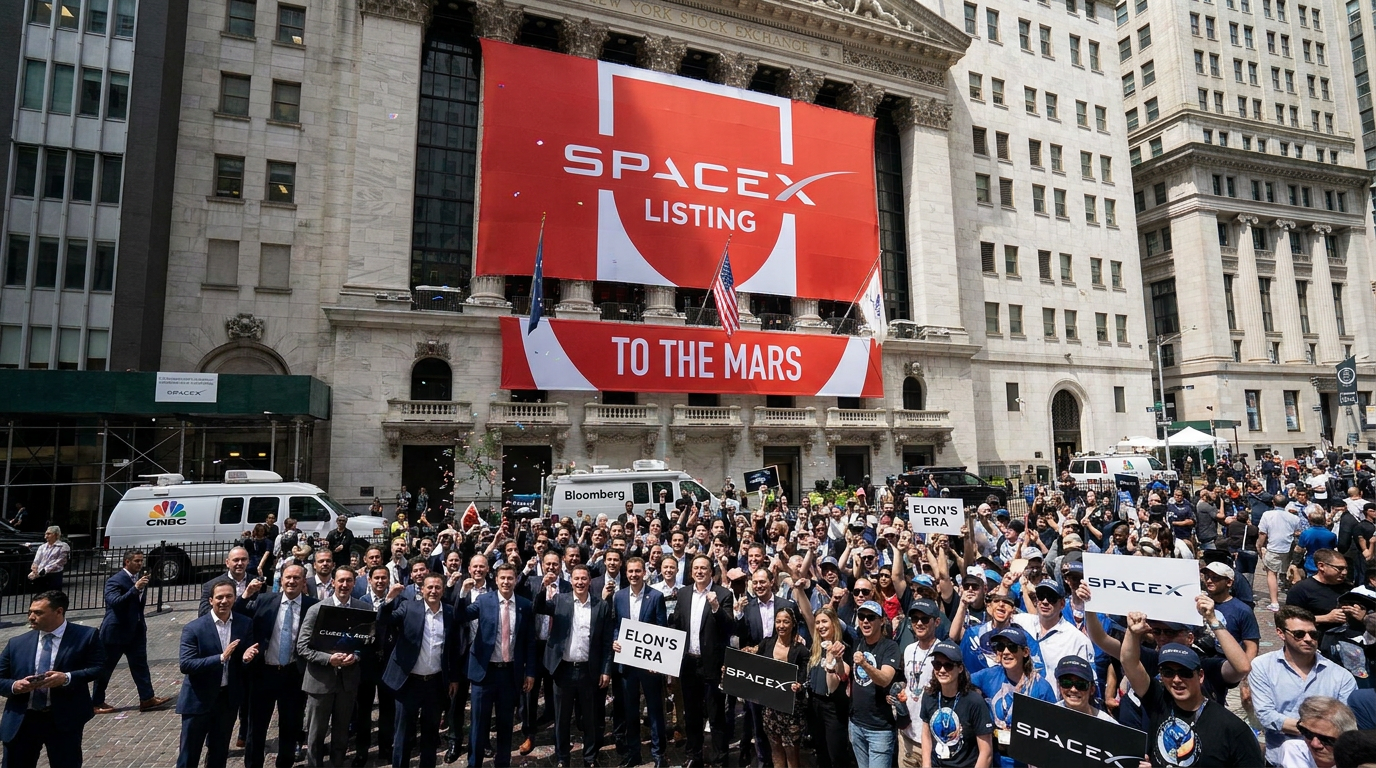
SpaceX has successfully executed the largest initial public offering in history, reaching a $2.2 trillion valuation and cementing the commercial viability of the space sector. While investors celebrate the milestone, institutional watchdogs are raising concerns over the company's unprecedented governance structure.
By Factlen Editorial Team
- Space Economy Optimists
- Believe the IPO validates the commercial space sector and unlocks a new era of innovation and investment.
- Institutional & Regulatory Watchdogs
- Concerned about the lack of traditional oversight, fast-tracked index inclusion, and absolute founder control over a $2.2T public entity.
- Long-Term Visionaries
- View the stock as a generational hold, focusing on the long-term vision of Mars colonization and global connectivity.
What's not represented
- · Legacy aerospace contractors facing new public-market competition
- · Astronomers concerned about the rapid expansion of satellite constellations
Why this matters
The transition of the world's dominant space company to the public markets opens up direct investment in orbital infrastructure to everyday retirement accounts. It also sets a new precedent for how mega-cap technology firms balance visionary founder control with public shareholder rights.
Key points
- SpaceX completed the largest IPO in history, raising $75 billion and achieving a $2.2 trillion valuation.
- The successful debut transformed founder Elon Musk into the world's first individual trillionaire.
- The IPO has triggered a surge in venture capital investment across the broader commercial space industry.
- Financial watchdogs have expressed concern over the company's fast-tracked inclusion into major stock indices.
- SpaceX's governance structure remains controversial due to the near-absolute control retained by its founder.
- Capital from the offering will primarily fund the Starship launch vehicle and the expansion of the Starlink network.
June 12, 2026, marked a watershed moment in financial and aerospace history as Space Exploration Technologies Corp., universally known as SpaceX, completed the largest initial public offering on record. Raising a staggering $75 billion, the stock market debut instantly propelled the company to a market capitalization of approximately $2.2 trillion. The sheer scale of the offering fundamentally alters the landscape of publicly traded mega-cap technology stocks.[1][3]
The velocity of the offering caught even seasoned Wall Street veterans off guard, delivering a 19% return to IPO buyers on the very first day of trading. This unprecedented surge not only cemented SpaceX as one of the most valuable public entities on Earth but also pushed its founder and CEO, Elon Musk, across a historic threshold, making him the world’s first individual trillionaire.[1][3]
Beyond the headline-grabbing wealth generation, the IPO represents a structural shift in how the commercial space sector is capitalized. For over two decades, SpaceX operated as a closely held private enterprise, funding its ambitious Starship development and Starlink satellite constellation through private funding rounds, venture capital, and lucrative government contracts. The shift to public markets democratizes access to the space economy.[8]

Transitioning to the public markets required navigating complex regulatory frameworks, detailed in the company's extensive Form S-1 filings with the U.S. Securities and Exchange Commission. These documents outlined the company's dual-engine revenue model: a dominant global launch services business that controls the vast majority of orbital payload delivery, and a rapidly expanding satellite internet monopoly that generates recurring subscription revenue.[5]
The broader space industry immediately felt the gravitational pull of the listing. According to the Space Foundation, the successful debut serves as a definitive proof-of-concept for the entire sector, demonstrating that space infrastructure can yield viable, massive-scale profitability rather than just serving as a capital-intensive research endeavor heavily reliant on state funding.[6]
Smaller aerospace startups and adjacent technology firms experienced a sympathetic surge in investment interest. Venture capitalists and institutional funds, previously hesitant about the long time horizons associated with space tech, are now aggressively seeking the next breakthrough, injecting fresh liquidity into orbital manufacturing, lunar logistics, and advanced propulsion startups.[7]

Retail investors have also clamored for a piece of the orbital pie. Financial commentators have largely framed the stock as a generational asset, with analysts advising that it is not too late for retail buyers to initiate positions, provided they view the stock as a long-term bet on human space exploration rather than a short-term momentum trade.[2]
Retail investors have also clamored for a piece of the orbital pie.
However, the mechanics of SpaceX's integration into the broader financial ecosystem have sparked intense debate among institutional watchdogs. The company was aggressively fast-tracked for inclusion into major global indices, including the MSCI Global Standard and FTSE Russell, bypassing traditional seasoning periods that typically require newly public companies to demonstrate a sustained track record of public earnings.[4]
This rapid index inclusion forces passive index funds and retirement accounts to automatically purchase SpaceX shares, regardless of their individual risk models. Financial watchdogs and municipal leaders, including the New York City Comptroller, publicly raised alarms over this dynamic, arguing that index providers are abandoning established criteria to accommodate the sheer market weight of the aerospace giant.[1][4]
The core of these institutional concerns lies in SpaceX's unprecedented corporate governance structure. Unlike traditional mega-cap public companies, SpaceX has retained a framework that grants Musk near-absolute dominant control over corporate decisions, featuring limited shareholder voting rights and a board structure that critics argue lacks sufficient independent oversight.[4][5]

Defenders of this structure argue that the unique, high-risk nature of space exploration requires a visionary founder to have unencumbered decision-making power. They point to the company's track record of achieving what legacy aerospace contractors deemed impossible—such as landing and reusing orbital-class rocket boosters—as proof that traditional corporate bureaucracy would stifle innovation.[8]
The capital raised from the IPO is earmarked for aggressively accelerating the company's most ambitious projects. Chief among these is the Starship program, the fully reusable super-heavy lift launch vehicle designed to dramatically lower the cost of accessing space and eventually facilitate human colonization of Mars.[5][8]
Simultaneously, a significant portion of the $75 billion war chest will fund the expansion of Starlink. The satellite internet constellation is moving beyond consumer broadband, targeting lucrative enterprise contracts, maritime and aviation connectivity, and direct-to-cell services that could disrupt traditional terrestrial telecommunications providers globally.[5]

The success of this dual mandate—launch dominance and global connectivity—relies heavily on maintaining an aggressive launch cadence. SpaceX currently accounts for the vast majority of all mass delivered to orbit globally, a monopoly that the newly acquired public capital will likely entrench for the foreseeable future.[6]
As the dust settles on the historic listing, the implications for global entrepreneurship are profound. The SpaceX IPO has effectively rewritten the rules for deep-tech commercialization, proving that companies tackling existential, multi-decade engineering challenges can eventually deliver astronomical returns to the public markets.[8]
How we got here
2002
Space Exploration Technologies Corp. is founded by Elon Musk with the goal of reducing space transportation costs.
2008
Falcon 1 becomes the first privately developed liquid-fueled rocket to reach Earth orbit.
2020
SpaceX successfully launches humans to the International Space Station, restoring crewed spaceflight capabilities to the United States.
2024
The Starship super-heavy lift vehicle achieves successful orbital test flights, proving the viability of fully reusable architecture.
June 12, 2026
SpaceX completes a record-breaking $75 billion initial public offering, reaching a $2.2 trillion market capitalization.
Viewpoints in depth
Space Economy Optimists
Believe the IPO validates the commercial space sector and unlocks a new era of innovation and investment.
Industry advocates and venture capitalists view the SpaceX IPO as the ultimate validation of the commercial space thesis. For years, space exploration was viewed as a capital sink reliant on government subsidies. By proving that orbital logistics and satellite internet can generate massive, sustainable revenue, SpaceX has effectively de-risked the sector for other startups. This camp argues that the influx of public capital will accelerate humanity's expansion into the solar system, funding the infrastructure necessary for lunar bases and Mars colonization.
Institutional & Regulatory Watchdogs
Concerned about the lack of traditional oversight, fast-tracked index inclusion, and absolute founder control over a $2.2T public entity.
Financial regulators and municipal fund managers are sounding the alarm over how SpaceX has been integrated into the public markets. Their primary concern is the abandonment of traditional 'seasoning periods'—the time usually required for a newly public company to prove its stability before being added to major indices like the MSCI Global Standard. Because passive retirement funds are forced to buy index components, millions of everyday investors are now exposed to a company where a single individual holds dominant voting power and faces limited independent board oversight.
Long-Term Visionaries
View the stock as a generational hold, focusing on the long-term vision of Mars colonization and global connectivity.
Retail investors and long-term analysts argue that applying traditional corporate governance metrics to SpaceX misses the point of the enterprise. This perspective maintains that the high-risk, multi-decade engineering challenges of space exploration require a visionary leader with unencumbered decision-making authority. They point to the company's history of achieving 'impossible' milestones—like landing orbital boosters—as proof that standard corporate bureaucracy would only stifle the innovation required to make humanity a multi-planetary species.
What we don't know
- How traditional institutional investors will navigate SpaceX's unconventional corporate governance structure over the long term.
- Whether the influx of capital will allow competitors to close the technological gap in reusable launch vehicles.
- How regulatory bodies will respond to the rapid expansion of the Starlink constellation and its impact on orbital debris.
Key terms
- Initial Public Offering (IPO)
- The process of offering shares of a private corporation to the public in a new stock issuance, allowing the company to raise capital from public investors.
- Market Capitalization
- The total dollar value of a publicly traded company's outstanding shares of stock, calculated by multiplying the current stock price by the total number of shares.
- Index Inclusion
- The addition of a company's stock to a major financial index (like the MSCI Global Standard), which automatically forces passive index funds and retirement accounts to buy the stock.
- Seasoning Period
- A traditional requirement for newly public companies to demonstrate a track record of stable earnings and market performance before being added to major financial indices.
Frequently asked
How much did SpaceX raise in its IPO?
SpaceX raised $75 billion in its initial public offering, making it the largest stock market debut in history.
What is SpaceX's market valuation after going public?
The company ended its first day of trading with a market capitalization of approximately $2.2 trillion.
Why are some institutional investors concerned about the stock?
Critics have raised alarms over the company's fast-tracked inclusion into major indices and its governance structure, which grants Elon Musk dominant control with limited independent board oversight.
Sources
Source coverage
8 outlets
3 viewpoints surfaced








[1]BloombergInstitutional & Regulatory Watchdogs
What to Know About SpaceX’s Record-Breaking IPO
Read on Bloomberg →[2]CNBCSpace Economy Optimists
Jim Cramer says it's not too late to buy SpaceX — under one condition
Read on CNBC →[3]ForbesLong-Term Visionaries
How Elon Musk Just Became The World's First Trillionaire
Read on Forbes →[4]ReutersInstitutional & Regulatory Watchdogs
SpaceX fast-tracked for major index inclusion despite governance concerns
Read on Reuters →[5]U.S. Securities and Exchange CommissionInstitutional & Regulatory Watchdogs
Form S-1 Registration Statement: Space Exploration Technologies Corp.
Read on U.S. Securities and Exchange Commission →[6]Space FoundationSpace Economy Optimists
The Space Report 2026: Commercial Space Economy Milestones
Read on Space Foundation →[7]Financial TimesSpace Economy Optimists
SpaceX IPO ignites venture capital surge in orbital logistics
Read on Financial Times →[8]Factlen Editorial TeamLong-Term Visionaries
Synthesis by Factlen editorial team
Read on Factlen Editorial Team →
Every angle. Every day.
Get business stories with full source coverage and perspective breakdowns delivered to your inbox.